Friday, January 02, 2009
"Card check" fever breaks in the light of day
In the category of good news for us all (with the possible exception of the union bosses who read TigerHawk), Kimberley Strassel reports that erstwhile supporters of "card check" unionization are wobbling now that there is some chance it might actually get enacted.
For those few of you who do not know, "card check" allows a union to become the collective bargaining representative of the workers in a plant without a secret ballot election. Under the Orwellian "Employee Free Choice Act," 49% of the workers in a shop would become bound if 51% of them checked cards, even if they did it in secret. No election, no debate, and no symmetry, insofar as 51% of employees could not turn the union out by checking cards. Then, if the employer and the union did not reach an agreement within 120 days the matter would go to binding arbitration and a panel of labor lawyers would dictate how the business ought to be run. The law is an outrage, and it would destroy the flexibility of American business. Do we really want any company to follow the example of the Detroit Three or Big Steel?
Fortunately, some Democratic senators are realizing that it is much easier to vote for a ridiculous law when there is no chance that it will be enacted.
Responsibility has a way of focusing the mind.
Take Mark Pryor, Democratic senator from Arkansas. In 2007, Mr. Pryor voted to move card check, Big Labor's No. 1 priority. And why not? Mr. Pryor knew the GOP would block the bill, which gets rid of secret ballots in union elections. Besides, his support helped guarantee labor wouldn't field a challenger to him in the primary.
Postelection, Mr. Pryor isn't so committed. He's indicated he wouldn't co-sponsor the legislation again. He says he'd like to find common ground between labor and business. He is telling people the bill isn't on a Senate fast-track, anyway. His business community, which has nimbly whipped up anti-card-check sentiment across his right-to-work state, is getting a more polite hearing.
It hasn't been much noticed, but the political ground is already shifting under Big Labor's card-check initiative. The unions poured unprecedented money and manpower into getting Democrats elected; their payoff was supposed to be a bill that would allow them to intimidate more workers into joining unions. The conventional wisdom was that Barack Obama and an unfettered Democratic majority would write that check, lickety-split.
Instead, union leaders now say they are being told card check won't happen soon.
With the economy in trouble, even Democratic politicians do not want to raise taxes on the "rich" or let unions take over the economy. It is almost as if they are conceding that these things would be bad for economic growth, which invites the question, why do them at all?
(2) Comments
Wednesday, March 23, 2011
Bullet dodged: "Card check" is deader than a dead parrot
It will no doubt surprise and please you that the Democrats seem to have missed an opportunity to subtract from our national wealth. "Card check" -- the workplace "election" of a union through open rather than secret ballot -- is dead (lest that was not obvious after November). Liberals argue that you need "card check" -- essentially an election without an election -- because otherwise employers will intimidate workers in to voting against the union. Of course, it is also possible that in many modern workplaces people prefer meritocracy, which they know is inherently incompatible with unionization.
Either way, the defeat of card check is a victory for the general interest against special interests, and for our posterity.
(6) Comments
Thursday, October 23, 2008
George McGovern on "card check"
John McCain will not make the case against compulsory "card check" unionization, but George McGovern will:
MORE:
(2) Comments
Sunday, October 19, 2008
A vote for Barack Obama is a vote against democracy
At least in the workplace.
Barack Obama supports Big Labor's ambition to intimidate American workers into joining unions that they would not join if they were permitted to vote in secret. This is the central idea of "card check," a program that would eliminate the need to have an election -- and the debate that precedes it -- before unionizing an American workplace. Big Labor is trying to accomplish through legislation what it cannot in the marketplace of ideas (in 2007, only 7.5 percent of private sector employees belonged to labor unions). "Card check" is such a naked power grab that even USA Today could not help but editorialize against it:
When citizens go to the polls on Nov. 4, they will be free to vote their conscience — regardless of pressure from relatives, friends or co-workers — after having had a chance to weigh the alternatives. Campaigns and secret ballots are sacrosanct elements of American democracy.
So it's surprising and disturbing that organized labor wants to do away with both these elements when workers decide whether to form a union.
Under the current system, once 30% of a company's workers sign union authorization cards, the National Labor Relations Board (NLRB) administers a confidential vote, typically 39 days after it receives the cards. The union and employer campaign for votes.
Under a major rewrite of U.S. labor law being promoted by unions, when more than 50% of employees sign authorization cards, the NLRB would have to recognize the new union. No campaign. No secret ballot.
This misguided measure passed the House shortly after Democrats took the majority in 2007. But it needs several more votes in the Senate and a president who will sign it. Barack Obama supports it; John McCain does not. It's no surprise, then, that the AFL-CIO plans to spend an eye-popping $200 million this election cycle to support Obama and Democratic candidates for Congress. A win for Obama and big gains for Senate Democrats could remove the remaining obstacles to the euphemistically named "Employee Free Choice Act."
Cajoled choice is more like it. The proposed change would give unions and pro-union employees more incentive to use peer pressure, or worse, to persuade reluctant workers to sign their cards. And without elections, workers who weren't contacted by union organizers would have no say in the final outcome.
Choice in the workplace: Just one of the many freedoms you have today that you may not have tomorrow.
CWCID: Mickey Kaus.
(11) Comments
Thursday, August 27, 2009
A small symptom of monopoly power
Public Service Enterprise Group, the utility that exerts dominion over New Jersey's electricity and gas, charges a service fee of $5.95 if you pay your bill online with a credit card. Is there a single consumer business in an actually competitive market that does that?
Of course, PSEG is a notoriousy inefficient operation, so it does not surprise me that they would rather you mail in a check that they then have to process at greater expense in labor and float than the bank card fees they could negotiate if they tried. There is no doubt somebody inside PSEG who owns the check envelope-opening turf, and it is his or her mission to maximize employment within that operation, the interests of stockholders and ratepayers notwithstanding.
MORE: The local water company does the same thing, including for electronic checks (which are free through PSEG). Apparently employing a staff to tend envelop-opening machines and handle the paper directly with the delay of physical mail delivery is preferable to automating the front end. I would describe these people as idiots, except that I know that they do not exist for the same reasons that real businesses do, to maximize profits.
(20) Comments
Friday, May 15, 2009
Arlen Specter raises card-check from the dead
Those of you who have reveled in the purification of the GOP following Arlen Specter's defection might reconsider your opinion if the Donks now pass the Employee Free Choice Act, which will damage American business by slowing the speed with which it can adapt just when it needs to move faster.
A trade war, higher taxes on American corporations who do business internationally, the adoption of the European approach to anti-trust, and now more labor unions and their work rules. How much harder is Barack Obama going to make it for those of us who will have to earn the money to pay back everything he has spent?
(6) Comments
Thursday, March 05, 2009
Will the Democrats introduce "card check" legislation next week?
The Morgan Lewis law firm is reporting "rumors" that the Democrats are going to introduce the Orwellian "Employee Free Choice Act" (which involves taking away the right of employees to vote on whether they want to unionize their place of work) on March 9. There is, apparently, considerable risk that the Republicans do not have the votes to avoid cloture on a filibuster in the Senate (emphasis added).
Passage of EFCA in the House is all but assured. In the Senate, EFCA’s chances are less clear. Due to Senate rules, 60 senators must vote for “cloture” on EFCA before it is brought to a full Senate vote. Once it is brought to a full vote, only 50 votes are needed to pass the bill (Vice President Biden would break a 50-50 tie). Congressman Miller and Senator Kennedy apparently believe that they already have the needed 60 votes in the Senate to pass EFCA. The Democrats currently hold 58 Senate seats, with a 59th likely to come soon from Minnesota’s Al Franken. At least one Republican, Senator Arlen Specter (R-Pennsylvania), has previously voted for cloture on EFCA. While some more conservative Democrats have recently expressed doubts about EFCA, there is concern in some management quarters that these Democrats might vote for cloture (where 60 votes are needed), allowing the bill to come to a floor vote, and then vote against the bill in the final vote (where only 50 votes are needed). This would arguably give those more conservative Democrats the ability to say they voted against EFCA, while supporting the party by voting for cloture.
I am generally not one to support "purges" of Republicans who do not vote in lockstep with the rank-and-file. This is different. The EFCA would be terrible for our economy at any time -- fluid labor markets and workplaces free of "rules" are one of our great competitive advantages -- and a farookin' catastrophe in the next couple of years. Do not make life any harder for business than it is already. If Arlen Specter votes for cloture and enables its passage I will personally swim the Delaware to work against him in the next election.
MORE: You have to admit, enacting the EFCA now would be substantial new evidence in support of the argument that the Obama administration is pushing the economy down on purpose.
(11) Comments
Monday, October 27, 2008
"Card check" link of the day
The Corner's Peter Kirsanow continues to post about the Employee "Free Choice" Act, the most underpublicized among Barack Obama's worst policy prescriptions. Excerpt:
Some of the commentary responding to my observations about EFCA's mandatory arbitration provisions emphasized the benefits to workers of getting a contract done quickly; no longer can employers drag out negotiations to the point that employees want to get rid of the union. Under EFCA, the employees will get a "contract" in a more timely fashion.
False. They won't get a contract.
Under EFCA, the terms set by the arbitrator will be the furthest thing from a "contract." It won't be an agreement between management and labor. Rather, wages, hours and terms and conditions of employment will be dictated by a government appointed arbitrator. The mandate will be binding on the parties for two years. Neither the company nor the employees can reject it (At least when the Central Committee set the wages for tractor assembly workers in the Leningradskaya oblast there was always the possibility that the wages might change later that afternoon).
Broken-record time: The Employee Free Choice Act is a terrible piece of legislation. If Barack Obama wins the White House and the donks book big gains in the Senate, it is hard to see what stops this job-destroying law.
(1) Comments
Wednesday, November 25, 2009
Private sector experience of cabinet secretaries, by administration
Paul Kedrosky has a curious graph from a JP Morgan research report that purports to show the private-sector experience of cabinet secretaries, by administration, since Theodore Roosevelt.
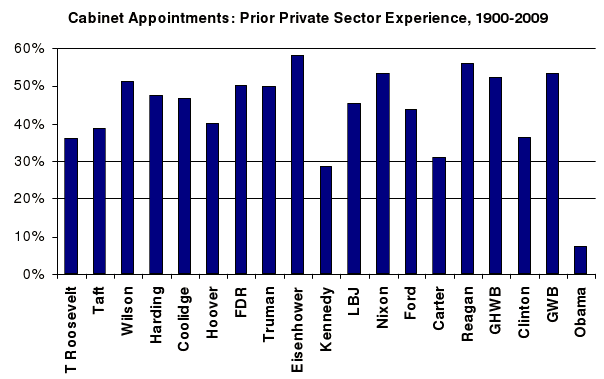
It is not obvious from the graph that one can relate the quality of an administration's cabinet to experience outside of government, but perhaps the graph does explain why the Obama administration does not seem to understand the impact of uncertainty on economic growth. It piles on the stimulus, but does not comprehend that we will not get sustainable growth until the federal government removes or resolves the massive regulatory and legislative uncertainty that hangs over a huge proportion of the economy like a sword of Damocles. Who in their right mind would decide to make a big new investment before the administration has clarified the threatened new regulation of health care (17% of GDP), financial services (9% of GDP) and energy (8% of GDP), not to mention the staggering but still unclear increases in business and individual taxes? Everybody outside of government knows that legislative, regulatory, and taxation risks are now the biggest obstacles to economic growth. The question is whether anybody inside government understands that.
MORE: Great minds think alike. The editors of the Wall Street Journal were thinking the same thing this morning. After noting that the stimulus has not delivered anything like the advertised results, the editors drop a dime on regulatory uncertainty (emphasis added):
The panicked Democrats' biggest problem is that Congress and the President have erected the biggest overhang of economic policy uncertainty that anyone can remember.
One big difference between Washington and private markets is that politicians think everything they do is free-standing. Markets, however, combine all the potential costs of Washington's policies and then decide whether to invest, or not. Consider what private decision-makers see in their future:
A 2,074-page, trillion-dollar health-care bill to redesign 17% of the U.S. economy. A carbon tax—cap and trade—that remains an Obama priority ahead of the Copenhagen climate summit next month. A falling dollar and gyrating commodity prices, with no idea where those prices will go next.
Democratic liberals are talking about an income tax surcharge to pay for any commitment in Afghanistan. Card check, to expand unionization of the private economy, remains a priority. Domestic discretionary spending in fiscal 2010 is set to rise at 12.1%, with inflation near zero.
Nurturing a fragile economic recovery into a durable expansion requires policies that restore public confidence and reassure investors, risk-takers and employers. The Democratic agenda is doing precisely the opposite, which is how you get subpar growth and fewer new jobs.
How could I not agree? However, intellectual honesty compels me to observe that to some degree the difference between left and right on economic policy comes down to this: Democrats believe that the economy can only recover if workers and consumers gain confidence (so that they spend money to create aggregate demand), and Republicans believe that the confidence of executives, directors, and investors is essential to unleash new investment and capacity expansion (which is necessary to capitalize on aggregate demand). Certainly both are necessary to restart an economy that has been sucking wind for two years. Economic stimulus to generate aggregate demand would be a lot more effective if there were not nearly so much uncertainty in law, regulation, and tax. The "progressive agenda" has sabotaged the stimulus, sad to say, and the economy will continue to move slowly until the government relieves the pressure on the people who actually make business decisions.
(10) Comments
Friday, October 24, 2008
"Card check" unionization video of the day
Today's Employee "Free Choice" Act video:
Unions pose a classic problem in economics. By leveraging specific legal privileges, they are able to capture benefits for their current members and externalize the costs both to the businesses that they "organize" and other sectors of the economy. It works for a while, because an industry can, for a time, shift profits from its investors to the union members. Eventually, though, things fall apart. Quality declines because workers know that they really cannot be fired, customers leave, and capital flees to businesses that generate higher returns. If you doubt me, consider the relative health of the heavily unionized industries: Railroads, airlines, automobile manufacturing, newspapers, and integrated steel. The unionized businesses in all those industries provide famously worse service than the non-union businesses. See, e.g., Southwest Airlines vs. U.S. Air or United, and General Motors or Chrysler vs. Honda or Toyota.
Involuntary unionization: Just the thing we need to restart growth in the economy.
MORE: I am an idiot for going from memory rather than checking. Fortunately, I have layers of fact-checkers! Southwest Airlines is unionized, as various commenters have pointed out.
(6) Comments
Monday, February 08, 2010
The off-to-Florida tab dump
I'm off to Florida for a week of business, returning next Sunday morning. From the Gallagher's in Terminal C at Newark Liberty Airport, an ejaculation of tabs.
My sister, a scientist, observes that the internet has made it impossible for scientists to speak with unchallenged authority. True. The question is whether the consequences are all bad.
Saturday night, the battle for Ivy League supremacy: Princeton vs. Cornell men's basketball at Jadwin Gym. Wish I could be there.
The "six Republican ideas already in the health care bill," from liberal blogger Ezra Klein. It's only a little snarky.
Orwell weeps: If the "jobs bill" contains card check unionization, it will be a "jobs bill" only insofar as it destroys them.
Is the problem that there is too little money in politics?
Lame, I know. I'll try to step up my game next time.
(25) Comments
Wednesday, October 22, 2008
The "comprehensive" argument against Barack Obama
Hot Air posts the "comprehensive" case against Barack Obama. Sadly, it is far from comprehensive. Among other omissions, it ignores the single most idiotic plank in his economic platform: "card check" unionization and other "reforms" designed to destroy the fluidity of the American labor market. Read the Heritage Foundation's critique of the "Employee Free Choice Act" -- an Orwellian title if there ever was one. In addition to depriving employees of their right to vote on whether to unionize, it gives the unions enormous leverage in negotiations over collective bargaining agreements. It is hard to imagine a more efficient way to drive "good jobs" off shore.
Fortunately for Mexicans, Chinese, Pakistanis, and even some Europeans, Barack Obama, Nancy Pelosi, and Harry Reid all support this law. It is rare that all these countries get so much support from American politicians, even Democrats.
If you run a business with more than a very few employees, if Barack Obama wins your life is going to get much more complicated long about March next year.
(9) Comments
Thursday, November 06, 2008
Spreading the wealth already!
Judging from its alleged labor and hours practices, the Obama campaign organization at least ought to be relieved that "card check" unionization is not already the law.
(1) Comments
Wednesday, June 16, 2010
Frustrated Liberal New York Billionaires
Well, I was surprised and not a little amused at how unhappy they were - and stridently so - with pretty much every policy decision pursued thus far by the Obama Administration. Save for taxes, which this group had no problem seeing increase, they thought every major policy initiative of the current administration was a disaster - healthcare, energy, employment, TARP, card check - they were furious.
It gave me pause, actually, to see this group - which had so ardently opposed George W. Bush - seem similarly unhinged talking about Obama. Some of the commentary was completely loopy, akin to Tom Friedman's infatuation of being China for a day (so we can "impose" the obvious solutions to all our problems). And this from people who were actually Obama's supporters. I had to ask myself, what did they expect?
In the end it was a useful reminder that economic success alone is not much of a measure of, well, anything really, other than money. Historical knowledge was pathetic. The whining; the sense of entitlement; the absence of any genuine wisdom was really startling. The wisdom of "flyover country" trumped this "elite" group of deeply confused and flummoxed limousine liberals.
Can't wait til November.
(26) Comments
Wednesday, January 07, 2009
Brace yourselves: The latest on "card check"
The Corner's Peter Kirsanow reports on the latest Congressional inside baseball concerning the prospects for passage of the deceptively-named "Employee Free Choice Act." Sadly, it appears that Democrats really are going to push the legislation, which would effectively turn the management of American business over to the lawyers. The enactment of this law would do more to damage the great strength of the U.S. economy -- the flexibility of its companies -- than September 11 did, or another successful terrorist attack would do. It is that dumb.
(8) Comments
Tuesday, October 28, 2008
Unionization in a declining economy
The Wall Street Journal, which is doing the work the McCain campaign should have done weeks ago, is running an op-ed this morning that makes the useful historical point that the Wagner Act -- our basic federal union law -- significantly prolonged the Great Depression.
Then, in 1937, the DJIA plunged 33% in what is often called "a depression within a depression." Joblessness skyrocketed.
A principal factor in the meltdown that year was the U.S. Supreme Court's surprise 5-4 decision in early April to uphold the constitutionality of the Wagner Act, which had passed two years earlier. This measure, which is still the basis of our labor relations regime, authorized union officials to seek and obtain the power to act as the "exclusive" (that is, the monopoly) bargaining agent over all the front-line employees, including union nonmembers as well as members, in a unionized workplace.
As Amity Shlaes observed in her recent history of the Great Depression, "The Forgotten Man," within a few months after the Wagner Act was upheld, industrial production began to plummet and "the jobs started to disappear, with unemployment moving back to 1931 levels," even as the number of workers under union control was "growing astoundingly."
Given the reality of unions in the workplace, the law meant that efficiency and profitability were compromised, by forcing employers to equally reward their most productive and least productive employees. Therefore subsequent wage increases for some workers led to widespread job losses.
Suffice it to say that "card check," the Employee "Free Choice" Act that Barack Obama has pledged to sign and Nancy Pelosi and Harry Reid are committed to enacting, will increase the unionization of private sector employees. If you believe that the least competent and diligent employee should be paid as much as you (or, obviously, if you are incompetent or dilatory) and if you work in an industry that cannot easily move offshore or be automated, you should be delighted at the prospect. Otherwise, vote McCain.
(6) Comments
Monday, March 30, 2009
Feinstein defects from EFCA?
Sen. Feinstein issued the following written statement:
“I have thought for some time that the way to approach this issue is by trying to see if there can’t be a compromise between the business community, the agriculture community and labor. This is an extraordinarily difficult economy and feelings are very strong on both sides of the issue. I would hope there is some way to find common ground that would be agreeable to both business and labor.”
With Sen. Specter's (R-PA) previously announced opposition, it looks less and less likely that EFCA will be passed this year.
When even Sen. Feinstein appreciates the timing problem of legislatively increasing labor costs during a steep recession, perhaps there is hope.
UPDATE: Language ("in 2007") added in first sentence to reflect the 2007 co-sponsorship of EFCA by Sen. Feinstein. H/T: Anon commenter.
(6) Comments
Saturday, November 15, 2008
Do not bail out the Detroit Three
NYU finance professor David Yermack absolutely crushes the arguments in favor of bailing out the Detroit Three automakers. Teaser:
In 1993, the legendary economist Michael Jensen gave his presidential address to the American Finance Association. Mr. Jensen's presentation included a ranking of which U.S. companies had made the most money-losing investments during the decade of the 1980s. The top two companies on his list were General Motors and Ford, which between them had destroyed $110 billion in capital between 1980 and 1990, according to Mr. Jensen's calculations.
I was a student in Mr. Jensen's business-school class around that time, and one day he put those rankings on the board and shouted "J'accuse!" He wanted his students to understand that when a company makes money-losing investments, the cost falls upon all of society. Investment capital represents our limited stock of national savings, and when companies spend it badly, our future well-being is compromised. Mr. Jensen made his presentation more than 15 years ago, and even then it seemed obvious that the right strategy for GM would be to exit the car business, because many other companies made better vehicles at lower cost.
Roger Smith, who retired as chairman in 1990, seemed to understand that all too well, and so did Chrysler's management, which happily sold their company to Daimler Benz for $30.5 billion in 1998. That deal, one of the savviest corporate divestitures ever, ended very badly for Daimler, which essentially paid Cerberus a few billion dollars (by agreeing to retain pension liabilities) to take Chrysler off its hands in 2007.
Over the past decade, the capital destruction by GM has been breathtaking, on a greater scale than documented by Mr. Jensen for the 1980s. GM has invested $310 billion in its business between 1998 and 2007. The total depreciation of GM's physical plant during this period was $128 billion, meaning that a net $182 billion of society's capital has been pumped into GM over the past decade -- a waste of about $1.5 billion per month of national savings. The story at Ford has not been as adverse but is still disheartening, as Ford has invested $155 billion and consumed $8 billion net of depreciation since 1998.
As a society, we have very little to show for this $465 billion. At the end of 1998, GM's market capitalization was $46 billion and Ford's was $71 billion. Today both firms have negligible value, with share prices in the low single digits. Both are facing imminent bankruptcy and delisting from the major stock exchanges. Along with management, the companies' unions and even their regulators in Washington may have their own culpability, a topic that merits its own separate discussion. Yet one can only imagine how the $465 billion could have been used better -- for instance, GM and Ford could have closed their own facilities and acquired all of the shares of Honda, Toyota, Nissan and Volkswagen.
Read the whole thing.
Frankly, I'd love to blame the fall of the Detroit Three on the UAW, but the harsh reality is that these companies have archaic corporate cultures that preclude their renaissance. Even the most casual observer knows that these companies simply have not become 21st century service organizations. If there is creativity and imagination in there, it does not make it out of the bureaucracy. When was the last time you thought cool when looking at an American car? Where is the Steve Jobs of the American automobile industry?
But it is worse than that. Even if the Detroit Three were able to boost the quality of their actual products to the level of the Germans and the Japanese, the dealer networks suck. With only occasional exceptions, the American brand dealers still treat their customers with contempt, at least by the standards of their principal competition. For years we had at least one American car -- either Ford or Chrysler -- but the service at the local dealers is so terrible (again, compared to virtually every Japanese dealer) that we could not take it any more. There is no Dodge dealer out of several in the area, for example, that does not simply blow compared to its Japanese competition.
So then you might ask why the carmakers do not just fire their dealers. Well, the dealers are protected by state legislation that makes them virtually impossible to terminate. Yes, these laws also protect dealers for the Japanese brands, but the Japanese networks are much newer so the dealers were selected after the development of modern customer service practices. If we are so stupid as to bail out the Detroit Three, we should, at a minimum, preempt any state dealer protective legislation. Yes, that will result in some "small" businesses going under, but as a matter of policy we should not care because better dealers will spring up to replace them and, presumably, employ people.
Ultimately, though, the failures are managerial and they almost certainly go a lot deeper than the top ten guys or even the top hundred. I (obviously) know no more about the automobile industry than anybody who reads the business pages, but it does seem to me that more creative management could have developed really exciting products and dealt with the unions and the dealers more effectively. There are a lot of ways to provoke cultural change, and had some small percentage of that $465 billion in capital been deployed to that purpose in 1980 the industry would be very different today. Even the dealer network.
MORE: Via Glenn, Megan McArdle tears into the UAW and the various shortcomings of the union movement as it has developed. All the more reason to oppose "card check," by the way.
I do take issue with this, though:
Almost everyone I know makes less than an autoworker, and has a whole lot less job security.
Megan's experience differs from my own passing observations (although she no doubt has different friends than I do!). Generally, the more people make, the less job security they have. Take a hard look at the longevity of the typical CEO, CFO, portfolio manager, investment banker, or professional athlete, even in normal times. And Detroit Three auto workers certainly do not appear to have a lot of job security, union contract notwithstanding. Of course, it has been obvious for a generation that these companies would not survive as automobile manufacturers. The only people who do not seem to know that live in southeastern Michigan or work in Washington.
(46) Comments
Wednesday, September 07, 2011
Annotating Mitt Romney's jobs program
Mitt Romney has just published a massive economic proposal (more than 150 dense pages), at the back of which is an appendix with 59 summary proposals to "Get America Back To Work." I haven not read the huge document, but I did read the appendix. Herewith, the Official TigerHawk Ill-Considered Reactions to Mitt Romney's 59 Proposals.
59 Policy Proposals That Will Get America Back To Work
1. Maintain current tax rates on personal income
This is pretty much required in order to get the Republican nomination, but does it make sense? What is so sacrosanct about the current rates other than their arbitrary political significance? More significantly, the game is not in the rates, but in numbers against which the rates apply.
2. Maintain current tax rates on interest, dividends, and capital gains
Even I, a consummate corporate tool and investor in private equity, do not understand the policy justification for taxing "carried interest" at capital gains rates, rather than as ordinary income. Romney's position on that question ought to make him vulnerable given his career in private equity, but it won't because (i) the GOP hard core is against raising any tax, no matter how justified in the abstract, and (ii) nobody understands what "carried interest" is.
3. Eliminate taxes for taxpayers with AGI below $200,000 on interest, dividends, and capital gains
This is a little weird. Taxes on dividends and capital gains for such people are only 15% to begin with. Putting interest on the same footing as profits (whether reflected as dividends or capital gains) would seem to encourage leverage and saving rather than equity financing and investment, and that seems counterproductive if the objective is to create jobs. So this seems like a random tax cut designed to buy votes from seniors rather than pro-growth tax policy, but maybe I am missing something.
4. Eliminate the death tax
Sure. But also eliminate the step-up in basis at death. (My own view is that the best estate tax would be one with a very low exemption -- say, $100,000 -- but also a tax rate so low that people would not go to a lot of trouble to avoid it. I suspect that a 15% rate with a $100,000 exemption would both generate more revenue and redirect estate planners and lawyers to more productive work.)
5. Pursue a conservative overhaul of the tax system over the long term that includes lower, flatter rates on a broader base
Yup. I'd go one further and make essentially everybody with income pay income tax by folding payroll taxes in to the mix so that people recognize FICA and such as a tax, rather than as a pension contribution or some such nonsense.6. Reduce corporate income tax rate to 25 percent
Excellent. Along with proposal #7, that would make it worthwhile to keep profits in the United States compared to most other meaningful countries. I suspect we would actually collect a lot more corporate tax at the expense of the other OECD countries with lower corporate rates.
7. Pursue transition from “worldwide” to “territorial” system for corporate taxation
Again, excellent. Not only would hundreds of billions in overseas "trapped cash" come home, but vast armies of tax lawyers and accountants would have to find more productive work.
8. Repeal Obamacare
Coming from Mitt, that seems like rank pandering. And replace it with what? The status quo is a mess. I think Obamacare has many deep flaws and may also constitute a mess, but Republicans need a plan that goes beyond "repeal."
9. Repeal Dodd-Frank and replace with streamlined, modern regulatory framework
Yes. And while you are at it, figure out how to keep financial institutions from being too big to fail.
10. Amend Sarbanes-Oxley to relieve mid-size companies from onerous requirements
Wrong. Eliminate SOX 404 (relating to the internal controls audit) for all companies. It is a failure on many levels, but mostly because it makes companies obsess about process rather than results. Too much focus on process destroys initiative (because as organizations get larger people are worried that internal audit will whack them for a controls violation), and it distracts people from real business risk (see, e.g., the financial crisis). Also, eliminate the Federal Accounting Oversight Board, which is the indirect cause of staggering costs to public companies of all sizes.
11. Ensure that environmental laws properly account for cost in regulatory process
Pablum. How do you measure cost "properly"? All in the eye of the beholder. If failure to enact a policy will cause the ice caps to melt, it is easy to justify pretty much anything.
12 Provide multi-year lead times before companies must come into compliance with
onerous new environmental regulations
Yes, at least four years.
13. Initiate review and elimination of all Obama-era regulations that unduly burden the economy
There were plenty of Bush-era regulations that "unduly burden" the economy. See, e.g., Sarbanes-Oxley and its progeny. How about eliminating all regulations that unduly burden the economy, even if Ronald Reagan thought them up?14. Impose a regulatory cap of zero dollars on all federal agencies
Huh? I suppose we have to read the tome in order to understand this one. That is a bad omen for a campaign proposal.
15. Require congressional approval of all new “major” regulations
Excellent. The drafting agency should have to send them back to Congress for an up or down vote. I could live with eliminating filibusters for such votes just to make the fight a fair one.
16. Reform legal liability system to prevent spurious litigation
Mitt, nobody is against that. What is "spurious" litigation? The devil is in the details. I, however, have an answer: Require parties to pay for the costs of any discovery that they demand. That would make discovery requests a lot more reasonable in a hurry, and lower the cost of litigation by a lot.
17. Implement agreements with Colombia, Panama, and South Korea
And every other country in the world.
18. Reinstate the president’s Trade Promotion Authority
Absolutely. The president cannot negotiate trade agreements on behalf of 100 Senators.
19. Complete negotiations for the Trans-Pacific Partnership
I don't know what this is and it sounds creepy weird, like "the Trilateral Commission," but if it makes people here and their richer, let's do it!
20. Pursue new trade agreements with nations committed to free enterprise and open markets
And all other nations. Trade is a basic human right (or ought to be), and we do not help the oppressed peoples of the world by refusing to trade with them.
21. Create the Reagan Economic Zone
Sigh. This seems like a nonsense name for something buried in the tome.
22. Increase CBP resources to prevent the illegal entry of goods into our market
Sure, but could we prevent the illegal entry of people first?
23. Increase USTR resources to pursue and support litigation against unfair trade practices
Absolutely. Start with monopsonistic purchasers of medical devices, please.
24. Use unilateral and multilateral punitive measures to deter unfair Chinese practices
Panderer. Why only the Chinese?
25. Designate China a currency manipulator and impose countervailing duties
This feels like something that would be hard to do and might backfire hideously, but I admit I do not have the expertise to know. Does Romney?
26. Discontinue U.S. government procurement from China until China commits to GPA
Ditto.
27. Establish fixed timetables for all resource development approvals
Absolutely. The Obama administration's nonsense in the Gulf of Mexico is reason enough. (Although this item does make Romney sound like the candidate from ExxonMobil, a point the Donks will make in a trice.)
28. Create one-stop shop to streamline permitting process for approval of common activities
Frankly, this needs to be implemented within states, rather than at the federal level. But, sure. Lead the way, Mitt.
29. Implement fast-track procedures for companies with established safety records to conduct pre-approved activities in pre-approved areas
Yes.
30. Amend Clean Air Act to exclude carbon dioxide from its purview
One would have hoped that this was not necessary, but since it is, good idea.
31. Expand NRC capabilities for approval of additional nuclear reactor designs
This is especially important if we don't allow the EPA to regulate carbon dioxide!
32. Streamline NRC processes to ensure that licensing decisions for reactors on or adjacent to approved sites, using approved designs, are complete within two years
Romney, unlike any other candidate, understands that delays cost actual money, which raises the return hurdles necessary for projects, which means that at the margins projects will not be done and people will not be hired.
33. Conduct comprehensive survey of America’s energy reserves
Why? This sounds like horseshit to me.
34. Open America’s energy reserves for development
Drill baby drill!
35. Expand opportunities for U.S. resource developers to forge partnerships with neighboring countries
Is this code for building the pipeline from Canada, or something else? Because it seems like code for something.
36. Support construction of pipelines to bring Canadian oil to the United States
See #35 above. But, yes, a good idea.
37. Prevent overregulation of shale gas development and extraction
Is there anybody who is against "overregulation"? The question is, what constitutes overregulation?
38. Concentrate alternative energy funding on basic research
Basic research is by far the most productive use of government R&D funding. But should there be any such thing?
39. Utilize long-term, apolitical funding mechanisms like ARPA-E for basic research
The problem with apolitical funding mechanisms is that no elected official can take the credit for having delivered money to a constituent. What politician would vote for such a program?
40. Appoint to the NLRB experienced individuals with respect for the rule of law
Who could be against that?
41. Amend NLRA to explicitly protect the right of business owners to allocate their capital as they see fit
What does this mean? What in the NLRA prohibits business owners from "allocating capital"?
42. Amend NLRA to guarantee the secret ballot in every union certification election
Yes. Kill "card check" forever.
43. Amend NLRA to guarantee that all pre-election campaigns last at least one month
What are the unions afraid of?
44. Support states in pursuing Right-to-Work laws
What does that mean? President Romney is going to campaign for the proponents of right to work laws?
45. Prohibit the use for political purposes of funds automatically deducted from worker paychecks
Not sure how this creates jobs, but it is a great idea for weakening the Democrats!
46. Reverse executive orders issued by President Obama that tilt the playing field toward organized labor
Agreed. Hard to argue with "reversing" President Obama's executive orders.
47. Eliminate redundancy in federal retraining programs by consolidating programs and funding streams, centering as much activity as possible in a single agency
Who could be against this, but how will it create jobs?
48. Give states authority to manage retraining programs by block granting federal funds
Ditto.
49. Facilitate the creation of Personal Reemployment Accounts
Sigh. Gotta read the tome.
50. Encourage greater private sector involvement in retraining programs
How? That could go horribly wrong.
51. Raise visa caps for highly skilled workers
Yes. Drain the brains from the rest of the world.
52. Grant permanent residency to eligible graduates with advanced degrees in math, science, and engineering
Ditto.
53. Immediately cut non-security discretionary spending by 5 percent
Again, not sure how this creates jobs, but it sounds like a good idea in the abstract.
54. Reform and restructure Medicaid as block grant to states
There are competent states and incompetent states. These ideas only really work in competent states.
55. Align wages and benefits of government workers with market rates
At least some of the time, that will mean that wages will go up. U.S. Attorneys would earn a lot more under any such formula.
56. Reduce federal workforce by 10 percent via attrition
What is the annual turnover rate in the federal workforce? How long would it take to attrit by 10%? What do we do about unique skills?
57. Cap federal spending at 20 percent of GDP
Agreed.
58. Undertake fundamental restructuring of government programs and services
Isn't that like Al Gore's "reinvention of government"? 'Member that? If not, why not?
59. Pursue a Balanced Budget Amendment
"Pursue"? With all deliberate speed?
Release the hounds.
(18) Comments
Saturday, December 24, 2005
The Fourth Branch Of Government
In many ways, the RatherGate scandal was a watershed event for the press. It represented the first breach in the wall between pesky fact-checking bloggers and professional journalists. But try as they might to repair the damage, information (like water) finds and exploits the tiniest crack and forces it open wide.
About this time last year, I argued that blogging was revitalizing democracy. It is also revolutionizing the news cycle. The current NSA tempest in a teapot illustrates this feedback cycle perfectly. The mainstream media were determined to cast this story as the civil rights crisis of the century, inconvenient truth be damned. But a deluge of facts and case law from righty bloggers and the conservative punditocracy quickly reached critical mass, making this all but impossible. They managed what the White House was unable (or unwilling) to do: create a virtual Radio Free America to smuggle information past the Iron Curtain erected by the largely liberal-leaning media.
In the past few days, it has come out that President Clinton used warrantless domestic searches absent a foreign intelligence goal. In fact, he wanted to use them in public housing projects. Where was the Congressional outrage?
President Carter, in 1978, used warrantless searches against two men suspected of spying for the Vietnamese.
As Noel Sheppard points out, both Carter and Clinton felt strongly enough about the use of warrantless searches to issue executive orders asserting their authority to conduct them. Jamie Gorelick, Deputy Attorney General under Bill Clinton, was quite certain of the President's inherent authority in 1994 when she assured the House Permanent Select Committee on Intelligence:
"The Department of Justice believes -- and the case law supports -- that the president has inherent authority to conduct warrantless physical searches for foreign intelligence purposes and that the president may, as he has done, delegate this authority to the attorney general,"
But this week, she, like many other Democratic partisans, seemed to be suffering a mysterious short-term memory loss:
In an interview yesterday, Miss Gorelick acknowledged her testimony before Congress but said it pertained to presidential authority prior to 1994, when Congress expanded FISA laws. Left unanswered, she said, is whether that congressional action trumped the president's "inherent authority."
"The Clinton administration did not take a position on that," she said.
Oh really? Then what was Ms. Gorelick doing testifying to the House that the President had inherent authority in 1994? And why on earth would John Schmidt, associate Attorney General under Clinton from 1994-1997, cite exhaustive case law showing that not only did Clinton administration continue to exercise that authority subsequent to 1994, but the FISA court itself upheld the President's inherent authority to conduct such searches?
Four federal courts of appeal subsequently faced the issue squarely and held that the president has inherent authority to authorize wiretapping for foreign intelligence purposes without judicial warrant.
In the most recent judicial statement on the issue, the Foreign Intelligence Surveillance Court of Review, composed of three federal appellate court judges, said in 2002 that "All the ... courts to have decided the issue held that the president did have inherent authority to conduct warrantless searches to obtain foreign intelligence ... We take for granted that the president does have that authority."
As to the other burning question in everyone's mind - why didn't Bush go to Congress - that seems to have been answered too:
"It's been briefed to the Congress over a dozen times, and, in fact, it is a program that is, by every effort we've been able to make, consistent with the statutes and with the law," Vice President Cheney said yesterday in an interview with ABC News "Nightline" to be broadcast tonight.
Bush and other administration officials have said congressional leaders have been briefed regularly on the program. Sen. John McCain (R-Ariz.) said there were no objections raised by lawmakers told about it. [Senate Minority Leader Harry] Reid acknowledged he had been briefed on the four-year-old domestic spy program "a couple months ago" but insisted the administration bears full responsibility.
But 'tis the season for hindsight, and 'most every Democrat in Congress is there with bells on:
Senate Intelligence Committee Chairman Pat Roberts says he's "puzzled" by that letter the committee's senior Democrat sent the vice president in 2003, expressing concerns over the NSA's domestic surveillance program — since he never heard those concerns at the time.
West Virginia Senator Jay Rockefeller released the letter this week and in it, complained that security restrictions kept him from consulting with experts on the program, while arguing that it raised "profound oversight issues." But Roberts says he recalls that Rockefeller voiced his support to the vice president at the time and as recently as two weeks ago. He adds that Rockefeller is releasing the letter at a "politically advantageous" time... and says he finds the move "a bit disingenuous."
It begins to seems the only ones still in doubt about the legality of the NSA wiretaps are the folks at the NY Times (whose timing, it turns out, is highly convenient...for them). But then scratch any high-profile NY Times story and you're likely to find
In a recent oval office meeting, President Bush pleaded with both the executive editor and the publisher of The New York Times not to run the story on NSA wiretaps. Nine days later, the Times published the story anyway. But the paper had decided not to run the same story more than a year ago and a Times source tells The New York Observer that the piece was regarded as dead. So why publish it now?
Turns out, the story's author, Times reporter James Risen, was set to release a book detailing the NSA program next month, leaving the Times with the choice of publishing the story or being scooped by their own reporter. The Times' Bill Keller tells the Los Angeles Times the book had nothing to do with it, saying, "We published the story when we did because after much hard work it was fully reported, checked and ready and because we were convinced there was no good reason not to publish it."
No good reason not to publish it.
I suppose having the President of the United States argue the welfare of your country demands restraint doesn't fall under the
The press has long been referred to as the Fifth Estate. In America, they seem to be trying to levy the First Amendment as a shield that makes them into, in effect, an unacknowedged and unaccountable but nonetheless potent Fourth branch of government. It leaves them free to meddle in foreign policy, national security, and military affairs with impugnity. They leak our intelligence and military secrets and no one can touch them: the First Amendment makes them fireproof. They shield whistleblowers (and even people who aren't whistleblowers but who are, in fact, shielding lawbreakers) and they can't be touched. There is something seriously wrong with this state of affairs.
We have seen the media wield an increasing amount of power as television, radio, and the Internet have brought instant and often compelling mass communication into the homes of every American. With the power of the First Amendment behind them, however, the media are accountable to no one. They can print or say whatever they like: true or not, about public figures. Given the plethora of media outlets, it is virtually impossible to track down and scotch every falsehood. But unfortunately, media knavery is not always as benign as simply printing falsehoods. It often stretches into actively blowing federal investigations, as special prosecutor Patrick Fitzgerald found out during his first encounter with the often-forgetful Judy Miller:
This isn't the first time Plame prosecutor Patrick Fitzgerald has tangled with Judy Miller while investigating a leak out of the Bush White House.
A little more than a year ago, I reported on TPM how Fitzgerald had quite aggressively investigated another Bush White House leak in late 2001 and early 2002. Fitzgerald had been investigating three Islamic charities accused of supporting terrorism -- the Holy Land Foundation, the Global Relief Foundation, and the Benevolence International Foundation. But just before his investigators could swoop in with warrants, two of the charities in question got wind of what was coming and, apparently, were able to destroy a good deal of evidence.
What tipped them off were calls from two reporters at the New York Times who'd been leaked information about the investigation by folks at the White House.
One of those two reporters was Judy Miller.
No wonder the NY Times is crusading in favor of shield laws. Their reporters seem to get in an inordinate number of scrapes with the law, to say nothing of forgetting to read their own notebooks, having really lousy memories, and making multiple misleading statements to federal prosecutors... something that seems to result in charges if you're a White House staffer, but for some reason lets you get off scot-free if you are a professional journalist.
Several months ago people were killed when Newsweek ran an unauthenticated story about Koran flushing. The periodical was unapolagetic.
Now USA Today has recklessly revealed another damaging secret:
U.S. officials have secretly monitored radiation levels at Muslim sites, including mosques and private homes, since September 11, 2001 as part of a top secret program searching for nuclear bombs, U.S. News and World Report said on Friday.
The news magazine said in its online edition that the far-reaching program covered more than a hundred sites in the Washington, D.C., area and at least five other cities.
"In numerous cases, the monitoring required investigators to go on to the property under surveillance, although no search warrants or court orders were ever obtained, according to those with knowledge of the program," the magazine said.
An FBI spokesman declined to confirm or deny the U.S. News and World Report article and said, "We can't talk about a classified program."
But apparently what the FBI can't talk about, because it is top-secret, the press can. Because the press feels no duty to think of anything other than getting the story out. They have no independent way to check on whether the allegations are true - they simply published this story, knowing it was classified and might harm national security. Most of you have probably already seen Emily Francona's excellent commentary on the proper channels for dealing with intelligence oversight issues. There is an appropriate venue for handling matters like this, and a concerned news agency could even use blackmail (i.e., deal with this, or we'll go public) as a means gaining the needed assurances or bringing the matter to light. The problem with the press is that they have appointed themselves as another branch of government.
It is not their place to conduct intelligence oversight, nor to expose classified operations that they think may possibly not be conducted properly. They simply don't have enough knowledge to judge. Taking a tip from some insider who may or may not be giving them correct information and blasting it out to US News and World Report is not a responsible course of action.
Blowing two federal investigations, as Judy Miller did by tipping off the suspects, is illegal behavior and she should have been prosecuted.
And in the age of the Internet, bloggers, and citizen-journalists, perhaps someone can explain to me why we have, in effect, created special class of citizens who are exempt from their duty to cooperate with the justice system? If a private citizen witnesses a crime, it is his or her civic duty to report it. That this duty is sometimes difficult and/or dangerous does not excuse the exercise of it. It is not the place of a journalist to "shield" a private citizen, should he or she choose to shirk that duty or exercise it inappropriately or in the wrong venue. And the behavior of journalists has not been of such a high caliber that it entitles them to ignore their legal duties as citizens.
Professional journalists like Judy Miller are backed by giant corporations like the NY Times which are, even though they don't like us to remember it, profit-seeking ventures. They are hardly without resources, nor without a soapbox should the heavy hand of government come down upon them. Journalists do not check their citizenship at the door, or at least they should not do so.
That they have been allowed to do so all too often is one of the great tragedies of modern life. The First Amendment is important, but it should not be a trump card that outweighs all other considerations, creating, for instance, a professional class of persons who are for all intents and purposes above the law.
This is what is beginning to happen with the press. We have seen it happen with the Joseph Wilson affair, where a disaffected minor CIA functionary and her former ambassador husband took it on themselves to undermine the administration's foreign policy and weaken our credibility abroad. The press has become a conduit, through which anyone with a grievance can attack our own government with impugnity, be it a foreign power or disaffected persons within our own government. We need to take a long, hard look at the role of the media within this country, especially during wartime. Freedom of speech is a cherished right and I would not see it abridged.
But as Justice Robert H. Jackson famously remarked, our Constitution was never meant to be a suicide pact, and there is nothing wrong with placing some sensible limits on those in the media who are determined to behave as the enemy within.
(32) Comments