Friday, March 31, 2006

John Dean relives glory days 

John Dean, who peaked very early in life when he helped topple Richard Nixon, will say absolutely anything, no matter how absurd, to return the limelight:
Former White House counsel John Dean said on Friday that U.S. President George W. Bush's domestic spying program raised more concerns about abuse of power than the Watergate scandal that toppled his boss Richard Nixon.

Even if the NSA wiretap program were a "domestic spying program" that constitutes an "abuse of power" -- and both characterizations are only political positions, notwithstanding Reuters acceptance of them as received truth -- the claim that it is worse than Watergate is absurd. Watergate involved a conspiracy to subvert the domestic electoral process, followed by a massive coverup from the top. The NSA wiretap program was not covered up in the least. Yes, it was kept secret because its military value depended upon secrecy, but it was both disclosed to Congress and defended forthrightly by the President when revealed to the enemy by the New York Times. It is at worst a violation of the law in the service of national security objectives pursued in good faith, and even that remains to be seen. Iran-Contra is a far better analogy than Watergate, and even that was obviously a much graver violation of law and subversion of justice than the NSA case, which may well be entirely lawful.

Pathetic.

(2) Comments

Swonk: The bombing starts in eight months 

I attended an investment conference yesterday in Dayton, Ohio. Investors don't like talking politics much, but one cannot look at financial markets in a bubble; geopolitical issues and domestic politics are often discussed at these types of events, at least in passing.

Nevertheless, I was surprised to hear Diane Swonk, the Chief Economist at Mesirow Financial say the following to room of more than 1000 people (mostly MBA candidates):

"We're going to hit Iran. We are currently selling Israel 5 planes a month. They've got about 40, and will need 60, five squadrons, to help us complete the mission which will be a joint effort. It will begin the week after the US mid-term elections." (paraphrased from my notes.)

This topic came up in the context of a question regarding whether or not the US would put pressure on China to change their exchange rates. Her answer was no, because the US will need China's support in executing the Iranian mission, which she described as above.

This is a pretty provocative thing for anyone to say, but from an economist? Economists are usually quite careful with their predictions, always hedging with contingencies, variables, and assumptions. And yet here she was predicting without qualification not only the action that will occur, but the week in which it would occur! It was one of the more interesting things I heard all day. Certainly it will be worth seeing whether her prediction comes to pass, and if it does, we're going to have to pay closer attention to the writings of Diane Swonk.

(Later in the day, self-described "adventure capitalist" Jim Rogers was asked what he would do his first day if he were Chairman of the Fed. Without hesitation he said he would "close down the Fed and resign." All in all it was a pretty amusing conference.)

(5) Comments

What was the first battle of the American Revolution? 

If you said "Lexington and Concord," you would be wrong, at least according to the United States Congress. It was the Battle of Point Pleasant, Virginia, October 10, 1774, officially recognized by the U.S. Congress in 1908 as the first battle of the American Revolution. Learn these and other exciting factoids at this online timeline of the American Revolution.

CWCID: The TigerHawk daughter.

(1) Comments

The treatment for guinea pig ringworm 

We had occasion in our family to learn the treatment for guinea pig ringworm (yes, "Tie Die" has an ugly skin condition). Who knew it was available over-the-counter in any pharmacy?

(3) Comments

The Iran Crisis: A "roundtable" discussion at Princeton University 

Last night I attended "roundtable" discussion of the Iranian nuclear crisis at Princeton University. I originally wrote my report up as a "live-blogging" session, but it was sometimes tough to hear through the accents and some of it turned out to be a bit basic for our readers, so I have rendered it into an after-action report.

The discussion, at the Woodrow Wilson School's Dodds Auditorium, featured the following luminaries:
Ali Ansari, reader in the School for Modern History at the University of St. Andrews in Scotland, and author of the forthcoming Confronting Iran: The Failure of American Foreign Policy And the Next Great Crisis in the Middle East (which I expect to be quite smart if Ansari's well-balanced commentary is any measure).

Johannes Reissner, head of the Department for Near East and Africa at the German Institute for International Politics and Security in Berlin.

Frank von Hippel, professor of public and international affairs and co-director of the Program on Science and Global Security in the Woodrow Wilson School.

Wolfgang Danspeckgruber, director of the Liechtenstein Institute.

It was not obvious why our Teutonic friends dominated the panel, although Professor von Hippel spoke English sans accent, suggesting that the demographic make-up may have been coincidental. I can, however, report that after reading Kenneth Timmerman's Countdown to Crisis : The Coming Nuclear Showdown with Iran, which obsesses about German technical assistance to Iran, there is the sense that in matters involving Iran, one cannot be too paranoid.

Rather than relate the whole discussion, which was interesting to listen to but tough to render into interesting blog fare, I'll mention a couple of the high points.

Professor von Hippel gave an interesting technical presentation about Iran's nuclear options, the sum and substance of which is that they are building their power program specifically around "dual use" technologies for which there are alternatives. If their sole concern was to build a power system, they could do so in ways that are much less inflammatory.

"It's a tale of two isotopes, and two routes to the bomb." U-235 will sustain a fission chain reaction if separated, and U-238 if turned into plutonium. Iran is pursuing both methods.

Iran is furthest along in separating out U-235 using gas centrifuges. You fill a spinning cylinder with a gaseous uranium. The heavier molecules go closer to the wall of the centrifuge, and a scoop skims them off. For a power reactor, you need a 4% concentration, but for weapons you need a 90% concentration. A cascade for power generation requires 987 centrifuges to get to 4% concentration, and a weapons grade cascade rquires around 4000 centrifuges (see, for example, a captured Libyan design). Professor von Hippel showed a slide of first-generation Urenco centrifuges in the Netherlands in the 1970s, a vast room that appeared larger than an airplane hanger with thousands of the things, all spinning down U-235.

Iran has build underground centrifuge halls, suitable for housing 50,000 of them. Professor von Hippel displayed a satellite image of the Natanz facility, which revealed the constructon of two larged centrifuge halls, plus a pilot plant for perfecting the technique. You can see a copy of the satellite image here.

What could Iran do with the 1000 centrifuges in the pilot plant?
Master the technology for commercial-scale enrichment.

Make enough weapon-grade uranium for a bomb in one year using natural-uranium feed.

Produce low-enriched uranium for a year and then enrich the product to enough for a bomb in two months.

Iran could also try to build a clandestine enrichment plant.

No one has argued that Iran could produce enough HEU for a single nuclear weapon before 2009. (emphasis in original slide)

There is also the plutonium route -- India's chosen path, for example, and Israel's. Iran is building a 40 megawatt plant, which could produce enough inventory for a couple of Nagasaki-sized bombs a year.

Iran is developing a nuclear weapon option, although still a few years from fruition.

von Hippel notes that if Iran really just wanted an energy program, it has less provocative alternatives. If Iran were worried that it would be cut off from its supply of fuel, it could build ten years of fuel in advance, a buffer against fuel supply dispruptions.

Or, it could use a light-water reactor instead of heavy-water. Its light water research reactor could produce almost as many neutrons for research as the 40 MWt heavy-water reactor while producing less than 2% of the plutonium. Von Hippel asks, could these elements be part of a larger compromise?

The question of the fuel cycle keeps coming up, as it did later in the discussion. One questioner asked whether Iran might be receptive to a deal to enrich uranium in another country, so that the fuel could be tracked. One of the professors present believed that it might at one time have entertained such a proposal from the Western Europeans -- meaning the French -- but that it did not trust the Russians to live up to their word. The French, who are the only one of the E-3 with the capability of supplying Iran's fuel cycle, were not willing to entertain the proposal in part because they have been bending over backward to avoid ruffling Washington's feathers during this crisis. I admit, I had not realized that the French were working so hard to repair their relationship with the United States, but apparently they have been, which explains why Jacques Chirac has in some respects been Europe's most intransigent hawk in the confrontation with Iran.

Professor Ansari observed that one version or another of this crisis extends back a very long time. He reminded us of the thriller from 1976, the Crash of '79, which posits an expansionist Shah with a nuclear weapon, who hatches a plan to drop that bomb on the Saudi oil fields, grab the Iraqi fields in a surprise attack across the Shat al-Arab, and corner the market on variable oil production. Ouch.

Professor Ansari's most interesting comments related to the significance of Iran's new President Ahmadinejad. Mr. Ahmadinejad represents a "throwback" to the early ideals of the revolutionary era. His main platform was one of anti-corruption, social justice and the redistribution of wealth. During his campaign, he did not really mention religion at all, because he was worried that people would be turned off by it. He was therefore elected for three reasons. First, he ignored religion, which would not have been popular among the voters. Second, there was a massive fraud to get him into the second round. And, finally, the electorate preferred the unknown Ahmadinejad to Rafsanjani, who was very unpopular but foolishly thought he would win without having to campaign for it.

Ahmadinejad is not a particularly saavy person, and was quite surprised, perhaps, by his own election. Power seems to have seduced him rather quickly, and he appears to enjoy being provocative without having a real awareness of how his outrageous statements have hurt Iran's standing and polarized Western public opinion against Iran. He is a parochial person who had never been beyond the borders of Iran, and has an very, very deep distrust of the West. Unlike the reformists, or even the centrist technocrats such as Rafsanjani, Ahmadinejad does not even have a willingness to deal with the West.

He does not have a strong political base, and did not do what he might have done, which was to spend the surging oil revenues on big public works projects.

He also has a rather fascinating obsession with the return of the "hidden Imam," which he says will return from a well in the ground south of Tehran, perhaps imminently.

Ahmadinejad is increasingly thought of as a loon within Iran, even among the elites, and he is not in a strong position. Ansari quoted an Iranian diplomat, who was amazed that Ahmadinejad thinks that he dazzled the United Nations with his oratory: "If he goes on like this we won't have to worry because the ayatollahs will get him." Ansari says that people are beginning to wonder whether he is leading the country.

All of this hammers home the point that Iranian politics is substantially more complicated than, say, Saddam's Iraq. Ahmadinejad is, in fact, a loon, but it is not at all clear that he himself has the power to move the military or press any button that might be available to press.

Ansari's other interesting observation related to the impact within Iran of the West's failure to react to the "stolen" parliamentary elections of early 2004. The parliamentary elections in 2004 were massively fraudulent by Western standards, insofar as the Guardian Council disqualified literally thousands of candidates, including all the reformists. There was a great deal of consternation in the Iranian press -- which while not free in the Western sense is substantially more robust than in much of the Arab world -- that the elections were not more open and, according to Ansari, that the West -- particularly the Europeans -- stood silent. This was compounded by Prince Charles' "quite unwise" visit to Tehran shortly thereafter, which suggested that the West actually supported the fraud that occurred. This has greatly eroded the credibility of the West in the eyes of those Iranian elites who are not friendly toward the mullahs.

Professor Ansari finally added that he thought that the nuclear crisis was to a great degree a proxy for other unresolved conflicts with Iran. He believe that if a crisis does emerge, it will be over Iraq, where Iran wants neither a permanent American presence nor instability.

Professor Reissner spoke quietly and with a fairly strong accent, so I had a hard time following him. He did, however, make a couple of observations that struck me as very sensible.

First, Reissner argues that it is not possible for Europeans to negotiate effectively with Iran while the United States and Iran are not themselves on speaking terms. This is too big a burden for the E-3 to shoulder, and it makes it very difficult for them to accomplish anything. Does the recent breaking of this taboo over Iraq, at least, indicate that some new thinking has been going on in the Iranian leadership? [And see this article off the wire yesterday, in which an unnamed U.S. "official" "did not, however, rule out direct discussions between the United States and Iran, suggesting they could be a spinoff of the U.S. administration's decision earlier this month to talk to Iran about Iraq after a nearly three-decade break in diplomatic ties."]

Profesor Reissner also argued persuasively that communication needs to improve considerably. The E-3 badly botched the presentation of the "incentives package" that Iran so defiantly rejected last August. In this regard, the E-3's failure to line up its own press in advance was significant -- Reissner believes that the Iranian leadership plays close attention to the Western media, and judges the credibility of Western negotiations based to a great degree on our own press coverage.

Reissner also observed that the Iranians thought that the Europeans were using the negotiations with Iran as "therapy" to repair their relationship with Washington after the Iraq crisis, and that to some degree the Iranians were correct in this perception. The essence of the charge is that the Europeans were less interested in the actual results with Iran than in rebuilding their credibility with the United States.

During the question and answer session, three generated a lot of discussion. The first was the question about whether a deal might still be done to enrich Iranian fuel in some other country, the upshot of which is discussed above.

The second had to do with looking at Iran's security situation from Tehran's perspective: the United States, a hostile power, has effectively encircled Iran with its military, squeezes Iran with sanctions, talks endlessly about regime change, has in fact changed the regimes of two bordering countries with military force, and quite openly appropriates money to undermine the regime. Why should we be surprised that Tehran is looking for a nuclear deterrant?

The panel looked at this question from several angles. The questioner's observations were surely true -- Iran's feelings of insecurity in the reality of American encirclement are surely genuine. In addition, the panel appeared to agree almost universally that the Bush administration "regime change" vocabulary was not helping the situation. Ansari in particular argued that it was not well enough defined to be useful -- that you cannot get American officials to say what they mean in detail when they use the words "regime change" in the Iranian context. He noted wryly that the Americans seemed to be awakening to this analytical sloppiness insofar as Condoleezza Rice was begining to use the term "regime transformation." In any case, in a complex government such as Iran's with multiple elites and power centers, the threat to "change" the regime causes a great many people to wonder whether they are included in the group to be removed, and that has the perverse effect of strengthening the regime. [I agree. Note that "regime change" was pointedly not on the table in our negotiations with Libya(pdf), and that almost certainly made it easier for Qaddafi to come in from the cold.]

Finally, Ansari observed that the Iranians have not exactly handled their relations with the United States well. "You can't sieze their embassy and not expect the Americans to hit back some day. You can't destabilize Iraq and not expect American to bite back."

The third question came from me: If we have this time underestimated the pace of Iran's weapons program as we did with Saddam's the first time around, or if Iran has acquired a weapon on the black market, how do we react on the revelation of that fact? What do we know about Iran's command and control over its military? How do we know that our deterrance threat will be received credibly?

The answers to these questions are, I think, momentous, because the odds are quite low that we will actually prevent Iran from acquiring an atomic weapon. To my narrower questions the panelists offered a series of observations. First, these questions were eerily reminiscent of the debates in advance of Pakistan's atomic bomb, and we have learned to deal with that. This should not necessarily give us comfort in the Iranian case, but it does suggest that we will find a way to manage. [It is not at all clear that the Pakistani bomb will not yet prove to be a disaster -- see Wednesday's news that Pakistan may be helping Saudi Arabia build a bomb.] Second, Professor Ansari thought that the Iranians would maintain very tight control over any weapons that they did build. Their program has, to date, been characterized by a great deal of discipline, so there is no reason to think that it would become lax in its handling of an actual weapon. Finally, the credibility of American deterrance, Ansari observed, required that the United States actually have a clear policy toward Iran. Thus far, it has failed to articulate one beyond the demand that Iran not complete the nuclear fuel cycle and that it stop sponsoring terrorism. America needs to be much more clear in its objectives and its basis for negotiation going forward.

That, it seems to me, is very true.

(11) Comments

Thursday, March 30, 2006

Iraq, al Qaeda and "blowback": Correspondance with my sister 

My sister, who consorts with six-legged fauna for a living, sent me an email this afternoon with a gently worded question about the risk that Iraq might result in blowback against Americans or American interests, just as the war against the Soviets in Afghanistan did. I thought you might be interested in the question and the response (slightly edited from the originals).

The sister:
My book group just read Good Muslim, Bad Muslim : America, the Cold War, and the Roots of Terror by Mahmood Mamdani, an interesting analysis of current global events from an African. Have you read it? (You once told me that your time was better spent reading authors you disagree with rather that agree with.) [True, until I can't take it any more. - ed.] It's clear this author has an agenda, but his thesis is compelling. One part of it
(which I believe is pretty well accepted in the mainstream) is that in training the Afghan mujahideen to fight the Soviets and then cutting them loose after Soviet withdrawl, we basically unleashed a lot of bloodthirsty killers on the world who were in need of a new target. It struck me during discussions of the book that this is not a new problem. Remember Dad's research on the French routiers? ["Routiers" were brigands -- in effect, unemployed knights -- that were the scourage of Europe for much of the late Middle Ages. They terrorized the country for generations, until finally the French king rolled them up into an army. - ed.] My question is, putting aside any benefit that has occurred or can occur from this point in Iraq, aren't we doing the same thing now? (This time it isn't
the CIA training the future terrorists, but we have provided a training ground by turning the country over to chaos.)


My brotherly answer:
Hey, how are you? How's my niece? And [the brother-in-law] for that matter?

Haven't read Good Muslim, Bad Muslim, although it sounds familiar. I'll take it under advisement.

My solicited thoughts:

1. There is no question that al Qaeda is, to some significant degree, blowback from the Soviet/Afghan war. The book to read on that topic is Ghost Wars by Steven Coll.

The question, of course, is what lesson there is to be learned from this. All wars create the conditions for the next security problem. So, for example, the Treaty of Versailles created the conditions in Germany that made National Socialism a popular alternative. Hitler was, to some degree, "blowback" from the Allied victory in World War I. Had Germany won, or at least won the peace, fascism might never have taken root there.

Similarly, the Soviet Union was a wimpy power until its victory over Germany in World War II. We armed the Russians so that they would take most of the casualties during the war (roughly 60 Russians died for every American in World War II) and drain Germany. The result? Soviet occupation of half of Europe and a Cold War that involved massively more American bloodshed than Iran, Afghanistan, and September 11 combined. Again, blowback.

Still, we generally view both of these victories as worth the cost, notwithstanding the subsequent security problems that flowed from them. My own take is that the same can be said of the aid we provided to the mujahideen in Afghanistan. Which is worse: the Cold War, which cost a staggering amount of money (defense spending is still only about half what it was during that period) and hundreds of thousands of lives and which always presented the risk of global annihilation, or the current war, even if broadly defined? I'll take this war over the Cold War any day of the week.

2. There is also no question that the war in Iraq is going to result in blowback. I wouldn't dream of arguing with that point. But: the inquiry should not end there, however much that critics of the war wish that it would. We are not the only people in the world who suffer blowback. The jihad is also suffering from blowback. The tactics of the insurgency in Iraq have created a great many new enemies of al Qaeda, both in Iraq and elsewhere in the Arab and Muslim world. It is very instructive that the popularity of al Qaeda in the Arab and Muslim world peaked in 2003, and has been steadily declining since. Lots of Arabs and other Muslims around the world have taken up arms against al Qaeda since 2001, and the trend has only accelerated since 2003. So, my answer is that it is far too soon to know whether Iraq is a strategic defeat for the United States. Even with all the troubles there, I do not see how the position of the jihad is stronger today relative to all its enemies than it was in early 2003.

I have written a ton on this subject, as you may or may not know, but this post captures most of my thinking in one handy reference.

Love, "TigerHawk"

That's the kind of family we are.

(3) Comments

Hamas campaign video 

For your lunchtime viewing pleasure.1
________________________________________
1. Unless, of course, it would violate your company's computer use policy to run a video over its network (you know who you are!).

(0) Comments

Are we afraid of ordinary Muslims? 

Is our fear of ordinary Muslims changing our behavior in countless small ways? In the last day or so, Charles Johnson and Eugene Volokh have documented two very different cases of major institutions -- a huge corporation and a famous university -- giving in to Muslim pressure because they are afraid. This fear is quite obviously not of al Qaeda, but of ordinary Muslims. Is it warranted, or are Borders Books and New York University racist institutions, conjuring and spreading unjustified fear? I'm struggling to come up with a third explanation.

(2) Comments

Immigration: Chicago and the new underground railroad 

[UPDATED below]


I regret to say that I have a hard time getting agitated about the immigration issue. Part of this is that I am not a nativist, and I think that the nativist element that has been part of the Republican Party since it absorbed the "Know Nothings" in the late 1850s is just about the GOP's least attractive constituency. Combine that with the fact that I think that Mexican immigrants, legal or otherwise, are a large net positive for the United States (even if not the taxpayers of a few states), and you can see that I am generally unsympathetic with the various people who want to build high walls and secund employers to the INS.

I am, of course, all for trying to keep al Qaeda out of the country, but I generally think that is a hopeless task. If they can sneak into Gaza notwithstanding Israeli security, they can certainly get in to the United States, whether or not we have a southern wall. For starters, they can walk across the vast Canadian border, which is a lot harder to defend than the Mexican. If keeping out the jihadis is the real concern, why don't we build a northern wall? Let's be honest: security against terrorism is mostly an excuse for essentially anti-Mexican immigration policies.

All of that having been said, I think it would be a disaster for the United States to become a de jure bilingual country, a la Canada and Belgium. I am a very strong proponent of the view that the only official language should be English, and that as a society we should look dimly on people who do not make a game effort to learn enough English to get along. The American version of the English language is central to our national identity and founding myths, and if it takes a constitutional amendment to require that only English be used in all government transactions, then let us adopt that amendment post haste. If today's immigrants know that they have to learn English to get along, as the European immigrants did of old, it will speed their assimilation.

All of that leads me to this article from Chicago's Sun-Times, which reports that Chicago's city council has passed an ordinance prospectively nullifying some versions of proposed federal legislation insofar as they relate to the provision of social services. I am actually sympathetic with the City Council (although I wonder if Chicago wants to become a specific magnet for illegal immigrants, which will be the obvious if unintended consequence of this legislation), but the rhetoric in support of this ordinance is over the top even in the long tradition of Chicago blowharditude:

If the great immigration debate now raging in Congress is decided in a way that turns illegal immigrants into criminals, Chicago Police officers and other city employees would not enforce it, the City Council decided Wednesday.

Three weeks after a massive rally in Chicago demanding better treatment of immigrants, Chicago aldermen blazed another trail on the red-hot issue.

They turned a 1989 executive order on immigration into law...

The ordinance passed Wednesday "would say, 'Look, when we provide city services, be it by police or any other city agency, our focus is not immigration status,'" said Ricardo Meza, regional counsel for the Mexican-American Legal Defense and Education Fund, who testified in support of the law.

The U.S. Senate is debating legislation this week that would tighten border security while enabling illegal immigrants eventually to become citizens.

But any Senate bill would have to be reconciled with a get-tough measure passed earlier by the House of Representatives. That version would turn illegal immigrants into felons and compel private individuals and employers to report them.

"But there is nothing in the proposed law that says you have to check someone's status before providing them with free city services and opportunities," said Meza. "This law would not supersede employment laws. It is not going to be in conflict with any federal statute."

Finance Committee Chairman Edward M. Burke (14th), the City Council's resident historian, noted that there is Chicago precedent for defying draconian federal laws on human rights issues.

In 1850, Congress passed the Fugitive Slave Act that mandated citizens to report and return runaway slaves to their owners.

Led by then-Mayor James Curtis and Ald. Amos Throop, for whom a Chicago street is named, the City Council ordered Chicago Police officers not to enforce the act.


"I would encourage you to recall the courage and fortitude of our predecessors in refusing to cooperate with extreme and ill-conceived federal law," Burke said.

Huh? Giving social services to illegal immigrants is akin to nullifying the Fugitive Slave Act? Is Alderman Burke really proposing an underground railroad through Chicago for illegal immigrants? I hope Chicago is ready for it.

UPDATE: The same Chicago that elected James Curtiss of Fugitive Slave Act fame (whose remains, incidentally, were "lost" during the construction of Lincoln Park) then elevated one Levi Boone, one of the few significant "Know Nothing" elected officials. Boone campaigned on an anti-immigrant platform -- the unpopular groups of the day were German and Irish Catholics -- and he promptly barred all immigrants from city jobs. He also quite famously banned the sale of beer on Sundays, which led to the Lager Beer Riot of April 21, 1855. So there is all kinds of precedent buried in Chicago's ante-bellum politics. We do not, however, expect today's nativists to invoke the ghost of Mayor Boone to answer Eddie Burke's Fugitive Slave Act analogy.

CWCID: Spoons.

(18) Comments

A small thought in line at the DMV 

My driver's license was to expire tomorrow, so I went this fine spring morning to the Department of Motor Vehicles, the one next to the Quakerbridge Mall on Route 1, for Garden State DMV afficionados. You cannot determine the hours of operation from the web site, so I guessed that it opened at 7:30, as I remember that it always has. Guessed wrong, as did lots of other people who waited in line until the doors opened at 8 a.m. No matter -- I had in hand Loretta Napoleoni's book, Insurgent Iraq : Al-Zarqawi and the New Generation, which led to a conversation with the guy behind me, who had a friend who had just gotten back from a stint as an interrogator in Iraq. The returned soldier was only 22 years old, and had been through one of the military's language schools for an intensive course in Arabic, which after a year in Iraq he could claim fluency in. Because of a shortage of such people, he will be going back in a few months.

All of this reminded me of a thought I have had before: the Iraq experience, for better or for worse, is creating a huge pool of Americans with a much deeper and more subtle understanding of Arab and Muslim culture. Many of these returning soldiers are going to leave the military and go to graduate school, or into the private sector, or into a civilian agency in the government. Eventually, a few of them will go in to politics. Aside from the direct and indirect geopolitical consequences, what will be the long-term impact on our society, culture, economy and public policy of running hundreds of thousands of our best young people through Iraq?

Comments are more than welcome.

(5) Comments

The Reynolds family has a very bad week 

First, the Instapundit's grandmother dies, and now this. If you are an oncologist who knows how to treat a high grade stage III rhabdomyosarcoma, he is looking for some advice. If you are not an oncologist, please invoke your customary divine or mystical intervention.

(0) Comments

Wednesday, March 29, 2006

Bill Clinton has a good idea 

Bill Clinton has called for mandatory testing for HIV/AIDS in nations that have high infection rates.

Link.

I agree with this. There will be huge social consequences that flow from the full revelation of HIV infections in the developing world, but we will decrease the fatalities from the epidemic if we act courageously now to measure the scope of the infection precisely now. And, Clinton is right when he says this, too:

"I think there needs to be a total rethinking of this testing position in the AIDS community and a real push for this," Clinton said. "There is no way we are going to reduce the spread of this epidemic without more testing because 90 percent of the people who are HIV positive don't know it."...

"The whole idea is to treat this as a public health problem, not as some source of shame or disgrace and to keep as many people alive as possible," he explained.

(4) Comments

The "Dream Deferred" Essay Contest on Civil Rights in the Middle East 

This strikes me as a very interesting project, and we should watch the results. Entries are due by the end of the day Friday, but if you are an American student under the age of 26 and write quickly, you have a real opportunity to contribute to the discussion.

CWCID: Sabbah, who has many more links to "moderate Arab voices."

(0) Comments

Helicopters 

Amir Tahari:

Hassan Abbasi has a dream--a helicopter doing an arabesque in cloudy skies to avoid being shot at from the ground. On board are the last of the "fleeing Americans," forced out of the Dar al-Islam (The Abode of Islam) by "the Army of Muhammad." Presented by his friends as "The Dr. Kissinger of Islam," Mr. Abbasi is "professor of strategy" at the Islamic Republic's Revolutionary Guard Corps University and, according to Tehran sources, the principal foreign policy voice in President Mahmoud Ahmadinejad's new radical administration.

For the past several weeks Mr. Abbasi has been addressing crowds of Guard and Baseej Mustadafin (Mobilization of the Dispossessed) officers in Tehran with a simple theme: The U.S. does not have the stomach for a long conflict and will soon revert to its traditional policy of "running away," leaving Afghanistan and Iraq, indeed the whole of the Middle East, to be reshaped by Iran and its regional allies.

To hear Mr. Abbasi tell it the entire recent history of the U.S. could be narrated with the help of the image of "the last helicopter." It was that image in Saigon that concluded the Vietnam War under Gerald Ford. Jimmy Carter had five helicopters fleeing from the Iranian desert, leaving behind the charred corpses of eight American soldiers. Under Ronald Reagan the helicopters carried the corpses of 241 Marines murdered in their sleep in a Hezbollah suicide attack. Under the first President Bush, the helicopter flew from Safwan, in southern Iraq, with Gen. Norman Schwarzkopf aboard, leaving behind Saddam Hussein's generals, who could not believe why they had been allowed live to fight their domestic foes, and America, another day. Bill Clinton's helicopter was a Black Hawk, downed in Mogadishu and delivering 16 American soldiers into the hands of a murderous crowd.

According to this theory, President George W. Bush is an "aberration," a leader out of sync with his nation's character and no more than a brief nightmare for those who oppose the creation of an "American Middle East." Messrs. Abbasi and Ahmadinejad have concluded that there will be no helicopter as long as George W. Bush is in the White House. But they believe that whoever succeeds him, Democrat or Republican, will revive the helicopter image to extricate the U.S. from a complex situation that few Americans appear to understand.

For the span of a generation -- a longer period than the politically conscious lives of the great majority of people in the Arab and Muslim world -- America has fled from conflict in a part of the world where weakness earns contempt and begets more aggression, not less. On September 11, 2001 we reaped the whirlwind. So, whatever our strategy in the long war -- and you will read no argument here that it cannot be improved upon -- we must end Hassan Abbasi's helicopter metaphor. Helicopters can stand for different things. Let them no longer conjure the image of "fleeing Americans."

(10) Comments

Tuesday, March 28, 2006

Mao on the object of war 

We were discussing the rise of Communism in China over dinner -- it is the subject of the Son's history homework tonight -- and I was moved to hunt through the attic bookshelves for my copy of the Little Red Book, the Quotations from Chairman Mao Tse-Tung. I bought the book in 1977, new, for a dollar, cheap for a book even then. The low price makes sense, of course: commies can't be seen to be turning a profit on the sayings of Chairman Mao.

Now, Mao is one of the biggest dirtbags in history. But that doesn't mean that he didn't have a smart thing or two to say about people's war, of which he is the modern architect. This passage on the object of war stands up well, I think:
The object of war is specifically "to preserve oneself and destroy the enemy" (to destroy the enemy means to disarm him or "deprive him of th epower to resist", and does not mean to destroy every member of his forces physically). In ancient warfare, the spear and the shield were used, the spear to attack and destroy the enemy, and the shield to defend and preserve onself. To the present day, all weapons are still an extension of the spear and the shield. The bomber, the machine-gun, the long range gun and poison gas are developments of the spear, while the air-raid shelter, the steel helmet, the concrete fortification and the gas mask are developments of the shield. The rank is a new weapon combining the functions of both spear and shield. Attack is the chief means of destroying the enemy, but defence cannot be dispensed with. In attack the immediate object is to destroy the enemy, but at the same time it is self-preservation, because if the enmy is not destroyed, you will be destroyed. In defence the immediate object is to preserve yourself, but at the same time defence is a means of supplementing attack or preparing to go over to the attack. Retreat is in the category of defence and is a continuation of defence, while pursuit is a continuation of attack. It should be pointed out that destruction of the enemy is the primary object of war and self-preservation the secondary, because only by destroying the enemy in large numbers can one effectively preserve oneself. Therefore attack, the chief means of destroying the enemy, is primary, while defence, a supplementary means of desroying the enemy and a means of self-preservation, is secondary. In actual warfare the chief role is played by defence much of the time and by attack for the rest of the time, but if war is taken as a whole, attack remains primary.

"On Protracted War" (May 1938), Selected Works, Vol. II, p. 156.

(3) Comments

Earth to Sharon Stone 

Actress Sharon Stone graduates from the Alec Baldwin school of public policy with this startling piece of political analysis (via drudge):

"I think Hillary Clinton is fantastic. But I think it is too soon for her to run. This may sound odd, but a woman should be past her sexuality when she runs. Hillary still has sexual power, and I don't think people will accept that. It's too threatening."


Just for the sake of argument, let's adopt Sharon's basic premise. My cursory analysis indicates it is indeed safe for Hillary to run.

Extending the argument to its logical end, I can also conclude that Sharon Stone made a wise decision in deferring her candidacy back in 1992.


(6) Comments

Saddam and al Qaeda: Overarguing denial 

The United States government is releasing a huge cache of documents captured in Iraq and Afghanistan, some of which are indeed tantalizing in their hints at contacts between the Iraqi Ba'athists and al Qaeda or its allies. However, my gut tells me that the 911 Commission's basic conclusion will stand even after all the evidence is in: that the relationship between the two was tentative, and did not lead to any actual operations. Peter Bergen pushed me further in that direction this morning, with his assertion that "not one of the thousands of documents found in Afghanistan substantiate such an alliance, even though Al Qaeda was1 [sic] a highly bureaucratic organization that required potential recruits to fill out application forms." Since Bergen is a credible guy with deep knowledge of his subject matter (he is the author of the recently published The Osama bin Laden I Know : An Oral History of al Qaeda's Leader, which I have purchased with great enthusiasm but not yet read), I trust that this claim is true as far as he knows. Smoking gun enthusiasts will argue that we may find as yet untranslated gems in that trove, but let's assume that the odds of that are diminishing every day.

However, in their zeal to resist the idea that Saddam and al Qaeda might have cooperated, the critics of the administration -- including Bergen -- do a lot of damage to their own credibility. First, they try to discredit the argument for a connection by responding to two different arguments as if they were one and the same: that Saddam and al Qaeda were working together on substantive matters (probably not true) and that Saddam and al Qaeda were likely enough to work together in the future that the United States had to take action in advance. The documents that have emerged so far tend to reinforce the 911 Commission's finding that Saddam and al Qaeda had not actually planned any missions together, but they make me, at least, less comfortable that they would not have in the future.

Bergen anticipates my point to some degree, but he does so by rather dramatically overstating his case:
Some administration supporters have drawn an analogy to the 1939 Molotov-Ribbentrop pact, in which Stalin and Hitler put aside ideology in favor of pragmatic goals (carving up the Baltic states, Poland and Finland). But history is not a good guide here: not only was the ideological divide between Al Qaeda and Baathist Iraq far greater than that between the two 20th-century dictators, but unlike Nazi Germany and the Soviet Union, the two sides had nothing practical to gain by working together. (bold emphasis added)

Now, I'm not going to argue with Bergen's estimate of the ideological divide between Saddam's regime and al Qaeda, but it does seem to me that the Stalin-Hitler analogy is exactly on point. Stalin and Hitler promoted starkly adverse ideologies -- you can't get further apart than communism and national socialism -- that drove them to similar results: expansionist totalitarianism. Saddam and al Qaeda claim different ideological roots, but they both aspire to the reestablishment of the Caliphate, they both use terrorism to promote that end, they both are intransigent opponents of the United States and Israel, they both hate the House of Saud, and, by the nineties, they both were using Islamist rhetoric in support of their geopolitical objectives.

That leads me to the second point, which is that Bergen and other critics hurt themselves by overstating their case. In addition to his highly suspect rejection of the analogy to the Molotov-Ribbentrop pact, Bergen in his short op-ed piece Bergen makes at least two other highly disingenuous points. First, he writes that "Vice President Dick Cheney has argued that the evidence for such an alliance was 'overwhelming'". False, actually. According to the left-wing Center for American Progress, Cheney said:
There's overwhelming evidence there was a connection between al Qaeda and the Iraqi government. I am very confident that there was an established relationship there. (bold emphasis added)

This is precisely the conclusion of the 911 Commission, which is cited approvingly by Bergen. The argument here is not over Cheney's statements, however much Bergen tries to make it so, but over the significance of the "connection" that everybody agrees was there. Did it hold the potential for an alliance that the United States could ill afford?

Second, Bergen tries to discredit evidence of a 1995 meeting between Osama bin Laden and Iraqi government representatives:
The results of this meeting were ... nothing. Two subsequent attacks against American forces in Saudi Arabia — a car bombing that year and the Khobar Towers attack in 1996 — were carried out, respectively, by locals who said they were influenced by Mr. bin Laden and by the Saudi branch of Hezbollah, a Shiite group aided by Iranian government officials.

What Bergen does not tell you, however, is that the same 9/11 Commission that he cites so approvingly for the proposition that Iraq and al Qaeda had no operational connection noted that there was, in fact, evidence that tied al Qaeda to the Khobar Towers bombing. See the 9/11 Commission report at p. 60 and the sources cited there. Khobar Towers was, in all probability, a joint venture. It is extremely disingenuous of Bergen to fail to note at least the possibility that this might be true.

Beyond the simple objective of bashing the Bush administration, the important question remains unrefuted: could the United States tolerate the risk that Saddam's Iraq, free of sanctions, would form an alliance of convenience with al Qaeda? I still believe that the answer was that we could not.
____________________________________
1. Bergen's use of the past tense is curious. It is interesting that opponents of the Bush administration's policies can't decide whether the war with al Qaeda is over or if it has gotten much worse because of his incompetence.

(22) Comments

Documenting Francophobia 

If you haven't checked out the presidential campaign "hotel demands" of John Kerry and Dick Cheney, now available at The Smoking Gun, please do. No matter who you are, your reaction to these disclosures will probably reinforce your conviction that you voted for the right ticket in November 2004.

The matter of bottled water is particularly political, apparently. The Vice President was quite happy with "four cans" of Diet Caffeine Free Sprite (I had thought that all Sprite was caffeine free, but we can forgive the hapless advance man for being careful), but when "Mrs. Cheney" was along they also required two bottles of sparkling water, "Calistoga or Perrier" (emphasis added). It seems that in the most francophobic American political campaign maybe ever, our vice president was -- *cough* -- letting his wife drink Perrier. That, ladies and gentlemen, is true power.

John Kerry's advance team, however, used very imperative language: "Bottled water must be everyplace that JK is." Woe betide the bottled water that is not in proximity to John Kerry.

The Kerrys like their bottled water sans gas, as we say in Provence. However, we never hear this in Provence: "Poland Spring preferred. No Evian" (emphasis added). Apparently neither French ancestry nor having actual French relatives -- to say nothing of looking French -- is enough for John Kerry to overcome a loathing for Evian that he must have acquired... hmmm. When and where did Kerry learn to hate Evian so much? When he studied a laboratory analysis of its contents.

(4) Comments

Monday, March 27, 2006

"Hey bin Laden" 

LGF helpfully points us to the new "Patrick Henry" song, "Hey bin Laden." Give it a listen. As Charles observed, if this one doesn't earn him a fatwa, nothing will.

I'm a big believer in mocking the enemy, and there's been far too little of it in this war. Sixty years ago, Spike Jones and the City Slickers made a specialty of it, particularly with their smash hit, "Der Fuhrer's Face." Yes, we need to kill jihadis, and killing is a serious business. But the seriousness of the war doesn't mean that it is somehow inappropriate to ridicule these sanctimonious, preachy, decapitating, bomb-detonating, mass-murdering windbags. After all, who is more important to mock than your enemy?


(3) Comments

Rubbing two brain cells together 

Alec Baldwin v. Sean Hannity.

Who ya got?

(6) Comments

Common sense and multiculturalism 

Mark Steyn has an article on the Abdul Rahman story in the JWR that, as always, is worth reading in its entirety.

Steyn gives us two thought provoking anecdotes that say a lot about how the West's values and approach to other cultures has evolved:

Consider, for example, the words of the Prince of Wales, speaking a few days ago at al-Azhar University in Cairo. This is "the world's oldest university," though what they learn there makes the average Ivy League nuthouse look like a beacon of sanity. Anyway, this is what His Royal Highness had to say to 800 Islamic "scholars":

"The recent ghastly strife and anger over the Danish cartoons shows the danger that comes of our failure to listen and to respect what is precious and sacred to others. In my view, the true mark of a civilized society is the respect it pays to minorities and to strangers."

That's correct. But the reality is our society pays enormous respect to minorities — President Bush holds a month-long Ramadan-a-ding-dong at the White House every year; the immediate reaction to the slaughter of 9/11 by the president, the prince, the prime ministers of Britain, Canada and everywhere else was to visit a mosque to demonstrate their great respect for Islam. One party to this dispute is respectful to a fault: after all, to describe the violence perpetrated by Muslims over the Danish cartoons as the "recent ghastly strife" barely passes muster as effete Brit toff understatement.

In a more culturally confident age, the British in India were faced with the practice of "suttee" — the tradition of burning widows on the funeral pyres of their husbands. General Sir Charles Napier was impeccably multicultural:

''You say that it is your custom to burn widows. Very well. We also have a custom: When men burn a woman alive, we tie a rope around their necks and we hang them. Build your funeral pyre; beside it, my carpenters will build a gallows.You may follow your custom. And then we will follow ours."

India today is better off without suttee. If we shrink from the logic of that, then in Afghanistan and many places far closer to home the implications are, as the Prince of Wales would say, "ghastly."


I think the term "culturally confident" is extremely apt, at least as illustrated in the two quotes from Britain's leaders. Somewhere along the line, multiculturalism, which began I think as a good faith tolerance of cultures different from our own, has evolved not into open minded tolerance, but into a lack of confidence, if not downright intolerance, of our own culural values.

Clearly, there are many many people in the West who have lost their cultural confidence. We've been walking on eggshells for years now, and to what effect? The Islamists don't seem to have any problems imposing their values on us when given the opportunity. Is cultural confidence lost to the West, and if not, what will it take to bring it back? Four years ago I would have predicted that we had begun a reversal of sorts, but the West's collective lack of spine in defending our own cherished values of free expression during the cartoon kerfuffle make me wonder whether, as a society, we've passed the point of no return.

(5) Comments

Will the Hamptons be destroyed? 


The CNBC weather man is beating the drums this morning about the risk of a major hurricane in the northeastern United States during the next decade or so. Pointedly, he did not blame global warming, but instead observed that ocean temperature patterns today are corresponding with those that triggered huge hurricanes in the northeast in 1938, 1944, and 1954.

The basis of CNBC's report seems to be this story, or one like it.
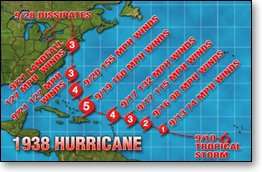


The current cycle and above-normal water temperatures are reminiscent of the pattern that eventually produced the 1938 hurricane that struck Providence, R.I. That storm killed 600 people in New England and Long Island. The 1938 hurricane was the strongest tropical system to strike the northeastern U.S. in recorded history, with maximum gusts of 186 mph, a 15- to 20-foot storm surge and 25- to 50-foot waves that left much of Providence under 10-15 feet of water. Forecasters at AccuWeather.com say that patterns are similar to those of the 1930s, 40s and 50s when storms such as the 1938 hurricane, the 1944 Great Atlantic Hurricanes and the Trio of 1954--Carol, Edna and Hazel--battered the coast from the Carolinas to New England. The worry is that it will be sooner, rather than later, for this region to be blasted again.

The 1938 storm was so powerful it altered the counters of the Long Island coastline. Click here and scroll down for some startling "before and after" aerial photographs. The difference between then and now is that the Hamptons were not nearly as built up. One can only wonder whether the houses there were built to withstand hurricane force winds. Have Hamptonites full absorbed the Department of Homeland Security's disaster preparedness tips? One can only hope.

And we must not forget the lessons of Katrina. Let's all agree right now that if the Hamptons are inundated by a huge hurricane we won't abandon all the poor people who can't evacuate while school buses sit undisturbed in their parking lots.

(5) Comments

Sunday, March 26, 2006

The importance of the perception of victory: replying to Tbogg 

Lefty blog TBogg and his commenters are mocking me for this post, in which I asserted that we should all want the perception that al Qaeda has been defeated in Iraq, whatever our personal politics. Specifically:
Anybody who thinks that an American withdrawal from Iraq will weaken al Qaeda because there will no longer be the "incitement" of the "crusader occupation" is a fool. Victory begets victory, and defeat begets defeat. Whether or not the Iraq invasion has worked out precisely as its supporters had hoped -- it obviously has not -- it is surely in the interests of all Americans, and indeed all Westerners, that it be perceived as a defeat for al Qaeda. Any American who argues otherwise does so from a narrower agenda, such as the political advancement of Democrats. Any other Westerner who argues otherwise does so from misplaced anti-Americanism. There is no other plausible explanation.

TBogg replied:
To recap: victory begets victory which is not exclusively limited to victory and may also include defeat if you can make it look like victory. And if you point out that the defeat is, in actuality, defeat, and not victory, which it isn't - you hate America.

Personally I preferred pre-9/11 plausibility when reality was still in vogue.

Actually, the first part of TBogg's "recap" is precisely correct: "victory begets victory which is not exclusively limited to victory and may also include defeat if you can make it look like victory." There are countless such examples in American military history going both ways (see, e.g., the defense of the Alamo, virtually the entire campaign of the Confederacy before the fall of Atlanta, and the American war in the Philippines, for starters), but the archtype is the Tet offensive. The Tet offensive, a coordinated nationwide attack by the Viet Cong on the date of the Vietnamese lunar new year in January 1968, is now widely understood to have been an operational catastrophe for the insurgency that may have broken the back of the Viet Cong. But that's not the way it was reported in the Western press, probably because the attack's ferocity and proximity to Saigon seemed to discredit the claims of American commanders that they were winning. Shortly thereafter, Walter Cronkite delivered his now famous report "We are mired in stalemate," Lyndon Johnson withdrew from the 1968 election, and the public debate turned away from the prospect of victory to the acceptable conditions for withdrawal. Even though the war would drag on for Americans for four more years while Nixon and Kissinger negotiated the Paris accords that would end American involvement, the United States had effectively given up just as it was relearning the art of counterinsurgency (as we seem condemned to do every couple of generations) because of the Viet Cong was perceived to have won a victory, regardless of the reality.

Setting aside for a future post the question of how to measure success or failure for the United States in Iraq, I believe we can agree on at least a few points.

First, al Qaeda has declared that it will drive the United States from Iraq and has staked its prestige on that objective. If it succeeds, its prestige will grow just as its antecedents rose to influence after driving the Soviets from Afghanistan.1 If it doesn't, al Qaeda will suffer a blow to its credibility, one of many we must inflict in order to degrade the attractiveness of its ideology and, ultimately, operational power.

Second, when the United States does ultimately withdraw its military from Iraq, al Qaeda will benefit if it is widely believed that it forced the United States from Iraq, and it will suffer if it is widely agreed -- especially in the Muslim world -- that whatever the reason for American withdrawal, al Qaeda did not bring it about.

Third, genuine enemies of the jihad should want al Qaeda to suffer, and therefore should want the world to perceive that al Qaeda did not bring about the American withdrawal from Iraq, when and if it occurs. No matter how much they also hate George Bush.

The left instinctively agrees with me that perceptions matter in war. It proves this every day in the debate over the reasons for the war. Whatever the stated reasons of the Bush administration -- which has, both legitimately and illegitimately2, pushed a particular perception of its reasons for deciding to invade -- the left often or perhaps usually claims that the Bush administration is not telling the truth about its motives. We have been hearing and reading these explanations for years: the Iraq war is to grab the oil for Halliburton, or because Israel issues the White House secret instructions through a cabal of neocons, or to foment a "climate of fear" to achieve electoral advantage, or because Bush the son has to exorcize the demons of Bush the father. The left does this because it knows that American voters will be much less forgiving of the alleged "failure" in Iraq if they believe that the reasons for the war were in the personal interest of the president and his chief advisors, rather than a sincere expression of the perceived national interest.

Well, if the perceptions of our reasons for starting the war matter, the perceptions of our reasons for ending it -- or at least our involvement in it -- must also matter. My fairly incrementalist claim is that they matter beyond American domestic political considerations. They also matter to the credibility and fortunes of al Qaeda. In this, the anti-al Qaeda left should agree with me that we are all much better off if at the end of the American time in Iraq, whenever that end shall come, the world perceives al Qaeda as having failed.

The good news for our compadres on the left -- at least those who are more concerned with advancing American interests in the war against al Qaeda than validating every last criticism of the current administration -- is that it is entirely possible to believe that the Iraq adventure has been an operational failure for the United States in the sense that it was not worth the cost and still agree with me that it has been a grievous defeat for al Qaeda. One can believe Bush is incompetent and scream it from the rooftops, and still advertise the idea that al Qaeda is worse for wear having turned Mesopotamia into a battleground. On Iraq, lefties can have their cake and eat it too, which they almost never get to do.

Of course, unreconstructed lefties will complain that it is not credible to claim that al Qaeda is on its way to defeat in Iraq. Some lefties still bleat that "Iraq has nothing to do with f*cking al Qaeda. Putz!" Even if that were true before the war, pretty much everybody, not least of all al Qaeda, agrees that since the invasion Iraq has had quite a bit to do with al Qaeda. If al Qaeda was not in Iraq before the Coalition's invasion, it is now, attracted there by the prospect of humiliating the United States, just as it believes it humiliated the Soviet Union in Afghanistan.

Indeed, this is the crux of the main lefty complaint about the Iraq war, at least as it relates to al Qaeda: that the jihadis have exploited popular outrage among Arabs and other Muslims over the Iraq war to recruit men and attract money for the purpose of ousting Westerners from Iraq, ensuring that popular sovereignty never gains legitimacy there, and attacking Westerners elsewhere, all of which undermines American credibility and diminishes our security. In this way of thinking, the problem isn't just that the war in Iraq is a waste, or that the costs far outweigh the benefits of ousting Saddam. It's that the war has, allegedly, strengthened the jihadis.

But has it? Is it not possible that just as al Qaeda has leveraged the battle of Iraq into more recruits and money, its methods and ideology -- now fully revealed in all their implications for Arabs and other Muslims -- have also inspired many hundreds of thousands to take up arms against it? About a month ago I spelled out this argument in some modest detail:
Recognizing that there are bitter divisions over whether Iraq was a legitimate extension of the wider war, almost nobody disagrees that it is part of that war now. Commentators tend to obsess about the impact of present-day events on the future of Iraq and the politics of Coalition democracies, but the most important effects are on the wider war against al Qaeda and its ideological allies. When we look at Iraq through that lens, we see an entirely different debate. The clear majority in the West argue that the war in Iraq is enormously beneficial to the jihad. A small, besieged minority -- of which I am a member -- believe that Iraq is to al Qaeda as Kursk was to Germany, or Afghanistan was to the Soviet Union: a strategic ambush. Even as the war has clearly deepened anti-Americanism in the region, perhaps irredeemably so, as Peters argues it has also polarized millions of Arabs and other Muslims against the jihad. This polarization is the necessary first step to victory against the jihadi ideology.

Jihadism will not be defeated and the terrorist threat to the West ended until the ideology that underlies it is discredited among Arabs and Muslims. Why? Because only Arabs and Muslims can win this war, which is first and foremost a massive civil insurgency within Islam. If love of America were a prerequisite to that result, we would be in a lot of trouble in the wider war. However, as I have argued many times before, the crucial prerequisite is not that we win hearts, but that the jihad, by its actions and failures, makes enemies. As this happens, as the Arab and Muslim world realizes that the jihadis offer only death and despair notwithstanding their soaring rhetoric, more Arabs and Muslims will supply the intelligence and make the sacrifices necessary to defeat al Qaeda and its allies in the streets and finally in the caves.

The great opponents of the Iraq war, including many liberal hawks who have now "returned," argue that al Qaeda has leveraged the Iraq war into waves of new volunteers and huge new resources. However, this almost certainly true but exquisitely unidimensional fact is of little use in describing the wider jihad's strategic condition. The armed forces and military industrial capacity of Germany were almost certainly larger at the end of 1942 than at the end of 1941, but that did not mean that its position had improved. So it is with al Qaeda.

How do the jihadis earn these enemies that will one day, this generation or the next, defeat them? In two ways. First, the jihadis hurt their own credibility by adopting tactics that alienate Arabs and Muslims. The United States and its allies presented al Qaeda with an irresistable hard target when it occupied Iraq. Austin Bay made precisely this point two months before the invasion. When al Qaeda and its domestic Sunni allies failed to dent the hard target they had to choose between giving up on Iraq -- a decision that would have shattered their credibility -- or attacking softer targets. They started blowing up civilians, particularly Shiites, which decision polarized the insurgency and created millions of enemies of al Qaeda. They extended their war to Egypt, Saudi Arabia and Jordan. According to the Pew Global Attitudes Project survey taken before the attacks on Egypt and Jordan, support among Muslims for suicide bombing as a tactic and Osama bin Laden as a leader declined significantly between 2003 and July 2005, notwithstanding surging anti-Americanism during the same period. It is a safe bet that the jihad and its ideology is even less popular after the slaughter at Sharm al-Sheikh, Amman and the Golden Mosque.

Second, the jihadis create enemies by failing. Yes, al Qaeda was able to attract volunteers, money and arms to "defend" Iraq. Notwithstanding the ignominious failure of the optimistic scenarios peddled by the Bush administration before the war and in the early months of the occupation, the lingering imperfections of Iraqi democracy and the continuing low-grade war, it is far more likely than not that Iraq will sustain the most diverse and representative government in the Arab world (with the possible exception of Lebanon). More importantly, it does not matter if the Arab world believes that this result is in spite of America's efforts, rather than because of them. Indeed, al Qaeda will be all the more humiliated -- and its ideology that much more discredited among Muslims -- if Muslims believe that Iraqis alone defeated it in Iraq.

So, yes, Tbogg, America can fail in many of its objectives in Iraq and al Qaeda can still come out the big loser. You can hate Bush and still celebrate a defeat for the jihad. The question is, why don't you?
_______________________________________
1. Bin Laden recognizes the value of claiming the credit for victory. He quite famously promoted the perception of the victory over the Soviets as having been entirely to the credit of the mujahideen, even though they weren't able to get anywhere against the Soviet helicopters until the United States gave them Stinger missiles.
2. Legitimate reasons are geopolitical -- the protocols of diplomacy require us to deny that one of our reasons for invade Iraq was to coerce and cajole Saudi Arabia into cracking down on al Qaeda. But it was. Illegitimate reasons include the administration's deliberately unclear statements about the connections between Saddam's government and September 11, which were largely for domestic political purposes.

(21) Comments

Today, I've lived longer than F. Scott Fitzgerald 


As of today, I have lived longer than F. Scott Fitzgerald did. That's, er, sobering. And, in light of our respective lifetime achievements, food for thought.

At age 24, Fitzgerald published This Side of Paradise, an autobiographical novel set at my favorite university. It was an instant hit and made Fitzgerald famous, such that my grandmother, who was four years younger than Fitzgerald, remembered when it was a bestseller stacked up in book stores. That same year, 1920, Fitzgerald "married the beautiful Zelda Sayre and together they embarked on a rich life of endless parties."

To be clear, I've done none of that. I'm rarely even invited to parties, and when I have been I either forget to go or the hosts regret having me.

The rich life of endless parties, however, did not stop Fitzgerald from pumping out The Beautiful and the Damned, which I have never read but which you have to admit has a cool title, and, of course, The Great Gatsby, which is, according to The Guardian, the 48th greatest novel of all time.

Fitzgerald also wrote screenplays, and some very amusing short stories during a time when short stories were a staple of American popular entertainment. He even veered into speculative or even science fiction, although lit snobs would find some specious ground to deny it. See, e.g., "The Curious Case of Benjamin Button" and "The Diamond As Big As The Ritz." (Both short story links go to the full text, so you can read them right now if you are so inclined!)

Here's to hoping that I can accomplish in my entire life a fraction of what Scott Fitzgerald achieved in his truncated one.

(8) Comments

Friday, March 24, 2006

My kind of kitten blogging 


A four-week-old Siberian tiger at the zoo in Berlin, 2004. Two wild baby tigers, orphaned and famished, scrambled out of a Siberian forest in eastern Russia and into the hands of startled loggers, the Russian ministry of natural resources said.

(2) Comments

Harper's Magazine has gone insane 

I subscribed to Harper's Magazine for many years, but gave it up a few years back when my subscription lapsed. It has developed such a case of unreconstructed "Bush derangement syndrome" that it has moved from the credible center-left to to the barking moonbat left. The March issue was given over to the magazine's campaign for the impeachment of the president. Now, the April issue devotes its cover story to the prospect of an "American Coup D'Etat" (no link). The opening paragraph reads thusly:
Eternal vigilence being the price of liberty, Americans -- who spent decades wargaming a Soviet invasion and have taken more recently to daydreaming about "ticking bomb" scenarios -- should cast at least an occasional thought toward the only truly existential threat that American democracy might face today. We now live in a unipolar world, after all, in which conquest of the United States by an outside power is nearly inconceivable. Even the best-equipped terrorists, for their part, could dispatch at most a city or two; and armed revolution is a futile prospect, so fearsomely is our homeland secured by police and military forces. To subdue America entirely, the only route remaining would be to seize the machinery of state itself, to steer it toward malign ends -- to carry out, that is, a coup d'etat.

When the far right used to say such things -- remember the black helicopter crowd? -- liberals denounced them as crazies when and if they gave them any thought at all. What has changed to cause one of America's leading pop intellectual magazines to raise a scenario it would have mocked a few years ago? Feel free to offer your speculations in the comments.

In the meantime, reflect upon this bit from the same issue, a factoid from the Harper's Index:
Percentage of Americans who say they trust the military, the presidency, and the Congress, respectively: 74, 44, 22.

Does this make Harper's speculation more or less absurd?

(14) Comments

Of course we want permanent bases in Iraq 

This kind of thinking is very silly:
Even as military planners look to withdraw significant numbers of American troops from Iraq in the coming year, the Bush administration continues to request hundreds of millions of dollars for large bases there, raising concerns over whether they are intended as permanent sites for U.S. forces.

When have we ever fought a war and invested our strategic hopes in a new government and not kept permanent bases? I can think of but one example.

The argument, of course, is that a "permanent" presence will incite al Qaeda:
"It's the kind of thing that incites terrorism," Rep. Ron Paul (R-Texas) said of long-term or permanent U.S. bases in countries such as Iraq.

Paul, a critic of the war, is co-sponsoring a bipartisan bill that would make it official policy not to maintain such bases in Iraq. He noted that Al Qaeda leader Osama bin Laden cited U.S. military bases in Saudi Arabia as grounds for the Sept. 11 terrorist attacks.

Why do people, especially Republicans from Texas, insist on legitimizing bin Laden's view of the world? Who cares if bin Laden "cited U.S. military bases in Saudi Arabia" as grounds for the September 11 attacks? He also cited the expulsion of Saddam from Kuwait in 1991 and American support for Israel. He thinks that Spain should be a Muslim country called al Andalus, that women should walk around with bags over their heads, and that the only legitimate source of governmental power is Allah. Do we think that al Qaeda will pack it in -- "all right, then, you're out of Iraq, no hard feelings" -- if America withdraws? Indeed, I can't think of a better reason in support of permanent bases in Iraq than bin Laden's opposition to them. That, and the containment of Iran.

Let us agree on several propositions, which I believe to be self-evident but apparently require endless reinforcement.

First, we will keep no troops in Iraq over the objections of its legitimate government.

Second, having been the midwife of that government, we will not abandon it as long as it is legitimate in the eyes of most Iraqis.

Third, if the legitimate government of any country offers basing privileges to the United States and if it is otherwise in our strategic interests to accept those privileges, we should not allow the objections of Osama bin Laden to dictate a contrary decision.

Fourth, al Qaeda has publicly vowed to expel the United States from Iraq. We are far more likely to strengthen al Qaeda's credibility and therefore its ability to attract men and money if we grant it that victory than if we deny it.

Anybody who thinks that an American withdrawal from Iraq will weaken al Qaeda because there will no longer be the "incitement" of the "crusader occupation" is a fool. Victory begets victory, and defeat begets defeat. Whether or not the Iraq invasion has worked out precisely as its supporters had hoped -- it obviously has not -- it is surely in the interests of all Americans, and indeed all Westerners, that it be perceived as a defeat for al Qaeda. Any American who argues otherwise does so from a narrower agenda, such as the political advancement of Democrats. Any other Westerner who argues otherwise does so from misplaced anti-Americanism. There is no other plausible explanation.

(31) Comments

Impending milestone 

At some point later today, this blog will achieve its millionth page view since the Site Meter went up. That's, like, a lot of page views for a humble blog.

(1) Comments

America sucks! 

Heh.

CWCID: John Hawkins.

In other news, my week of intense travel and other commitments, which began Sunday evening in Washington at a delightful dinner with the Villain and Cassandra, ends today. I have pent up a lot of things, much of which should come pouring out, for better or for worse, in the next few days.

(2) Comments

Why America supports Israel 

Time and again we read that America's foreign policy is slaved to Israel because of the nefarious workings of the "Israel lobby." I have heard this myself ever since my undergraduate days more than 25 years ago, from leftist professors and even the mother of a girlfriend who was working toward a graduate degree in "United Nations studies."

Martin Kramer's response, which sets forth the "realist" case for supporting Israel, is today's essential reading.

(0) Comments

Thursday, March 23, 2006

Pandaring 


Is China pandaring to the people of Taiwan, or is Chen pandaring to his hard-line voters?
Taiwan President Chen Shui-bian told China on Thursday to drop the idea of giving the island a goodwill gift of a pair of pandas, saying they would not be happy.

"A-bian sincerely urges the Chinese leaders to leave the giant pandas in their natural habitat, because pandas brought up in cages or given as gifts will not be happy," Chen wrote in a weekly electronic newsletter, using his nickname...

Or maybe I'm just pandaring to our readers.

(1) Comments

The murder of Allen Ginsberg 

"Growl".

(Real thing here).

CWCID: Glenn.

(1) Comments

Who is Dave Pike? 

As a collector of jazz and funky music, I learned the answer to that question about four years ago. As a fan of "traditional" jazz, it took me many years to venture too far afield from the well known artists like Miles Davis, John Coltrane, Ornette Coleman, Clifford Brown, and other giants. But enjoying and collecting music is all about exploration, and at some point I stumbled into the genre of "soul jazz," or at least the form of it so well rendered on the Prestige label, whose artists brought forth great music with plenty of organ and guitar and heavy drums. Organists like Charles Kynard and Trudy Pitts, guitarists like Melvin Sparks and Boogaloo Joe Jones, drummers like Bernard Purdie and Idris Muhammed. And from there I was sufficiently emboldened to explore some of the more untraditional forms of jazz, some of which cross dangerously over to other genres like funk and soul, and, dare I say it, easy listening pop. And then I discovered Dave Pike.

Who is Dave Pike? Hyp Wax tells it like it is.

Dave Pike is a class act, unafraid to try any style, at least for an album, and usually succeeding wildly at it. His earliest LPs and session work are classics and mostly hard to find. Then as he "freaked out" in the late 1960s and early 1970s, he laid down some monster cuts of psychedelic soul jazz, James Brown covers, funky-sitar beats, and more that still enjoy new favor in the nightclubs of the subsequent century. There are not that many soul-jazz and funk vibraphonists of great note, but Dave Pike is the first name in hip vibe records.

Born in 1938 Detroit, he first played piano and drums, even joining the Detroit Junior Symphony Orchestra at age eleven. Having moved to Los Angeles, Pike in 1954 discovered the vibraphone at a drum shop. This became his chief instrument, seconded by the marimba, which he played early on with Mexican bands and later on his albums. He played rock and Latin in his early days, and later this experience lent his music great versatility as well as popular appeal. Playing always with great earnestness, humor, and even earthiness, he can be heard chanting along with the tunes on several LPs.

Pike began to gig with such jazz stars as Elmo Hope, Buddy DeFranco, and Paul Bley by 1956. By 1958 Pike had moved to San Francisco to be closer to New York musicians, and in 1960 he made the move to New York. Siz years of stints with globetrotting Herbie Mann exposed him to some of the world's farther-flung music. In 1966 he moved to Germany, where the newly formed Dave Pike Set quickly became the leading jazz act. Pike's usually thematic albums are recognized as seminal jazz and soul-jazz classics, and at least one cut has reached immortal status among disc jockeys.

What to buy (assuming y'all still buy music in some album form)? Its all good, but I'd recommend starting with Jazz for the Jet Set, which came out on Atlantic in 1968. It features Herbie Hancock and is groovy, baby. Manhattan Latin is a nice loungey set with a Latin vib, suitable for all occasions. The Dave Pike Set albums on MPS, like Noisy Silence - Gentle Noise are a bit more sophisticated and varied, using a wide range of rhythms and adding the occasional sitar twang, but they are truly outstanding as well. The best of the MPS albums have been collected on the compilation Masterpieces, which is fantastic, albeit hard to find. (Note: I have linked to Amazon, but have had better luck finding some of these titles over at Dusty Groove America.)
Updated with album links.

(4) Comments

Well well well 

ABC News:

A newly released pre-war Iraqi document indicates that an official representative of Saddam Hussein's government met with Osama bin Laden in Sudan on February 19, 1995 after approval by Saddam Hussein. Bin Laden asked that Iraq broadcast the lectures of Suleiman al Ouda, a radical Saudi preacher, and suggested "carrying out joint operations against foreign forces" in Saudi Arabia. According to the document, Saddam's presidency was informed of the details of the meeting on March 4, 1995 and Saddam agreed to dedicate a program for them on the radio. The document states that further "development of the relationship and cooperation between the two parties to be left according to what's open (in the future) based on dialogue and agreement on other ways of cooperation." The Sudanese were informed about the agreement to dedicate the program on the radio.


RTWT


Of course there has been plenty of evidence linking Saddam and Al-Qaeda, yet there are plenty of people who make a point of denying any connection whatsoever. But at some point the evidence will become overwhelming, and I suspect that we have reached that point, or will very soon now that these documents are being examined.

(And before you Hooligans start foaming on your keyboards, please note that I am making no assertions whatsoever regarding any direct linkage between 9-11 and Saddam, and never have.)

(2) Comments

Military deaths 

Powerline reveals a startling statistic:

[M]ore active duty service members (2,392) died in 1980, Jimmy Carter's last year in office, than in either 2003 or 2004, when the Iraq war was being fought (1,410 and 1,887, respectively). No military actions were conducted during 1980 other than the failed effort to rescue the hostages in Iran, in which eight servicemen lost their lives. Keep that in mind next time you hear Carter pontificating about the "carnage" in Iraq.


UPDATE
In my original post, I did not get into the back and forth over these statistics that is happening around the blogosphere, but it is quite interesting. As often is the case, Belmont Club cuts right to the chase with an excellent summary and analysis of the issue at hand.

(7) Comments

The continuing NYT trainwreck 

Perhaps we have reached the point where the deteriorating quality of the New York times ceases to be infuriating and simply becomes sad. Like CBS before it, it increasingly appears to lack even the most basic editorial review process in its efforts to make the administration look bad. Whatever way you lean, to have the NYT making these kinds of errors is a disgrace to our country's great journalistic traditions.

Here's today's gem from the corrections page (via Lucianne):

An article in The Metro Section on March 8 profiled Donna Fenton, identifying her as a 37-year-old victim of Hurricane Katrina who had fled Biloxi, Miss., and who was frustrated in efforts to get federal aid as she and her children remained as emergency residents of a hotel in Queens.

Yesterday, the New York police arrested Ms. Fenton, charging her with several counts of welfare fraud and grand larceny. Prosecutors in Brooklyn say she was not a Katrina victim, never lived in Biloxi and had improperly received thousands of dollars in government aid. Ms. Fenton has pleaded not guilty.

For its profile, The Times did not conduct adequate interviews or public record checks to verify Ms. Fenton's account, including her claim that she had lived in Biloxi. Such checks would have uncovered a fraud conviction and raised serious questions about the truthfulness of her account.

I hope we don't hear any more pompous newsmen criticizing fact checking on the blogosphere any time soon.

(2) Comments

The highest authority in Sunni Islam bans depictions of Jesus 

Here's a tough one for the tolerance fetishists: the alleged highest authority in Sunni Islam has issued a fatwa banning the depiction of any prophet of Islam, including Jesus. It will be interesting to see whether the Muslims of Europe react to this. The Louvre might actually become a dangerous place.

Yes, it may well be that this is all about oppressing the Copts, and does not portend another attempt by Islamic activists to demand that Western societies modify core principles to accomodate Islam. But Islam is waging a long, expansionist struggle on the basis of politicized theology. Do not be surprised if this fatwa resurfaces in some way that is extremely invasive of our most cherished principles.

CWCID: Gateway Pundit, who has more.

(1) Comments

Arming Iran: Our friends the Germans 

I have never understood the loyalty that John Kerry wants us to have toward our "traditional allies," by which he means (in 2004, at least) France and Germany, neither of which have lept to our defense more recently than 220 years ago, in the case of France, or ever in the case of Germany.

France might irritate the typical American more than Germany, but Berlin has done much more to hurt the interests of the United States. It pays ransoms to al Qaeda that will be used to buy weapons to kill Americans and other not-Germans. And now we learn that Germany has been a center for the unlawful sale of arms and strategic materials to Iran. The Deutsche-Welle article contains -- if I may step gingerly -- a bombshell:
Speaking to German public broadcaster ARD on Monday, security experts confirmed that as many as up to 100 dummy firms in Germany are involved in illegally exporting components for missiles and aircraft to Iran.

Johannes Schmalzl, president of the Office for the Protection of the Constitution in the state of Baden-Württemberg, told the program "Report Mainz" that the situation wasn't entirely new.

"We've been devoting time to the topic since 2002," he said. "And we've concluded that an estimated 100 dummy firms in Germany are involved in it."
Schmalzl added that the authorities could hardly keep up with the scale of illegal exports to Iran.

"When I say, 100 dummy firms, you can imagine that when we discover one and the federal prosecutor opens a case against them, we're happy and pat ourselves on the back. But 99 others are still in business," Schmalzl said.

Got that? The government of Germany -- or at least a part of it -- has known about a massive arms smuggling scheme in defiance of international law and American policy for at least four years, and largely done nothing about it. Either the Germans were trying to help Iran defy the United States, or they are incompetent. As in really not-keeping-good-records incompetent. As in makes-America's-plan-for-port-security look ingenuous. Sheesh.

(2) Comments

Wednesday, March 22, 2006

The "netroots" thingy 

Why is it only the left that uses the term "netroots" to describe online political activism? Yes, there are celebrated differences between political activism in the left and right blogospheres, largely -- in my opinion -- the result of the emergence of blogs during a time when the right was ascendant. But even if political blogging had emerged as a force during the Clinton years, what are the chances that the righty bloggers would describe themselves as the "netroots"? Nil.

The "netroots" thingy comes from "grassroots," which is short for "grassroots revolution." Leftists, even those who aren't the least bit revolutionary, are attracted to the idea of revolution. Remember how the lefty activist groups on campus used to put up posters advertising "mass meetings"? Normal people -- those of us who are OK with hierarchy -- couldn't imagine any gathering less appealing or functional than a "mass meeting," yet this was considered in lefty circles to be just the sort of meeting one wanted to attend.

The problem is, activists who traffic in the vocabulary of revolution are not inclined to compromise in the cause of victory. That is why the netroots bloggers spend at least as much time threatening Democrats as Republicans, even in the guise of pulling together.

(4) Comments

Straw men 

Editor & Publisher has a story reviewing the controversy surrounding an Associated Press news article of last Saturday, "Bush Using Straw Man Arguments In Speeches." The original article is controversial because it is not labeled as opinion or even analysis, but -- in the view of Power Line and others -- is closer to either than hard news.

For my own part, I think these labeling distinctions are silly, and the mainstream media would do well to abandon them. News and opinion flow seamlessly together in all media other than newspapers, wire services and tiny corners of broadcast journalism, the last bastions of the old idea that the press should at least aspire to objectivity. Why not just admit the obvious -- that the failure to label everything as "opinion" or "analysis" is itself a deceptive trade practice. Who are we kidding?

Look no further than the Editor & Publisher article, which is one of those cringingly self-conscious second-derivative pieces that E&P specializes in: a review of the (first derivative) articles and blog posts written about an original piece of journalism. E&P describes the "straw man" arguments that George Bush allegedly uses more often than his opposition:
The story, posted by AP last weekend, cited the president's habit of using phrases such as "some say" or "some believe" when introducing a viewpoint that challenges his own. One example Loven noted was Bush saying "some look at the challenges in Iraq and conclude that the war is lost and not worth another dime or another day." She also cited his recent statement that "some say that if you're Muslim you can't be free."

Loven then contends that "hardly anyone in mainstream political debate has made such assertions." But she notes that Bush, in presenting opposing views in such a "straw man" way, sets himself up well to fire back, often appearing in defense of his viewpoint or as an underdog.

"The device usually is code for Democrats or other White House opponents," Loven writes about the "some" to which he refers. "In describing what they advocate, Bush often omits an important nuance or substitutes an extreme stance that bears little resemblance to their actual position." She adds that "he typically then says he 'strongly disagrees' -- conveniently knocking down a straw man of his own making."

All well and good. But then E&P quotes Moveon.org doing the same thing with neither comment nor irony:
On Monday, Washington Post blogger Dan Froomkin called Loven's piece "a bold departure for Associated Press," adding that Bush's straw-man arguments are "extensive and generally unchallenged." MoveOn.org's Media Action sent an e-mail to media outlets urging support for Loven, claiming "some reporters take notes on what President Bush says and don't bother to research what is and isn't true. But the AP took a bold step this week and engaged in exactly the sort of strong watchdog journalism MoveOn Media Action members have been calling for."

Er, no. If the AP -- or Editor & Publisher, for that matter -- engaged in "strong watchdog journalism," it would have observed that George Bush's opponents are equally as prone to make straw man arguments. In fact, the press is so blind that they cannot bring themselves to observe that Moveon.org impeached -- and I used that term advisedly -- the thesis of the Associated Press's hit piece even as it celebrated it in a mass distribution email! How did E&P let that pass unnoticed? Oh. Wait a minute. Its article is labeled "news."

CWCID: Lucianne.

(1) Comments

Alford going...where? 

Hawk Central reports on the latest Steve Alford related rumors. The upshot: Indiana is not interested, but Missouri is, a curious twist in the story.

Why would Alford leave the Big 10 for Mizzou? The Press Citizen speculates on his success at his last job at what is now called Missouri State. The unsaid reason might be his ongoing estrangement with a significant portion of the Hawkeye nation over Alford's track record, particularly with respect to personnel. The incarcerated Pierre Pierce is the most visible example, but the list of defections and disappointments is long. Much of this damage may have been repaired over the course of this season's 18 game winning streak at Carver Hawkeye Arena, but with 4 key seniors leaving the team and a rebuilding year on the horizon, perhaps Alford feels he might make a move while his stock is on the rebound.

Those supporting an Alford departure have often pointed to UNI coach Greg McDermott as his probable successor. McDermott, after all, has shown that he can win out of Cedar Falls, Iowa. Surely he could do even better out of Iowa City. But that plan has been derailed, probably for eternity, as McDermott has just signed on with Iowa State.

McDermott, 41, had a 90-63 record and three NCAA Tournament appearances in five seasons at Northern Iowa. The Panthers lost to Georgetown in the opening round of the NCAA Tournament on Friday. He has a 221-127 career coaching record at Northern Iowa, Wayne State and North Dakota State.

"This was a heart-wrenching decision for me," McDermott said. "I left a special place. The University of Northern Iowa is a big part of who I am, but this place was special enough to get me away."

"He will bring stability to the program," said former Iowa State all-American Gary Thompson, who assisted Pollard in the coaching search. "He is an Iowa kid, which adds a little bit more in this search. It is great for an Iowan to be coaching in the Big 12 and Iowa State."

(0) Comments

Certain people turn 11 today... 

Happy Birthday!


(7) Comments

Iran, the United States, and Iraq 

I am on the road and exceedingly busy, so my contributions here have -- and will be -- a bit on the shallow side, even by my standards. I did want to pass along some choice excerpts from Stratfor's letter of last night($), which considers the public negotiations that Iran and the United States have agreed to undertake. It supports a point I have believed for some time, which is that the negotiation with and coercion of Iran is very different in its requirements than the challenge posed by Ba'athist Iraq, both in the abstract -- Iran is not an autocracy run by a single fuhrer sustained by a cult of personality -- and because of the American and Iranian experiences in Iraq. Here are some fair use excerpts (and, in case they are not fair use, may I repeat my longstanding recommendation that you scrape up the coin to Stratfor):
Not to put too fine a point on it, but the real players in Iraq are now going to sit down and see if they can reach some decisions about the country's future. They are going to do this over the heads of their various clients. Obviously, the needs of those clients will have to be satisfied, but in the end, the Iraq war is at least partly about U.S.-Iranian relations, and it is clear that both sides have now decided that it is time to explore a deal -- not in a quiet Georgetown restaurant, but in full view of the world. In other words, it is time to get serious.

The offer of public talks actually was not made by Iran. The first public proposal for talks came from U.S. Ambassador to Iraq Zalmay Khalilzad, who several months ago reported that he had been authorized by Bush to open two lines of discussion: One was with the non-jihadist Sunni leadership in Iraq; the other was with Iran. Interestingly, Khalilzad had emphasized that he was authorized to speak with the Iranians only about Iraq and not about other subjects. In other words, discussion of Iran's nuclear program was not going to take place. What happened last week was that the Iranians finally gave Khalilzad an answer: yes.

As we have discussed many times, Iraq has been Iran's obsession. It is an obsession rooted in ancient history; the Bible speaks of the struggle between Babylon and Persia for regional hegemony. It has some of its roots in more recent history as well: Iran lost about 300,000 people, with about 1 million more wounded and captured, in its 1980-88 war with Iraq.... The Iranians, then, came out of the war with two things: an utter hatred of Saddam Hussein and his regime, and determination that this sort of devastation should never happen again....

The Iranians were unable to wage war against Hussein but were content, after Desert Storm, that he could not attack Iran. So they focused on increasing their influence in the south and bided their time. They could not take out Hussein, but they still wanted someone to do so. That someone was the Americans....

Iran responded to the 9/11 attacks in a predictable manner. First, Iran was as concerned by al Qaeda as the United States was. The Iranians saw themselves as the vanguard of revolutionary Islam, and they did not want to see their place usurped by Wahhabis, whom they viewed as the tool of another regional rival, Saudi Arabia. Thus, Tehran immediately offered U.S. forces the right to land, at Iranian airbases, aircraft that were damaged during operations in Afghanistan. Far more important, the Iranians used their substantial influence in western and northern Afghanistan to secure allies for the United States. They wanted the Taliban gone. This is not to say that some al Qaeda operatives, having paid or otherwise induced regional Iranian commanders, didn't receive some sanctuary in Iran; the Iranians would have given sanctuary to Osama bin Laden if that would have neutralized him. But Tehran's policy was to oppose al Qaeda and the Taliban, and to quietly support the United States in its war against them. This was no stranger, really, than the Americans giving anti-tank missiles to Khomeini in the 1980s...

But the main chance that Iran saw was getting the Americans to invade Iraq and depose their true enemy, Saddam Hussein. The United States was not led to invade Iraq by the Iranians -- that would be too simple a model. However, the Iranians, with their excellent intelligence network in Iraq, helped to smooth the way for the American decision....

The Iranians wanted the United States to defeat Hussein. They wanted the United States to bear the burden of pacifying the Sunni regions of Iraq. They wanted U.S. forces to bog down in Iraq so that, in due course, the Americans would withdraw -- but only after the Sunnis were broken -- leaving behind a Shiite government that would be heavily influenced by Iran. The Iranians did everything they could to encourage the initial engagement and then stood by as the United States fought the Sunnis. They were getting what they wanted.

What they did not count on was American flexibility. From the first battle of Al Fallujah onward, the United States engaged in negotiations with the Sunni leadership. The United States had two goals: one, to use the Sunni presence in a new Iraqi government to block Iranian ambitions; and two, to split the Sunnis from the jihadists. It was the very success of this strategy, evident in the December 2005 elections, that caused Iraqi Shia to move away from the Iranians a bit, and, more important, caused the jihadists to launch an anti-Shiite rampage. The jihadists' goal was to force a civil war in Iraq and drive the Sunnis back into an unbreakable alliance with them.

In other words, the war was not going in favor of either the United States or Iran. The Americans were bogged down in a war that could not be won with available manpower, if by "victory" we mean breaking the Sunni-jihadist will to resist. The Iranians envisioned the re-emergence of their former Baathist enemies. Not altogether certain of the political commitments or even the political savvy of their Shiite allies in Iraq, they could now picture their worst nightmare: a coalition government in which the Sunnis, maneuvering with the Kurds and Americans, would dominate an Iraqi government. They saw Tehran's own years of maneuvering as being in jeopardy. Neither side could any longer be certain of the outcome.

In response, each side attempted, first, to rattle the other. Iran's nuclear maneuver was designed to render the Americans more forthcoming; the assumption was that a nuclear Iran would be more frightening, from the American point of view, than a Shiite Iraq. The Americans held off responding and then, a few weeks ago, began letting it be known that not only were airstrikes against Iran possible, but that in fact they were being seriously considered and that deadlines were being drawn up.

This wasn't about nuclear weapons but about Iraq, as both sides made clear when the talks were announced. Both players now have all their cards on the table. Iran bluffed nukes, the United States called the bluff and seemed about to raise. Khalilzad's request for talks was still on the table. The Iranians took it. This was not really done in order to forestall airstrikes -- the Iranians were worried about that only on the margins. What Iran had was a deep concern and an interesting opportunity.

The concern was that the situation in Iraq was spinning out of its control. The United States was no longer predictable, the Sunnis were no longer predictable, and even the Iranians' Shiite allies were not playing their proper role. The Iranians were playing for huge stakes in Iraq and there were suddenly too many moving pieces, too many things that could go wrong...

From the Iranian point of view, if ever a man has needed a deal, it is Bush. If there are going to be any negotiations, they are to happen now. From Bush's point of view, he does need a deal, but so do the Iranians -- things are ratcheting out of control from Tehran's point of view as well....

The Iranians want at least to Finlandize Iraq. During the Cold War, the Soviets did not turn Finland into a satellite, but they did have the right to veto members of its government, to influence the size and composition of its military and to require a neutral foreign policy. The Iranians wanted more, but they will settle for keeping the worst of the Baathists out of the government and for controls over Iraq's international behavior. The Americans want a coalition government within the limits of a Finlandic solution. They do not want a purely Shiite government; they want the Sunnis to deal with the jihadists, in return for guaranteed Sunni rights in Iraq. Finally, the United States wants the right to place a force in Iraq -- aircraft and perhaps 40,000 troops -- outside the urban areas, in the west. The Iranians do not really want U.S. troops so close, so they will probably argue about the number and the type. They do not want to see heavy armored units but can live with lighter units stationed to the west.

Now obviously, in this negotiation, each side will express distrust and indifference. The White House won the raise by expressing doubts as to Tehran's seriousness; the implication was that the Iranians were buying time to work on their nukes. Perhaps. But the fact is that Tehran will work on nukes as and when it wants, and Washington will destroy the nukes as and when it wants. The nukes are non-issues in the real negotiations.

There are three problems now with negotiations. One is Bush's ability to keep his coalition intact while he negotiates with a member of the "axis of evil." Another is Iran's ability to keep its coalition together while it negotiates with the "Great Satan." And third is the ability of either to impose their collective will on an increasingly self-reliant Iraqi polity. The two major powers are now ready to talk. What is not clear is whether, even together, they will be in a position to impose their will on the Iraqis....

The only incremental observation that I am going to make this morning -- I am in a bit of a rush -- is that the United States faces something of a paradox in these negotiations. It can cut a deal with Iran, and then, as Stratfor suggests, fail to get the Iraqis to "go along," whatever that may mean in the particulars of the matter. Ironically, the ability of Iraq to resist any deal cut by the United States and Iran will be a reflection of rising post-Ba'athist Iraqi nationalism, which is probably a positive development for the future of a united Iraqi state and geopolitical balance in the region.

Stratfor's strength, and its weakness, is that as an organization it follows the tendencies of its founder, George Friedman. Friedman tends to derive geopolitical strategy in all the actions of nation states, apparently not allowing as much room for rank emotionalism or bureaucratic stupidity as I would. However, he has long seen our game with Iran more deeply than conventional American politics will allow, and in that regard makes a huge contribution to the discussion.

(5) Comments

Tuesday, March 21, 2006

The United Nations slanders Denmark 

If a picture speaks a thousand words, a poster produced by the United Nations must be an extended bill of indictment. In some ways, this is more powerful evidence why the United Nations is no longer a force for good in the world than its twin fetishes for moral equivalence and corruption.

(9) Comments

Bush in Cleveland: Eloquence from unexpected (and expected) places 

Following a suggestion from one of Glenn's readers, I took the time to watch the C-Span feed of the President's speech to the City Club of Cleveland. The set speech was fine and worthwhile, but the question and answer session afterward is must-see TV. Bush was far more eloquent and engaging on a number of pressing issues of the day, including particularly the war in Iraq but also immigration reform and various domestic policy controversies, than he seems to be via network sound bites. The quick response of the opposition will be that that is because he appeared before a "friendly" audience rather than the Washington press corps. But that isn't really true. While the audience demonstrated the respect of ordinary Americans rather than the arrogance of the media elite (who certainly don't consider that their first loyalty is as Americans), the questions were not softballs. Indeed, they were far more relevant and penetrating than we ever see at presidential press conferences or the daily gaggle. The flower and chivalry of Cleveland asked serious and sophisticated questions about policy, and did not once ask the president to defend something silly that somebody else said, or to reconcile two apparently inconsistent statements made in entirely different times, places and contexts. Listen to the Indian-American ask about America's cozy relationship with Pakistan, for example, or the question on domestic wiretapping, or the controlling of the borders. And listen to the president's comfortable and articulate responses. It seems to me that the president is more than willing to answer tough questions if they are intelligent. The press corps would elicit these sorts of genuine and ultimately useful responses -- and the president would have more press conferences -- if it, like the Clevelanders yesterday, it roused itself to ask questions about subjects that matter. Instead, the MSM thought it interesting that the president used the word "kerfuffle", thanks to James Taranto a signature term of the blogosphere. Suffice it to say that the A.P.'s Nedra Pickler didn't ask whether the president reads blogs.

One final point: when you watch the C-Span feed (and if you have broadband it is a better use of 90 minutes than any television you are likely to watch tonight) notice that Bush seems extraordinarily comfortable and relaxed for a guy whose poll numbers are in the toilet. This is not the performance of a man who feels that he is under siege. Confidence like that comes from only two places -- isolation and denial, or faith. If you tell me which you believe it is, you will also probably be telling me how you voted in 2004.

(22) Comments

"The Stone Face of Zarqawi" 

Christopher Hitchens has an interesting column in today's Wall Street Journal. In its eloquent exposition on the link between the war in Iraq -- according to both me and the president, a "theater" in the wider war -- and the war on Islamic jihad, it neatly supplements the president's talk in Cleveland yesterday. Here's a bit:
In February 2004, our Kurdish comrades in northern Iraq intercepted a courier who was bearing a long message from Abu Musab al-Zarqawi to his religious guru Osama bin Laden. The letter contained a deranged analysis of the motives of the coalition intervention ("to create the State of Greater Israel from the Nile to the Euphrates" and "accelerate the emergence of the Messiah"), but also a lethally ingenious scheme to combat it. After a lengthy and hate-filled diatribe against what he considers the vile heresy of Shiism, Zarqawi wrote of Iraq's largest confessional group that: "These in our opinion are the key to change. I mean that targeting and hitting them in their religious, political and military depth will provoke them to show the Sunnis their rabies . . . and bare the teeth of the hidden rancor working in their breasts. If we succeed in dragging them into the arena of sectarian war, it will become possible to awaken the inattentive Sunnis as they feel imminent danger."...

Since February 2004, there have been numberless attacks on Shiite religious processions and precincts. Somewhat more insulting to Islam (one might think) than a caricature in Copenhagen, these desecrations did not immediately produce the desired effect. Grand Ayatollah Sistani even stated that, if he himself fell victim, he forgave his murderers in advance and forbade retaliation in his name. This extraordinary forbearance meant that many Shiites--and Sunnis, too--refused to play Zarqawi's game. But the grim fact is, as we know from Cyprus and Bosnia and Lebanon and India, that a handful of determined psychopaths can erode in a year the sort of intercommunal fraternity that has taken centuries to evolve. If you keep pressing on the nerve of tribalism and sectarianism, you will eventually get a response. And then came the near-incredible barbarism in Samarra, and the laying waste of the golden dome....

Everybody now has their own scenario for the war that should have been fought three years ago. The important revelations in "Cobra II," by Michael Gordon and Bernard Trainor, about the underestimated reserve strength of the Fedayeen Saddam, give us an excellent picture of what the successor regime to the Baath Party was shaping up to be: an Islamized para-state militia ruling by means of vicious divide-and-rule as between the country's peoples. No responsible American government could possibly have allowed such a contingency to become more likely. We would then have had to intervene in a ruined rogue jihadist-hosting state that was already in a Beirut-like nightmare.

I could not help noticing, when the secret prisons of the Shiite-run "Interior Ministry" were exposed a few weeks ago, that all those wishing to complain ran straight to the nearest American base, from which help was available.

RTWT.

(3) Comments

Monday, March 20, 2006

Iran: thinking politically 

I have not written much about Iran, partly because I feel ignorant about it. Iran is in many respects far more complex than Saddam's Iraq -- even considering the latter in retrospect -- both in its strategic challenge and in its internal politics. While no democracy, Iran is no longer a revolutionary government devoted to a cult of personality. There are various political factions in Iran with various motives, and their influence ebbs and flows. I, for one, do not even know how much power Iran's crackpot president actually wields, particularly in foreign policy.

With that backdrop, I therefore commend to you a very interesting article about Iran in today's Washington Post. This bit was especially illuminating:
Inside Iran, however, an appetite for rapprochement grew along with a population whose youthful majority had no memory of the revolution.

In 2002, a poll found that three-quarters of Iranians surveyed favored talks with the United States. The pollster was thrown in jail, but the reality drove a quiet competition between Iran's two rival political forces.

"Whoever could take the prize" of U.S. rapprochement would, it was widely believed, dominate Iranian politics for the foreseeable future, said Mehdi Karrubi, a moderate cleric who was speaker of the last parliament dominated by reformers.

The competition, however, had paralyzed the effort: Neither side would allow the other to reach out to the United States without risking accusations of betraying the Islamic revolution.

That changed last year, when conservative clerics edged reformists out of government, unifying Iran's elaborate ruling structure for the first time in nearly a decade. It also cleared the way for the opening to Washington, and even reformists urged the conservatives to act.

"This might be a historic irony, but it's true the state is in 'harmony,' " said Mostafa Tajzadeh, a prominent reformist theoretician, speaking before the announcement of the direct talks. "No time has been more convenient for talks between the two countries. We are less sensitive than at any time since the revolution."

A few conservatives quietly urged the same. Behind the scenes of Iran's conservative establishment, insiders whispered about the prospect of negotiations.

To some degree, the United States is lost in a mirrored version of the same political trap. Owing to the embassy seizure and other depredations, Iran is so unpopular in the United States that no American politician wants to appear accomodating, even though both the Clinton administration and the current president engaged in extensive back channel discussions with Tehran.

So, the Iranian public wants to deal with the United States, but rival factions in Iran have frustrated their will for fear of giving up political advantage. In the United States, both the hard-line Bushies and the more accomodating Clintonites believed that we needed to talk to Iran and were willing to do so in secret, but neither did so in public (until the very recent overtures regarding Iraq) for any number of reasons, including the fear that the party out of power would attack them for being soft on Tehran.1

Comments?
_______________________________________________
1. I am somewhat overstating the dilemma to make the point. In fact, the Clinton administration, via Madeline Albright, did quite famously (and, frankly, correctly) "apologize" for past interference in Iran's internal politics, but got nothing but a cold shoulder in return. Why? Probably for the same domestic Iranian political considerations described in the linked article.

(10) Comments

Sunday, March 19, 2006

Iraq three years on: taking stock, Part I 

The media and the blogosphere are taking stock of the Iraq war from various angles. Belgravia Dispatch has famously despaired, the Guardian has published a progressive case for the war, Donald Rumsfeld conjures up his own wishful thinking, Gateway Pundit is looking at various wrong predictions made by critics of the war, and Canadians compare Bush to Hitler (as if that were news).

I will have my own thoughts on the subject within the next day or so. It will make nobody happy, as I am struggling to look at the situation as objectively as possible, recognizing that virtually all data available to me (and everyone else) has been laundered through a partisan agenda. Jack Murtha's absurd ranting on "Meet the Press" this morning is symptomatic of the problem -- one can think of all sorts of criticisms of the war in Iraq, but when the most prominent public critics incessantly analogize to a flawed conception of the alleged lessons of Vietnam it is almost impossible to promote a dispassionate discussion of the state of play and the best policy for the future.

(34) Comments

Saturday, March 18, 2006

The New York Times is used like an old snot rag 

Editor's Note Appended


The New York Times has retracted an anti-American cover story only a week after it was published. Captain Ed examines the Times' retraction and is merciless. Deservedly so, since the Times thought it plausible to defend its error by claiming reliance on PBS and Vanity Fair.

In other words, the Times didn't bother to do its own research; it relied on the "independent" reporting of PBS and Vanity Fair -- wait, I can't even write that with a straight face -- to identify Qaissi as the man in the photograph.

Indeed, it sounds like something a blogger would do.

But actually, the Times had correctly reported the essential fact in dispute -- the identity of the Iraqi in the famous "hooded scarecrow" photo from Abu Ghraib -- two years ago.
But the worst part of this correction comes when the paper blames the military for not doing the reporter's research for them. "The Pentagon, asked for verification, declined to confirm or deny it." It then says it should have been "more persistent" in getting an answer from the Pentagon, but in the same paragraph notes that the military named the correct detainee two years ago -- and that the Times reported it!

Is it the Pentagon's fault that the original reporter, Hassan Fattah, is too incompetent to do a search through the archives of his own newspaper? (emphasis in original)

Ouch. Apparently the "paper of record" has so little confidence in its, er, record that it would sooner rely on Vanity Fair and PBS than its own archives.

The original story was, as Power Line writes, gripping:
Almost two years later, Ali Shalal Qaissi's wounds are still raw.

There is the mangled hand, an old injury that became infected by the shackles chafing his skin. There is the slight limp, made worse by days tied in uncomfortable positions. And most of all, there are the nightmares of his nearly six-month ordeal at Abu Ghraib prison in 2003 and 2004.

Mr. Qaissi, 43, was prisoner 151716 of Cellblock 1A. The picture of him standing hooded atop a cardboard box, attached to electrical wires with his arms stretched wide in an eerily prophetic pose, became the indelible symbol of the torture at Abu Ghraib, west of Baghdad.

Thing is, Qaissi wasn't there. [See note below. Qaissi was at Abu Ghraib, but not in the "scarecrow" photo.] Somebody was there, but it wasn't the man who told the Times' credulous Mr. Fattah that he "never wanted to be famous, especially not in this way." Whoever it was who suffered so, it wasn't the lying weasel about which the Grey Dufus wrote this:
In all, there were about 100 cells in the cellblock, he said, with prisoners of all ages, from teenagers to old men. Interrogators were often dressed in civilian clothing, their identities strictly shielded.

The prisoners were sleep deprived, he said, and the punishments they faced ranged from bizarre to lewd: an elderly man was forced to wear a bra and pose; a youth was told to hit the other adults; and groups of men were organized in piles. There was the dreaded "music party," he said, in which prisoners were placed before loudspeakers. Mr. Qaissi also said he had been urinated on by a guard. Then there were the pictures.

"Every soldier seemed to have a camera," he said. "They used to bring us pictures and threaten to deliver them to our families."

The Times has now published a legend at the top of the first page of the original article that says "Editors' Note Appended." You have to read through the whole article to realize that Qaissi is a fraud, one who the Times was so eager to believe that it did not even do a simple computer search of its own archives.

I have one final observation that the other esteemed righty bloggers have not yet proposed: Mr. Qaissi is a moral cretin. He is claiming that suffering he did not endure confers moral authority that he does not have. He has done a grievous disservice to everyone involved in Abu Ghraib. His fraud needlessly hurts the credibility of the Iraqis who really did suffer there, it trivializes the crimes of the Americans who should be punished, and it slanders the soldiers who did nothing wrong.

And the Times bought it hook, line, and sinker. Because PBS said it was true. Can you imagine any excuse more humiliating? Probably not, but it is instructive that the Times obviously thought the "PBS said it" defense would fly. Sheesh.

CWCID: Instapundit, who has more.

UPDATE (5:30 a.m. Sunday): Editor's Note

Tom Maguire -- more gently than necessary -- notes in the comments and on his blog that the Times did in fact make it quite clear in its story on the subject yesterday that Mr.Qaissi was at Abu Ghraib during the relevant period and did suffer at least some documented mistreatment. Therefore, it was incorrect to write that he "wasn't there." It was also probably unfair -- or at least overkill -- to describe him as a "moral cretin." He has some genuine Abu Ghraib cred, and we have to reserve the phrase "moral cretin" for people who are much worse than Mr. Qaissi. But he still hurt his cause, rather than helped it, if we say that he "embellished" his story rather than lied about it.

But Qaissi
did use the New York Times like an old snot rag.

(14) Comments

Protesting Turks 

Every now and then I stumble across a paragraph in a wire service story that strikes me as more important than everything else. In the very last paragraph of the Reuters article about the demonstrations in France over the loosening of the labor laws, there was this arresting sentence:
Unexpected violence broke out in Lyon when a march of about 2,500 Turks protesting against a memorial to Armenian victims of a 1915 massacre in the then Ottoman Empire crossed paths with the anti-CPE demonstrations.

Isn't that exactly analogous to Germans demonstrating against a memorial for the Holocaust? Where's the outrage? Are we so jaded to Muslim brutality that we have given up all pretense of holding them to the same standards as the West?

Astonishing.

UPDATE: As a commenter points out, the linked article deleted the relevant paragraph in the write-through. However, Reuters has a longer story on the encounter between the Turks and job protestors here.

(3) Comments

Caption this! 


(15) Comments

Cool parents or nerd parents? 

We are hosting a squad of 9th graders on the occasion of my son's birthday. The entertainment for the evening was "Shaun of the Dead" a hilarious romantic comedy involving, er, zombies. The night's activity is a marathon session of Dungeons & Dragons, which has been going strong for four hours and probably will not wane until three or four in the morning. If not six or seven.

So, does this evening make us "cool parents," or "nerd parents"? Or maybe we're "cool nerd parents." That last seems the most likely.

Don't, by the way, fail to miss "Shaun of the Dead". It's frackin' hilarious.

(5) Comments

Friday, March 17, 2006

VDH asks a couple of good questions 

The public wonders why the incompetent Americans can't catch Osama bin Laden, or at least Abu Musab al-Zarqawi. Few note that it has been over six years since the collapse of the Serbian rogue regime, and still no one seems to know where either Radovan Karadzic, or his military commander, Ratko Mladic, is hiding inside Europe — not exactly the Sunni Triangle or the borderlands of the Hindu Kush.

Might a circumspect European ever acknowledge to us, "We know how hard it is to catch a Zarqawi since we can't get Karadzic or Mladic," or "It's tough trying war criminals like Saddam — look at our dilemma with Milosevic"? If a French bestseller insisted that 9/11 was staged by the U.S., will the next conspiracy thriller allege that Milosevic was poisoned by a European cabal fearful that the killer of Muslims might beat the rap at The Hague and cause a backlash from radical Islam?


Read the whole thing.

(1) Comments

Hawks go down in a heartbreaker 

Unbelievable. It was a game of runs, with Iowa opening up a 14 point early lead, letting NW State come back, Iowa opening up a 15 point lead in the second half, and then giving it up.

They still should have won it. Iowa sent Greg Brunner to the line with a 1 point lead and 14 seconds left in the game. He made the first but clanked the second, putting Iowa up 62-60. State brought it up and took it to the hole, but missed. A frantic scramble for the rebound ensued, the ball was kicked to the corner, where one of those purple guys rained in a three as time expired for the 63-62 win. Reminiscent of a similar defeat at the hands of Toledo in 1979, or the loss to Idaho in 1982 on a shot that bounced three times on the iron before falling through.

It is the biggest upset so far in the tournament, with the 3 seeded Hawks falling to a 14.

Sick to my stomach, but such is life in March. Might start the Jameson's a little early.

(5) Comments

Happy St. Patty's! 


With all the hoops hoopla, I almost forgot that it is St. Patrick's Day. There was never any doubt in New York, since you started running into drunken revelers (some in uniform) on your morning commute. Here in Charlottesville, there is very little evidence that today is any different from any other, aside from the occasional green clad lassie.

But here's to it anyway, and all wonderful things Irish (including my old friend Banshee)!

How will I celebrate you ask? Well, my days of getting blitzed in a pub are thankfully behind me (particularly since there are none within walking or subway distance in my current neighborhood). Instead, I'll enjoy home cooked corned beef, cabbage and soda bread courtesy of my wife (and of course several days of reubens afterwards). And then after the kids are in bed, I'll settle down to watch some hoops, but instead of my usual bourbon I will be sipping this:

(About which you can learn much more here).

(1) Comments

Why I read Drudge 

Why do I still look at Drudge? Because every few days you get to read stuff like this:

Talk about a wild night near Seguin. A cow came flying out of its trailer, sent DPS and police scrambling, and left two police cars going up in flames.

Watson told News 4 WOAI, "We believe the gate of the cattle trailer came open, and the cow, for lack of a better phrase spilled out onto the Interstate. It was pretty chaotic for a while."

Several cars hit some of the cows. One cow died. DPS troopers called for backup.

That's when one officer was nearly run down by a speeding truck, carrying two illegal immigrants inside.

Seguin Police were out looking for those illegal immigrants. They parked their cars in the hot grass, burning two of them including that brand new 2006 Crown Victoria. Watson said, "Well, all of a sudden, another officer who'd arrived on the scene, alerted the sergeant that there was a fire."

Everything inside was destroyed, including tens of thousands of dollars worth of equipment designed for the patrol cars.


And its all cleverly packaged under the headline Flying Cow Leaves Two Police Cars in Flames

(1) Comments

Hoop Dreams, Day 1 

You've gotta love that first day of scrambling action in the NCAA basketball tournament. Back in New York I would take an, uh, extended lunch in some nearby pub to catch some of the action, but that is a lot easier to do in a city where you can just slip out the door and the pub is on the same block. So how happy was I to find that the internet has finally fulfilled its promise and can deliver the games live to my computer! I heard about this stuff back in the rah rah new economy days, but it never materialized, so I figured it was all a bunch of BS, along with the hydrogen car and cold fusion. But I logged into CBS Sportsline and found that, indeed, I could watch basketball live on a little box on my computer screen, while still returning email in real time (and not raising suspicions with the blackberry signature).

The headline on sportsline today is "Flirting With Disaster," and rings true for a number of high profile teams. I watched most of the Tennessee-Winthrop game, a match up of a 2 and a 15, and can say it did not lay to rest the criticisms following the selection committee for seeding Tennessee so highly. Winthrop played right with them the whole game, and lost only on an off balance jumper as time expired. Gonzaga was being pounded by Xavier the entire game, before making a few plays down the stretch to win it; George Washington trailed by 18 before making a 19-0 run that got them back in the lead agains UNC-Wilmington. They pulled it out in OT. Boston College, a favorite to go deep into the tourney, trailed by 6 in overtime to Pacific. I didn't see them pull it out, but they got it to a second OT and won going away.

Today should be an interesting day. Of course it is of personal interest, as the Hawkeyes take the court against Northwestern State, a game a surprising number of pundits are picking Iowa to lose. Iowa has too many seniors and has just endured the fires of the Big 10 Tournement, so I don't expect that to happen, but that doesn't mean it won't be a gut wrenching nail biter like most of their games.

In other interesting action, three of the four top seeds will see the court, as will Penn, the Ivy League representative. It should be a fun day.

For some other good sports bloggy goodness on this topic, check out Sportsprof and the Big Ten Wonk, and scroll. Both have excellent commentary and analysis.

(0) Comments

Getting in to Holland: testing immigrants for social tolerance 

They should probably also give this test on the Golden Gate Bridge:
The camera focuses on two gay men kissing in a park. Later, a topless woman emerges from the sea and walks onto a crowded beach. For would-be immigrants to the Netherlands, this film is a test of their readiness to participate in the liberal Dutch culture.

If they can’t stomach it, no need to apply.

If we made prisoners at Gitmo watch this, Human Rights Watch would complain.

Just sayin', is all.

CWCID: The Big Pharoah, who suggests that if you have to watch a movie to get in to Holland, you should have to endure a lap dance to get in to Sweden. Can you imagine explaining that at home? "Of course not, dear. I got the hickey before getting my passport stamped in Stockholm."

(19) Comments

Blogging the captured documents 

Bloggers have begun to examine the trove of documents captured in Iraq and Afghanistan, finally released by John Negraponte. Good -- it is great that millions of people will have a chance to chew on these documents and argue over them. It took many years to translate and release captured German documents toward that end. And it would happen even faster if the government would release untranslated documents, of which there are apparently millions of pages.

By the way, Roger Simon's suggestion that Pajamas Media may have played an important role in the release of the documents is far from the least plausible CEO victory lap I've ever seen.

(0) Comments

Thursday, March 16, 2006

The Ring of Fire 

This one is for those of us out there positively addicted to hot chile peppers. Yes, I am happiest when my mouth has a pulse. I cook regularly with a large variety of hot chiles, and other times resort to sauce or just pour crushed red pepper on my food.

I don't put a lot of stock in "studies" these days, and really don't need any other reasons to endure the subsequent "ring of fire," but I nevertheless enjoyed seeing this news today.

Capsaicin, which makes peppers hot, can cause prostate cancer cells to kill themselves, U.S. and Japanese researchers said on Wednesday.

Capsaicin led 80 percent of human prostate cancer cells growing in mice to commit suicide in a process known as apoptosis, the researchers said.

Prostate cancer tumors in mice fed capsaicin were about one-fifth the size of tumors in untreated mice, they reported in the journal Cancer Research.

"Capsaicin had a profound anti-proliferative effect on human prostate cancer cells in culture," said Dr. Soren Lehmann of the Cedars-Sinai Medical Center and the University of California Los Angeles School of Medicine.

"It also dramatically slowed the development of prostate tumors formed by those human cell lines grown in mouse models."

While it is far easier to cure cancer in mice infected with human tumors than it is in human beings, the findings suggest a possible future treatment. They also may offer a good excuse for men who like spicy food to eat more of it.

What a wonderful world we live in!

(1) Comments

Nano-map 

Cool: A map of the Americas, just a few nanometers across, fashioned from folded strands of DNA.

Is it art, is it cartography, is it science, or is it engineering?


(5) Comments

Iran 

Well. One has to scratch the head and wonder what prompted this:

Tehran Says It Is Open
To Talks With U.S. on Iraq

Associated Press
March 16, 2006 12:25 p.m.

TEHRAN, Iran -- A top Iranian official said Thursday that his country was ready to open direct talks with the U.S. over Iraq, marking a major shift in Iranian foreign policy a day after an Iraqi leader called for such talks.

The White House said the U.S. ambassador to Iraq, Zalmay Khalilzad, is authorized to talk with Iran about Iraq, much as the U.S. has talked with Iran about issues relating to Afghanistan.

"But this is a very narrow mandate dealing specifically with issues relating to Iraq," presidential press secretary Scott McClellan said.

U.S. concerns about Iran's suspected nuclear weapons program are being dealt with at the United Nations. "That's a separate issue from this," Mr. McClellan said.

Ali Larijani, Iran's top nuclear negotiator and secretary of the country's Supreme National Security Council, also told reporters that any talks between the U.S. and Iran would deal only with Iraqi issues. "To resolve Iraqi issues and help establishment of an independent and free government in Iraq, we agree to [talks with the U.S.]," Mr. Larijani said after a closed meeting of the parliament Thursday.

But any direct dialogue between Tehran and Washington -- were it to happen -- could be a beginning for negotiations between the two foes to end the standoff over concerns Iran is seeking to develop atomic weapons. Tehran says its nuclear program is only aimed at generating electricity.

Mr. Larijani said Mr. Khalilzad repeatedly had invited Iran for talks on Iraq.

The statement marked the first time since the 1979 Islamic Revolution that Iran had officially called for dialogue with the U.S., which it has repeatedly condemned as "the Great Satan." Washington has accused Iran of meddling in Iraq's affairs and of sending weapons and men to help insurgents in Iraq.

Defense Secretary Donald Rumsfeld recently said Iran's Revolutionary Guards had been assisting the smuggling of explosives and bomb-making material into Iraq. Tehran has denied the U.S. charges, saying the occupying forces were responsible for the instability in Iraq.

Predominantly Shiite Iran also has expressed grave concerns about the prospect of more violence in Iraq, where bloody sectarian fighting and reprisal killings have broken out in recent weeks. The proposal to hold direct talks on Iraq came in response to a request a day earlier from senior Iraqi Shiite leader Abdul-Aziz al-Hakim.

Mr. Hakim has close ties to Iran, and heads one of the main Shiite parties in Iraq, the Supreme Council for the Islamic Revolution in Iraq. "I demand the leadership in Iran open a clear dialogue with America about Iraq," Mr. Hakim said. "It is in the interests of the Iraqi people that such dialogue is opened and to find an understanding on various issues."

Mr. Larijani said Iran will officially name negotiators for direct talks with the U.S. but declined to give further details. "These talks will merely be about resolving Iraqi issues," he told the parliament, without singling out any issues.

The U.S. broke diplomatic relations with Iran in 1979 after the U.S. Embassy in Tehran was seized by students to protest Washington's refusal to hand over Iran's former monarch to Iran for trial. Militant students held 52 Americans hostage for 444 days.

Tehran-Washington relations began thawing after the 1997 election of former President Mohammad Khatami, who called for cultural and athletic exchanges to help bring down the wall of mistrust between both countries.

But relations worsened after President Bush named Iran as part of an "axis of evil" and after the election of hard-line Iranian President Mahmoud Ahmadinejad and growing differences over Iran's nuclear activities.

Iran has supported Afghanistan's reconstruction since the ouster of the Taliban in late 2001 by U.S.-led forces, and participated in the Bonn Process, the international agreement signed in Germany that mapped out Afghanistan's transition to democracy.

(46) Comments

Operation Swarmer 

Operation Swarmer is a huge combined arms assault on insurgent positions northeast of Samarra. I don't have any pithy analysis to offer, but there were a couple of cool pictures on the Yahoo slideshow:


U.S. soldiers and aircraft take their position at Forward Operating Base Remagen airstrip shortly before they launched Operation Swarmer, an assault operation with the combined U.S. and Iraqi forces targeting insurgents near the town of Samarra, about 100 km (60miles) north of Baghdad March 16, 2006. The U.S. military said on Thursday it had launched its biggest air offensive in Iraq since the 2003 invasion. A military statement said the operation involving more than 50 aircraft and 1,500 Iraqi and U.S. troops as well as 200 tactical vehicles targeted suspected insurgents operating near the town of Samarra.


Go get 'em, boys.

UPDATE: If you feel the need to listen to the "Ride of the Valkyre" as you view these pictures, click here. Courtesy commenter Andrewdb.


(7) Comments

HuffPost: One Stop Shopping For Fake, But Accurate Blog Posts 

Because some things are just too delicious not to share...

I will...not...laugh.

OK, I lied. Bwa-ha-ha-ha!!!

I'm glad we got that over with. Sadly for us, we're told Clooney's faux post has been airbrushed from the HuffPo. Whatever happened to the blogging convention of leaving up one's mistakes, annotated with the appropriate mea culpa or correction, we snarkily wonder?

"It's not a misunderstanding, it's misrepresentation," he said. "She knows what she was doing. She was saying to people that she had George Clooney's blog and was printing it. George Clooney does not make statements. He answers questions."

Rosenfield said Clooney had requested an addendum of clarification to the posting.

Glad we cleared that up. But thanks to the vaguaries of syndication and the heroic efforts of VC's snarky and underpaid labor force of itinerant Eskimo typists (the Caribou apparently not being in season this time of year), you can read it here, at least for now:

I am a liberal. And I make no apologies for it. Hell, I'm proud of it.

Too many people run away from the label. They whisper it like you'd whisper "I'm a Nazi." Like it's dirty word. But turn away from saying "I'm a liberal" and it's like you're turning away from saying that blacks should be allowed to sit in the front of the bus, that women should be able to vote and get paid the same as a man, that McCarthy was wrong, that Vietnam was a mistake. And that Saddam Hussein had no ties to al-Qaeda and had nothing to do with 9/11.

This is an incredibly polarized time (wonder how that happened?). But I find that, more and more, people are trying to find things we can agree on. And, for me, one of the things we absolutely need to agree on is the idea that we're all allowed to question authority. We have to agree that it's not unpatriotic to hold our leaders accountable and to speak out.

That's one of the things that drew me to making a film about Murrow. When you hear Murrow say, "We mustn't confuse dissent with disloyalty" and "We can't defend freedom abroad by deserting it at home," it's like he's commenting on today's headlines.

The fear of been criticized can be paralyzing. Just look at the way so many Democrats caved in the run up to the war. In 2003, a lot of us were saying, where is the link between Saddam and bin Laden? What does Iraq have to do with 9/11? We knew it was bullsh*t. Which is why it drives me crazy to hear all these Democrats saying, "We were misled." It makes me want to shout, "F*ck you, you weren't misled. You were afraid of being called unpatriotic."

Bottom line: it's not merely our right to question our government, it's our duty. Whatever the consequences. We can't demand freedom of speech then turn around and say, But please don't say bad things about us. You gotta be a grown up and take your hits.

I am a liberal. Fire away.

From your lips to Gaia's ear, sir. Sadly Mr. Clooney is now encarcerated without right of habeus corpus in some dank airless cell in Gitmo while female servicemembers rub their large American breasts all over him while reading subversive literature from Federalist Society meetings, all to the accompaniment of scratchy Mel Torme CDs.

But freedom isn't free, is it? Even in Amerikka.

(6) Comments

George P. Shultz and the origins of the Bush Doctrine 

Former Secretary of Labor, Treasury and State George P. Shultz spoke Wednesday afternoon at Princeton University before a tweedy audience of grumpy-looking professors and townies at McCosh 50. There were only a few obvious undergraduates present, perhaps because they did not know who he is.

Shultz, who graduated from Princeton in 1942, was a Marine, served every administration except Carter's from Eisenhower to Reagan in one capacity or another, was dean of the University of Chicago Graduate School of Business, was another time president of the construction giant Bechtel, and wrote innumerable books (including Management Organization And The Computer in, *cough*, 1960), remains one of the most perceptive Americans alive.

Shultz's message was at once both optimistic -- "the world has never been in a situation of greater promise than now" -- and concerned -- "the terrorists must not be allowed to abort this opportunity." The challenge, he said, is to develop a sustainable American strategy against Islamic terrorism that will carry us through a very long war.

Shultz's speech Wednesday afternoon, of which I will write more in a subsequent post, led me to the astonishing realization that he understood threat of terrorism, and particularly Islamic terrorism, long before virtually anybody else in the foreign policy establishment of either party. On October 25, 1984, more than 21 years ago, he gave a speech1 in New York City that today appears startlingly prescient, and can fairly be said to be the foundational document of current American policy. Shultz spoke then of the nature of terrorism, the moral confusion of the West in the confronting of it, and the requirement that it be preempted by military force, if necessary. Considering what has transpired in the years since then, Shultz's argument is arresting. Excerpts follow below, with bold emphasis added and my commentary in italics.

On the moral confusion of the West in the confronting of terrorism:
The magnitude of the threat posed by terrorism is so great that we cannot afford to confront it with half-hearted and poorly organized measures. Terrorism is a contagious disease that will inevitably spread if it goes untreated. We need a strategy to cope with terrorism in all of its varied manifestations. We need to summon the necessary resources and determination to fight it and, with international cooperation, eventually stamp it out. And we have to recognize that the burden falls on us, the democracies--no one else will cure the disease for us.

Yet clearly we face obstacles, some of which arise precisely because we are democracies. The nature of the terrorist assault is, in many ways, alien to us. Democracies like to act on the basis of known facts and shared knowledge. Terrorism is clandestine and mysterious by nature. Terrorists rely on secrecy, and, therefore, it is hard to know for certain who has committed an atrocity.

Democracies also rely on reason and persuasive logic to make decisions. It is hard for us to understand the fanaticism and apparent irrationality of many terrorists, especially those who kill and commit suicide in the belief that they will be rewarded in the afterlife. [We made little progress in understanding this impulse right through September 10, 2001. - ed.] The psychopathic ruthlessness and brutality of terrorism is an aberration in our culture and alien to our heritage.

And it is an unfortunate irony that the very qualities that make democracies so hateful to the terrorists -- our respect for the rights and freedoms of the individual -- also make us particularly vulnerable. Precisely because we maintain the most open societies, terrorists have unparalleled opportunity to strike at us. Terrorists seek to make democracies embattled and afraid, to break down democratic accountability, due process, and order; they hope we will turn toward repression or succumb to chaos.

These are the challenges we must live with. We will certainly not alter the democratic values that we so cherish in order to fight terrorism. We will have to find ways to fight back without undermining everything we stand for. [Both left and right will agree that this remains a central challenge. - ed.]

There is another obstacle that we have created for ourselves that we should overcome -- that we must overcome -- if we are to fight terrorism effectively. The obstacle I am referring to is confusion.

We cannot begin to address this monumental challenge to decent, civilized society until we clear our heads of the confusion about terrorism, in many ways the moral confusion, that still seems to plague us. Confusion can lead to paralysis, and it is a luxury that we simply cannot afford.

The confusion about terrorism has taken many forms. In recent years, we have heard some ridiculous distortions, even about what the word "terrorism" means. The idea, for instance, that denying food stamps to some is a form of terrorism cannot be entertained by serious people. And those who would argue, as recently some in Great Britain have, that physical violence by strikers can be equated with "the violence of unemployment" are, in the words of The Economist, "a menace to democracy everywhere." In a real democracy, violence is unequivocally bad. Such distortions are dangerous, because words are important. When we distort our language, we may distort our thinking, and we hamper our efforts to find solutions to the grave problems we face.

There has been, however, a more serious kind of confusion surrounding the issue of terrorism: the confusion between the terrorist act itself and the political goals that the terrorists claim to seek.

The grievances that terrorists supposedly seek to redress through acts of violence may or may not be legitimate. The terrorist acts themselves, however, can never be legitimate. And legitimate causes can never justify or excuse terrorism. Terrorist means discredit their ends.

We have all heard the insidious claim that "one man's terrorist is another man's freedom fighter." When I spoke on the subject of terrorism this past June, I quoted the powerful rebuttal to this kind of moral relativism made by the late Senator Henry Jackson. His statement bears repeating today: "The idea that one person's 'terrorist' is another's 'freedom fighter,'" he said, "cannot be sanctioned. Freedom fighters or revolutionaries don't blow up buses containing non-combatants; terrorist murderers do. Freedom fighters don't set out to capture and slaughter school children; terrorist murderers do. Freedom fighters don't assassinate innocent businessmen, or hijack and hold hostage innocent men, women, and children; terrorist murderers do. It is a disgrace that democracies would allow the treasured word 'freedom' to be associated with acts of terrorists." So spoke Scoop Jackson. [If today's Democratic Party had a single leader of national stature who understood threats with the moral clarity of Scoop Jackson, the national discussion over foreign policy would not be nearly as divided. - ed.]

We cannot afford to let an Orwellian corruption of language obscure our understanding of terrorism. We know the difference between terrorists and freedom fighters, and as we look around the world, we have no trouble telling one from the other.

How tragic it would be if democratic societies so lost confidence in their own moral legitimacy that they lost sight of the obvious: that violence directed against democracy or the hopes for democracy lacks fundamental justification. [Is not the failure of much of the West to support the democrats of Iraq implicit proof that this predicted moral tragedy has come to pass? - ed.] Democracy offers the opportunity for peaceful change, legitimate political competition, and redress of grievances. We must opppose terrorists no matter what banner they may fly. For terrorism in any cause is the enemy of freedom.... [And here I thought George W. Bush spoke that line. - ed.]

Moral confusion about terrorism can take many forms. When 2 Americans and 12 Lebanese were killed at our Embassy Annex in East Beirut last month, for instance, we were told by some that this mass murder was an expression, albeit an extreme expression, of Arab hostility to American policy in the Middle East. We were told that this bombing happened because of a vote we cast in the United Nations, or because of our policies in Lebanon, or because of the overall state of our relations with the Arab nations, or because of our support for Israel.

We were advised by some that if we want to stop terrorism--if we want to put an end to these vicious murders-- then what we need to do is change our policies. In effect, we have been told that terrorism is in some measure our own fault, and we deserved to be bombed. I can tell you here and now that the United States will not be driven off or stayed from our course or change our policy by terrorist brutality.

We cannot permit ourselves any uncertainty as to the real meaning of terrorist violence in the Middle East or anywhere else. Those who truly seek peace in the Middle East know that war and violence are no answer. Those who oppose radicalism and support negotiation are themselves the target of terrorism, whether they are Arabs or Israelis. One of the great tragedies of the Middle East, in fact, is that the many moderates on the Arab side -- who are ready to live in peace with Israel -- are threatened by the radicals and their terrorist henchmen and are thus stymied in their own efforts for peace.

The terrorists' principal goal in the Middle East is to destroy any progress toward a negotiated peace. [Plus ca change... - ed.] And the more our policies succeed, the closer we come toward achieving our goals in the Middle East, the harder terrorists will try to stop us. The simple fact is, the terrorists are more upset about progress in the Middle East than they are about any alleged failures to achieve progress. Let us not forget that President Sadat was murdered because he made peace, and that threats continue to be issued daily in that region because of the fear--yes, fear--that others might favor a negotiated path toward peace.

Whom would we serve by changing our policies in the Middle East in the face of the terrorist threat? Not Israel, not the moderate Arabs, not the Palestinian people, and certainly not the cause for peace. Indeed, the worst thing we could do is change our principled policies under the threat of violence. What we must do is support our friends and remain firm in our goals.

We have to rid ourselves of this moral confusion which lays the blame for terrorist actions on us or on our policies. We are attacked not because of what we are doing wrong but because of what we are doing right. We are right to support the security of Israel, and there is no terrorist act or threat that will change that firm determination. We are attacked not because of some mistake we are making but because of who we are and what we believe in. We must not abandon our principles, or our role in the world, or our responsibilities as the champion of freedom and peace.

Then, late in this speech of 21 years ago, Shultz told us what we had to do:
While terrorism threatens many countries, the United States has a special responsibility. It is time for this country to make a broad national commitment to treat the challenge of terrorism with the sense of urgency and priority it deserves.

The essence of our response is simple to state: violence and aggression must be met by firm resistance....

Much of Israel's success in fighting terrorism has been due to broad public support for Israel's antiterrorist policies. Israel's people have shown the will, and they have provied their government the resources, to fight terrorism. They entertain no illusions about the meaning or the danger of terrorism. Perhaps because they confront the threat everyday, they recognize that they are at war with terrorism. The rest of us would do well to follow Israel's example.

But part of our problem here in the United States has been our seeming inability to understand terrorism clearly. Each successive terrorist incident has brought too much self-condemnation and dismay, accompanied by calls for a change in our policies or our principles or calls for withdrawal and retreat. [This speech could have been written today. - ed.] We should be alarmed. We should be outraged. We should investigate and strive to improve. But widespread public anguish and self-condemnation only convince the terrorists that they are on the right track. It only encourages them to commit more acts of barbarism in the hope that American resolve will weaken.

We must reach a consensus in this country that our responses should go beyond passive defense to consider means of active prevention, preemption, and retaliation. [Got that? "Prevention, preemption, and retaliation." - ed.] Our goal must be to prevent and deter future terrorist acts, and experience has taught us over the years that one of the best deterrents to terrorism is the certainty that swift and sure measures will be taken against those who engage in it. We should take steps toward carrying out such measures. There should be no moral confusion on this issue. Our aim is not to seek revenge but to put an end to violent attacks against innocent people, to make the world a safer place to live for all of us. Clearly, the democracies have a moral right, indeed a duty, to defend themselves.

A successful strategy for combating terrorism will require us to face up to some hard questions and to come up with some clear-cut answers. The questions involve our intelligence capability, the doctrine under which we would employ force, and, most important of all, our public's attitude toward this challenge. Our nation cannot summon the will to act without firm public understanding and support.

First, our intelligence capabilities, particularly our human intelligence, are being strengthened. Determination and capacity to act are of little value unless we can come close to answering the questions: who, where, and when. We have to do a better job of finding out who the terrorists are; where they are; and the nature, composition, and patterns of behavior of terrorist organizations. Our intelligence services are organizing themselves to do the job, and they must be given the mandate and the flexibility to develop techniques of detection and contribute to deterrence and response.

Second, there is no question about our ability to use force where and when it is needed to counter terrorism. Our nation has forces prepared for action -- from small teams able to operate virtually undetected, to the full weight of our conventional military might. But serious issues are involved -- questions that need to be debated, understood, and agreed if we are to be able to utilize our forces wisely and effectively....

The heart of the challenge lies in those cases where international rules and traditional practices do not apply. Terrorists will strike from areas where no governmental authority exists, or they will base themselves behind what they expect will be the sanctuary of an international border. And they will design their attacks to take place in precisely those "gray areas' where the full facts cannot be known, where the challenge will not bring with it an obvious or clear-cut choice of response.

In such cases we must use our intelligence resources carefully and completely. We will have to examine the full range of measures available to us to take. The outcome may be that we will face a choice between doing nothing or employing military force. We now recognize that terrorism is being used by our adversaries as a modern tool of warfare. It is no aberration. We can expect more terrorism directed at our strategic interests around the world in the years ahead. To combat it, we must be willing to use military force.

What will be required, however, is public understanding before the fact of the risks involved in combating terrorism with overt power.

The public must understand before the fact that there is potential for loss of life of some of our fighting men and the loss of life of some innocent people.

The public must understand before the fact that some will seek to cast any preemptive or retaliatory action by us in the worst light and will attempt to make our military and our policymakers -- rather than the terrorists -- appear to be the culprits.

The public must understand before the fact that occasions will come when their government must act before each and every fact is known -- and the decisions cannot be tied to the opinion polls.

Public support for U.S. military actions to stop terrorists before they commit some hideous act or in retaliation for an attack on our people is crucial if we are to deal with this challenge.... [Is there any question that this speech, by a United States Secretary of State in 1984, was, in fact, the intellectual ancestor of American foreign policy in the 21st century. - ed.]

If we are going to respond or preempt effectively, our policies will have to have an element of unpredictability and surprise. And the prerequisite for such a policy must be a broad public consensus on the moral and strategic necessity of action. We will need the capability to act on a moment's notice. There will not be time for a renewed national debate after every terrorist attack. We may never have the kind of evidence that can stand up in an American court of law. But we cannot allow ourselves to become the Hamlet of nations, worrying endlessly over whether and how to respond. A great nation with global responsibilities cannot afford to be hamstrung by confusion and indecisiveness. [This is the memorable line of this speech -- the "Hamlet of nations" metaphor is perhaps Shultz's most famous quotation. In light of that, it is interesting and surprising that this speech has not been the subject of any significant post 9/11 journalism, except via references in recent speeches that Shultz himself has given. - ed.2] Fighting terrorism will not be a clean or pleasant contest, but we have no choice but to play it.

I will trust that any reader who has made it this far is familiar enough with George W. Bush's policies and pronouncements -- and the claims by the opposition that they are without precedent -- to see that George P. Shultz's speech of October 25, 1984 foreshadowed it all. Interestingly, the Shultz speech did not pass without notice, coming as it did on the eve of a presidential election. In his talk this afternoon, he briefly mentioned the hostile reaction at the time, saying that he was glad that he had gotten Reagan's approval to give it in advance. The barest footprints of that controversy remain on the Web today. The CBS Evening News of October 26, 1984 reported (abstract):
(Studio) President Reagan's campaign efforts today said sidetracked by apparent conflict within administration over policy on terrorism; Secretary of State George Shultz's claim admin. supports quick military retaliation despite potential loss of innocent lives quoted.
REPORTER: Dan Rather
(Hackensack, New Jersey) [REAGAN - supports Shultz's speech on terrorism; remarks transcribed on screen.] [Vice President George BUSH - disagrees with Shultz; explains.] [REAGAN - backs off earlier blanket support of Shultz's statement] White House spokesperson said later endorsing Shultz's speech as reflecting administration policy in full; possible effect on President's reelec. efforts mentioned dismissed by his campaign aides. Reagan's courting of Jewish vote, moving away from him due to his stance on Church-State relations, said include veiled reference to Jesse Jackson. [REAGAN - attacks Democratic party `s lack of resolution condemning anti-Semitism.]
REPORTER: Lesley Stahl

Dan Rather and Lesley Stahl reporting on a split between Ronald Reagan and George H. W. Bush over Shultz's speech -- it just doesn't get any better than that.

And see this from ABC Evening News:
(Studio) Disagreement within Reagan administration on United States response to terrorism generalized.
REPORTER: Peter Jennings
(DC) Secretary of State George Shultz's outline for dealing with terrorism, presented at New York City synagogue last night, discussed; Shultz quoted on screen. Secretary's remark on probable deaths of innocent people in process of combating terrorism noted contradicting President Reagan's comment on issue during Sunday's debate. [October 21, REAGAN - will retaliate only if innocent civilians aren't endangered.] State Department spokesperson John Hughes' explanation of their stmts. outlined. [HUGHES - warns terrorists.] CIA decision not to retaliate against terrorists responsible for last month's embassy bombing in Beirut, despite knowing their identification immediately after attack, discussed; apparent change in admin.'s stance just prior to election considered.
REPORTER: John McWethy

(Hackensack, New Jersey) Reagan and Vice President George Bush reported trying to define policy on terrorism and clarify Shultz's remarks during campaign appearances today; films shown. President mentioned claiming Shultz's speech contained nothing new policy-wise. [BUSH - disagrees with Shultz; explains.] [REAGAN - tries to interpret Shultz's statement] Terrorist issue noted arising as result of bombings of United States ints. in Lebanon; President's use of holocaust metaphor in speech to Jewish audience to rationalize United States military presence in Lebanon noted. [REAGAN - claims US troops are in region to assure avoidance of such devastation.] Possible relationship between administration's sudden talk of retaliation and threat of terrorist attack in closing days of campaign noted.
REPORTER: Sam Donaldson

Judging from these abstracts of the evening news broadcasts, the objection to Shultz's speech was not that he advocated preemption, but that in retaliation for terrorism innocent people might die. (Do not also fail to notice that the CIA decided -- on its own initiative? -- not to retaliate for the attack on our embassy in Beirut.) The press seems to have missed the part about preemption, and focused its coverage and the rhetoric of the presidential campaign around the now quaint idea that innocent people might die if we retaliate.

In October 1984, George Shultz was quite obviously losing a bureaucratic fight along with a philosphical argument about American policy with regard to terrorism. Would 3000 Americans have died on September 11, 2001, if he had won them?
________________________________
1. I could not locate a permanent link to the speech, but if you Google the words *US Department of State Bulletin 1984 Shultz terrorism* (without quotation marks) the first hit on a findarticles.com search page will lead you to the transcript.
2. I surfed the index and notes of James Mann's book, Rise Of The Vulcans: The History of Bush's War Cabinet, which contains lots of discussion of the ties between Shultz and Rumsfeld, Wolfowitz, Cheney, Rice and Armitage, yet found no reference to Shultz's speech on terrorism of October 25, 1984. This strikes me as an almost unbelievable omission, given the obvious prescience of that speech. How could it not have influenced Bush's "war cabinet"?

(22) Comments

Wednesday, March 15, 2006

Russia exposes capitalist plot 

via Drudge:

Russian Communist leader sees U.S. behind bird flu outbreak
MOSCOW. March 14 (Interfax) - Russian Communist party leader Gennady Zyuganov has blamed the United States for the spread of avian influenza, or bird flu, in a number of European countries, including Russia.

"The forms of warfare are changing. It's strange that not a single duck has yet died in America - they are all dying in Russia and European countries. This makes one seriously wonder why," Zyuganov said at a press conference at the Interfax main office on Tuesday.

No doubt this will soon have them foaming at the mouth over at Democratic Underground. It shouldn't take more than an afternoon of dot connecting to pin Avian flu firmly on Karl Rove (unless Cheney's already arranged to have Libby to take the fall).

(2) Comments

Iraq and Clinton - 1998 

I found this very useful summary of President Clinton's perspective on Iraq, circa 1998.

It highlights the latent bipartisan reality supporting action to change the regime in Iraq. Everything else is merely political horse puckey and pandering to isolationists and pacifists.

(14) Comments

The movement to impeach President Bush and the denial of the war 

The Wall Street Journal observes this morning that the Democrats are setting up President Bush for impeachment proceedings in the event that they win control of the House in November. What I said.

The sincerity of the left's rage notwithstanding, the case against Bush is at least as lame as the case against Clinton. Politically, it may be even more dangerous, insofar as the Democrats seem to have latched on the NSA's warrantless eavesdropping as their "best" high crime. Far more Americans approve of listening in on the telephone calls of Americans who talk to the Middle East -- and, yes, I put that in the most favorable terms for the Democrats -- than approved of perjury and adultery in 1998. Impeachment could be so destructive to the Democrats, in fact, that one is almost tempted to hope that they go through with it. Only the war -- the fact that al Qaeda and its allies will be heartened by an impeachment campaign against their great nemesis -- prevents me from wishing that the Democrats would try this.

The most respectable publication today calling for impeachment is Harper's Magazine, edited by Lewis Lapham. The cover story of the March issue is a screed by Lapham (no link) in favor of impeachment, and the magazine actually sponsored a gathering of pro-impeachment public intellectuals in New York on March 2 to build publicity and momentum around the idea. Lapham details a familiar list of Bush's alleged crimes, most (if not all) of which were spelled out in a huge report published by John Conyers' staff in December. According to Lapham, the Conyers report (I have not read it) encompasses the analytical and evidentiary basis for the impeachment case.

I suggested a couple of weeks ago that pro-Bush bloggers would do well to divide up the Conyers report for fisking in anticipation of the impeachment campaign gaining steam.

The argument over impeachment may well turn into a fight over whether America is in fact "at war," other than the obvious brushfire wars in Iraq and Afghanistan. Most of the Conyers/Lapham attack assumes that we are not. That assumption appears necessary to the discovery of Bush's alleged true motive, which is to replace democracy with dictatorship. Lapham:
"We're at war," the President said on December 19, "we must protect America's secrets."

No, the country isn't at war, and it's not America's secrets that the President seeks to protect. The country is threatened by free-booting terrorists unaligned with a foreign government or an enemy army; the secrets are those of the Bush administration, chief among them its determination to replace a democratic republic with something more safely totalitarian. The fiction of permanent war allows it to seize, in the name of national security, the instruments of tyranny.

This, gentle reader, reveals the lefty argument at its core: that the Bush administration has put us on the road to permanent dictatorship. My response:
Well, I certainly agree that if the country is not at war, the administration's actions are awfully suspicious. Lapham's definition of war, though, defies our normal understanding of history. For the thousand years between the fall of the Roman empire in the West and the emergence of France as the first genuine nation in Europe, violent conflict involved -- essentially -- "free-booting terrorists unaligned with a foreign government or an enemy army." Was the incessant fighting of that millenium not war because no governments were involved? This idea that war is confined to nation-states is a fiction of the Left, intended to define away the all the possible explanations for the administration's actions that aren't nefarious.

The problem, of course, is that we are at war, as staunch Democratic critics of the Bush administration remind us every chance they get.

The fact that we are at war alters the legal, historical and political context of the Bush administration's actions. To impeach him, therefore, the left must deny the war. This will not work out well for the Democrats at the ballot box.

(10) Comments

Goldberg on France 

In a column entitled Viva La Sloth! Jonah Goldberg examines the effect of recent, ahem, reforms in France.

Imagine riot police had to be sent into Harvard to quell an enormous student protest. OK, that's not terribly hard to imagine. But instead of the usual reasons for prosperous students to get all uppity — gay rights, antiwar hoopla, a strong math requirement — imagine that Harvard students rioted over the possibility that they could ever be fired from their first jobs.

Well, that's pretty much what happened over the weekend at the Sorbonne, the creme de la Brie of French education. Prime Minister Dominique de Villepin, the leader with the most important hair in Europe, pushed through a law which says that employers don't have to give lifetime job security to job applicants under the age of 26.

I was disappointed Goldberg couldn't work in any good surrender jokes, but instead he goes on to note the problems the French system has in creating new jobs in France. After all, if you knew you were stuck with a new employee forever, no matter what, how many of them would you hire? I think everyone goes through periods of feeling unmotivated at work, but wouldn't this happen more often if you knew the worst thing that could happen to you is to maybe get yelled at?

There are definitely some hard working French guys, lifetime employment notwithstanding. But I must also say, having worked for a large French bank for three years in New York, that I was always amazed at how many of the French expats seemed to spend their afternoons standing on the street smoking and sipping espresso.

(2) Comments

Feingold 

Dana Milbank authors a very amusing piece in today's Washington Post that is a must read. Given that the last time I saw Milbank, he had foolishly and callously donned an orange hunting outfit on CNN, I credit him with some redemption today. He pokes fun at the Democratic Party divide on the wiretapping kerfuffle.

It is funny. Anything that shuts up Chuck Schumer for a day has to get some of my respect.

The more salient point is that Milbank sticks his finger, and some salt, in a festering Democratic Party wound, which Feingold has just reopened. This is the divide between those Democrats who do understand the requirement to fight wars, and those who would never fight them; those who respect the broader electorate's desire for heightened security after 9/11, and those who prefer deemphasizing it in favor of a law enforcement only approach to domestic security; and so forth.

Feingold is playing for the VP slot I think. He will play the dove to Hillary's hawk, with the potential to deliver an important swing state in Wisconsin in 2008. It's pissing off a lot of Dems today, but it is probably not a bad political move for Feingold.

Politics is just so weird.

(2) Comments

The worlds smallest violin... 

From the Jerusalem Post:

Three Palestinian terrorists identified as members of the Popular Resistance Committees were injured Wednesday morning during an attempt to fire Kassam rockets at Israel, Palestinian security forces reported.

The rockets prematurely exploded before they were launched, the officials said.

Now that Hamas is actually the government of Palestine, I wonder when we can stop saying "Palestinian terrorist" and start saying "Palestininan army."

(0) Comments

Tell us something we don't know 

Any wife knows this must be true. Indeed, I'm surprised its only six million hours in a country as large as Britain.

Of course, neither your wife nor the esteemed reporter (whose name and therefore gender is unavailable to us) appreciate this basic point: asking for directions costs points. Asking directions from another man means that you surrender points to him. Most of us don't have that many points to spare, ladies. As, I am sure, many of you point out in your own way, from time to time.

(6) Comments

Tuesday, March 14, 2006

Iraq: Revising the first draft of history 

In Iraq, we have already learned, again, that bad decisions -- or at least decisions that turn out badly -- are rife in war. That doesn't make the enterprise itself a wrong decision, although most people in the world think it was, and history's verdict won't be in for a generation. We are learning, though, that the pretentions of journalists notwithstanding, we are only now getting a glimpse of the "first draft" of that history.

The New York Times is running yet another series of bombshell stories in connection with the publication of a book by its reporters. Times reporter Michael R. Gordon and General Bernard E. Trainor have published -- today -- Cobra II : The Inside Story of the Invasion and Occupation of Iraq (which, by the way, I have ordered).

Gordon and Trainor made much on the Sunday talk show circuit of the divisions within the American command and its many failures of perception and decision, the subject of their story in yesterday's Times. This is the bit that will sell books in today's highly charged political atmosphere.

In the long run, the more important story will be the first story in the series, Sunday's "Even as U.S. Invaded, Hussein Saw Iraqi Unrest as Top Threat".

The Sunday article helpfully summarizes its key revelations in bullet points:
...Mr. Hussein was so preoccupied about the threat from within his country that he crippled his military in fighting the threat from without.

Only one of his defenses — the Saddam Fedayeen — proved potent against the invaders. They later joined the insurgency still roiling Iraq, but that was largely by default, not design.

Ever vigilant about coups and fearful of revolt, Mr. Hussein was deeply distrustful of his own commanders and soldiers, the documents show.

He made crucial decisions himself, relied on his sons for military counsel and imposed security measures that had the effect of hobbling his forces. He did that in several ways:

¶The Iraqi dictator was so secretive and kept information so compartmentalized that his top military leaders were stunned when he told them three months before the war that he had no weapons of mass destruction, and they were demoralized because they had counted on hidden stocks of poison gas or germ weapons for the nation's defense.

¶He put a general widely viewed as an incompetent drunkard in charge of the Special Republican Guard, entrusted to protect the capital, primarily because he was considered loyal.

¶Mr. Hussein micromanaged the war, not allowing commanders to move troops without permission from Baghdad and blocking communications among military leaders.

Did you notice that The New York Times buried the lede? Iraq's own "top military leaders were stunned" only three months before the war when he told them that he had no weapons of mass destruction. If anybody is counting the days, that revelation happened after Iraq served up its required and obviously fraudulent declaration of December 7, 2002.

There is also this bit:
Even some Iraqi officials were impressed by Mr. Powell's presentation [to the United Nations Security Council]. Abd al-Tawab Mullah Huwaish, who oversaw Iraq's military industry, thought he knew all the government's secrets. But Bush administration officials were so insistent that he began to question whether Iraq might have prohibited weapons after all. "I knew a lot, but wondered why Bush believed we had these weapons," he told interrogators after the war, according to the Iraq Survey Group report.

If senior military officers within Saddam's government who should have known that there were no WMD were "stunned" to learn this after the first weapons declaration, and if Colin Powell's allegedly lame presentation spread doubts among Iraqi officials who thought they knew there were no weapons, is there anything left remaining of the "Bush lied, people died" canard? Indeed, if there was this vast confusion within Saddam's chain of command, it would have been astonishing if there had not been huge controversy about what was going on within the American intelligence establishment.

The linked article also stands for a different proposition, but one equally germane to the decision to go to war: that Saddam Hussein made national security decisions irrationally, and therefore was not reliably deterrable.

The nuanced argument for war (summarized, among other places, in a post I wrote back before I had readers) relied on exactly this point: that if containment collapsed -- as it was -- our only fall back position was to deterrance. Saddam, however, had demonstrated through countless decisions that he was not merely aggressive and expansionist but irrational. Since deterrance requires a rational actor on the other side, we therefore could not safely rely on our ability to deter Saddam. Kenneth Pollack, quoted in the linked post, was particularly persuasive on this point.

Well, Sunday's article reinforces the pre-war claims of those who claimed that Saddam could not be deterred. His perception of the threat he faced on the eve of the Coalition's invasion was divorced from all reality. How is it possible to deter such a person? If containment had collapsed, as it was going to do under pressure from the French, the Russians, and the NGOs, how could any American president have relied on deterrance alone to contain Ba'athist Iraq?

(10) Comments

What if He Worked for the US Postal Service? 

Read Richard Pipes' article, "Sudden Jihad Syndrome." (h/t Powerline) It's about the North Carolina Tar Heel Iranian Muslim bad driver, and all the politically incorrect implications.

Brings new meaning to the term "March Madness."

(3) Comments

Gandhi's lesson 

The last couple of nights we have as a family watched Gandhi, a startling film that I last saw more than twenty years ago. His story is absolutely remarkable, the memory of which is worth refreshing. Today's world would much benefit from such a man.

There are many moments in the movie that bear on our troubles today. Consider this bit, on the ultimate consequences of terrorism, and the power of non-violent non-cooperation:
PATEL (to business: Gandhi has been admitted to the
power circle, he is not the power
): Well, I've called you here because I've had a chance to see the new legislation. It's exactly what was rumored. Arrest without warrant. Automatic imprisonment for possession of materials considered seditious . . .

He looks at Gandhi.

PATEL: Your writings are specifically listed.

Gandhi nods at the "compliment," but they are all angered
by the severity of it.


KRIPALANI: So much for helping them in the Great War.
. .
[Muhammed] JINNAH [the leader of India's Muslims and the father of Pakistan] (fire): There is only one answer to that. Direct action – on a scale they can never handle!

Again the temper of it produces a little silence. Then

NEHRU: I don't think so.

He moves to a servant who stands, holding a large tray with a silver service of tea. Of them all, Nehru's manner is the most naturally patrician and Jinnah watches him with a somewhat envious awareness of it.

NEHRU: Terrorism would only justify their repression. And what kinds of leaders would it throw up? Are they likely to be the men we would want at the head of our country?

His stand has produced a little shock of surprise. Holding his tea, he turns to Gandhi with a little smile.

NEHRU: I've been catching up on my reading.

He means Gandhi's of course. Jinnah looks at the two of them. Gandhi has removed his sandals and is sitting cross-legged on a fine upholstered chair. Jinnah's eyes rake him with anger and distaste.

JINNAH (coldly): I too have read Mr. Gandhi's writings, but I'd rather be ruled by an Indian terrorist than an English one. And I don't want to submit to that kind of law.

PATEL (to Nehru – diplomatically – but with a trace of condescension): I must say, Panditji, it seems to me it's gone beyond remedies like passive resistance.

GANDHI (in the silence): If I may – I, for one, have never advocated passive anything.

They all look at him with some surprise. As he speaks, he rises and walks to the servant.

GANDHI: I am with Mr. Jinnah. We must never submit to such laws – ever. And I think our resistance must be active and provocative.

They all stare at him, startled by his words and the fervor with which he speaks to them.

GANDHI: I want to embarrass all those who wish to treat us as slaves. All of them.

He holds their gaze, then turns to the immobile servant and with a little smile, takes the tray from him and places it on the table next to him. It makes them all aware that the servant, standing there like an insensate ornament, has been treated like a "thing," a slave. As it sinks in, Gandhi pours some tea then looks up at them with a pleading warmth – first to Jinnah.

GANDHI: Forgive my stupid illustration. But I want to change their minds – not kill them for weaknesses we all possess.

It impresses each one of them. But for all his impact, they still take the measure of him with caution.

AZAD: And what "resistance" would you offer?

GANDHI: The law is due to take effect from April sixth. I want to call on the nation to make that a day of prayer and fasting.

"Prayer and fasting"? They are not overwhelmed.

JINNAH: You mean a general strike?

GANDHI (his grin): I mean a day of prayer and fasting. But of course no work could be done – no buses, no trains, no factories, no administration. The country would stop.

Patel is the first to recognize the implications.

PATEL: My God, it would terrify them . . .

AZAD (a wry smile): Three hundred fifty million people at prayer. Even the English newspapers would have to report that. And explain why.

KRIPALANI: But could we get people to do it?

NEHRU (he is half sold already): Champaran stirred the whole country. (To Gandhi) They are calling you Mahatma – the Great Soul.

GANDHI: Fortunately such news comes very slowly where I live.

NEHRU (continuing, to the others): I think if we all worked to publicize it . . . all of the Congress . . . every avenue we know.

The idea has caught hold. As the others talk "papers," "telegrams," "speeches," Jinnah looks over his cup at Gandhi with an air of bitter resignation, but he tries to make light of it.

JINNAH: Perhaps I should have stayed in the garden and talked about the flowers.

If, at any time before the second intifada, the Palestinian Arabs had dedicated themselves to non-violent non-cooperation -- imagine, for a moment, that they had simply walked, unarmed and without resistance, to the beach at Tel Aviv to go swimming, much as Gandhi walked to the sea to make salt -- how would Israel have responded? Would the Palestinian Arabs have a country today, without a wall?

Discuss.

(15) Comments

Monday, March 13, 2006

Unleash the Davids 

The President has finally prevailed upon the intelligence establishment to release the documents captured in Afghanistan and Iraq. The entire world will be free to translate them and interpret them. If John Negroponte gets them out as quickly as we hope -- the "details" still need to be decided -- this should be a fascinating experiment in distributed, spontaneous documentary analysis. An "army of Davids", working in the open, will learn more from these documents in weeks than the United States intelligence apparatus has been able to divine in years.

(2) Comments

How disappointing: Civil war averted yet again 

It is impossible to miss the ring of disappointment in the wire service coverage of Iraq. Today, for example, the Associated Press brings us the headline "Baghdad Still Calm Despite Revenge Deaths". Once again, Baghdad is "still calm." Despite the brutal, incessant, unremitting efforts of al Qaeda and its allies, quite unaccountably Iraqis have gone yet another day without starting a civil war.
Scorched pavement, destroyed shops, burned out cars and four men shot in the head then hanged from electricity pylons — victims of revenge killings — awaited Shiite residents emerging from their homes Monday in Baghdad's Sadr City slum.

The scene, although gruesome, was not what many had feared: That deadly explosions the previous night in Sadr City would ignite all-out civil war, pitting majority Shiites against minority Sunnis.

One might just as easily have written,
The scene, although gruesome, was what many had hoped: That Iraqis would resist the constant pressure from al Qaeda and its allies to take up arms against each other in retaliation, pitting majority Shiites against minority Sunnis.

Just as true, but doesn't it feel quite different written my way?

Maybe some day I will go to journalism school and learn why reporters write things the way they do.

(3) Comments

Let the madness begin! 

Apologies to co-bloggers on my extended hiatus. Two weeks of travel (including one in Japan) and then one week of frantic recovery pretty much crowded out all other activities. Well, not including basketball, of course, for tis the season for excellent college hoops.

Back in the 1980s the Big Ten and the Pac Ten were anomolies among major conferences in that they did not have post-season conference tournaments for the automatic qualifying berth in the NCAA. The Big Ten stuck to its guns until well into the late 1990s, and for good reason. Post-season tournaments to determine a conference champion are pretty stupid when you think about it. After all, if you've slugged it out with a full round robin conference schedule for 2 1/2 months, why should the "true" champion be determined by one frantic, scrambling weekend of games?

But during this period the Big Ten found itself perceived as a declining basketball power. I never truly subscribed to this notion, but in the 80s in particular, and the 90s to a lesser extent, it did seem as though Big Ten teams seemed to fade sooner than they should have come mid-March. Purdue in particular seemed a chronic underachiever in the NCAA tournament even when dominating Big Ten play for several years. Meanwhile Duke, Kentucky, North Carolina, Arkansas, UNLV, Connecticut, and Kansas all made multiple trips to the Final Four.

There was some interesting speculation during that time that the absence of a conference tournament was putting the Big 10 at a disadvantage. The intensity of the conference tourney was a crucible that the championship teams had to weather over three or four days, the perfect preparation for what was to come. Certainly it appeared as though teams from the ACC and SEC were entering the big dance with momentum and a level of intensity that teams from the Big Ten lacked. Extreme examples are evident, say, in the unlikely post season run of the 1983 NC State Wolfpack, juxtaposed against the 1986 upset of #3 seed Indiana at the hands of Cleveland State and a guard named Mouse McFadden.

Of course if you look at the history, the Big Ten has been well represented in the Final Four over the years. And the adoption of the post-season conference tournament was all about TV money, not whether or not there was a correlation between a tournament and success in the NCAAs. But the Big Ten has faired pretty well in the years since, sending 8 teams between 1999 and 2005 (Michigan State 4 times, along with Ohio State, Indiana, Wisconsin, and Illinois).

Looking back at the historical appearances pre-Big 10 tourney, it doesn't appear as though the league was at any particular disadvantage. There was a disturbing five year gap between Indiana's two championships (1981 and 1987) when no Big Ten team made the Final Four, and it was probably during that drought that the question came up in the first place. Since then, the league has held its own.

Still, having watched the Iowa Hawkeyes come from behind to win three close games and capture the Big 10 Tournament Championship, I can certainly see how a team might ride the momentum from such a performance into overachievement in the big dance. Iowa is not good enough to coast through the first two rounds, and despite a #3 seed probably will have its hands full in round one. But having gone through the crucible of a tough conference tournament, perhaps those boys from Iowa are a little bit better prepared for the challenges to come than they were, say, back in 1982 when they lost to farookin' Idaho in the second round.

Let the games begin!

(1) Comments

Plus ca Change... 

It looks like Ariel Sharon was right. I imagine more than a few French Jews are inquiring as to real estate values outside of France, given the abominable torture and execution by French Muslim immigrants of Jewish 23 year old Ilan Halimi. Read it if you can stand it. Or even if you can't.

Sadly, history does repeat itself -- if it is allowed to.

(3) Comments

Milosevic 

We haven't seen much ink spilled over the disgraced Serb leader's recent death of a presumed heart attack, in prison, in the midst of his War Crimes Tribunal. It is worth a moment, it seems to me, to recount if only briefly his history, as this very recent bit of history is not a bad analog for current events.

Milosevic's ascent to the Serbian Presidency served eventually to unleash a Civil War which dissolved Yugoslavia. First a war between Orthodox Serbs and Catholic Croats, eventually the region's Muslims also became embroiled in what became a brutal, even genocidal conflict. Here in her backyard, not 50 years after the slaughter of WWII, once again Europe bore witness to indiscriminate death and carnage -- some 250,000 dead.

Europe was paralyzed, unable to act to stop the slaughter. The UN was present at the genocide of 7,000 men and boys at Srebrenica, and didn't stop it. The US acted unilaterally to reverse the Serbian tide, mostly by aerial assault, and eventually the Serbian leader and his ethnic allies in Bosnia were stopped and brought to account.

The Milosevic and Serbian saga played out in between our 2 Iraqi Wars. Had Milosevic been given the time and maneuvering room, he certainly could have become Saddam's genocidal equal. That he did not is a testament to the use of unilateral American power -- not diplomacy, not Europe, not Yeltsin, Chirac or Schroeder or anybody else. American power, American people and American commitment did away with a genocidal maniac in Europe.

In the Middle East, the same story is playing out with Saddam and Iraq. It should have happened before Slobo, but it happened after. It is easy to blame the Bush I administration for a failure here. But if one must be fair in the analysis, 1991 was vastly different than 1995 and 2003. The further removed we were from the Cold War, the more capable the US became to act against rogue regimes. And 9/11 provided a motivator to act aggressively in the Middle East.

The American action in the Balkans in the mid 90's may disappear quietly into history as something of small consequence (almost as Slobo's recent demise as treated by the MSM). But it was of a piece with the evolution of American foreign policy since the end of the Cold War.

Slobo will not be missed.

(0) Comments

Recruitment and the war 

Last spring and early summer, the crisis of the moment was the shortfall in the Army's recruitment, and the even bigger gaps in the recruitment for the National Guard. The press was wondering whether an all-volunteer force could sustain a long war. The leading newspapers in the country were filled with stories about how the Iraq War "drains the military." Leftist activist groups -- who undoubtedly "support the troops" -- were organizing "counterrecruitment" campaigns to obstruct the military's efforts to catch up.

When was the last time you read such a story? It must have been a while ago, because the problem has gone away. Recruitment is way up, even in the face of a strong economy and rising private sector wages. Even the much-maligned National Guard is recruiting record numbers of new soldiers. How so? James Joyner noticed that they are using soldiers having just returned from that quagmire of defeat, Iraq. The WaPo:
Today, the Guard is surpassing its goals and growing in strength -- a welcome boost for an all-volunteer Army stretched thin by unprecedented deployments. In recent months, the Guard enlisted nearly as many troops as the active-duty Army, even though it is a much smaller force. Indeed, the Army Guard, present in about 3,500 U.S. communities, will launch pilot programs this year to recruit for the entire Army.

"We're seeing quantum leaps," said Lt. Gen. Clyde A. Vaughn, director of the Army National Guard. "We should probably be America's recruiter for the Army."

A driving force in this year's early success, Guard leaders say, is that thousands of Guard members have now returned from Iraq and are reaching out to friends, old classmates and co-workers -- widening the face-to-face contacts that officials say are critical to recruiting. Guard members "are staying with us and want to fill up units with their neighbors and friends," Blum said in an interview. "Now that they're back -- watch out."

While the mainstream media has dutifully reported this outstanding news, we haven't heard a peep from all those editorialists and other Democrats who were proclaiming that we needed a draft -- that Iraq was going so badly we had to force people into the Army. We aren't likely to hear from them, either. Why? Perhaps they do not want to explain why soldiers who weren't signing up last spring because Iraq was an unwinnable quagmire are signing up now on the say-so of returning vets. You didn't see that happening during the Vietnam war. And because they do not want to remind people that recruitment started turning around last summer, almost precisely when George Bush personally stepped in and asked for more volunteers.

CWCID for various links: Instapundit.

(10) Comments

Sunday, March 12, 2006

Iowa wins the Big Ten Tournament 


Link.

The Hawkeyes were behind almost all of the first thirty minutes, but didn't let the Buckeyes pull away. In the end they closed, and won the Big Ten Tournament for the second time in six years.

Who's got next? We'll know in a couple of hours.

UPDATE: Iowa is a #3 seed, meeting Northwestern St. in the first round in Auburn Hills, Michigan. If they win, they will take on the winner of West Virginia - Southern Illinois.

(4) Comments

The Muslims of invention 

The Independent published an article yesterday that tells us "How Islamic inventors changed the world." It is publicity for an exhibition called "1001 Inventions: Discover the Muslim Heritage in Our World" that is beginning a tour of the United Kingdom, starting at the Science Museum in Manchester. Website here.

The Independent's story is an interesting tour of the history of medieval Muslim science. We learn that Muslims invented the bank check ("In the 9th century, a Muslim businessman could cash a cheque in China drawn on his bank in Baghdad"), the windmill, the fountain pen, and the brewing of coffee. On closer reading, however, The Independent's coverage is damnation by faint praise.

Of the twenty putative inventions that "changed the world," all but one occurred during the Middle Ages, from roughly the 9th to the 11th centuries (Western calendar). The only "invention" that is even arguably modern is "shampoo," which was "introduced to England by a Muslim who opened Mahomed's Indian Vapour Baths on Brighton seafront in 1759 and was appointed Shampooing Surgeon to Kings George IV and William IV." And 1759 is not the date of the invention of shampoo, but its introduction in England, which surely says more about the English than Muslim ingenuity.

There is a reason for the great antiquity of the Muslim inventions that "changed the world." The umma persecuted its own Thomas Aquinas.

His name was Ibn Rushd Averroes, an Andalusan Arab who translated Aristotle and proposed the compatibility of Aristotelian philosophy, the foundation of Western scientific achievement, and Islam. The bland Wikipedia summary only hints at the fate of Islamic science:
His most important original philosophical work was The Incoherence of the Incoherence (Tahafut al-tahafut), in which he defended Aristotelian philosophy against al-Ghazali's claims in The Incoherence of the Philosophers (Tahafut al-falasifa), himself arguing against the earlier Aristotelian, Avicenna, that it was self-contradictory and an affront to the teachings of Islam.

With the wave of fanaticism that swept Al Andalus at the end of the 12th century following the Almohads conquest, his high connections could not preserve him from political trouble and he was banished to an isolated place near Cordoba and closely monitored until shortly before his death (in Morocco). Many of his works in logic and metaphysics have been permanently lost in the ensuing censorship. (embedded links omitted, bold emphasis added)

Oriana Fallaci offers spicier fare, but truer:
Islam has always persecuted and silenced its intelligent men. I remind you of Averroes who for his distinction between Faith and Reason was accused of heterodoxy by the caliphs and forced to flee. Then, imprisoned like a criminal. Then, confined to his home and humiliated to such a degree that when rehabilitated he no longer had any desire to live and died within a few months. Not without good reason, in his famous lecture held in 1883 at the Sorbonne, Ernest Renan said that attributed the merits of Averroes to Islam would be like attributing the merits of Galileo to the Inquisition.

Indeed, Averroes work so singularly informed Thomas Aquinas that Aquinas referred to Averroes as "The Commentator" in discussions of Aristotle, whom he reverred as "The Philosopher."

The dirty little secret of the Renaissance is that it and all that followed might not have happened without Muslim scholars such as Averroes. The much dirtier secret of Islam is that it never learned to reconcile faith and reason. It persecuted its geniuses. Christianity did too, but the Inquisition was a losing rearguard action against the Age of Reason, which had already been ratified by Saint Thomas Aquinas and other theologians. Islam's own inquisition persists to this day.

This brings us back to The Independent's conception of Islamic inventiveness. Along with shampoo, bank drafts, the three-course meal, the pointed arch, gardens as places of "beauty and meditation," surgical instruments, early discoveries about human anatomy, and the transmission to the West of various inventions from points east -- virtually all of which happened roughly a thousand years ago -- The Independent might have mentioned, but did not, the recovery and translation of the great works of Greek antiquity. Without them, the West might not have risen to the cultural, scientific and military pre-eminance it has enjoyed for more than 400 years.

Did The Independent omit Ibn Rushd Averroes' critical contributions because it agreed with Renan -- that attributing "the merits of Averroes to Islam would be like attributing the merits of Galileo to the Inquisition" -- or because his story and his fate are so devestating to the point that The Independent is laboring to make: that Islam has nothing to do with the scientific, cultural, economic and political poverty of the Arab and Muslim world?1
_____________________________________
1. In fairness, The Independent's story is hardly original journalism. It is undoubtedly recut from a press package put out by the "1001 Inventions" touring exhibition. It is equally interesting, though, that a search of the exhibition's web site discloses not a single mention of Averroes.

(25) Comments

Saturday, March 11, 2006

I can't count that high either 

This has to be the most asinine headline of, well, this week. If it weren't for the Associated Press, I would have had no idea that four years had elapsed since the invasion of Iraq. Time flies.


(3) Comments

Regarding Mohammed and the prospects for "respect" 

Eugene Volokh has a post up about the Danish cartoons, and the rage of many Muslims, and the pending request that Western governments apologize for the lawful acts of their own citizens. While I agree entirely with Professor Volokh, who naturally comes down on the side of free speech, I think he -- like most Westerners -- is avoiding the real issue here: that Muslims care a lot that non-Muslims do not regard Mohammed the same way that they do.

At the risk of earning a fatwa, let us speak a simple truth. With regard to Mohammed, there are three sorts of people in the world. First, there are those who have never heard of him, or know too little of him to have an opinion. Disregard them.

Second, there are the Muslims, who believe him to be the messenger of God, the true Prophet.

Finally, there are those of us who know who Mohammed was, and have chosen not to regard him as a prophet, the Messenger of God, or as having any religious significance at all. By definition, the best we can think of Mohammed was that he was a charismatic leader who invoked myths of his own creation to inspire a bunch of Arabian tribes to attack, kill and subjugate peoples within his reach who did not willingly submit to him. In this, the most favorable possible conception of Mohammed to a non-Muslim, he was an imperialist of the first order who launched an extended war -- one that some would say has never ended -- against the Jews and Christians within the reach of his armies, or those of his descendants.

Of course, most non-Muslims who are themselves religious don't merely regard Mohammed as an imperialistic leader of the Arabs. They view him as having made fraudulent claims in the name of God. After all, if they believed his claims they would be Muslims. If they don't believe he was the Messenger of God, then they must believe that he is a liar. Or insane. Mohammed, to religious non-Muslims, is a heretic and a fraud. Who are we kidding by suggesting otherwise? Why do we deny that this is so? Because we are afraid of where this logic -- and I dare you to challenge it -- will lead?

If non-Muslims do not, by definition, believe that Mohammed was telling the truth, it follows rather abruptly that they cannot respect him. This is not surprising. It is merely an honest expression of the exclusive nature of most religious belief. You can believe Jesus Christ or you can believe Mohammed. You cannot believe them both, and therefore you cannot respect them both.

Muslims understand this. They know both that Christians do not "respect" Mohammed according to any usual meaning of that word, and that they do not respect the Christian understanding of Jesus Christ. Westerners, whether secular or Judeo-Christian, prefer to promote the analytically indefensible but socially useful idea that we can both believe one thing -- that Jesus Christ was the son of God, for example -- and have "respect" for another thing -- that Mohammed was the Messenger of God.

It is this asymmetry that makes the cartoon controversy so difficult to resolve. Today's New York Times has an interesting article about a conference in Denmark that is working to smooth over differences between Muslims who were offended by the famous cartoons and Westerners who desperately want to live in peace with Muslims. A short passage reveals the gulf:
"Freedom of speech shouldn't be absolute," said Al Habib Ali Aljifri, an Islamic scholar from Yemen, noting that many European countries do not allow anti-Semitic speech. "We must come to an understanding of rules governing freedom of expression." In the Muslim world, the conference on Friday was criticized before it even opened, with some saying no Muslim should have attended.

Sheikh Youssef el-Qardawi, 79, who is based in Qatar and is host of a weekly show on Al Jazeera television, said the trip to Copenhagen looked like surrender. "You have to have a common ground to have a dialogue with your enemy," he said on Al Jazeera. "But after insulting what is sacred to me, they should apologize."

It may be propitious for a religious non-Muslim to apologize -- who really needs to live under fear of a death threat? But it would not be honest. Every time a sincere Christian honors Jesus Christ he reveals what he really believes: that the Muslim's Prophet is a fraud. Should that bother us? I think not. I guarantee that the Sheikh Youssef el-Qardawi has no more respect for anybody who claims that Jesus is the son of God.

Religious people who think deeply about their beliefs will never "respect" the other. To believe otherwise is a fool's errand. Neither the right of freedom of speech nor the right to freely exercise one's own religion -- both of which are sacrosanct to Americans, if not all Europeans -- have anything at all to do with respect. They are rules of engagement that are preferable to war for dealing with people that we do not respect. Get used to it.

(30) Comments

Caption this! 


This one is, I think, particularly challenging for the dwindling number of supporters of the Bush administration.


(11) Comments

Justice denied 

Slobodan Milosevic has died of natural causes. That is a shame, for God, Allah or chance has denied his victims their justice.

(5) Comments

Al Qaeda in Iraq is on the run 

Al Qaeda made its stand in Iraq, declaring it the defining battle of the war. The Coalition's invasion may indeed have inspired many men to join Abu Masab al-Zarqawi and his band of unreconstructed dirtbags. But many more men have taken up arms against al Qaeda.
Insurgent groups in one of Iraq's most violent provinces claim that they have purged the region of three quarters of al-Qa'eda's supporters after forming an alliance to force out the foreign fighters.

If true, it would mark a significant victory in the fight against Abu Musab al-Zarqawi, the head of al-Qa'eda in Iraq, and could partly explain the considerable drop in suicide bombings in Iraq recently.


"We have killed a number of the Arabs, including Saudis, Egyptians, Syrians, Kuwaitis and Jordanians," said an insurgent representative in the western province of Anbar.

The claims were partly supported by the defence ministry, which said it had evidence that Zarqawi and his followers were fleeing Anbar to cities and mountains near the Iranian border.

It is this move that is believed to have prompted a statement a fortnight ago from the insurgent groups in the central city of Hawija that they were declaring war on al-Qae'da. It is being interpreted by intelligence experts as a response to an unwanted influx of foreign fighters seeking refuge. Iraq's Sunni Muslim insurgents had originally welcomed al-Qa'eda into the country, seeing it as a powerful ally in its fight against the American occupation.

But relations became strained when insurgents supported calls for Sunnis to vote in last December's election, a move they saw as essential to break the Shia hold on government but which al-Qa'eda viewed as a form of collaboration. It became an outright split when a wave of bombings killed scores of people in Anbar resulting in a spate of tit-for-tat killings.

In reaction, the insurgent groups formed their own anti-al-Qa'eda militia, the Anbar Revolutionaries. The group has a core membership of 100 people, all of whom had relatives killed by al-Qa'eda. It is led by Ahmed Ftaikhan, a former Saddam-era military intelligence officer.

It claims to have killed 20 foreign fighters and 33 Iraqi sympathisers. Many more are said to have fled. The United States has confirmed that six of Zarqawi's deputies were killed in Ramadi.

Osama al-Jadaan, a tribal chief, has claimed that with the support of the Iraqi army his supporters have captured hundreds of foreign fighters, and has sought to prevent jihadis entering the country from Syria.

Al Qaeda thought that the Coalition's invasion of Iraq would polarize the Arab and Muslim world to its advantage, sending thousands of recruits in its direction and metastesizing the jihad. Maybe it has. But the American military and bull-headed intransigence of the current American president have proven to be much harder targets than bin Laden and his gang imagined they would be. The jihadis found that they could not drive the Americans out with direct attacks, so they murdered Iraqis who "collaborated" with the new government. A year ago January the first elections proved that there were far more "collaborators" -- nine million or more -- than could possibly be killed by al Zarqawi's thugs. So they switched tactics again, hoping next to start a full-blown sectarian civil war. The wisdom of the clerics, the self-interest of the Sunni tribal leaders, the horror of al Qaeda's mass attacks and, yes, deft American diplomacy among the factions have neutralized that tactic as well. Now al Qaeda is quite publicly on the run in Iraq.

Whether or not Iraq emerges as the Jeffersonian democracy imagined by the most optimistic supporters of the war, any obvious defeat of al Qaeda there will be much more than a tactical setback. The public defeat of al Qaeda in Iraq will be a lesson to Arabs and Muslims everywhere in the world that jihadism is a losing ideology, and that given the chance in Afghanistan and now Iraq, the great majority of Arabs and Muslims will choose otherwise. That is the key to victory, and the strategic significance of the Iraq war.

UPDATE: See this related report from Iraq the Model, via Pajamas Media.

(0) Comments

Friday, March 10, 2006

A dangerous question 

Steve Antler asks a very dangerous question for which I have no principled answer. I'd like a little help with this one.

UPDATE: I actually do have a principled answer, which I may or may not work up the courage to reveal. But I'd still appreciate your comments.

(12) Comments

Bad sportsmanship 


Q: Why doesn't Iowa fall into Missouri?

A: Because Minnesota sucks!


(0) Comments

A "David" rises up 


While Cuba played the Netherlands in the World Baseball Classic, a spectator in the stands raised a sign saying: "Down with Fidel," sparking an international incident that escalated Friday with the velocity of a major league fastball.

The image of the man holding the sign behind home plate was beamed live Thursday night to millions of TV viewers — including those in Cuba. The top Cuban official at the game at Hiram Bithorn Stadium in San Juan rushed to confront the man.

Puerto Rican police quickly intervened and took the Cuban official — Angel Iglesias, vice president of Cuba's National Institute of Sports — to a nearby police station, where they lectured him about free speech.

"We explained to him that here the constitutional right to free expression exists and that it is not a crime," police Col. Adalberto Mercado was quoted as saying in El Nuevo Dia, a San Juan daily.


The Cubans apparently took such umbrage at this that they organized demonstrations back in Havana:
The brouhaha gathered steam Friday when Cuba's Communist Party newspaper, Granma, called the sign-waving "a cowardly incident." Cuba's Revolutionary Sports Movement exhorted Cubans to demonstrate in Havana late Friday, saying U.S. and Puerto Rican authorities were involved in "the cynical counterrevolutionary provocations."

Which is more "cowardly": waving a sign that enrages a Communist police state known to assassinate its enemies, or protesting officially that a single homemade sign incidentally broadcast from a foreign country is a "provocation"?

Any regime that is so hard up for legitimacy that it cannot suffer a homemade sign at a baseball game is ultimately doomed. We also know that this fan -- known only to his fans as "Enrique" -- and the Puerto Rican police did the right thing. Congratulations to police Col. Adalberto Mercado, who knew exactly whose rights he was supposed to sustain.

(6) Comments

Dubai Ports Turndown 

I have not verified the claim, but the folks at Gates of Vienna have posted what may be a legitimate reason not to do the Dubai deal -- namely, living up to our commitment to Israel.

What no one seems to be paying attention to is that the deal violates our agreement with Israel not to do business with companies that are owned by states which embargo trade with Israel.

The UAE has been doing just that for a long time: Israel is not on their list of trade buddies
.

It seems to me this merits some due diligence, in two vectors: 1) is the core claim true - that we committed to Israel that we wouldn't do business with states that embargo Israel?; and 2) is this a commitment that we have historically lived up to? On the second point, I have my doubts, since we do a lot of business with Saudi Arabia, and they are no buddy to Israel either.

It's the only claim I've seen thus far that isn't the product of that toxic mixture of fear, bias and, oh yes, politics.

(6) Comments

The irresponsible politics of the Dubai ports deal 

The political reaction to the Dubai ports deal was American nativism at its worst, an embarrassment to the country. I was going to write about this, but Cassandra, our occasional partner in crime, so precisely eviscerates the culprits that even attempting to top her would be a waste of time.

(8) Comments

Hearts, Minds and Souls 

Read Wretchard's post on deprogramming in Australia. For lack of a better word, it's cool.

(1) Comments

The Council on American-Islamic Relations 

Power Line has a link-rich post this morning summarizing the work of Daniel Pipes and others who have documented the dubious pronouncements and affiliations of The Council on American-Islamic Relations (CAIR). Some of it is fairly thin gruel -- I'm not sure what to make of the charge that CAIR "discourages Americans from improving their counterterrorism skills" -- but it is important to read nonetheless. The mainstream media constantly calls upon CAIR to declaim on the American umma and other matters, so you have to know who they really are.

In related news, my post excerpting the opening chapter of Oriana Fallaci's new book -- which post was linked throughout the righty 'sphere -- seems to have raised The Force of Reason to #51 on Amazon yesterday. We'll trust that the brilliant Ms. Fallaci and her publishers will agree that my appropriation of a thousand or so of her words was "fair use."

(0) Comments

The Casey Sheehan tombstone kerfuffle 

A number of bloggers on the right have worked themselves up in a lather over the report that famous mother Cindy Sheehan, who was transformed into a strident anti-war activist and friend of neo-communists (you know, "neocoms") over the combat death of her son Casey, has not yet arranged to put a headstone on Casey's grave.

Frankly, I think this particular attack on Mother Sheehan is -- how to say it -- in poor taste. Yes, it has a "goose/gander" fairness to it. Sheehan is seen in some quarters as exploiting the fact of her son's death toward a political end, so what could be wrong with doing it back? Well, all tats don't deserve a tit, and this is one of them.

Look, Cindy Sheehan is a fool who has allowed herself to be used by the radical left for no end of causes entirely unrelated to legitimate anti-war activism. All sorts of unpleasant people have taught her the left's party line which she has then spewed back at very inopportune moments, with the result that she has become toxic to virtually all Democratic politicians. It is one thing to denounce the war, and quite another to make kissy-face with Hugo Chavez.

But. Sheehan's grief at the loss of her son is manifestly genuine, and it is tawdry to suggest otherwise.

(6) Comments

Thursday, March 09, 2006

Jon Stewart's best line. Ever. 

Link (video).

CWCID: The ever fraternal -- and I mean that in only the most juvenile sense -- Gorilla Mask.

(7) Comments

The Alaska oil leak and MSM propaganda 

Some editorial decisions are impossible to explain.

Today we have the news that there has been a big oil spill from a leak in the trans-Alaska pipeline up near Prudhoe Bay. It is bigger than most that have happened up there, but nothing like the Exxon Valdez spill of 17 years ago.
Officials confirmed that -- while the leak is miniscule compared to the spillage caused by the Exxon Valdez shipping disaster in 1989 -- it could turn out to be the worst spill ever on Alaska's North Slope.

One has to dig five paragraphs into the story to learn that the leak covers less than two acres of "snow covered tundra." Notwithstanding this, the Agence-France Press saw fit to put up the headline "Oil pipeline breach sparks one of worst spills in Alaska."

But never mind the absurd headline (screen-cap below). Look at the photo published next to the story:


Want a closer look?


All well and good, until one reads the caption:

Trees stand over icy water in Prince Willam Sound near Valdez, Alaska. An oil pipeline leak on Alaska's North Slope has spewed up to 220,000 liters (58,000 gallons) of crude onto the tundra, causing one of the region's worst spills, officials said.

These beautiful trees are more than 800 miles from the two acres of dirty snow near Prudhoe Bay. This would be almost defendable if the editors didn't have any actual photos of the "spill," but they did. Here's the most graphic published photograph of the leak in question:


Oil stain is more like it. Of course, if they published this picture, there would be no hue and cry against drilling on Alaska's North Slope. It is very difficult to see how any editor interested in even the appearance of objectivity could have written that headline or selected that accompanying photograph.

Unbelievable.


(2) Comments

An Army Of Davids: The TigerHawk review 

An Army Of Davids by Glenn Reynolds. Nelson Current, 289 pp., $24.991

To center-right bloggers and at least some of their readers, the prepublication enthusiasm for Glenn Reynolds' An Army Of Davids was almost Potteresque. I found myself nervously refreshing my Amazon "Track packages" page, frustrated all day Monday that my AAOD package had unceremoniously stalled in Philadelphia at 5 pm Friday afternoon, even though it had covered the distance from Nashville to Roanoke to the City of Brother Loving in a mere 22 hours, 36 minutes. But there it was, helpfully propped against the door to our garage (lest somebody steal it from the front stoop, which was a risk, what with all the excitement). Imagine my relief.

It finally having arrived, I faced the question that all bloggers now face, or will face: How might one review a book with the subtitle How Markets And Technology Empower Ordinary People To Beat Big Media, Big Government And Other Goliaths?

It seemed to me that there were several alternatives.

I thought about scanning each page of the book into a separate file and rounding up 289 bloggers each to review one page. Unfortunately, I don't know how to make pdf files -- I'm told you need particular software -- and my secretary might raise a ruckus if I asked her to do it. The last thing I need is "an army of one disgruntled employee" on my case.

I also thought about live-blogging my reading of the book -- you know, "here I am on page 16, where suddenly we are talking about crime."

I could fisk the book, but I require an advanced state of personal agitation to crank myself up to fisk something, and I quite enjoyed An A of D.2

Then, of course, there was the option of linking to the hundreds of A of D blog posts already out there, hoping to synthesize a market-like average review therefrom.

In the end, though, I decided that the straightest path to glory -- which for me would be a blurb before the title page of the paperback edition -- would be a conventional, decidedly non-Army of Davids book review. Albeit one with links.

[Short bits of praise suitable for extraction into blurbs for the inevitable paperback edition are rendered in bold type. - ed.]

In the second sentence of the Introduction, we learn that Glenn Reynolds' grandfather, like Reynolds himself, was a libertarian:

About fifteen years ago, I started brewing my own beer. Nothing new about that: people have been brewing their own beer for millenia [approximately 3.9 millenia, to be precise - ed.], and my grandfather was reputed to have been a pretty good brewer during Prohibition.

It is important to honor one's grandparents, and Professor Reynolds has done so with this book. The Instapundit (who, by the way, enjoyed only 1,600 visits a day in early September, 2001, roughly this blog's traffic on days when we don't, er, get a link from Instapundit) explains how technology has enabled and will further empower unregimented and spontaneous "armies" of ordinary individuals to wield extraordinary wisdom, social influence, and raw, unfettered political and even police power.

In the first sentence of the introduction, we get a glimpse of the reason why there are hundreds of thousands of readers of Instapundit: he is interested in an enormously wide range of things.

These two facts about Glenn Reynolds -- that he is a libertarian and has very widely ranging interests -- explain the central thesis of the book, and why it sometimes strays from that thesis just because Reynolds is really interested in what he is writing about.3

At the risk of being too reductionist, Reynolds' argument is this: technology is radically shrinking the sphere of activity that is, or ought to be, the function of governments and big corporations. Since virtually all readers of this review read Instapundit or see Professor Reynolds when he declaims on television, I'll skip the extended recap and try to confine myself to observations that may not have been made elsewhere.

An Army of Davids is a romantic book. Reynolds loves the idea that individuals can defeat the threats against them. In the fifth chapter -- "a pack, not a herd" -- Reynolds writes with particular verve about the capacity and even tendency of humans to preserve civilized habits and responses even in moments of extreme danger. He cites the academic literature that is quite at odds with the popular, Hollywood idea that people panic in a crisis, and looks at the particular case of September 11, both the evacuation of the Twin Towers and the cobbled together response on Flight 93. Before September 11, al Qaeda adapted itself to each change in airline security, and ultimately exploited the critical loophole in the system: the assumption that hijackers would want to survive. Within minutes, a pack of ordinary Americans responded:
But no sooner did the first plane strike the World Trade Center than the hijackers had to confront someone with a swifter learning curve. As Brad Todd noted in a terrific column written just a few days later, American civilians, using items of civilian technology like cell phones and twenty-four-hour news channels, changed tactics and defeated the hijackers aboard United Airlines Flight 93. These civilians overcame years of patient planning in less than two hours.
Just 109 minutes after a new form of terrorism -- the most deadly yet invented -- came into use, it was rendered, if not obsolete, at least decidedly less effective.

Deconstructed, unengineered, thwarted, and put into the dust bin of history. By Americans. In 109 minutes.

And in retrospect, they did it in the most American of ways. They used a credit card to rent a fancy cell phone to get information just minutes old, courtesy of the ubiquitous twenty-four-hour news phenomenon. Then they took a vote. When the vote called for sacrifice to protet country and others, there apparently wasn't a shortage of volunteers. Their action was swift. It was decisive. And it was effective.

No one has successfully hijacked a Western civilian airliner since -- and, as "shoe bomber" Richard Reid learned, those terrorists who threaten civilian airlines now tend to emerge rather worse for wear. Against bureaucracies, terrorists had the learning curve advantage. Against civilians, they do not.

This bit, and the lengthy appeal in the same chapter to learn arcane skills of the pre-industrial era that might allow you, the gentle reader, to rise up and be a David when your opportunity to defend your loved ones or the country arises, is a core idea in the book. My question is, how much of this is attributable to technology, and how much of it is a fundamentally American -- or "Americanesque" -- response? I can imagine a plane full of Israelis reacting the same way, or Australians. But if al Qaeda had hijacked a Japanese plane, would the passengers have reacted the same way? Was the Flight 93 counterattack determined by the technology, or was it a cultural response enabled by it? To what degree is Reynolds imagining the impact of technology on an American world, rather than the whole world? I don't know the answer to that question, but if he needs a topic for another book that would give him the excuse to travel abroad...

Another, related point: Like most romantic American individualists, Reynolds writes about competent people. Technology will endow capable people to virtually god-like power, and says so toward the end of the book. He does not (in this book, anyway) wrestle with a really interesting derivative question: what happens to a society predicated on equality of opportunity (as opposed to equality of outcome) when purchased technology can change the terms of virtually every competition? This omission, though, is not a bug. It is a feature of Reynolds' irrepressible optimism, which is why I so love to read him. But if he's looking for a topic for another book...

Energy and enthusiasm are core values for Reynolds. In a passage early in the book that describes in positive tones the changes in work and family relationships enabled by technology, he concludes that "[n]obody was that thrilled with the Gray Flannel Suit era." Well, there are a lot of slugs out there who just want to make it to the weekend. They will never be "that thrilled" with work, but much preferred it when they could earn a comfortable living in the middle management of a huge corporation that would take care of their family and virtually guarantee them a job as long as they were willing to pull up stakes whenever the "personnel" department said "move to Wichita." Technology and its hot, cosmopolitan twin, globalization, finished that off about 1975 (except in a few regulated industries), but there are surely a lot of Americans who are unhappy about that. And many more in Europe.

An Army of Davids almost always concludes that the benefits of technology will outweigh their burdens. I tend to agree, but this is largely extrapolation from history. Technology has brought such huge benefits to the human condition that only the most narrow primitivists argue otherwise. But will that trend continue beyond the "Singularity"?

The "Singularity" is the favorite term of futurists "to describe the point at which technological change has become so great that it's hard for people to predict what would come next," and the chapter devoted to it is very illuminating if you are not used to the idea. But by its nature, by its definition, it begs a lot of questions. If we accept that there is such a moment in our near future, perhaps yet in Glenn's lifetime4, how do we know that our historical experience that technology benefits humanity will continue to apply? I certainly don't, but I remain a technology triumphalist because I do not have a good answer to one of the most important questions Isaac Asimov ever asked. But first we have to get back to Reynolds and the future of humanity.

Reynolds' vision of human potential technology focuses on hardware, which is a good thing for my company and its industry. In an extended discussion of technologies that will enhance human ability, Reynolds imagines that devices will make ordinary people extraordinary by today's standards:
Running as fast as light, a la The Flash, might be out of the question, and web slinging is unlikely to catch on regardless of technology. But other abilities, like super strength, x-ray vision, underwater breathing, and the like are not so remote. (The dating potential promised by The Elongated Man's abilities, meanwhile, may produce a market even for those second-tier superpowers.) ["Dating?" Reynolds dates himself! - ed.] Regardless, transcending human limitations is part of what science and medicine are about.... [See my post on functional neurosurgery for more. - ed.]

Reynolds quite noticeably does not even specifically mention the possibility of engineering germ line changes in humanity, which omission allows him to bypass the really nettlesome philosophical controversies. Fine, Reynolds makes no secret of his love of gadgets, and I'm shoulder-to-shoulder with him. But just as new hardware will revise, or revolutionize, the boundaries of human potential, so may human genetic engineering. What will happen when it arrives? Should we be afraid of that future? Will the Singularity only occur when biological and computational inventiveness intersect?

Since we cannot see beyond the Singularity, it will be tempting to resist it. Resistance, though, will be futile. Even if the West resists germ line engineering and Islam is incapable of it, do we really think that it will not emerge in China, India or even Brazil? How can we face this future without fear of its consequences? My answer is to ponder Asimov's question: What if it turns out that like the manipulation of tools, oral language, and writing, the further development of the species requires that we learn to manipulate our own DNA?

I choose to believe that it does.

Don't be a fool. Read An Army of Davids, and then give it to the people in your life who will really need it: your teenaged children.
____________________________________
1. If you're too dumb not to buy it through Amazon.
2. "An A of D" sounds like Borg nomenclature, and there lies the irony: An A of D, after all, integrates with its technology quite in a spirit quite different than that of the Borg.
3. I was fascinated by his fairly lengthy discussion of the Orion project, by which massive space ships might be lifted out of Earth's gravity well by the sequential explosion of shaped atomic bombs. It did not seem to fit the book's core argument, which Reynolds acknowledged by titling that subchapter "Goliaths in Space." He might have, though: I think he missed a chance to mention Footfall, the Niven-Pournelle classic in which humanity overthrows its alien overlords by cobbling together an Orion-type weapons platform. As I recall, the project to build that platform had a decidedly Davids quality to it (although I read it twenty years ago and if you tell me that it was all a big government black-op, I'll concede defeat on this point).
4. I believe I am one law school class younger than Professor Reynolds, although I would more obviously benefit from the anti-aging nanorobots that will, presumably, materialize on or about the Singularity.

(1) Comments

Wednesday, March 08, 2006

New Fallaci 

In case you only walk in to a book store occasionally, you might not have noticed that Oriana Fallaci's penultimate book, The Force of Reason, was published in English last week. As polemic goes, it is hard to beat. Especially in the wake of the cartoon intifada, it will strike many readers as extraordinarily prescient and in most regards both comforting and distressing. Distressing, because Oriana Fallaci is not optimistic about the future of the West. Comforting, because in writing to our fears she reminds us that there are people out there -- eloquent, passionate, dying, European people -- who appreciate that we are in the fight of our generation, if not our civilization.

One need not agree with everything Oriana Fallaci writes to admire her courage for writing it and the style with which she writes it.

Rather than review the book -- I am about six books behind in promised reviews to begin with -- I will simply excerpt the first five pages of Chapter 1, and let you decide whether you should buy and read The Force of Reason immediately, or wait until you are out of the conversation at all the least politically correct cocktail parties. Remember that she wrote the following well before the French riots of November or the systematic effort by Muslim activists around the world to coerce Denmark's government into qualifying one of its most cherished civil liberties:
I don't like to say that Troy is burning. That Europe is by now a province of Islam or rather a colony of Islam and Italy an outpost of that province, a stronghold of that colony. Saying this amounts to admitting that the Cassandras really do talk to the wind, that in spite of their screams of pain the blind remain blind, the deaf remain deaf, consciences reawoken soon relapse into sleep, and the Mastros Cecco die for nothing. But the truth is just this. From the Strait of Gibraltar to the fjords of Soroy, from the cliffs of Dover to the beaches of Lampedusa, from the steppes of Volgograd to the valleys of the Loire and the hills of Tuscany, the fire is spreading. In each one of our cities there is a second city. A city superimposed and equal to the one that in the Seventies thousands and thousands of Palestinians set up in Beirut installing a State within a State. A government within the goverrnment. A Muslim city, a city ruled by the Koran. An Islamic expansion's stage. The expansionism that no-one has ever managed to overcome. No-one. Not even the armies of Napoleon. Because it is the only art in which the sons of Allah have always excelled, the art of invading and conquering and subjugating. Their most coveted prey has always been Europe, the Christian world, and shall we run a rapid eye over the History that Mr. Doudou would like to control or rather cancel?

It was in 635 AD, that is three years after Mohammed's death, that the armies of the Crescent Moon invaded Christian Syria and Christian Palestine. It was in 638 that they took Jerusalem and the Holy Sepulchure. It was in 640 that after conquering Persia and Armenia and Mesopotamia, present-day Iraq, they invaded Christian Egypt and overran Christian Maghreb. That is, the present Tunisia and Algeria and Morocco. It was in 668 that for the first time they attacked Constantinople and laid a siege that would last five years. It was in 711 that after crossing the Strait of Gibralter they landed in the most Catholic Iberian Peninsula, took possession of Portugal and Spain where despite the Pelayos and the Cid Campeadors and the other warriors engaged in the Reconquest they remained for noless than eight centuries. And whoever believes in the myth of *peaceful coexistence that marked the relationships between the conquered and the conquerors* should reread the stories of the burned convents and monestaries, of the profaned churches, of the raped nuns, of the Christian or Jewish women abducted to be locked away in their harems. He should ponder on the crucifixioins of Cordoba, the hangings of Grenada, the beheadings of Toledo and Barcelona, of Seville and Zamora. (The beheadings of Seville, ordered by Mutamid: the king who used those severed heads, heads of Jews and Christians, to adorn his palace. The beheadings of Zamora, ordered by Almanzor: the vizier who was called the-patron-of-the-philosophers, the greatest leader Islamic Spain has ever produced). Christ! Invoking the name of Jesus meant instant execution. Crucifixion, of course, or decapitation or hanging or impalement. Ringing a bell, the same. Wearing green, the colour exclusive to Islam, also. And when a Muslim passed by, every Jew and Christian was obliged to step aside. To bow. And mind to the Jew or the Christian who dared react to the insults of a Muslim. As for the much-flaunted detail that the infidel-dogs were not obliged to convert to Islam, not even encouraged to do so, do you know why they were not? Because those who converted to Islam did not pay taxes. Those who refused, on the contrary, did.

From Spain, in 721 AD, they passed into the no less Catholic France. Led by Abd al-Rahman, the Governor of Andalusia, they crossed the Pyrenees and took Narbonne. There they massacred the entire male population, enslaved all the women and children, then proceeded towards Carcassonne. From Carcassonne they were to Nimes where they slaughtered nuns and friars. From Nimes they went to Lyons and Dijon where they pillaged every single church... And do you know how long their advance in France lasted? Eleven years. In waves. In 731 a wave of three hundred and eighty thousand infantry and sixteen thousand cavalry reached Bordeaux which surrendered at once. Then from Bordeaux it moved to Poitiers, from Poitiers it moved to Tours and, if in 732 Charles Martel had not won the battle of Poitiers-Tours, today the French too would dance the flamenco. In 827 they landed in Sicily, another target of their voraciousness. Massacring, beheading, impaling, crucifying as usual, they conquered Syracuse and Taormina the Messina and Palermo, and in three-quarters of a century (which is what it took to break the proud resistance of the Sicilians) they Islamized the island. They stayed for over two centuries, in Sicily: until they werre cleared out by the Normans. But in 836 they landed at Brindisi. In 840, at Bari. And they Islamized Puglia too. In 841 they landed at Ancona. Then from the Adriatic they moved back to the Tyrrhenian Sea and in the summer of 846 landed at Ostia. They sacked it, they burned it, and moving upriver from the mouth of the Tiber they reached Rome. They laid siege to it and one night they burst in. They plundered the basilicas of St. Peter and St. Paul, sacked both, and to get rid of them Pope Sergius II had to stipulate an annual tribute of twenty-five thousand pieces of silver. To prevent further attacks, his successor Leon IV had to erect the Leonine Walls.

Having left Rome, though, they descended on Campania. They stayed there for seventy years destroying Montecassino and tormenting Salerno. A city where, at one time, they amused themselves by sacrificing a nun's virginity every night. Do you know where? On the cathedral's altar. In 898 they landed in Provence. To be precise, in present-day St. Tropez. They settled there, and in 911 crossed the Alps to enter Piedmont. They occupied Turin and Casale, set fire to all the churches and libraries, killed thousands of Christians, then went to Switzerland. Here they reached the Graubunden valley and the lake of Geneva. Then, put off by the snow, did an about-turn and returned to the warm climate of Provence. In 940 they occupied Toulon where they settled and... Today it's fashionable to beat our breast over the Crusades. To blame the West for the Crusades. To see the Crusales as an injustice committed to the detriment of the poor-innocent-Muslims. But before being a series of expeditions to regain possession of the Holy Sepulchure that is of Jerusalem (which had been taken by the Muslims, remember, not by my aunt), the Crusades were the response to four centuries of invasions and occupations. They were a counter-offensive to stem Islamic expansionism in Europe. To deflect it, mors tua vita mea, towards the Orient (meaning India and Indonesia and China) then towards the whole African continent and towards Russia and Siberia where the Tartars converted to Islam were already crushing the followers of Christ. At the conclusion of the Crusades, in fact, the sons of Allah resumed their persecutions as before and more than before.

By the hand of the Turks, this time. The Turks who were about the prepare the birth to the Ottoman Empire. An empire that until 1700 would concentrate on the West all of its greed: turn Europe into its favourite battlefield. Interpreters and bearers of that greed, the famous Janissaries who still today enrich our language with the synonym of killer fanatic assassin. And do you know who the Janissaries actually were? The chosen troops of the Empire, the super-soldiers as capable of self-immolation as of fighting and massacring and sacking. Do you know where they were recruited or rather pressed into service? In the countries subjugated by the Empire. In Greece, for example, or in Bulgaria, in Romania, in Hungary, in Albania, in Serbia. Often in Italy too, along the coasts plied by their pirates. Those coasts where still today you can see the remains of the watchtowers used for spotting their arrival and warning the towns and villages. And where still resounds the echo of the scream which today is used as a mockery but at that time was a cry of terror and despair: *Mamma, li turchi! Mother, the Turks!*. They abducted those killers to be at the age of eleven or twelve, together with even younger children to punt in the seraglios of the sultans and viziers given to paedophilia, and they chose them from the best-looking and strongest of the important families' firstborns. After the conversion they shut them in the military barracks and here, forbidding them to have any kind of amorous or affectionate relations, marriage included, they indoctrinated them as not even Hitler would indoctrinate his Waffen SS. They turned them into the most formidable fighting machine the world has seen since Roman times.

Read the whole thing. Even though it's a book.

(15) Comments

What is a Civil War Anyway? 

A lot of ignorance out there about what a Civil War really is. You'll recall in our own little Civil War, our army actually divided in two. A fellow named Robert E. Lee, a pretty fair officer as I recall, working for General Winfield Scott in the Mexican War, decided to play for the Virginia Cavaliers instead of the Cadets of West Point, from which he had graduated. Quite the violation, for an officer.

So he suited up in gray instead of blue, as did a whole bunch of others, and suddenly there was an army for the Confederate States of America. Fortunately for the Union, there were some pretty tough fellers who decided to suit up in blue. Grant, Sheridan and Sherman come to mind. Should have traded McClellan and Burns to the gray side, but, well, whatever. So you had the USA on one side and the CSA on the other, with armies shooting at each other. Now that's a Civil War.

Gotta hand it to us Americans, we are pretty clear about this stuff.

In Iraq, we have rebuilt the Iraqi Army, and it seems to be composed of both Shiites and Sunnis. The top dog is a Sunni it turns out. Saddam had thrown him in jail, but he wasn't killed. And the armed forces seem to be holding together and quieting down the fanatics and criminals who are trying to foment trouble.

They certainly haven't divided into two (or three) teams and started shooting at each other. The Sunnis haven't withdrawn into Sunniraq. The Kurds haven't formed Kurdiraq. And the Shiites haven't formed Shiiraq (try saying that; easier to sneeze it).

Do you know why? The guys who think they have the biggest reason to do it -- the Sunnis -- would wind up without any oil, no claim to it and in a deep minority. Their "best idea" would be to merge sunniland into Jordan. Hah. Good luck.

No, there is no Civil War in Iraq, all you BDS dreamers and bad sports out there. There is gang warfare. There is al Qaeda terrorism. There is Baathist revanchism. But they're running out of options. The Iraqi Army is standing up and staying together. Our troops are down from 168,000 to 132,000. The Iraqis are up to about 100,000 operating troops. The biggest risk is that the Kurds form Kurdistan, which they would do if they could clearly grab Kirkuk. But that's tough to do without open warfare between the Kurds and Shiites/Sunnis. Now that would be a real Civil War.

Pretty soon we're going to start selling the Iraqi Army equipment again. Oh boy. That might come in handy at the border you know.

(4) Comments

Dubai Ports deal 

I have been thinking recently about this situation and its meaning. To me, it is a warning sign of the inappropriate decisions and judgments that can be made in times of war as products of intense chauvinism.

Subjected to intense scrutiny, I would be very surprised if any evidence might be discovered which would legitimately lead one to conclude that our ports would be any less safe under DP ownership. There is only one reason to use government authority to block the deal. Fear. Arising from chauvinism and anti-Arabism.

Fear. That is driving Democrats and Republicans to kill this deal. Political fear and real, emotional fear. It leads to things like internment too. Fear and chauvinism is bipartisan folks. This is a sign of it. It ain't right.

(8) Comments

Iran - the Next Domino 

Please read the following testimony by Michael Ledeen to Congress provided by the New York Sun. His subject is Iran and an American policy. It is both chilling and optimistic, in that it first makes clear the danger of the current regime in Iran and, second, offers a prescription for fomenting revolution there. If it can be done as Ledeen suggests, it would without question be a tremendous outcome for the US. I don't think I am as optimistic.

(10) Comments

The line-item veto 

The Boston Globe has come out in support of President Bush's request that he be given a "line-item veto" of sorts. More to the point, so has John Kerry.

The request was at least superficially strange. President Bush, after all, has appeared for all the world as though he does not know what the word "veto" means, or even that the Constitution grants the President that power. No one can avoid noticing that Bush does not otherwise seem to have a hard time locating executive powers within the Constitution.

The Globe reminds us that a Republican Congress passed a line-item veto during the Clinton administration, but the Supreme Court struck it down as an unconstitutional delegation of power from the legislative branch to the executive. That version required a two-thirds majority of each house to override, just like a regular veto. The supporters of the current proposal hope to distinguish it on the grounds that it simply requires a majority-vote confirmation by the Congress that it intended to pass the particular items "vetoed" -- actually, "flagged" would be a better term -- by the President.

The purpose of this line-item veto is to shine a light on "earmarks," which are the particularly egregious rifle-shot appropriations that legislators drop on favored constituents by attaching them as amendments to some broadly popular bill. Every time you hear about some egregious piece of federal funding -- a "bridge to nowhere," for example -- it probably derived from an earmark. If the President could single these out for a specific confirming vote by the Congress, members might be embarrassed enough to vote against them.

Of course, none of this would be necessary if the members of the House of Representatives, virtually all of whom have safe seats, had a shred of self discipline. Congressional supporters of the proposal are, essentially, asking that the President stop them before they kill again.

The veto is really all about the allocation of bargaining power between the President and the Congress. The line-item veto appears to shift that power in the direction of the President by limiting the infinite flexibility of the Congress to force the government to spend more money that it has asked for, needs, or even wants. Congress is usually reluctant to surrender its prerogatives. Sometimes, though, Congress acts, or fails to act, against its own institutional interest. Constitutional scholars have wondered, for example, why Congress did not decide a long time ago simply to override any presidential veto cast. While that would have meant that some representatives would vote for legislation in the override that they opposed in the intial passage, it would have been a huge boost to Congressional institutional power. It is probably good for the country that the Congress never acted on that idea.

It is not however clear that the proposed line-item will work as intended. The President (Bush or any other) is not going to "veto" or send back for "confirmation" earmarks that benefit key constituencies in key states. Think steel tariffs.

Some Congressmen will argue that this will magnify the influence of representatives from "battleground" states, who already have disproportionate power. That fact alone may mean that this proposal will not pass. The counterargument, though, is that Congress can now point a finger at the President for any silly thing that does pass, on the grounds that he could have sent it back for "confirmation." Perversely, it is possible that this proposal will legitimize wasteful spending by creating a mechanism under which the White House can be held responsible. We might very well see a huge new rush of earmarks, just to see what might get by an embattled President with sinking poll numbers.

Comments?

(12) Comments

Reports of child abuse in Palestine 

According to an Israeli newspaper, the dominant political party of the territory that wishes to be the nation of Palestine has put up a web site encouraging children to commit suicide:
The Palestinian Authority's ruling Hamas terror group has launched a web site for children, preaching the moral desirability of being a suicide terrorist through cartoons and children's stories.

The news article reports that the story originally came from Palestinian Media Watch, but I couldn't find the source material in five minutes cruising around their site. Here's the alleged Hamas web site in question, but you need to know Arabic to make heads or tails of it.

CWCID: Drudge.

(2) Comments

Courage in Hollywood 

Ben Stein observes that the courage, or lack thereof, embedded in speaking truth to power is a function of context:
The idea that it is brave to stand up for gays in Hollywood, to stand up against Joe McCarthy in Hollywood (fifty years after his death), to say that rich white people are bad, that oil companies are evil -- this is nonsense. All of these are mainstream ideas in Hollywood, always have been, always will be. For the people who made movies denouncing Big Oil, worshiping gays, mocking the rich to think of themselves as brave -- this is pathetic, childish narcissism.

The brave guy in Hollywood will be the one who says that this is a fabulously great country where we treat gays, blacks, and everyone else as equal. The courageous writer in Hollywood will be the one who says the oil companies do their best in a very hostile world to bring us energy cheaply and efficiently and with a minimum of corruption. The producer who really has guts will be the one who says that Wall Street, despite its flaws, has done the best job of democratizing wealth ever in the history of mankind.

No doubt the men and women who came to the Oscars in gowns that cost more than an Army Sergeant makes in a year, in limousines with champagne in the back seat, think they are working class heroes to attack America -- which has made it all possible for them. They are not. They would be heroes if they said that Moslem extremists are the worst threat to human decency since Hitler and Stalin. But someone might yell at them or even attack them with a knife if they said that, so they never will.

Courage, more often than not, involves stepping out of one's prescribed role.

CWCID: LGF.

(9) Comments

Tuesday, March 07, 2006

Virginia is for donors 

Wow. And double-wow.

Someday, when I work myself into a snit, I will burden you all with my strong opinion that donors of human tissue, whether in life or afterwards, should be paid. But now is not a time for policy. It is a time to admire.

Via the Emirates Economist.

(3) Comments

Iraq - The Civil War That Hasn't Happened Either 

Read Ralph Peters posting from Iraq today. It is particularly helpful because it introduces us to the Commander of the Iraqi Armed Forces and makes it evident that their development is on track. That the Iraqis themselves maintained calm in the aftermath of the mosque bombing, and that the Iraqi Army performed effectively and without sectarian division is an exceptionally good sign that Iraq will become increasingly stable and friendly to the US and its interests.

Peters:

AS a result of its nationwide success, the Iraqi army gained tremendously in confidence. Its morale soared. After all the lies and exaggerations splashed in your direction, the truth is that we're seeing a new, competent, patriotic military emerge. The media may cling to its image of earlier failures, but last week was a great Iraqi success.


Much has been discussed about Iraqi elections and the creation of a constitutional democracy in Iraq, and these are important steps forward in the aftermath of the tyrannical, psychopathic Saddam era. However, the establishment of permanent and stabilizing institutions to support this political structure is vital, and the military is at the vanguard. For Iraq as it is organized to succeed, it must have a capable and functioning military to support the government, that can maintain domestic security and protect Iraq's borders.

This seems increasingly to be the case. Lt. General Abdul Qadir:

"Not one unit had sectarian difficulties," he stressed. "Not one. And when we canceled all leaves after the mosque bombing - we expected trouble, of course - our soldiers returned promptly to their units. Now it is as you see for yourself: Iraqis are proud of their own soldiers


Who knows? Maybe this General will be their George Washington.

Thanks again to Ralph Peters for doing what few others in the MSM care to do. Tell it like it is, rather than how they would like it to be.

(14) Comments

Afganistan and Pakistan: reading the news carefully 

When you read the news, try to figure out what is really going on. Most wire service news articles, and even more nuanced pieces in top newspapers, only hint at something much deeper. Experts, of course, know what lurks beneath, but for we amateurs half the fun is in divining the real story.

Today's news features a small, unremarkable story about a diplomatic row between Afghanistan and Pakistan, both putative allies of the West in the war on al Qaeda and its affiliates. Here's the heart of the matter:
A rift between Afghanistan and Pakistan deepened Tuesday as Afghan President Hamid Karzai's office said intelligence about Taliban and al-Qaida fugitives allegedly hiding in Pakistan was "very strong and accurate."

Karzai's spokesman Karim Rahimi said his government will present Islamabad with further intelligence about the militants' whereabouts and that it was "hopeful that measures will be taken" against them.

Relations between Pakistan and Afghanistan — key allies of Washington in its war on terror — have deteriorated sharply since Karzai gave Pakistan President Gen. Pervez Musharraf last month a list of Taliban and al-Qaida fugitives he said were hiding in Pakistan.

Pakistan has its own complaints:
In another sign of the increasing tensions, Pakistani Foreign Ministry spokeswoman Tasnim Aslam urged Afghanistan — and U.S.-led coalition forces — to do more to stop militants from sneaking across the porous Pakistan-Afghanistan border into its tribal regions.

She said Pakistan had deployed some 80,000 troops along the rugged frontier and that Afghan and coalition forces should "equally contribute in stopping militants."

The question is, why would Pakistan -- which supposedly combs its "tribal areas" for terrorists every chance it gets -- be angry that Hamid Karzai turned over his list of bad guys operating from Paki caves? One would think that it would be helpful.

The official explanation is that Pakistan did not appreciate that the Afghans apparently leaked the list to the media, because it implied that "Kabul did not trust Islamabad to act on it."
"The bad-mouthing against Pakistan is a deliberate, articulated conspiracy," Musharraf was quoted as saying Monday by the state-run news agency, Associated Press of Pakistan.

Of course Afghanistan doesn't trust Pakistan to act on it. But that does not explain why Hamid Karzai would deliberately bait Pervez Musharraf, who runs a much more powerful country on Karzai's eastern frontier.

Commentary

So, what is really going on? We cannot know for sure, but each version involves Hamid Karzai putting some heat on Pervez Musharraf in advance of George Bush's visit to the region last week.

Pakistan, as virtually all political blog readers know, is an internally conflicted ally of the United States in the war on Islamic jihad. It had previously supported the Taliban regime in Afghanistan, but mostly to secure its western border so that it could concentrate on the Kashmir conflict and India. Al Qaeda sympathizers, other Islamists and perhaps even al Qaeda infiltrators are thought to be rife in its intelligence agency and military. Yes, Pakistan quite emphatically switched sides after September 11, and, yes, it has rolled up hundreds of known bad guys. But it has failed to bring in the Big Three (Bin Laden, Zawahiri, and Mullah Omar).

In all likelihood Pervez Musharraf would love to arrest the Big Three, but he can't make his system function adequately to reach that end. There are probably too many people on the inside who will tip the bad guys off to any impending operation against them, either for money or for love. They get a few foot soldiers to allay suspicion -- every operation can't be a failure without heads rolling -- but golly, they just keep missing Zawahiri.

All of this dilly-dallying is making everybody from Hamid Karzai to George W. Bush quite impatient. The United States, for its part, has been cozying up to India, not just last week but for virtually the entire duration of the Bush presidency. Our relationship with India is important for many reasons, but coercion of Pakistan is high on the list. Whenever Pakistan's commitment flags, we inch closer to Delhi, and then Pakistan rounds up more of the usual suspects to bring us back again.

Against that backdrop, right before George Bush visited the region Hamid Karzai handed Musharraf a list of known bad guys allegedly living in Pakistan and leaked that fact to the media. Karzai evidently thought it propitious to humiliate Pervez Musharraf. No wonder the general is pissed.

So, did Karzai think up this idea all on his own, or did somebody put him up to it?

Karzai may have wanted a ready-made excuse to serve to President Bush, who was undoubtedly going to ask for a progress report. One must, after all, cover one's own rear end. Maybe.

Or, maybe, the United States put Karzai up to it. This would serve two purposes, both defense and offense. First, Bush would have a pre-made set of "facts" at his disposal lest the leadership in Islamabad chose to complain too loudly about American incursions into Pakistan's western borderlands. Second, Bush would have specific new reasons for pressuring the Musharraf government into taking greater efforts against the jihadis in the tribal lands, or for turning the other way the next time a Hellfire missile sky-hoses a bad guy.

So, is today's spat between Kabul and Islamabad for real, or is Musharraf really complaining to the United States?

Comments are more than welcome.

(2) Comments

Monday, March 06, 2006

If you can't free Tibet, save the tigers 


Caption:
An indian Royal Bengal Tiger looks from an enclosure at South Khairbari nature park, 103 miles from the northeastern Indian city of Siliguri February 8, 2006. The Dalai Lama, Tibet's spiritual leader, has thrown a lifeline to India's dwindling tiger population after an emotional appeal to outlaw the trade in animal skins provoked an extraordinary reaction in his homeland.

Tibetens have been getting richer, and that has been a bad thing for India's tigers:
Conservationists say there has been a sharp rise in the poaching of tigers and leopards in India in recent years to feed an explosion of demand from Tibet. They say the tiger faced being wiped out in India as a result.

Now they have some renewed hope....

An ancient tradition of wearing animal furs seemed to have been revived in Tibet in recent years, partly perhaps as a result of greater disposable income. Since December, 1999, 18 of 19 major seizures of wildlife parts or skins in India either involved Tibetans or were strongly linked to Tibet, said Wright.

If Tibetans have to have fur coats, I would much prefer that they bred Dalmation puppies to harvesting wild tigers. But that's just me.

(1) Comments

India and Pakistan - The War That Did Not Happen 

President Bush has just returned from an extraordinary diplomatic mission on which others surely will report more intelligently than I. Or they may not. We will see. But Bush visited Afghanistan, India and Pakistan, landing directly in Osama's backyard, and did business in a place which most would agree is extraordinarily important to our future.

Forgotten by now, of course, is that this victorious mission to India was by no means assured, and our relationships with both India and Pakistan -- leave alone Afghanistan -- were utterly unstable when Bush assumed the Presidency in January 2001.

In fact, the India-Pakistan War of 2002 is the war that did not happen - and is integrally related to the subsequent Iraq War. How so?

In the aftermath of the events 9/11, the US had finally decided to respond to Al Qaeda's previous declarations of war against the US (both in 1996 and again in 1998). Whereas attacks on American military installations and personnel abroad by Al Qaeda were deemed not to merit an overwhelming military response (Somalia, Khobar, Cole, Kenya, Tanzania etc.), the attack on the homeland in NY and DC which killed 2500 or so civilians served to mobilize an impressive American military response.

The first and obvious response was to attack Al Qaeda's sanctuary in Afghanistan. But of course, Al Qaeda was designed from inception as a transnational, sectarian institution, prepared to atomize and disperse its network of militants - and so they had and did. They withstood the initial assault in Afghanistan, losing significant personnel, their sanctuary and training facilities. However, they had dispersed and could move additional personnel to other hotspots. They had significant capability and leadership in Indonesia (Hambali), Iraq (Zarqawi) and Pakistan (Khalid Sheikh Mohammed). The subsequent strategic question was where might the US or its proxies or allies subsequently engage Al Qaeda.

In the spring of 2002, tensions escalated dramatically between India and Pakistan. Today, this is hardly recalled in the press, but at the time there was a distinct possibility of a hot war between the two nuclear powers. This hot war would have been over Kashmir, a source of great sectarian friction and a magnet for Islamofascists. This magnet in more significant than Bosnia or Palestine to al Qaeda. It is a unifying totem.

At that moment, the US had a vital strategic choice. It could have encouraged India to lead the war against Islamofascists, with Kashmir as the magnet. This would have put the US in the backseat and created grave risks in terms of the future of Pakistan. It was certainly a war which Pakistan could not win, though Musharraf could not have resisted using every weapon in his arsenal to try. It was a war the US could effectively sit out (like we did in earlier conflict in the region). Or wait to enter at a convenient or opportune moment.

This may seem silly, but it is not historically without precedent. Chamberlain's decision to placate Hitler with the Munich Agreement was an explicit effort to promote a war to Hitler's east with Stalin, and away from Britain and the west. When Stalin countered with his own agreement with Hitler and the partition of Poland, Chamberlain (the emperor) was left with no clothes.

Bush could have chosen to stand aside, let India and Pakistan go to war, and turned Kashmir and Pakistan generally into a killing ground for Islamofascists. It would not have been an insane strategic choice. More Islamofascists would almost undoubtedly be dead today, including Zawahiri and Bin Laden. Of course, so might hundreds of thousands of innocents. Maybe millions. And we would likely have seen the first usage of nuclear weaponry since 1945.

Instead, history has played out differently. We have used carrot and stick to enhance our effectiveness with Pakistan. We have rolled up a portion of Pakistani Al Qaeda (KSM being the most senior commander captured), relying on Musharraf to continue the process (with an occasional incursion or two from our, ahem, equipment). We have made progress in the stabilization of Indonesia, working with the locals to seize their senior commander, Hambali). Of course, the most controversial decision (at least to the MSM), was our decision to go to Baghdad, knock out Saddam and rollup Zarqawi and his Al Qaeda branch.

Viewed in this light, of course, the cost of going to war in Iraq seems a humane and intelligent way to address Al Qaeda forcefully without imposing maximum risk and cost. It also has the residual impact of putting us squrely in the heart of the Middle East where we can address a host of other political, economic and military problems.

And, finally, it positions us as the friend of India, who we increasingly will want and need as an ally to Britain, Australia and the US in the war against Islamofascism and other forms of tyranny. Personally, I am quite happy India and Pakistan did not go to war. Had this blog existed at the time, I wonder what we might have written....

(9) Comments

Actually supporting the troops 

The Supreme Court gets it right:
The Supreme Court ruled unanimously Monday that colleges that accept federal money must allow military recruiters on campus, despite university objections to the Pentagon's "don't ask, don't tell" policy on gays.

Justices rejected a free-speech challenge from law schools and their professors who claimed they should not be forced to associate with military recruiters or promote their campus appearances.

Chief Justice John Roberts, writing for the court, said that the campus visits are an effective military recruiting tool.

"A military recruiter's mere presence on campus does not violate a law school's right to associate, regardless of how repugnant the law school considers the recruiter's message," he wrote.

More later, when I have time.

(2) Comments

Countervailing force 

The United States has been playing a complex game in Iraq, supporting first the Shiites against the holdouts, then tilting toward the Sunnis when al Sadr rose in the spring of 2004, then back again to the Shiites when we moved on Fallujah for the second time November 2004. Notwithstanding the huge Shiite victory in early 2005, we spent most of the last year looking for ways to increase the influence of the Sunnis in the constitution and the resulting government. We've got al Qaeda, our global enemy, on one side, and Iran, the complicated regional threat, on the other, each trying to influence the facts on the ground.

At an extremely simple level, we want the Shiites to countervail al Qaeda, and the Sunnis to have sufficient power in the new government that Iran does not turn Iraq into a Finlandized client. In this regard, the Arab regimes of the Gulf are very much on our side. Iran also needs stability in Iraq -- instability will just agitate its Arab and Kurdish minorities, who are already restive -- but it wants a government sufficiently under its influence that it will ask the Americans to leave (or so minimize their presence and influence that Iran does not have to worry about American military operations from the west). I touched on some of these themes last week toward the end of a post on the matter of foreign fighters in Iraq.

Neither the administration or the mainstream media has done a great job of explaining this complexity to the public. The Los Angeles Times, however, did publish an interesting article yesterday that suggests that Iraq's Sunnis are increasingly concerned about an American withdrawal. They do not, quite simply, want to be left to the tender mercies of a Shia-dominated regime, especially in the wake of the bombing of the Golden Mosque. The Sunnis are, in short, coming around to an argument that we and others have been making for a long time -- that in any civil war with the Shiites and the Kurds, they will lose, and lose big time.

The question, then, is what this will mean for the war on al Qaeda. If the Sunnis want us to stay, perhaps we will agree to do so in return for a quid pro quo -- bring us al Qaeda in Mesopotamia, which can survive only with the cooperation of Iraq's Sunnis, and we will stay with sufficient force to influence the formation and performance of the new government. Alternatively, the Sunnis might conclude that more terrorism is the best way to pin us down in Iraq so that we may forever serve as their protectors. Either way, we will be looking for a result that (i) denies al Qaeda the military and propaganda victory that it has been looking for in Iraq, (ii) earns the support of the Sunni regimes in the region so that they do not destabilize Iraq at their next opportunity, and (iii) gives sufficient voice to Iraqi Arab nationalism (whether Sunni, Shiite or Kurdish) that Iran will not be able to operate in Iraq uncontested.

Comments?

(4) Comments

The talkies: What are the best counterinsurgency movies? 

Rather than suffer through the Acadamy Awards I watched the tough 1965 French film, The Battle of Algiers. It is in some ways the grittiest and most realistic counterinsurgency movie I have ever seen, even if it lacks the gore of more modern productions.

My son had seen it in school, and reported that the Pentagon had screened it for officers going to Iraq. Indeed, it did, as reported in this article from Slate a couple of years ago. Charles Paul Freund wondered -- presciently, I might add, since he was writing in August 2003 -- whether the American military would draw the right conclusions from this forty-year old French film about Arab terrorism:
What does any of this have to do with Baghdad? Terror. The Mideast learned the efficacy of insurgent terror from Algeria. The PLO, Hamas, and other groups are indebted to the Algerian strategy of so-called "people's war." Its lessons are now apparent in Iraq, too. Yet the film treats the Algiers terror campaign as a failure: Its later bombings and shootings are made to appear increasingly desperate and strategically pointless. "Wars aren't won with terrorism," says one key revolutionary. "Neither wars nor revolutions." But that depends at least in part on how the other side reacts to terror, whether the other side is France in Algeria or the United States in Iraq. Wars may not be won with terror, but they can be lost by reacting ineffectively to it.

This is where The Battle of Algiers is potentially most valuable and most dangerous as a point of comparison for the U.S. military. While The Battle of Algiers has next to nothing to say about overall French strategy in Algeria, its most obvious military lesson—that torture is an efficient countermeasure to terror—is a dangerous one in this particular instance. Aside from its moral horror, torture may not even elicit accurate information, though the film seems to suggest it is foolproof.

The French military view of torture is articulated by Col. Mathieu in the course of a series of exchanges with French journalists. As reports of torture spread, the issue becomes a scandal in France. Mathieu, however, is unwavering in defense of the practice: To him it is a military necessity. Informed that Jean-Paul Sartre is condemning French tactics, for example, Mathieu responds with a question that would warm Ann Coulter's heart: "Why are the liberals always on the other side?"

One is almost forced to wonder whether French cinema has influenced American policy for the worse. Rent or buy The Battle of Algiers, and form your own conclusions.

I've been interested in counterinsurgency movies since college, when the great Australian film Breaker Morant inspired my undergraduate thesis, "The Possibilities For Clean Counterinsurgency". That movie portrayed the moral confusion of irregular war as well as any yet produced, perhaps because we have enough historical distance from the Boer War that it is no longer grist for political or policy argument.

These are surely two of the best movies made about counterinsurgency outside of Vietnam. Are there others? Your nominations in the comments are most welcome.

There is a timelessness to this sort of struggle that makes one wonder whether Hollywood will find the courage to produce a great film about Iraq, parsing the complexity of that struggle with the subtlety of Breaker Morant and The Battle of Algiers. Very few people in Hollywood -- other than director Clint Eastwood (hint, hint) -- could make that film without it seeming like a propaganda piece for one side or the other. Some day a serious Iraq war film will be made, but how many generations will have to elapse before an honest one will be?

(3) Comments

Sunday, March 05, 2006

The jihadis suffer another crushing defeat 


Official Reuters caption:
A model wears a lingerie designed by Lynn company at a show held at Faraya mountain resort in eastern Lebanon March 4, 2006.

If you can force your eyes past the, er, garment, note well the big Stolichnaya banner in the background. Lebanon, it seems, has entirely embraced the spirit of "Democracy, whiskey, sexy!"

Faster, please.

(8) Comments

The New York Times: Dumber than a blonde 

A study by the World Health Organization found that natural blonds are likely to be extinct within 200 years because there are too few people carrying the blond gene. According to the W.H.O. study, the last natural blond is likely to be born in Finland during 2202.

Heh. And don't miss the bit about why we evolved blond hair.

(0) Comments

Searching for war in all the wrong places 

Ralph Peters snarks up a storm today (free reg. req.):
I'm trying. I've been trying all week. The other day, I drove another 30 miles or so on the streets and alleys of Baghdad. I'm looking for the civil war that The New York Times declared. And I just can't find it.

Maybe actually being on the ground in Iraq prevents me from seeing it. Perhaps the view's clearer from Manhattan. It could be that my background as an intelligence officer didn't give me the right skills.

Indeed, Peters is seeing blowback of an entirely different kind:
Rolling with the "instant Infantry" gunners of the 1st Platoon of Bravo Battery, 4-320 Field Artillery, I saw children and teenagers in a Shia slum jumping up and down and cheering our troops as they drove by. Cheering our troops.

All day - and it was a long day - we drove through Shia and Sunni neighborhoods. Everywhere, the reception was warm. No violence. None.

And no hostility toward our troops. Iraqis went out of their way to tell us we were welcome.

Instead of a civil war, something very different happened because of the bombing of the Golden Mosque in Samarra. The fanatic attempt to stir up Sunni-vs.-Shia strife, and the subsequent spate of violent attacks, caused popular support for the U.S. presence to spike upward.

Think Abu Musab al-Zarqawi intended that? (emphasis in original)

Notwithstanding the support for American soldiers described in that passage and elsewhere in Peters' excellent dispatch, I have never subscribed to the optimists' idea that Iraqis would love us, even if they did great us with flowers. But I am also utterly convinced that Arabs in Iraq and elsewhere will form an alliance of convenience with us to defeat jihadis even if they are also anti-American, and that that is the key to victory in the wider war. We have accelerated that process by polarizing the Arab and Muslim world, which polarization recruits enemies of al Qaeda to the counterinsurgency even faster than it radicalizes new jihadis. Abu Musab al-Zarqawi proves that point every day.

You're a fool if you don't read the whole thing.

(4) Comments

Sunday morning blogjam! 

I hope this will be the lamest post of the yet young week. Yes, I am merely going to link to the most interesting items I've seen this morning.

Megan McArdle excerpts an article from the New York Times Magazine that examines the connection between the regulation of housing and high home prices.
Homeowners, he points out, have a strong incentive to stop new development, both because it can be an inconvenience and also because, like any monopolist, stopping supply drives up the price of their own homes. "Lack of affordable housing isn't a problem to homeowners," Glaeser says; that's exactly what they want. "The thing you want most is to make sure that your home is not affordable if you own it. And for that reason, there's absolutely no reason to think that little suburban communities with no businesses that are run essentially by their homeowners will make the right decisions for the state as a whole, for the business in the area, for the country as a whole."

Megan goes on to observe that "A high concentration of liberals is certainly closely correlated with high housing prices. Glaeser is the first person I've seen suggest that the link is causative...."

Dan Riehl is soliciting votes for the best war movie of the "right wing" of all time. While I'm not sure that I agree with his category -- glorifying war and "right wing" have only become synonymous in the last generation or so -- it is a fun poll anyway. I voted for The Great Escape, as did Betsy. Given the choices, so should you.

Captain's Quarters is organizing an Army of Davids to deconstruct the Gitmo case files. I'm probably irresponsibly indifferent to Gitmo, which reflects poorly on my character, but Ed Morrissey's effort -- with a boost from Glenn Reynolds -- will be an interesting example of organized distributed analysis (as opposed to other famous examples of spontaneous distributed analysis, such as the les affaires RatherGate, Lott, and Eason Jordan). As I wrote yesterday, I think that partisan Republican blogs would do well to organize a blogswarm to fisk the Conyers report.

Roberto at DynamoBuzz notices that New Jersey's war on employers continues under the Corzine administration. Surprise, surprise.

Gateway Pundit looks at a massive protest in Bahrain against terrorism. This and other such recent demonstrations is good news, and at least some evidence in support of the idea that polarization in the Arab and Muslimm world works against al Qaeda and its allies. Most of these demonstrators, if asked, would evince strongly anti-American attitudes to go along with their vocal opposition to the jihadis. As I have written many times, our rather intentional destabilization of the Arab Middle East will -- all at once -- increase anti-Americanism and increase anti-jihadism at the same time. As long as Arab and Muslim opposition to al Qaeda and its ideology increases faster than al Qaeda's ability to attract support, the counterinsurgency within Islam will prevail, and Islamic jihad will lose its ability to inflict catastrophic losses on the West.

Gates of Vienna has launched its "bloody borders" project, detailing the wars on the frontiers of the Muslim world. Their flash animation of these conflicts is here (broadband only). As an exposition of facts, it is very interesting, and I would love to see it extended back in time at least to 1993. What conclusion we should draw from those facts is an entirely different matter.

Who "won" Libya? This is a question that has become enormously partisan, with hawks pointing to the object lesson of the Iraq war, and opponents arguing that years of sanctions and patient negotiation did the job (notwithstanding this fairly dispositive testimony). Haitham Sabbah posts and translates an Arabic cartoon, which perhaps does not add anything to the force-diplomacy debate(pdf) but which says something interesting about perceptions in his world.

Done. Now I have to advise certain people in the studying for final exams.

(0) Comments

Saturday, March 04, 2006

Psychological hedges 

If you think this is good news, then you want to own this stock. I'm not saying it is priced right today, as it has tripled in the past two years. However, I do believe -- in accordance with the wisdom of my grandfather -- that if you can possibly afford it you should always own a few shares of a few oil stocks. When oil gets more expensive you get capital gains, and that takes the sting out of filling up the gas tank.

Sometimes, the best hedges are psychological.

(0) Comments

The Left's case for impeachment: denying the war 

Far-fetched as it may seem with Republicans in control of both houses of Congress, the "respectable" Left has developed an astonishing level of ambition to impeach George W. Bush. If the Republicans lose control of the House of Representatives this fall, expect impeachment to become a huge topic of conversation on the Left, and probably in the mainstream media.

The procedural basis for all of this discussion is House Resolution 635, proposed by John Conyers with almost 30 co-sponsors:
H.RES.635

Title: Creating a select committee to investigate the Administration's intent to go to war before congressional authorization, manipulation of pre-war intelligence, encouraging and countenancing torture, retaliating against critics, and to make recommendations regarding grounds for possible impeachment.
Sponsor: Rep Conyers, John, Jr. [MI-14] (introduced 12/18/2005) Cosponsors (27)
Latest Major Action: 12/18/2005 Referred to House committee. Status: Referred to the House Committee on Rules.

The resolution is based upon the findings of Conyers staff, which has produced a vast report totalling more than 1000 pages that purports to show that the Bush administration has committed numerous impeachable offenses, particularly in connection with the Iraq war. I have not read the Conyers report, but more partisan bloggers of the Right would do well to task it out for response and, where appropriate, refutation.1

The leading "public intellectuals" of the Left are lining up behind the impeachment bandwagon, waiting for a Democratic victory in November. The once-balanced, now shrill, Harper's Magazine has been leading the charge. The March cover (not available online) features editor Lewis H. Lapham's "The Case For Impeachment: Why We Can No Longer Afford George W. Bush." Lapham's piece is a polemical distillation of the Conyers report, and as such it is an archtypical expression of the Left's bitter hatred of the current administration.

There are a thousand points at which opponents and supporters of the Bush administration part company, but Lapham makes clear that a central issue involves the perception of the war, or lack thereof:
"We're at war," the President said on December 19, "we must protect America's secrets."

No, the country isn't at war, and it's not America's secrets that the President seeks to protect. The country is threatened by free-booting terrorists unaligned with a foreign government or an enemy army; the secrets are those of the Bush administration, chief among them its determination to replace a democratic republic with something more safely totalitarian. The fiction of permanent war allows it to seize, in the name of national security, the instruments of tyranny.

Well, I certainly agree that if the country is not at war, the administration's actions are awfully suspicious. Lapham's definition of war, though, defies our normal understanding of history. For the thousand years between the fall of the Roman empire in the West and the emergence of France as the first genuine nation in Europe, violent conflict involved -- essentially -- "free-booting terrorists unaligned with a foreign government or an enemy army." Was the incessant fighting of that millenium not war because no governments were involved? This idea that war is confined to nation-states is a fiction of the Left, intended to define away the all the possible explanations for the administration's actions that aren't nefarious.

The problem, of course, is that we are at war, as staunch Democratic critics of the Bush administration remind us every chance they get.

______________________________________
1. Frankly, this is a project ideally suited to the blogosphere. A righty Army of Davids could probably do a lot of damage to the Conyers report, subject to defense by a lefty Army. It would be a fascinating exercise in distributed analysis.

(16) Comments

The astonishing sculpture of Ron Mueck 

Being something of a Philistine, I rarely consider the art world, much less write about it. This morning, though, a friend sent me an email with pictures of the "hyper-realist" sculptures of the Australian sculptor Ron Mueck. Here are a couple of samples, and there is a link to an amazing slide show at the bottom of the post.


Check out the slideshow.


(1) Comments

Men are simple creatures, Part II 

I was not aware that car shows had become so interesting.

(4) Comments

Friday, March 03, 2006

Your Blackberry is safe 

Research in Motion, the maker of the Blackberry wireless email device, has settled the lawsuit that putatively threatened its business for $612 million, somewhat more than the $450 million it had reserved based upon the broken settlement last summer. Your and -- more importantly -- my Blackberry is safe.

Of course, longstanding readers of TigerHawk have known for five months that there really was never anything to worry about.

UPDATE: I did not have time to offer any analysis last night other than to link to my earlier post on the subject. That post argued that the plaintiff had no incentive to enforce an injunction because to do wo would damage the capacity of the defendant to pay it money. Since the plaintiff's threat was not credible in a rational world, the plaintiff had to persuade RIMM that it would go to the brink in any case.

The gambit "worked" for the plaintiff in the sense that it got $162 million more than it had walked away from last summer. However, the final settlement was far short of the $1,000,000,000-plus numbers that have been bandied about in the press.

Canadian blogger Mark Evans, who seems to be "all Blackberry, all the time", has a detailed discussion of the facts around the settlement.

(1) Comments

Iraqi Kurdistan 

This place is the best hope within Iraq for a sane and prosperous future. Read this mind-bending report by Michael Totten from his visit there. These people suffered unspeakable cruelty. I hope they put Saddam's execution on pay per view.

(5) Comments

Billy Joel at Madison Square Garden 

It is a little dangerous for me to write a concert review, since I really know nothing about music or live performance and I lack the subtlety of taste to notice the things that are important if you have aficion, but here goes nothing.

Last night Mrs. TigerHawk, the Son, a friend of the Son, and I took the train into New York and saw Billy Joel on the 9th of a record-breaking 11 consecutive sold-out nights at Madison Square Garden. Our seats were three rows up directly behind the stage, and in this case that meant that they were spectacular. Had I focused on that fact before I left home, I would have brought my camera, and that would have been something. As it is, you'll have to be content with my scintillating "word pictures," or move the frack on to something else.

There are, obviously, a huge number of Billy Joel fans in the New York area. They know the lyrics by heart, and give a Joel concert the feeling of a sing-along. Any little reference in the lyrics to some neighborhood in New York brought pockets of cheers -- except, bizarrely, nobody cheered when he sang "I walked through Bedford Stuy alone" in "You May Be Right" -- and the B&T crowd roused itself mightily when the families of "Allentown" "spent their weekends on the Jersey shore," which lyric proves that Joel really knows nothing about New Jersey.1 And certain lyrics demand to be shouted: who knew that you were supposed to shout "You got a nice white dress and a party at your confirmation"? "We Didn't Start The Fire" (hilarious flash video here, by the way) is post-war history for most of these people -- how many of them would even have heard of Santayana otherwise? -- but one still doesn't expect to hear "JFK, blown away, what else do I have to say" booming joyously over the Garden (I myself have always been partial to "Chubby Checker, 'Psycho', Belgians in the Congo", perhaps because I'm a neo-imperialist who likes horror flicks). [UPDATE: Corrected.]

Joel and his excellent band were obviously having a good time. Joel, who is obviously free of any requirement to be smooth or cool in front of his die-hard but decidedly frumpy middle-aged suburban fans -- I did not see a single obvious non-white in the audience -- opened up with a rousing "I Go To Extremes," pounding away at his keyboard with his rear end at one point and kicking over the stool at another, all in a mockery of bad boy rock and roll. He announced before "52nd Street" that "I've been told this song is politically incorrect, but I don't give a shit," and nobody in his audience did, either. I'm not sure why, unless it's "we're going to have a little soul parade" that upsets people. Probably, since I found at least this example of that lyric having been changed. Joel's on-stage "Big Shot" was hilarious, with Joel pantomiming "big shots" of all kinds -- an obvious Italian "big shot," complete with gestures, and a fascist big-shot, complete with goose-stepping. You haven't lived until you've seen Billy Joel goose-step in Madison Square Garden.

After the opening, Joel settled down into a series of slower songs, including "The Ballad of Billy the Kid", "New York State of Mind" and "Vienna". The crowd didn't really heat up until "Allentown," roughly the tenth song, but from that point on it was on its feet stomping. Among the 26 songs (including the encore), highlights included the, er, rousing "Captain Jack" (Mrs. TigerHawk claims that song was a favorite of Bill Clinton, which perhaps explains why it made its way into an early Hillary Clinton campaign event), "Movin' Out" (fourteen songs in, and the first from The Stranger), "She's Always a Woman" and "Matter of Trust." Joel took no break, but picked up a guitar and turned the vocals over to one of his roadies, who was to sing what Joel called a "spiritual song" that we might want to reflect upon in a quiet moment. It turned out to be AC/DC's "Highway to Hell," and it got the place stomping. From there Joel cut into "We Didn't Start The Fire" and rolled right through "Big Shot" to the end. We got three encore songs from my high school years: "Only The Good Die Young," "Scenes From An Italian Restaurant," and "Piano Man." In the last, Joel stopped singing and shut down the band for one of the choruses, and just drank in 20,000 fans singing a song he wrote more than thirty years ago.

Must be one heckuva good feeling.

______________________________
1. Any genuine New Jerseyan would have written "spent their weekends down the Jersey shore." Duh.

(11) Comments

Did the Russkies try to whack John Paul II? 

The Russians are going bananas because various Italian politicians are reasserting the old claim that Soviet agents were behind the attempt to assassinate Pope John Paul II.
"All affirmations about any involvement of Soviet intelligence services, including the military secret service, in the attempted assassination of the pope are absolutely absurd and have nothing to do with reality," a spokesman for the service was quoted by Interfax news agency as saying.

Oh? It isn't just Italian politicians who clam the connection. Allow me to quote Yale's esteemed John Lewis Gaddis, writing about the rise of the Polish trade union Solidarity and the election of John Paul II:
It was a moment at which several trends converged: the survival of a distinctive Polish identity despite the attempts of powerful neighbors, over several centuries, to try to smother it; the church's success in maintaining its autonomy through decades of war, revolution, and occupation; the state's incompetence in managing the post-World War II economy, which in turn discredited the ruling party's ideology. But trends hardly ever converge automatically. It takes leaders to make them do so, and here the actor-priest from Krakow and the actor-electrician from Gdansk played to each other's strengths -- so much so that plans began to be made to remove them both from the stage.

The agent was Mehmet Ali Agca, a young Turk who may have plotted to kill Walesa on a January, 1981, visit to Rome, and who did shoot and almost kill the pope in St. Peter's Square on May 13, 1981. Agca's ties to Bulgarian intelligence quickly became clear. Soviet complicity was more difficult to establish, but it strains credulity to suggest that the Bulgarians would have undertaken an operation of this importance without Moscow's approval. The Italian state prosecutor's official report hinted strongly at this: "In some secret place, where every secret is wrapped in another secret, some political figure of great power ... mindful of th eneeds of the Eastern bloc, decided that it was necessary to kill Pope Wojtyla." The pope's biographer put it more bluntly: "The simplest and most compelling answer ... [is that] the Soviet Union was not an innocent in this business."

Of course the Russians signed off on the contract to murder John Paul II, and had they succeeded they probably would have taken down Lech Walesa, too. This is old news. The only thing that is troubling is that Vladimir Putin's government believes that it is more credible to deny the charge than to admit it and apologize for it.

(7) Comments

Jim Geraghty on "tipping point" politics 

I hope he's wrong, but I fear he's right.

(2) Comments

Thursday, March 02, 2006

The political and geopolitical significance of 'foreign fighters' in Iraq 

Bill Roggio has an interesting post discussing the "foreign fighters" who have come to Iraq to fight for al Qaeda. Perhaps I liked the post so much because he sounds many of the themes that I have been tirelessly (and tiresomely) repeating these many months, including the core point that in Iraq we have a wonderful chance to humiliate al Qaeda and discredit its ideology.
The influx of jihadis into Iraq is both a blessing and a curse. The positives: the influx of terrorists into Iraq has given the United States access to kill or capture experienced terrorists and jihadi sympathizers, where they were previously lying dormant in their home countries, beyond the reach of the U.S. military. This has given the U.S. intelligence on al-Qaeda’s networks and exposed the terrorist group’s support mechanisms and lines of communications. U.S. and Iraqi military and intelligence services are gaining valuable experience in identifying and fighting terrorists.

The negatives: there is the very real concern about ‘bleedback’, where jihadis gain experience on the battlefields of Iraq and return to their home countries to train others and conduct terror attacks. Coalition soldiers and the Iraqi people are paying with their lives, and the future of Iraq remains in doubt as the terror campaign continues.

But the terror campaign has served to alienate al-Qaeda in the heart of the Middle East. As al-Qaeda continues to indiscriminately target Shiites and Sunnis alike, along with their religious symbols, al-Qaeda becomes quite unattractive to even the most sympathetic element of the Iraqi public - the Sunnis. If the Coalition can complete the training of the Iraqi Security Forces, and the Iraqi government gains a footing and is able to continue holding successful democratic elections, al-Qaeda will have been dealt a serious blow on the ideological front.

Political significance

The question of the "foreign fighters" has become -- like so much about the Iraq war -- intensely politicized. The Bush administration's critics have variously claimed that the problem of foreign incursion into Iraq has been grossly overstated and dangerously minimized. The left objects to the Bush administration's claims that foreign fighters are in Iraq for at least three reasons. First, they see it as post hoc attempt to link the Iraq war to the war against al Qaeda, and therefore assign it approximately the same disrespect that they afford anything else that the administration says. Second, the "anti-imperialist" left wants to declare the United States to be an unlawful occupier, which claim is at least a little easier to sustain if the resistance in Iraq is entirely indigenous. George Galloway made essentially this argument in his debate with Christopher Hitchens back in September. Third, some commentators (Juan Cole, for example) claimed that the "falsehoods" embedded in the "foreign fighters myth" were cooked up by the Bush administration "to lay the groundwork for US wars against, and occupations of, Syria and Iran."

The ambivalent hawks from the last administration and elsewhere in Washington's permanent establishment, most of whom are stridently anti-Bush, argue the opposite point: that the Iraq war is a disaster precisely because it has lured so many foreign fighters to Iraq. See, for example, The Next Attack : The Failure of the War on Terror and a Strategy for Getting it Right by Daniel Benjamin and Steven Simon, two former Clinton administration officials.
Before U.S. forces even rolled into Iraq, a senior American intelligence officer observed that "an American invasion of Iraq is already being used as a recruitment tool by al Qaeda and other groups ... And it is a very effective tool." By the end of 2003, the flow of fighters was already considerable. Before the outbreak of hostilities, an underground railway had helped al Qaeda and Taliban fugitives get out of Afghanistan to relative safety in Europe. As the insurgency began, the train went into reverse, sending fighters to the new Iraqi field of jihad. Recruiters in Italy, Germany, France, Spain, Britain, and Norway provided false documentation, training, and travel funds, and pointed the routes into Iraq. About a dozen arrests were made in 2003 of these "travel agents." It may be that some of Abu Musab al-Zarqawi's success in the Sunni resistance owes to his entrepreneurship in moving fighters to the battle. Investigations have shown that he was in contact with an operative in Milan who had helped coordinate the movement of kamikazes, as some radicals referred to them, to Syria and then on to Iraq. One of those who got into Iraq in this way was Morchidi Kamal, who came from Italy and reportedly helped launch the October 2003 rocket attack aimed at the Baghdad hotel where Deputy Secretary of Defense Paul Wolfowitz was staying. As CIA Director Porter Goss told the Senate in February 2005, "Those who survive will leave Iraq experienced in and focused on acts of urban terrorism. They represent a potential pool of contacts to build transnational terrorist cells, groups and networks." (notes omitted)

There it is. The Democratic-left opposition to the administration's policies is quite split on the extent of the infiltration of "foreign fighters" into Iraq, and the meaning of whatever infiltration has occurred. This specific division is symptomatic of the analytical confusion that afflicts the opposition, and it probably explains why it has been so difficult for Democrats to form a coherent prescription for American policy in Iraq. It is not simply that Democrats are whipsawed between the anti-imperialist left and the few remaining America-firsters in their party. Their own intellectuals simply cannot agree on whether foreign jihadis have infiltrated Iraq, and if they have, the significance of that infiltration.

The supporters of the foreign policy of the Bush administration, for their part, have not been divided among themselves on the facts of the foreign fighters -- they have always said that there are a lot of them -- but they have been closed-mouthed about their significance. The Pentagon did not obviously prepare for a post-war insurgency, and there is no small evidence that it affirmatively rejected that preparation (see, for example, George Packer's excellent but painful book, The Assassins' Gate, in which he writes "[t]he guerrilla war that followed the invasion of Iraq caught the U.S. military by surprise," and then details quite exhaustively the many ways in which the military was, er, surprised). The failure to plan for an insurgency suggests that the leadership at the top -- including General Franks and the civilian leadership in the Pentagon -- did not for whatever reason understand Iraq to be the strategic trap for al Qaeda that it subsequently became.1

Since the end of Saddam's regime, the Bush administration and its supporters haven't been able to decide whether the foreign fighters are a good thing or a bad thing politically, largely for reasons that mirror the opposition's criticisms. On the one hand, the foreign fighters provided an alternative explanation for the instability in Iraq -- it wasn't that the Bush administration failed to understand Iraq, but we have al Qaeda to contend with (begging the question why they did not anticipate that). That argument has failed as it became clear to virtually everybody that the largest part of the insurgency, in terms of numbers, was in fact indigenous. While the first argument never held any appeal for me, the next argument -- that we are better off fighting al Qaeda in Iraq with our army than in New York with firefighters -- does, for reasons I will elaborate on below. And, finally, the infiltration of foreign fighters gives the administration something to complain about with respect to Syria and Iran2.

On the other hand, the presence of the foreign fighters rather starkly illuminates the weaknesses in planning that pervaded the run-up to the invasion, and it sustains the claim -- probably true at a superficial level -- that the Iraq war has helped al Qaeda recruit money and men. Both of these problems dispirit even strong supporters of the war (although I am far more unhappy about the former than the latter).

Geopolitical significance

The foreign fighters, whom both Both administration officials and "realist" critics, both Democratic and Republican, take to be al Qaeda's demon spawn, are relevant geopolitically for at least two reasons.

First, they are both a military asset of al Qaeda in a battle it has chosen to wage, and a target of opportunity for the counterinsurgency. Second, they are one of the several actors influencing Iraq's "communal" civil conflict, of which more later.

Foreign fighters as an asset and a target

At this point, virtually everybody other than the anti-imperialist left -- which processes everything in anti-American terms -- agrees that al Qaeda decidedly quite consciously to make a stand in Iraq. Abu Musab al-Zarqawi was in Iraq before the war, a fact that was both known and misinterpreted contemporaneously by the United States. Benjamin and Simon:
The radical Islamists' prominence in the insurgency may owe in part to their early start. Before the U.S. invasion, much was made of the presence in Iraq of the Jordanian jihadist Abu Musab al-Zarqawi -- Secretary of State Colin Powell and others pointed to Zarqawi as evidence of cooperation between al Qaeda and the regime of Saddam Hussein.... [A]s a former military officer who served as one of the Pentagon's top intelligence officials now notes, it appears that Zarqawi was in Iraq assembling a force to attack U.S. invaders. "One thing we didn't read right," he says, "was Zarqawi being in the country before the fight." The Jordanian was traveling the length and width of Iraq, and "the reporting I was reading at the time was consistent -- he was going to be there fighting Americans once we got there." This former officer admits, "We knew he was a big guy," in the jihadist world, but no one believed that the radicals would get much of a foothold in Iraq, which was considered to be too secularized, a "country of accountants" as some said before the war. "In terms of predicting a jihadist insurgency, we flat out missed that," he adds. "We thought it would be a Baathist/Sunni [nationalist] insurgency that would be easily contained."

Benjamin and Simon go on to argue -- with some supporting evidence -- that the Iraq war has motivated some Muslims to join the jihad who would otherwise not have been so motivated, in Iraq, elsewhere in the Muslim world, and in Europe.3 They are far from alone in this view -- it is virtually received wisdom.

Ultimately, however, the power of Iraq as a symbol or cause that can be recruited against turns on the outcome of Iraq as a battle. Al Qaeda, which is implacably opposed to any form of popular sovereignty as a matter of ideology (see, e.g., Mary Habeck's excellent Knowing the Enemy : Jihadist Ideology and the War on Terror) has staked its prestige on defeating a pluralistic, representative government in that country. If it fails, both al Qaeda as a movement and the ideology that is its motivating force will have suffered an enormous blow. It will be far more difficult for al Qaeda to push the dream of victory against apostate regimes and Crusader states if Iraqi soldiers and police and Marines from Wichita successfully defend the government that is growing in Baghdad. Al Qaeda may yet prevail in Mesopotamia, but until it does we can honestly say that its prestige and credibility are as hostage as the poor men and women captured and executed by Abu Masab al-Zarqawi. (On the slim chance that you have not seen it, you can read my post on the importance of discrediting al Qaeda's ideology here.)

Foreign fighters as actors in the communal war

Stephen Biddle has a "must read" article in the March/April issue of Foreign Affairs, "Seeing Baghdad, Thinking Saigon." Biddle reframes the debate about the counterinsurgency in Iraq by taking apart the idea that we can apply lessons that we learned, or should have learned, in Vietnam to Iraq (although from a perspective that does not hold out much help for parts of the Bush administration's articulated strategy).

Biddle argues that Iraq is not a "people's war" in the tradition of Mao, but a "communal war" that turns on tribal and ethnic divisions that will not resolve themselves in the absence of American pressure. After reviewing all the attempts from within the military and from outside to analogize Iraq to Vietnam, Biddle declares it all for naught:
Unfortunately, the parallel does not hold. A Maoist people's war is, at bottom, a struggle for good governance between a class-based insurgency claiming to represent the interests of the oppressed public and a ruling regime portrayed by the insurgents as defending entrenched privilege. Using a mix of coercion and inducements, the insurgents and the regime compete for the allegiance of a common pool of citizens, who could, in principle, take either side. A key requirement for the insurgents' success, arguably, is an ideological program -- people's wars are wars of ideas as much as they are killing competitions -- and nationalism is often at the heart of this program. Insurgents frame their resistance as an expression of the people's sovereign will to overthrow an illegitimate regime that represents only narrow class interests or is backed by a foreign government.

Communal civil wars, in contrast, feature opposing subnational groups divided along ethnic or sectarian lines; they are not about universal class interests or nationalist passions. In such situations, even the government is typically an instrument of one communal group, and its opponents champion the rights of their subgroup over those of others. These conflicts do not revolve around ideas, because no pool of uncommitted citizens is waiting to be swayed by ideology. (Albanian Kosovars, Bosnian Muslims, and Rwandan Tutsis knew whose side they were on.) The fight is about group survival, not about the superiority of one party's ideology or one side's ability to deliver better governance.

The underlying dynamic of many communal wars is a security problem driven by mutual fear. Especially in states lacking strong central governments, communal groups worry that other groups with historical grievances will try to settle scores. The stakes can be existential, and genocide is a real possibility. Ideologues or nationalists can also be brutal toward their enemies -- Pol Pot and his Khmer Rouge come to mind -- but in communal conflicts the risk of mass slaughter is especially high.

Whereas the Vietnam War was a Maoist people's war, Iraq is a communal civil war. This can be seen in the pattern of violence in Iraq, which is strongly correlated with communal affiliation. The four provinces that make up the country's Sunni heartland account for fully 85 percent of all insurgent attacks; Iraq's other 14 provinces, where almost 60 percent of the Iraqi population lives, account for only 15 percent of the violence. The overwhelming majority of the insurgents in Iraq are indigenous Sunnis, and the small minority who are non-Iraqi members of al Qaeda or its affiliates are able to operate only because Iraqi Sunnis provide them with safe houses, intelligence, and supplies. Much of the violence is aimed at the Iraqi police and military, which recruit disproportionately from among Shiites and Kurds. And most suicide car bombings are directed at Shiite neighborhoods, especially in ethnically mixed areas such as Baghdad, Diyala, or northern Babil, where Sunni bombers have relatively easy access to non-Sunni targets.

If the war in Iraq were chiefly a class-based or nationalist war, the violence would run along national, class, or ideological lines. It does not. Many commentators consider the insurgents to be nationalists opposing the U.S. occupation. Yet there is almost no antioccupation violence in Shiite or Kurdish provinces; only in the Sunni Triangle are some Sunni "nationalists" raising arms against U.S. troops, whom they see as d