Wednesday, November 30, 2005

A hanging in Singapore 

(via Blackberry)

I write this on the flight from Melbourne to Adelaide, having just digested
my daily dose of Aussie news. The papers here are obsessed with the looming
execution of Australian national Nguyen Tuong Van. The government of
Singapore is going to hang him tomorrow for having brought a large amount of
heroin into that sparkling, efficient, fascist city.

Australia, tough as it is, has abolished the death penalty. The letters to
the editor reflect a national revulsion at the very idea of retributive
executions. Capital punishment has none of the populist appeal here that
characterizes American attitudes.

I wonder, though, whether Americans would react to this event much
differently than Australians have. Singapore, a close neighbor of
Australia, is going to *hang* an Australian citizen for carrying drugs in
transit through that country. The Singaporeans have applied their law to
Nguyen without compromise, even denying requests that their death row
facility waive its "no contact" rule so that Nguyen's mother can give him a
final hug. This last bit has prompted a specific protest from Australia's
foreign minister Alexander Downer, who says that he is "having nightmares"
over the Nguyen case.

Then there is the controversy over Singapore's 74 year-old hangman, Darshan
Singh. He has said that he has been sacked, and has used the Nguyen case to
observe that you don't want some inexperienced hangman measuring the rope,
else Nguyen might "flop around." He is, in effect, arguing that such a high
profile case requires Singapore's top talent, and that he should therefore
be rehired.

Wierdly, the government of Singapore denies that Singh was fired at all.
Still, one of the points of press interest is the suspense over who will do
the deed, a subject that the American media never discusses.

Not surprisingly, Singapore doesn't just sling a rope over a tree and kick
the stool over. There is apparently some art to calculating the precise
length of rope needed to break the prisoner's neck when the trapdoor opens.
This requires weighing Nguyen on the eve of execution - apparently Singh is
too proud just to eyeball the guy and estimate. No, there is a whole
formula involved. If you have ever been to Singapore, you would be
surprised if there weren't.

So, how would Americans react if, say, the Mexicans proposed to hang an
American caught with some cocaine while changing planes in Mexico City?
With outrage, I would guess, notwithstanding the popularity of capital
punishment in the U.S. Remember a few years ago when the American press
went crazy when Singapore merely caned that American kid who vandalized
somebody's car? I daresay we would react much as Australia has to the
Nguyen execution.

Now for the inflammatory part: There is something to admire in Singapore's
application of the death penalty. They execute their criminals openly and
notoriously, figuring that the medium is the message. We hide our
executions from public view, sanitize them for peace of mind, and guard the
identities of the executioners because, perhaps, they are not so openly
proud of their function as Singapore's Mr. Singh. Singapore's system
achieve's two objectives at once: it maximizes the deterrant effect of the
execution and it forces the government to take a moral position in its
defense. Our hidden executions do neither.

Yes, I support the death penalty in at least three situations: kidnapping,
the killing of law enforcement officers and prison guards, and terrorism.
The first two are to leave ruthless people (kidnappers and people in a
position to kill a cop or prison guard) with something further to lose. The
second is because I believe that terrorism is war or insurrection. But I
would televise our executions, and I would require them to be every bit as
brutal as Singapore. If we are to sanction the taking of life in
retribution, we as citizens should have the moral fortitude to live with the
unvarnished consequences of our political opinions.


(17) Comments

Quick Hits 

Why bother fisking Richard Cohen when others do it so much better?

Rep. Norm Dicks, Man of the People, too!

It takes a big man to admit he made a mistake. It takes an even bigger man to admit he was fooled by a retarded chimp. Washington State Representative Norm Dicks is such a man. Like Sen. John Kerry and Rep. Jack Murka before him, Dicks has joined a growing list of Democrats who despite being intellectually superior to Republicans, have suddenly realized they were misled by a man who can’t even eat a pretzel without seriously injuring himself...

Now, as Bush’s poll numbers are plummeting and Americans are increasingly turning against the occupation, Dicks thrusts himself into the media spotlight with his call for a premature withdrawal from Iraq - save for a small handful of “advisors” who will remain behind to insure a Mogadishu-style outcome politically beneficial to all parties involved. In a darker, less enlightened era, Dicks’ sudden reversal would have been called “flip-flopping” or “limp-wristed waffling”. But today, we know it as something else: Courage.

Via No Government Cheese, Jacques Derrida would be proud. According to the University of Wisconsin, Eau Claire, the Establishment Clause prohibits resident assistants (RAs) from leading Bible studies in their own dormitories. Seems if other students see them reading the Bible, they might conclude they're not "approachable".

Interesting NPR audio: Rep. Mike Sodrel (R-IN) and Rep. Jim Marshall (D-GA) discuss what their constituents are saying about the situation in Iraq during the congressional recess.

The fascinating thing about this is how balanced and objective both young Representatives were - there was none of the overheated partisan rhetoric we've been hearing of late. And both have been to Iraq - the Democratic Representative has been six times. It's quite noteworthy that he is much more positive about our chances of success than many of his brethren. Give it a listen - well worth the time.

Two women elected to office in Saudi Arabia. Money quote:

With only 100 women among the some 3,880 chamber members who cast ballots, the pair's victory was effectively handed by men.

"We should give them (women) a chance because they have little representation in society," one male voter said Tuesday, adding he had voted for four women.

Truly, a fire has been lit in the hearts of men.

Good nightshirt.

People with good memories are actually just better at screening out things that don't matter - in other words, at strategically forgetting or ignoring irrelevant information:

"Until now, it's been assumed that people with high capacity visual working memory had greater storage but actually, it's about the bouncer – a neural mechanism that controls what information gets into awareness," Vogel said.

Working with two of his graduate students, Andrew McCollough and Maro Machizawa, Vogel recorded brain activity as people performed computer tasks asking them to remember arrays of colored squares or rectangles. In one experiment, researchers told subjects to hold in mind two red rectangles and ignore two blue ones. Without exception, high-capacity individuals excelled at dismissing blue, but low-capacity individuals held all of the rectangles in mind.

Say it loud... he's black and he's proud.

A man's a man for a' that.

And last but by no means least, Darleen Click is hosting this week's Cotillion - check it out to see what some of the conservababes of the blogosphere are saying. A few highlights:

- Bad Blog Awards - dish the dirt. Heh.
- Gender differences and money management
- Our own Jane Novak has once again infuriated the Yemeni government, who call her "a conspirator, Zionist, traitor, unemployed and the owner of a bad website and lying sources".

And she is *not* unemployed, either. May her Stomach Roast in Hell for all eternity.

(1) Comments

The Meaning of Conservatism 

This will either intrigue some TigerHawk readers or bore them to tears - I have no idea. I'd like to draw your attention to a site I rather enjoy: Right Reason. While I was still blogging I had no time to wade in with any regularity, but if you're looking for something a little more thought-provoking than the odd equine gaydar post or MoDope's scintillating speculations on why men are so intimidated by her towering intellect, Right Reason is a good place to start.

This week they are discussing the nature of conservatism. Roger Scruton has an interesting comment on the perils of overextending the free market model. This is my primary objection to Libertarianism, though I often test mildly Livid Terrier on online tests (to my eternal shame):

The free-market ideologues take one instance of spontaneous order, and erect it into a prescription for all the others. They ask us to believe that the free exchange of commodities is the model for all social interaction. But many of our most important forms of life involve withdrawing what we value from the market: sexual morality is an obvious instance, city planning another. (America has failed abysmally in both those respects, of course.)

Looked at from the anthropological point of view religion can be seen as an elaborate (and spontaneous) way in which communities remove what is most precious to them (i.e. all that concerns the creation and reproduction of community) from the erosion of the market. A cultural conservative, such as I am, supports that enterprise. I would put the point in terms that echo Burke and Chesterton: the free market provides the optimal solution to the competition among the living for scarce resources; but when applied to the goods in which the dead and the unborn have an interest (sex, for instance) it wastes what must be saved.

Chew on that for a while.

Scruton offers an intesting insight that seems to distinguish the difference the view most military people have of life from that of so many civilians, who see in the notion of duty or honor only a sort of hypnotized, 'support the dupes' mentality:

To describe an obligation as transcendent in my sense is not to endow it with some kind of oppressive force. On the contrary, it is to recognize the spontaneous disposition of people to acknowledge obligations that they never contracted. There are other words that might be used in this context: gratitude, piety, obedience -- all of them virtues, and all of them naturally offered to the thing we love.

What I try to make clear in my writings is that, while the left-liberal view of politics is founded in antagonism towards existing things and resentment at power in the hands of others, conservatism is founded in the love of existing things, imperfections included, and a willing acceptance of authority, provided it is not blatantly illegitimate. Hence there is nothing oppressive in the conservative attitude to authority.

It is part of the blindness of the left-wing worldview that it cannot perceive authority but only power. People who think of conservatism as oppressive and dictatorial have some deviant example in mind, such as fascism, or Tsarist autocracy. I would offer in the place of such examples the ordinary life of European and American communities as described by 19th century novelists. In those communities all kinds of people had authority -- teachers, pastors, judges, heads of local societies, and so on. But only some of them had power, and almost none of them were either able or willing to oppress their fellows.

I confess that I see much of modern American culture as reflexively anti-authoritarian. As a nation, we seem increasingly inclined to take the easy way out: self-righteously rejecting the notion of any limits on our actions or words (even self-imposed ones) as opposed to being thoughtfully independent or taking a principled stand against things which legitimately ought to be opposed. I truly believe this tendency explains the distressing and irresponsible behavior of our leaders on Capitol Hill.

How can we expect responsibility, much less accountability, from those who disrespect authority and acknowledge no duty to anything higher than their own selves?

(9) Comments

Talking with Iran 

Too. Tired. To blog.

But I will offer up somebody else's thinking in lieu of my own. Yesterday's letter from Stratfor argued that the United States and Iran are about to resume speaking to each other in public, and that both countries have been signalling that it is time to move from non-verbal to verbal negotiation. Fair use excerpt:
A Nov. 29 editorial in the Iran News, the leading Iranian English-language daily, called on Tehran to respond positively to Washington's offer to hold public and direct bilateral negotiations regarding Iraqi security. U.S. Ambassador to Iraq Zalmay Khalilzad first made the offer public.

The Bush administration's offer and the Iran Daily editorial indicate that both sides are eager to publicize back-channel talks that have taken place between the parties since before the 2003 U.S. invasion of Iraq. Together, these developments confirm what we have long said: Public rhetoric notwithstanding, the Bush administration and the clerical regime have engaged in secret talks over Iraq and the Iranian nuclear issue. Each side's cautious tone also constitutes an acknowledgement of how publicizing their secret meetings presents challenges on their respective home fronts, and of how the public acknowledgement could give the other side an unexpected advantage.

Both sides' fears aside, this announced-before-the-fact public meeting could represent a major milestone -- one that could gradually move the two countries toward re-establishing some semblance of bilateral ties.

In mid-2003, former U.S. Deputy Secretary of State Richard Armitage disclosed having met with former Iranian Foreign Minister Kamal Kharrazi earlier that year. That admission, however, came after the fact, whereas Khalilzad's remarks show Washington giving the world advance notice. The move resembles the Bush administration's offer in the aftermath of the late-2003 devastating earthquake that hit Bam, Iran, to send a high-powered delegation to Iran led by a senior member of the Bush family and U.S. Senator Elizabeth Dole. Iran rejected that offer.

It appears that Tehran will likely not turn down the opportunity this time around, even though a rift is emerging within the ruling conservative camp between pragmatic conservatives and ultraconservatives over how to achieve Iran's strategic objectives. The two rival factions agree that achieving Iranian national interests necessitates an interface with the United States. But the debate in Iran continues, which explains why the Iran Daily editorial tried to placate the fears of the unelected clerics in the ultraconservative camp, who fear losing their grip on power if U.S.-Iranian relations become too warm.

This would also explain the paper's quotation of Mohammad Javad Larijani, director of international affairs at Iran's judiciary, who reportedly said, "In politics, we should work with our enemies 80 percent of the time and only 20 percent of the time with our friends."

Recently, both senior Iranian Foreign Ministry officials and the U.S. State Department have not only acknowledged behind-the-scenes contacts, they have called for the groundwork to be laid in which both sides could enhance their ties. Further indicators of Washington's desire to engage Tehran include the recent U.S. acceptance that Iran can produce uranium hexafluoride (one step short of enrichment), and hints that circumstances might exist under which Iran could enrich uranium, so long as it could be objectively ensured that Tehran would not divert nuclear resources toward military use.

Here's a news article from Dawn, the Pakistani English-language paper, discussing White House authorization, ex ante, for Khalilzad to meet with the Iranians. More from The Indian Express here.

It is 10 pm here in Melbourne, and I have to get up at 5 to get on a flight to Adelaide, so I am not going to take the time to think this through. But that doesn't mean that we can't put the massive distributive intelligence of the blogosphere to work on this problem in the meantime. What do you think of Stratfor's analysis? Speak your mind in the comments, and I'll follow up with more developed thoughts later in the week.

(7) Comments

MoveOn.org blows it big time 

Heh.

(1) Comments

Tuesday, November 29, 2005

Real Estate 

The press and financial wise people are increasingly beating the drumbeat of a real estate bubble. I, for one, am doubtful that we have a generalized bubble in the asset class as we did in say, internet stocks, telecom stocks or, once upon a time, tulips. This is not to say that, like in anything else, people aren't making some poor real estate investments today, or that there couldn't be a setback in the market. But let me give offer some observations, and see what people think.

1) As opposed to some of the other assets which have become subject to bubbles, real estate often comprises the vast majority of a normal person's wealth; the income used to support carrying that asset often comprises a sizeable fraction of a person's income. The underwriting standards, therefore, that individuals apply to their investment decision tend to be high, as do that of banks. Much higher than the standards which many use to buy a stock, usually a far smaller portion of one's wealth; and certainly higher than margin loan underwriting standards.

Thus, the likelihood that the majority of Americans, and their lenders, are committing a substantial majority of their wealth and income to an irrationally priced asset class as a general matter seems to me unlikely. Most people do consider rental alternatives as a benchmark against which to weigh their real estate purchase. People do make rational decisions with their money and with their decisions to live someplace.

2) It is not uncommon for the New York real estate market, to use one example, to be thought of as an irrationally exuberant market. Prices seem exhorbitant. Competition can seem crazed for apartments. Even high earners seem to be priced out of the most attractive locations.

Yet, if you measure New York real estate by global standards, it is not insane. In fact, it is cheaper than comparable global cities, such as London, Paris, Milan, Tokyo and Hong Kong, to name a few. In addition, the New York real estate market tends to be moved by income...and New Yorker's income is increasing markedly, not decreasing.

And keep in mind that NY not long ago was subject to a violent attack which killed 2,000 of its inhabitants and made living downtown, well, not so great. That, coupled with a recession, was as good a test as I can imagine short of a dirty bomb of the resiliency of a market. It has sprung back to life extraordinarily.

3) Interest rate increases. Another excellent test of real estate financing markets has been the last 12 Fed meetings, which have resulted in an increase in the Fed Funds rate to 4%. The simple prediction is that an increase in mortgage rates should reduce the affordability of real estate unless prices adjust down. In some measure, again, this has occurred, but not dramatically so.

Again, absent a movement in rates to historically high levels from historically low levels (which would cause lots of other problems), I don't think rate increases will move the needle here.

So I think the general market is probably okay. Marginal locations are probably overpriced and will surprise people to the downside in a correction, but good locations wil hold value (a time tested cliche, of course).

Here is where the whole sector could get bombed, and if it happens, look out below. If the Congress messes around with the mortgage interest deduction, you will have a massive, generalized bear market in real estate, bubble or no bubble, good location and bad. If you are long real estate, write your congressperson...this is the financial nuclear weapon which would detonate on all real estate and really hurt us folks....

(7) Comments

Welcome aboard 

Observent readers will notice that we have a guest-blogger on board. A few more posts like those and the Great Unwashed will be begging for me to extend my trip!

Thanks to everybody for keeping this thing going while I'm in lands far away.

(0) Comments

Equine Gaydar Alert 
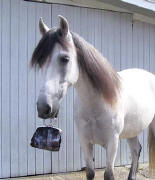
Since TigerHawk was kind enough to invite me to guest-blog, I thought it as well to set out some goals for my brief sojourn here.

Traffic seems to be a big concern for most male bloggers, so I'd like to begin by doing my part to boost his presence on the search engines... and what better way to do that than by making TigerHawk your one-stop-shopping destination for Gay Horse updates?

In case you haven't been following this breaking news story, let me fill you in:

Sam Brown, who graduated last summer, was arrested in May this year after a drunken conversation with a pair of mounted policemen on Cornmarket Street... Brown had just left the Cellar Bar when he allegedly called out to the policemen,

“Mate, you know your horse is gay, I hope you don’t have a problem with that.”

Warned by one officer not to repeat his comment, Brown reassured him that he was not insulting both horses, and said: “No, don’t worry. Your horse is fine, it’s his horse, his horse is gay.” He then proceeded to follow the policemen down the street, repeating his comments.

“Sam was adamant his equine gaydar was accurate,” eyewitness Daniel Cooper told The Oxford Student at the time. However, the officers considered the comments to be a breach of the Public Order Act, and took him into custody, calling on two squad cars and six policemen to make the arrest.

Among those present was ex-Balliol LGB (Lesbian-Gay-Bigender) Officer, Matthew Williams. “Aside from the hilariousness of the event there’s a serious question here,” he commented at the time.

“Isn’t it offensive to assume categorically the word ‘gay’ is insulting? I kept drunkenly shouting at the police that I was offended that they assumed ‘gay’ was being used as an insult.” Brown was released the following morning and issued with an £80 fine for, “causing harassment, alarm or distress.”

Matthew has a point.

As my oldest son is an officer of the law, I am all in favor of promoting a Sensitive, New Age Constabulary but this seems a bit much. To all accounts, the Officer's mount shows no signs of spouting overlong passages from Leaves of Grass or inciting his fellow equines to rousing choruses of Mame during working hours. That being the case, I think enlightened persuns need not concern themselves with what goes on behind paddock doors. Mark Steyn comments:

A spokesperson for Thames Valley Police told the student newspaper Cherwell that the "homophobic comments" were "not only offensive to the policeman and his horse, but any members of the general public in the area."

"Offensive to his horse"? Well, you never know. If any constabulary is keeping a full-time equine psychologist on staff, it's bound to be Thames Valley. Even now, the horse may be on one month's stress leave at home on full pay, with his feet up listening to Judy Garland on his iPod. Whoops, sorry. We don't know whether the horse in question is, in fact, gay. It may be just the way he trots. Whoops, there goes another 80 quid. What I'm getting at is that, even under a generous interpretation of "homophobia", it's hard to see why simply identifying the horse as gay should be a criminal offence.

Mr Brown didn't say: "Tell your gay horse to stop coming on to me" or "I couldn't get near Royal Ascot last year because those gay horses were queening around and backing up traffic." Few of us would appreciate inappropriate speculation about the sexuality of our mounts, yet even in Thames Valley the offence of hippophobia is surely a stretch.

Caligula made his horse a consul but only Thames Valley has made its horses' sexuality a hate crime.

(2) Comments

Fisking Turner 

Ted Turner, revealing his worldliness once again, gave a recent foreign policy speech at Kansas State University, summarized here at AccessNorthGa.com (via Drudge). My comments (difficult to type while shaking with rage) are in italics.


Media mogul Ted Turner said Monday that Iraq is "no better off" following the U.S.-led invasion that ousted dictator Saddam Hussein in 2003.

Exactly which part of Iraq is "no better off?" The persecuted Shia and Kurds? The Marsh Arabs? Aspiring journalists? Farmers? Business people? Oh, he must be referring to the fascist Sunni elements who used to run the country under Saddam. You know, the ones blowing others up.

Delivering the 141st Landon Lecture at Kansas State University, Turner said the world is at a "critical juncture" and compared the situation to that of a baseball team down two runs in the seventh inning.

Hmm. Would that be the Cubs or the Yankees? Who are we playing? Do they have a closer? Come on Ted, we want to know where you are going with this.

The philanthropist and founder of Atlanta-based CNN gave the lecture to a less-than-full auditorium. Earlier this fall, former Soviet President Mikhail Gorbachev delivered a similar message of peace to a packed room as he marked 20 years of the reforms he championed.

I think 'message of capitulation' would be a bit more accurate.

Turner said the situation in Iraq is serious but not hopeless. He raised concerns about global overpopulation, poverty and hunger.

Aha, now I get it. Turner regrets that Saddam is no longer working on his many strategies to solve the regional overpopulation problem.

He also called for nuclear disarmament.

Wasn't this debate settled twenty years ago? Ok Ted, why don't you and Jimmy Carter have another talk with the North Koreans. Let us know how it comes out.

He said the U.S. and Russia still have thousands of nuclear weapons pointed at each other on a "hair trigger." He said if he were in charge _ making it clear he wasn't and never would be _ "we'd be rid of them."

And thereby removing an effective deterrent to any other country with nuclear weapons and a grudge. Nice work, Ted.

He warned that a nuclear war could "kill everything on the planet" and said it could take place in an afternoon. Turner said he was afraid someone in power could make the mistake to launch a nuclear war, including President Bush, based on his previous decisions.

That's right, the danger here is Bush, as usual. Not the oppressed North Korea, Pakistan, or Iran. Who exactly, by the way, does he think Bush is going to nuke?

"You have to question ... the president on a lot of decisions he's made," Turner said. "He might just think launching those weapons would be a good thing to do. ... He thought Iraq was."

Liberating Iraq, launching a nuclear strike, c'est la meme chose!

Turner said war is an outdated form of diplomacy that has stopped working.

Uh, it would have been nice if there was a consensus on this point on, say, September 10, 2001. I'm looking forward to the new, updated forms of diplomacy that work. Like Jimmy Carter's North Korean deal, right?

"You would think that we would have learned that in Vietnam," he said.

You would think we would have learned from Vietnam not to undermine our own efforts with defeatist, utopian drivel.

Turner also said the authority of superpowers of tomorrow will be derived from education, health care, and science and technology. He encouraged the United States to focus it energies on those areas.

That's probably true. The Islamofascists would never have attacked us if Hillary's plan for universal health care had gone through. And of course stem cell research is well known as a great pacifier of nations.

"That's what's going to be on top in the future," he said.

Things are becoming increasingly globalized, he said, and if humanity is going to survive, its members are going to have to work together.

Work together at what, exactly? Organic farming, maybe. (I think this address would be more productive if delivered in Tehran, or perhaps a cave in Pakistan.)

"We are going to survive together, or we are going to perish together," he said.

Whatever, Ted.

(4) Comments

Analogies - How about Korea? 

The Vietnam comparisons to Iraq are really quite foolish...Vietnam bears no resemblance to Iraq. We have fought a different enemy (fascism not communism; small not large; ill supplied not well supplied, and so forth) and clearly and decisively vanquished him (in a few weeks) at minimal loss of life. The tyrant is on trial. We are in the midst of helping to midwife a democratic nation in the heart of Arabia. Remarkable. Extraordinary. The networks and papers don't see it, but the history books will. In Vietnam, we were never successful in giving birth to a free, democratic South Vietnam for a number of reasons. We abandoned the Vietnamese, and millions lost their freedom and their lives.

An imperfect, but perhaps more appropriate, post WWII analogy might be South Korea. At great peril and loss of life (60,000 Americans), we helped to secure a free and democratic South Korea as a bulwark to Communist expansion in Asia. Japan, South Korea and Taiwan form an Asian "arc" of freedom, democracy and prosperity that arguably has played an important role in moderating the worst tendencies of Chinese communism to the benefit of its people. And we did this in 1950 - just in the wake of an exhausting WWII -- in a faraway place, without immediate, tangible benefits. Few would today argue it was a mistake, though it was politically controversial, marred with disastrous setbacks along the way and (again arguably) may have contributed to significant electoral realignment. Generals as heroically recalled as MacArthur lost their jobs over Korea. As a moral matter, think about the disastrous plight of the North Korean people in comparison to the South Koreans or Japanese people. Amazing how the passage of time, and success, illluminates.

Some might argue that the loss of those 60,000 Americans wasn't worth it. How can you measure what might otherwise have been? Pat Buchanan argues today we shouldn't have fought the Nazis. Ridiculous. So too would I argue the point on Korea. Those 60,000 Americans gave their lives for American freedom as well as South Korean, Japanese and Taiwanese freedom. If you don't stem the growth of totalitarian societies by fighting for freedom, you eventually lose many more lives -- and quite possibly your own, and your family's freedom.

(1) Comments

KerryWatch: MisconScrewed Again 
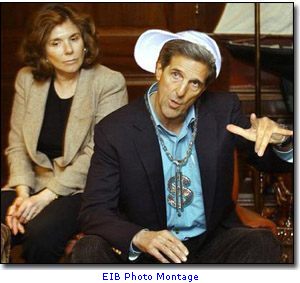
Poor John Kerry. The press-shy Junior Senator from Massachusetts who keeps his finger on the pulse of fresh-def urban culture would like nothing better than to forget the bitter partisan wounds of last year's election season. If only the media would quit dragging him into the limelight so he could quietly represent the needs of his Massachusetts constituents from the sidelines:

Asked what hurt him the most during the campaign, Kerry mused about how ''all of us are flawed as human beings" and ''I think I have a strong record" before raising his voice and declaring: ''One thing I know is that I didn't flip-flop on anything."

We sympathize, Senator. The lies of those partisan hacks at Faux News find their way into so many dialogues these days.

But when the call comes, the upright man rushes to answer. And so it appears Senator Kerry (D., Vietnam) is once more positioning himself to bring the Strong Strength of StrongnessTM back to a nation adrift. As I reported on another forum last week, after announcing that he still has his eye on the Presidency in 2008 (sacre bleu! who knew?) Mr. Kerry let fall another media bombshell:

The windsurfing Senator from Massachusetts also announced that if he had it to do over again, he would vote differently on the authorization to use force in Iraq:

During the interview, Kerry also said his vote authorizing President Bush to use military force was a mistake. He says he'd change his vote knowing what he does today.

We officially pronounce ourselves shocked at this totally unforseen turn of events. If stalwart men like Senator Kerry go wobbly in the GWOT, then all is lost.

Some might be tempted to see this pronouncement as... qu'est ce que c'est? une flippe-floppe? But more enlightened observers think of it as a nuanced clarification of the Senator's earlier position:

Democratic presidential nominee John Kerry said on Monday he would have voted for the congressional resolution authorizing force against Iraq even if he had known then no weapons of mass destruction would be found.

Taking up a challenge from President Bush, whom he will face in the Nov. 2 election, the Massachusetts senator said: "I'll answer it directly. Yes, I would have voted for the authority. I believe it is the right authority for a president to have but I would have used that authority effectively."

For those readers at home who don't speak French, the use of the word effectively denotes Mr. Kerry's courageous, principled, and unwavering policy of support for forcible regime change in Iraq, even without funding and without the aid of Germany and France. Sadly, even Mr. Kerry's laudable attempts at plain speaking cannot insulate him from the baseless sneers of the snarky reich-wing punditocracy:
From the Associated Press comes evidence that John Kerry* is running for president again, reprising the strategy that worked so well in 2004:

Kerry initially voted in favor of a Republican-sponsored resolution calling on President Bush to explain his strategy for success in Iraq. Minutes later, the Democrat changed his vote.

How to explain this unprecedented volte-face from The Stalwart Senator? The linked AP article elaborated:

Kerry, last year's Democratic presidential candidate who is said to be considering another run, first voted for the GOP resolution. He then left the chamber and was seen just steps off the Senate floor talking briefly to his senior home state colleague, Sen. Edward Kennedy, D-Mass. Kerry walked back into the chamber and changed his vote.

We think Mr. Kerry has shrewdly adopted the brilliant new battlefield strategery lately proposed by Rep. John Murtha on the House floor. Dubbed by some the rhythm method of warfare, the new tactic is generating much excitement amongst the vast reich-wing war punditocracy, threatening to displace even the reigning solution-du-jour, trainspotting. Sadly, shallow-minded critics often misconscrew Murtha's rhythm method, erroneously labelling it "premature withdrawal" or characterizing it as "pulling out" before "accomplishing our objective". As I explain here, nothing could be farther from the truth:

Ooohhh...it's not a premature withdrawal...we're just redeploying to the rear

I suggest that Mr. Kerry, by withdrawing his prior vote, is not "cutting and running". He is just, on the advice of the Senior Senator from Massachusetts, redeploying his forces leaving him free to attack from another direction.

After all, the man of nuance always leaves his options open.

(6) Comments

The slippery slope towards theocracy 

Just another example of how the far right continues to impose its views on the rest of us.

House Speaker J. Dennis Hastert has told federal officials that the lighted, decorated tree on the West Lawn of the U.S. Capitol -- known in recent years as the "Holiday Tree" -- should be renamed the "Capitol Christmas Tree," as it was called until the late 1990s.

Calling a Christmas tree a Christmas tree has become a politically charged prospect in jurisdictions across the country -- from Boston to Sacramento and in dozens of communities in between.

The debate boiled over in Boston last week when the city's Web site referred to a giant tree erected on Boston Common as a "holiday tree."
The Nova Scotia logger who cut down the 48-foot tree for Boston also was indignant. Donnie Hatt said he would not have donated the tree if he had known of the name change.

"I'd have cut it down and put it through the chipper," Mr. Hatt told a Canadian newspaper. "If they decide it should be a holiday tree, I'll tell them to send it back. If it was a holiday tree, you might as well put it up at Easter."


Is Nova Scotia a red state?

(7) Comments

SeRx appeal: Cheerleading as career path 

The New York Times published a hilarious article yesterday about the pharmaceutical industry's recruitment of former -- and sometimes current -- cheerleaders to work as sales reps. Certain schools, including perennial cheerleading powerhouse University of Kentucky, count more than a few pom-pom alumnae in the ranks of drug industry salesforces.

The article contains some choice bits. One theory holds that the rise of cheerleader sales reps is an unintended consequence of the prosecutorial blowback against other pharmaceutical sales practices:
Some industry critics view wholesomely sexy drug representatives as a variation on the seductive inducements like dinners, golf outings and speaking fees that pharmaceutical companies have dangled to sway doctors to their brands.

But now that federal crackdowns and the industry's self-policing have curtailed those gifts, simple one-on-one human rapport, with all its potentially uncomfortable consequences, has become more important.

One-on-one human rapport? Potentially uncomfortable consequences? I didn't call it blowback for nuttin'.

There are those who claim that it isn't just that hotties move the scrips -- it is also that they are naturally good at sales:
But many cheerleaders, and their proponents, say they bring attributes besides good looks to the job - so much so that their success has led to a recruiting pipeline that fuels the country's pharmaceutical sales force. T. Lynn Williamson, Ms. Napier's cheering adviser at Kentucky, says he regularly gets calls from recruiters looking for talent, mainly from pharmaceutical companies. "They watch to see who's graduating," he said.

"They don't ask what the major is," Mr. Williamson said. Proven cheerleading skills suffice. "Exaggerated motions, exaggerated smiles, exaggerated enthusiasm - they learn those things, and they can get people to do what they want."

I daresay.

And then there is rank cheerleader-triumphalism:
"The cheerleaders now are the top people in universities; these are really capable and high-profile people," said Gregory C. Webb, who is also a principal in a company that runs cheerleading camps and employs former cheerleaders. He started Spirited Sales Leaders about 18 months ago because so many cheerleaders were going into drug sales. He said he knew several hundred former cheerleaders who had become drug representatives.

That's strange. I thought the "top people in universities" were quarterbacks.

It only really gets good, though, when the pharmaceutical companies tell you that it has nothing to do with looks:
But pharmaceutical companies deny that sex appeal has any bearing on hiring. "Obviously, people hired for the work have to be extroverts, a good conversationalist, a pleasant person to talk to; but that has nothing to do with looks, it's the personality," said Lamberto Andreotti, the president of worldwide pharmaceuticals for Bristol-Myers Squibb.

You know the world is all topsy-turvy when people claim that it's the cheerleaders who have the "good personality." What's left for the ugly people?

(5) Comments

Monday, November 28, 2005

Books: Suggestions for the "Holiday Season" 

The writers of National Review Online have posted their long list of books to give for Christmas (no PC inclusiveness at NRO -- even the Jewish contributors post to the "Christmas" list). There are some surprises in there. Among the surprises, the list does not include the two books that regular readers know particularly enthralled me this year.

The Right Nation, by Economist correspondants John Micklethwait and Adrian Wooldridge (how could those guys not be Brits?), is perhaps the best book on American politics that I have ever read. It should fascinate and infuriate both left and right. If you are interested enough in politics to read blogs, you should read The Right Nation.

In the matter of America's place in the world, the must-read book of the year is Ralph Peters' New Glory. Like The Right Nation, there is something in New Glory to challenge your thinking no matter what your political persuasion (in particularly, you will hate the book if you are a manufacturer of weapons systems, Donald Rumsfeld, an Arab autocrat or an anti-war leftist). It is a wide-ranging discussion of the world today and the world as it was (I posted an excerpt describing the battle of Vienna in 1683 here). And it is beautifully written.

(4) Comments

The Trial of Saddam Hussein 

Times have changed. Mussolini was lynched and meathooked. Hitler shot himself. Today's fascist tyrants are put on trial, on global television no less. Milosevic and now Saddam are tried for genocide in front of a global audience.

This trial has an inevitability to it which of course robs it of any suspense, really. By now the crimes are well known. Today the trial moved passed procedural wrangling into its storytelling -- in this case, about the massacre of Iraqi citizens of Dujail, punished for an assassination attempt on Saddam in 1982. While a former Baathist Intellignce Officer for Hussein testified that there may have been 12-14 people involved, a far larger number were likely arrested, perhaps tortured and executed. The trial will likely get to the bottom of this isolated case.

What will we learn from all this? Mostly about primitive sorts of justice -- like massive collective punishment. If Saddam was wronged, he punished everybody in town. No surprise there, except to hear it out loud.

We will see two things put on display which will be instructive, I think:

1) Watching an omnipotent psychopath brought low - this may shock people
2) Learning how he intends to defend his actions -- will he deny there occurrence? Will his lawyers simply challenge the legitimacy of any trial as an American occupier's creation? Will he justify his actions as calculated to defend the nation? I suspect the latter two will b e his path, but seeing how he responds will be extraordinary. Blame the outsider, always. It will put on stark display the paranoia which fuels murder and genocide.

The reporting on the Saddam Hussein trial, progress on elections and the continued passage of time will make it clearer that Iraq is well on its way. Politically, it will be dangerous to align oneself in a fashion which has the natural implication of defending Saddam's continued rule.

(1) Comments

Deer season in Buckingham 

It is deer season in Virginia (and elsewhere I suppose). I've read numerous articles about the decline in hunting across the country. If you were driving around Buckingham County this weekend there was little evidence that this pastime is in danger of fading away in Central Virginia. Every bend in the road revealed parked pickups along the edge of the woods, often accompanied by men in blaze orange holding their rifles.

I am not a hunter myself, but have granted permission to a local hunting club to hunt deer in my acreage. My grandmother started this practice in her late 80s, when she was approached by representives of the self-dubbed Bellroad Boys. She granted permission on the reasoning that developing a good relationship with the local hunters might be a good idea for an 87 year old woman living alone in the woods. It was a decision that paid her many dividends, as the Bellroad Boys made themselves available to her anytime she needed work done around the house (and kept her supplied with venison).

I remember when a large tree began leaning and threatening her barn. One quick call produced four truck loads of men wielding axes and chainsaws. One of them climbed the tree and attached a rope that allowed them the guide the tree's fall so it missed the barn by about 25 feet. Within an hour the tree had been cut up and split into firewood and the brush hauled off to the burn pile.

I maintained the arrangement after she died, partly on the same logic, but also because I was then the absentee owner of a vacant house and appreciated having the local "boys" (ranging in age from 15 to 66) keeping an eye on my place. And, frankly, I think everyone is better served if the deer herd is culled with guns rather than cars. I've never had any problems with the group, who treat the woods with respect. From time to time I am graced with small gifts, which in addition to venison have included mason jars of moonshine, occasional labor, and when my grandmother died, a poinsettia and a bag of fried chicken.

We were down at the house over the weekend. Friday night we ate venison chile which I had prepared and frozen from last year's contribution, and shortly after finishing it up we were surprised by headlights in the drive. I went out back and it was one of the Bellroad Boys with five pounds of fresh tenderloin, which I gratefully accepted.

The meat will go into the freezer for now. There is more than enough to make more chile, but we'll be working on some other recipes as well. There are many interesting recipes to be found on line, such as this one (below). Of course if anyone out there has any favorites, bring them on!

Spicy Hearty Venison Stew

1 pound venison, cut into 1 inch cubes
2 tablespoons olive oil
3 cloves garlic, minced
1 tablespoon worcestershire
1/2 teaspoon Tabasco
1 can chicken broth
1 (28 ounce) can tomatoes, cut into chunks with liquid
1/2 large bell pepper, diced
8 medium mushrooms, cut into quarters
3 medium onions, cut into wedges
2 medium carrots, cut into bite size chunks
1 small rutabaga or parsnip, diced
1/4 teaspoon gumbo file
2 medium bay leaves
salt & pepper to taste

Brown venison in dutch oven with olive oil, Tabasco, worcestershire and garlic. When browned, add vegetable and other ingredients. Bring to a boil then reduce heat and simmer for 45 minutes to one hour. Serve in bowls over steamed or buttered noodles. This is an excellent pick-me-up, warming meal, for cold winter days.

(4) Comments

Colts - Steelers 

Imagine my surprise this morning when I saw a Bears post on Tigerhawk. This prompts a little commentary on the the NFL and history, as it intersected with my youth. TH and the Villain grew up in the midwest, hence their interest in Iowa collegiate football and Illinois professional football. Those teams have been there for eons and aren't going anywhere.

I was a little less fortunate. Growing up in Owings Mills, Maryland, we had the O's and the Colts. But I am a football guy, and I missed the Colts glory days. Johnny Unitas was finishing his career in a Charger uniform - ugh --by the time I was tuning in. The Colts quarterbacks in my first year of fandom were -- are you ready -- Marty Domres and Bill Troupe. That's worse than the Jets current predicament. It led to a 2 - 12 season and a significant retooling. But I loved them no matter what.

And in 1975, something remarkable happened. A pretty young Ted Marchibroda took over, and handed the QB job to Bert Jones -- an early and poor man's John Elway. He was a big boy from Louisiana who was hard to bring down and had a cannon. He in turn would hand the ball to Lydell Mitchell, Franco Harris's lesser known running mate at Penn State. And he had some targets to throw to --Rodger Carr (the father of the the current Houston Texans QB, David Carr), Glenn Doughty and Raymond Chester.

The defensive side of the ball was outstanding - with a line that was competitive with the best in football. Cook, Dutton, Ehrmann and Barnes. The backs and linebackers weren't hall of famers, but all were tough and capable - Stan White stood out at inside LB (Mike Curtis was gone by then).

As it happens, in 1975, the Colts were off to a very slow start -- but turned it all around at Soldier Field against Da Bears, no less. They went on to win 10 in a row and make the playoffs by beating the Dolphins with a Toni Linhart field goal in the fog, on the last play of the regular season. That's how I remember it anyway -- and I maybe wrong -- but I was 8 and it was unbelievably exciting.

Of course, the Colts could never muster the juice to get past the Steelers in the playoffs, and it was the Steelers who were the ones to build the incredible dynasty of the 1970s, the first 4 time Super Bowl winners. After one playoff loss to the Steelers, a small plane crashed into the upper deck at Baltimore's Memorial Stadium. Had the Colts won, I am sure many people would have perished in the celebration after the game. As it happened, the Colts loss meant the stadium was empty. It was as though the Colts loss had been preordained for the good of humanity. In 1977, the Colts peaked, taking the Raiders to overtime in an epic divisional playoff game still shown on ESPN Classic. Jones missed a wide open Chester deep down the field late for what undoubtedly would have set up a Colt victory. No dice. Raiders win, Colts done. When I see this game on ESPN Classic, even now, I always hope Jones brought it down just a little and Chester can leap to make the catch. It still makes me sick to see it. The next year, Jones hurt his shoulder in preseason, and it was all downhill from there.

And in 1984, after several dismal seasons (and John Elway's rejection of Baltimore after the team selected him #1), Robert Irsay moved the Colts to Indianapolis, a midnight heist from which Baltimore didn't recover until the Browns/Ravens, themselves escapees from Cleveland, brought a Super Bowl championship back to Baltimore.

So tonight, when the undefeated Indy Colts take on the Pittsburgh Steelers, the uniforms will recall a forgotten time and mean different things to people. Most Baltimoreans detest the Colts -- though as time passed, so did Irsay, and Baltimore adopted Art Modell's Browns/Ravens. The hate exists mostly among the older crowd -- those who still remember Unitas, Berry and Moore, Ewbank and Shula. Just watch Diner if you want to understand the intensity of an older generation of Baltimorean feeling for the Colts. For the middle aged, who only had Jones and Mitchell and Ehrmann, who have seen the Browns and Raiders move and understand football is a business, maybe some of us will pull for the Colts, for the uniform. Peyton Manning is the kind of guy you root for, who's a good role model for your kids. Tony Dungy is a class coach. It's been easier to root for that uniform since Bob Irsay has been gone. Can you imagine if Elway comes to Baltimore and the team stays? And Manning is Elway's heir? That would have been something to see in Baltimore for the last 21 years.

Colts by 10. And they should win Super Bowl 40 too.

UPDATE 11/29 8am:

The Colts win handily 26 - 7. Peyton Manning's offense is inconsistent early, with a critical interception allowing Pittsburgh to stay close until late in the first half. However, Indy's defense, fortified by Bob Hitman Sanders (yes, an Iowa Hawkeye) dominates the Steelers - no running game, no passing game, no nothing. Indy commits several costly penalties, but Pittsburgh makes some very questionable decisions - 2 head scratching fourth down calls and an unsuccessful onsides kick to start the second half. The Pittsburgh coaching staff played desperately and impatiently. Indy's offensive explosiveness, as revealed on their first play from scrimmage, coupled with their capacity to grind it out with Edgerrin James, and backed up by an increasingly explosive defense, is making opposing coaches flip out.

Tough schedule ahead, but undefeated is not impossible.

A reaction to some of the comments: though from Baltimore, I moved away at 18 and so did my family. So I may have left behind some of the passionate hatred locals feel even today for these Colts. As a diaspora Baltimorean, I find that the uniform means more than geography -- with the caveat that I detested Bob Irsay and his death made it possible to have an interest in the Indy Colts. Baltimore is a football town, and I think they love their Ravens. It helped the Ravens a lot that the old Colts adopted Modell's team early...Unitas was a regular as were many others. So I would not discount Baltimore passion for the Ravens. Some of my old firends would say there is more passion for them than the O's. One commenter correctly observed that the Browns did the right thing when they moved -- leaving the colors and name for the next Cleaveland franchise. It is a shame that the grotesque Irsay didn't make a similar agreement in 1984 so Baltimore's new team could have adopted the same colors.

Nonetheless, these Colts are quite a club. Look out '72 Dolphins...

(8) Comments

Da Bears! 

My NFL team of choice seems to have quietly won seven games in a row.

(1) Comments

Minting Marines 


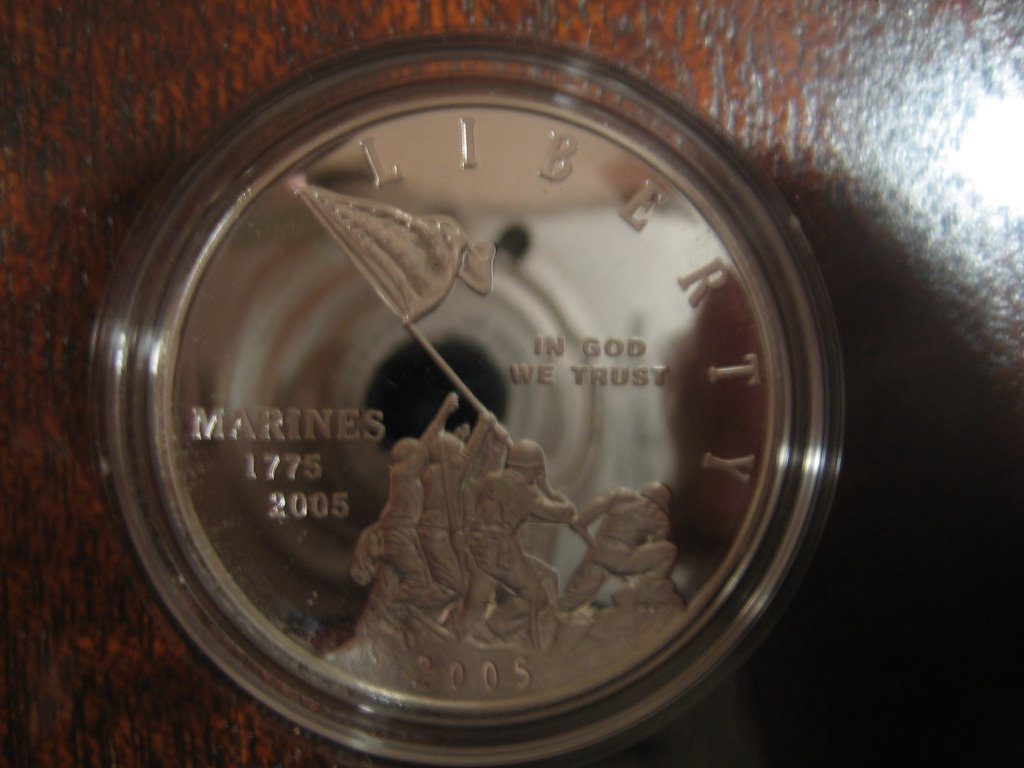
To commemorate the 230th anniversary of the founding of the United States Marines, the United States Mint has designed and struck a silver dollar. The design -- tracking as it does the U.S.M.C. War Memorial and the most famous combat photograph in history -- is not very original, but it will always inspire.

(3) Comments

At Narita Airport 

I arrived at Tokyo's Narita Airport just under two hours ago, facing a five-hour layover until I could board my Qantas flight to Melbourne. I was very excited to see that the Japan Air Lines club, right across from my gate to Australia, had affiliations with both Continental Airlines, my most frequently-flown airline and my airline of debarkation, and Qantas, my airline of embarkation. Naturally, I assumed my Continental President's Club membership, my in-bound Continental ticket stub, and my outbound Qantas ticket would get me through the door.

No dice. I encountered one of the many arcane barriers-to-entry for which the Japanese are famous. It seems that in order to take advantage of the Japan Air Line club at Narita, notwithstanding its advertised affiliations, one must have an affiliated club membership that matches one's airline of embarkation. My Continental membership, Continental inbound ticket, and Qantas outbound ticket got me nothing but a long stream of "so solly," and no end of pleading changed the result. So here I sit, recharging my batteries by the child play area, isolated from all that serene relaxation by the dead cold soul of Japanese bureaucracy.

(3) Comments

Sunday, November 27, 2005

Across the world 

I am about to board a flight to Australia, via Japan. Coach. That's a lot of flying. I hope I don't throw a clot.

My objective was to go visit customers and distributors in Australia and Japan. Unfortunately, a triangular ticket from the United States to Australia to Japan and back again was almost $8000, at least according to our crack travel agency. But, if I were willing to fly round-trip to Tokyo and then fly an interior round-trip from Tokyo to Melbourne the total cost would only be $1700. Our stockholders should pay great homage to me.

Point is, I'll be posting on strange topics and at strange times between now and my return on December 7 (yes, I'll be flying from Japan to the United States on the date that lives in infamy), and I won't be posting at all between now and some point early Tuesday, when I actually get to Melbourne.

Cardinalpark and the 'Villain promise to keep the fires burning in my absence.

(0) Comments

The "plan" to bomb Al-Jazeera 

The British press published a story early in the week that claimed that but for Tony Blair's intervention, George Bush would have ordered the bombing of the Arabic television station Al-Jazeera. The story was based on a memo leaked in apparent violation of Britain's Official Secrets Act. According to the tabloid Daily Mirror, which first reported the story, one government source said the alleged threat was "humorous," while another claimed that Bush was "deadly serious." The White House, of course, has refused to respond on the grounds that to do so would "dignify" an "outlandish" accusation.

Hmmm. The old "refuse to respond so as not to dignify" dodge. I'm guessing that he said it, but knowing our Dubya it was almost certainly a joke.

At least some sensible people, even in the Arab press, agree. Al-Jazz, though, is doing what any media organization would do, which is milking the story all the way to the bank (calling for an investigation, asking to meet with Blair, describing the memo as "hugely damaging to Bush"). Given all the attention and audience Al-Jazeera is undoubtedly getting from this non-story, CBS News, no doubt, wishes that Bush would joke about bombing it. Joke, of course, being the critical nuance.

The Arab world, which will believe any depredation about the United States and has for forty years, is going wild. Here, via Sabbah, is but one delightful example of cartoonish blowback:

Various Al-Jazz staff members have started an English-language blog, "Don't Bomb Us - A blog by Al-Jazeera staff members". It is pulling down lots of comments, particularly from Western moonbats. The very first comment in the current top post comes from one "Richard":
To live with conscience in America during these days .. is to know what it was to live, as an appalled citizen under the Nazis in Germany during the holocaust.

America needs a psychiatrist and group therapy and the Bush Administration must be put on trial for war crimes.

Humanity is one family with one heart.

Next thing you know, Bush will be joking about bombing "Richard."

For more reaction from the left, a Daily Kos thread is here. Enjoy.

The issue here, of course, is that Al-Jazeera claims that it has been targeted by the United States before (American bombs allegedly hit Al-Jazz facilities in Afghanistan and Baghdad during the those two invasions). Both Al-Jazz and the Bush haters claim that this new report, if true, would "cast serious doubts" on the Bush administration's claims that those previous incidents were mistakes.

The very idea is absurd. Apart from the rank stupidity of the idea -- which does not entirely dispose of the question since there is rank stupidity done in every war -- anybody who has ever watched a Hollywood movie knows that the order would not come from the President. If the United States were going to bomb Al-Jazz on purpose, you can bet that the people behind the idea wouldn't even tell the President. That's the whole point of plausible deniability.

UPDATE: Just a thought before I head to the airport: This is but another example -- this time in Blair's government rather than Bush's -- of (presumably) unelected bureaucrats deliberately sabotaging the policies of the elected government. Oh, you will cry, this is whistle-blowing! False. Nothing happened here, even if you accept the fairly implausible idea that Bush would have ordered the bombing of Al-Jazeera's headquarters in Qatar if Blair had not talked him out of it. There was no atrocity or outrage to blow the whistle on. So what if Bush had the idea? Every executive, and I daresay every President of the United States, has ideas that make no sense every single day. On discussion, they get talked out of them. Without such brainstorming, how else could an executive function?

But oh, you will cry again, this is such an atrocious idea that it proves that Bush is the incarnation of Hitler after all! False. Al-Jazeera may or may not be a force for good in the world in a net basis, but there is no doubt that it has worked tirelessly against the American effort to bring a representative government to Iraq, and that its coverage provides prestige and sheer audience for some of the most wicked men on Earth. Sure, if Bush's comment reflected a more developed idea than simply thinking out loud it was a bad one, but that does not make Al-Jazeera any less opposed to America and, more importantly, the mission of our soldiers.

(5) Comments

Saturday, November 26, 2005

The Carnival of the New Jersey Bloggers is up! 

Check out da linkage at Gigglechick. Or else.

(0) Comments

Women stand for election in Saudi Arabia 

This is news.
All eyes are on Jeddah Chamber of Commerce and Industry (JCCI) today as the election to its board of directors begins with 17 women contesting alongside 54 male candidates — for the first time in the history of Saudi Arabia.

Women’s participation in the elections has grabbed attention worldwide amid reports that some female candidates might surprise everyone by winning. In an unprecedented move, Saudi authorities gave the green light last September for women to run in the chamber elections.

True, it is only a Chamber of Commerce election. But Sabbah, with whom I only occasionally see eye-to-eye, thinks something is better than nothing:
Even if all women candidates lose the election, the biggest winner will still be the principle that allowed them to contest side by side men.

Faster. Please.

(0) Comments

Eliot's blessed 

Regarding the most extra-territorial attorney general of our age, so says New York Magazine. Professor Bainbridge calls bullshit. Somebody's got to.

(0) Comments

Pitchers o' stuff 


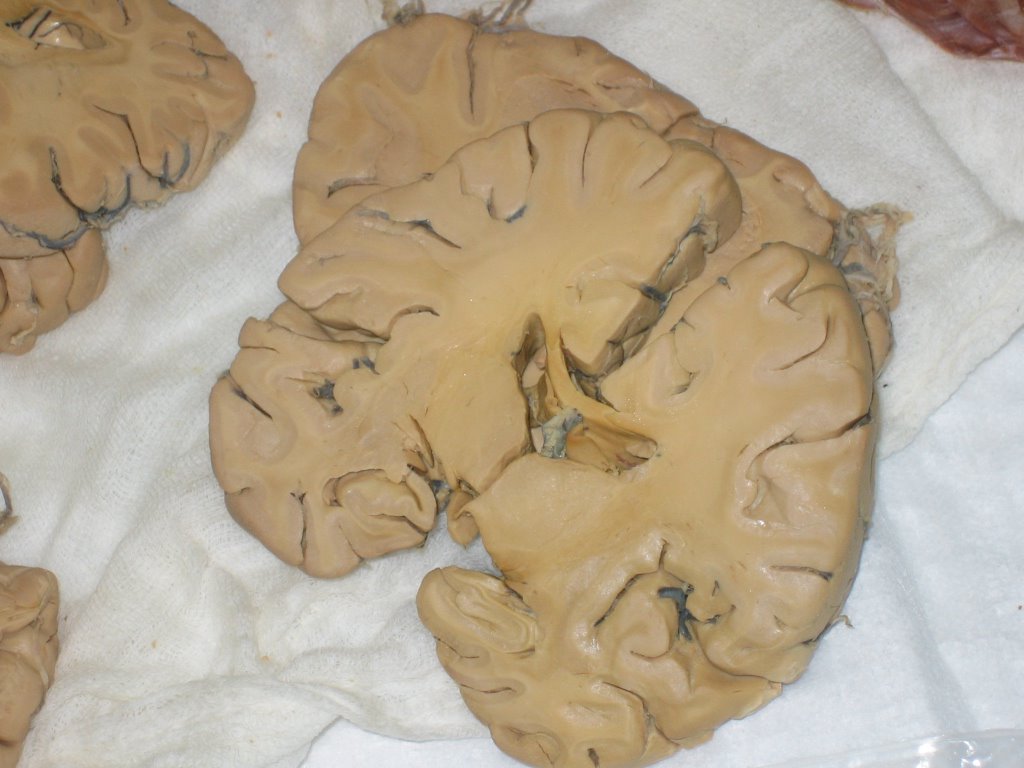
Gigglechick ("the perfect combination of estrogen and humor"), who is the hostess with the mostess for this week's Carnival of the New Jersey Bloggers (of which I am an occasional contributor), put the word on the street. She's looking for non-political blog posts. Never one to decline a woman who pleads, I promised an all-fluff, no content post. So, with that in mind, I present herewith photographs of things that struck me as interesting, beautiful or fun in the month or so just past (run your cursor over them for the captions). And, yes, that is a slice of brain to the right. Actual. Human. Brain.

It is no secret to regular readers that the TigerHawk household is not spic n' span. What with children, dogs, domesticated rodentia, and many better things to do, we don't keep a very neat house. Still, we were at least a little disturbed to find this old Chesterfield Cigarettes package on the floor of our basement. Since it contains no Surgeon General's warning, it must be at least 40 years old, which is a long time even by the standards of our household. So it's a mystery.

For years, Princeton's cheerleaders have been progressively more attractive. I have no idea whether this is because Ivy League cheerleading was at something of a nadir twenty-five years ago, or if it is just that I think college girls look better every year (which is a pathetic but nonetheless widespread affliction of middle aged men). This year, though, Princeton's cheerleaders are looking a bit burly...

They would, however, make a great kickline for the Triangle Club show.
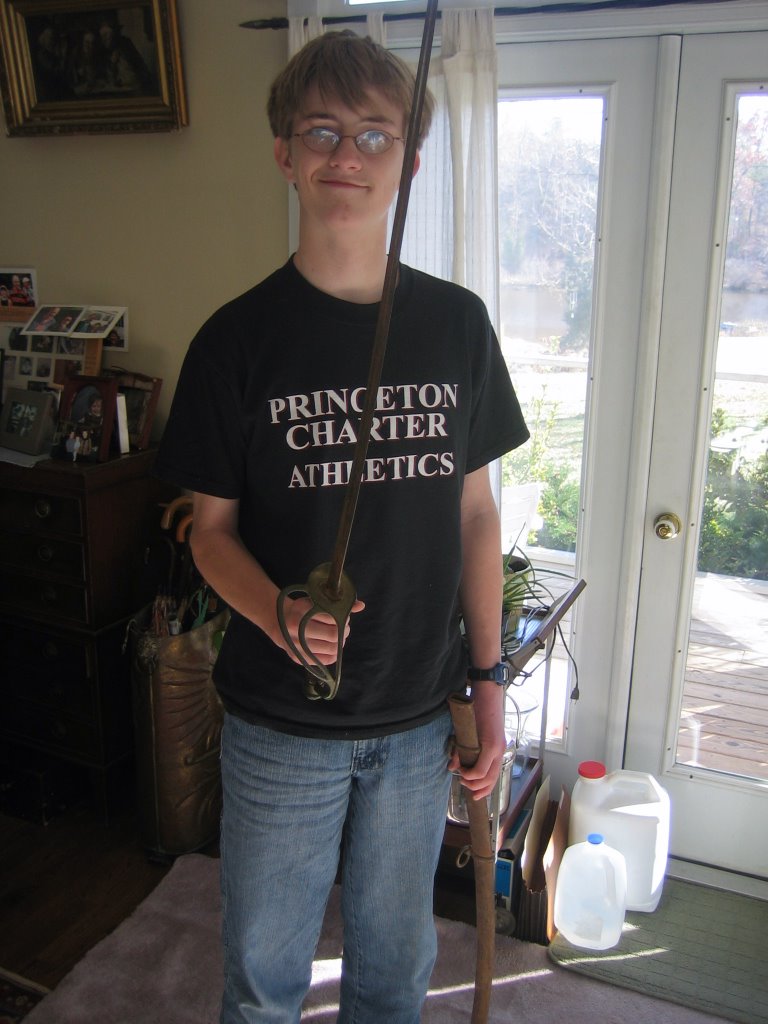
So there we were, visiting the TigerHawk Mom and Stepfather in the suburbs of Palmyra, Virginia. Inside their front door there is an umbrella rack with all sorts of random things sticking out, including the haft of this sword (hefted in the picture at left by the TigerHawk Son). It is all rusty and trashed, but if you carefully study the base of the blade you can see there engraved "U.S. J.H. 1862" (see below for the details). Anybody care to find out how many Union officers, serving in 1862, had the initials "J.H."?
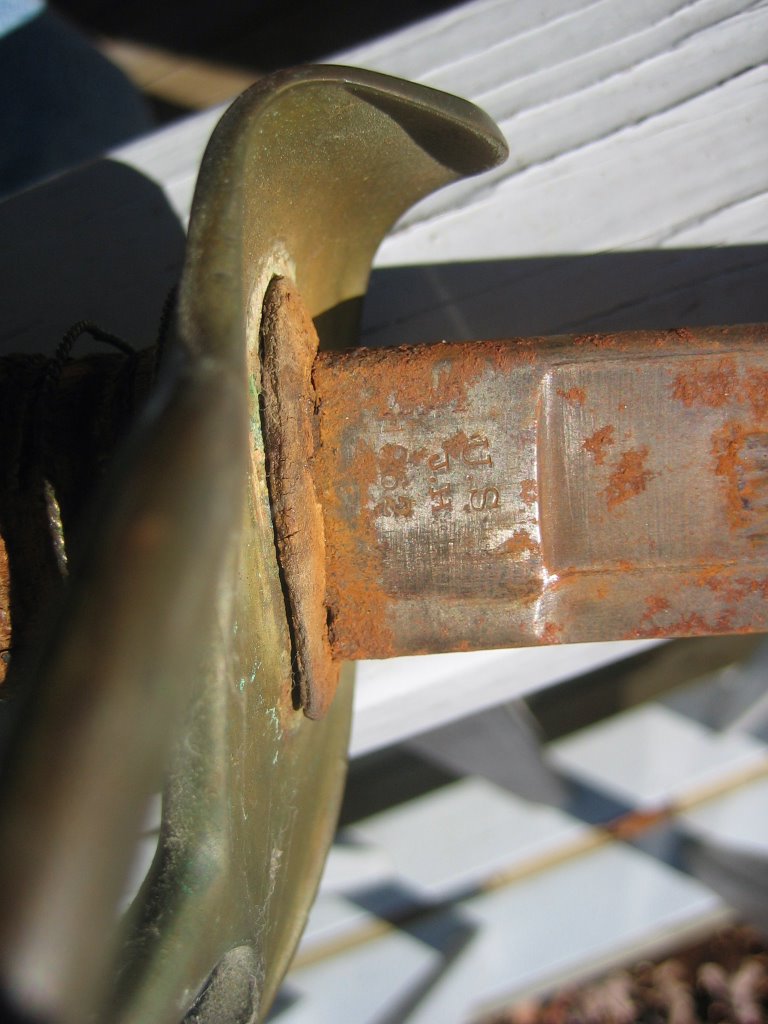
And, since my stepfather, who practices law in a two-lawyer town, seems to have received it "in kind" from a local, one is forced to wonder whether "J.H." did not meet some ugly fate at the hands of a soldier of the Army of Northern Virginia.

Regular readers also know that I collect coins. I both buy them and hunt through my change for them. It is rare to find something of numismatic interest in one's pocket change, but an experienced collector can tell by the color or feel of a coin whether it is different enough to warrant further inspection. On occasion, I have been tempted to reach into a tip jar to take an interesting coin "in change," but the fear of getting caught in a "Costanza-like" tip-jar move was sufficient deterrence. Until last week. I spotted a silver "war nickel" in the tip jar in the Princeton Starbucks. I brazenly offered the woman behind the counter a dollar for it, and when she said yes I plucked it out of the tip jar. Right in front of the flower and chivalry of Princeton. From the looks on their faces, I have to be at least a little concerned that I'll never eat lunch in this town again.

Here's the booty:
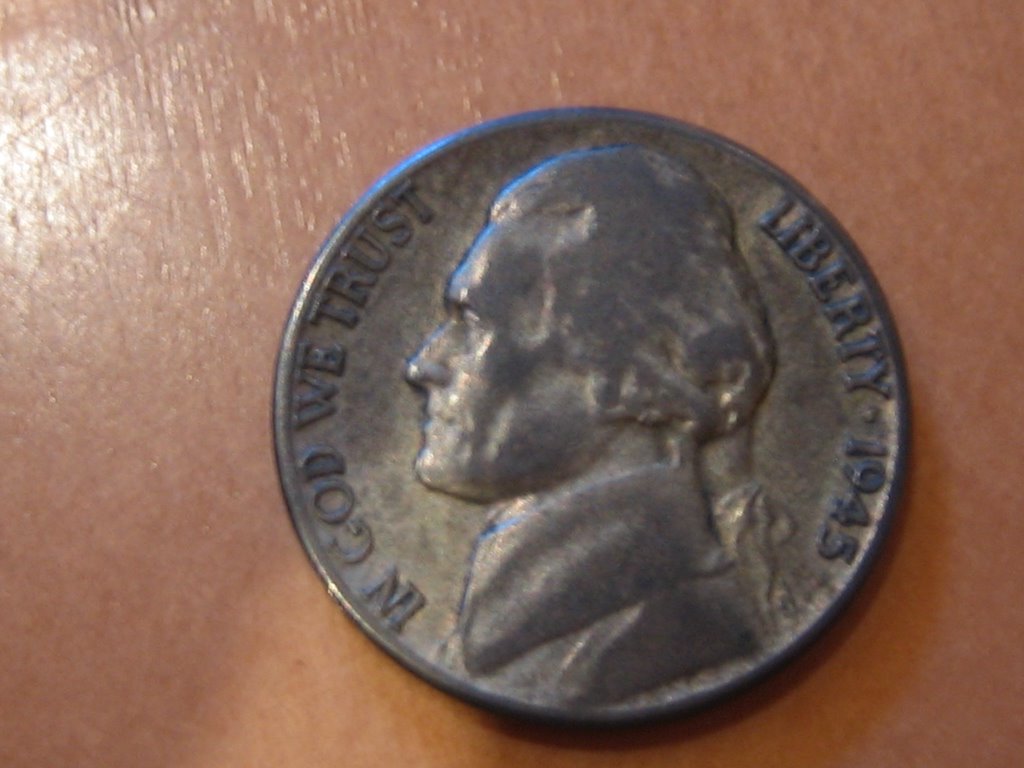

So what's the deal with a "silver" nickel. Wickipedia:
From mid 1942 to 1945, so-called "Wartime" composition nickels were created. These coins are 56% copper, 35% silver and 9% manganese. The only other U.S. coin to use manganese is the Sacagawea dollar. These coins are usually a bit darker than regular nickels, due to their manganese content (as was true of many British coins minted from 1920 through 1947), and feature the largest mint mark ever to grace a United States coin, located above Monticello's dome on the reverse. Nickels of this series minted in Philadelphia have the unique distinction of being the only US coins minted prior to 1979 to bear a "P" mint mark.

And, last but not least, a tombstone from the TigerHawk family cemetary in Buckingham County, Virginia:

If you draw all the hideous obvious conclusions, you're probably right.

So, Gigglechick, did I fill the bill?

(2) Comments

Silent support for American policy: political reform and the fight against al Qaeda 

It is possible to be both right and unpopular at the same time. Today, the United States is both in the Arab world.

Increasingly, the Arab world is understanding that only significant political reform -- the embrace of popular, rather than divine, sovereignty -- can save it from Islamic fascism. We see this in big ways -- the bloody rise of representative government in Iraq, the Cedar Revolution in Lebanon, and the first hints of political reform in Egypt, Kuwait, the United Arab Emirates, and even Saudi Arabia. We also see it in small ways -- such as newspaper editorials that agree with American policy without saying as much. The Daily Star of Lebanon, for example, wrote an editorial yesterday on the importance of political reform to Jordan's fight against al Qaeda.
The unfulfilled desire for economic opportunities and political reform has long been a source of popular discontent in Jordan. But since the recent triple suicide bombings in the kingdom, the need for reform has become even more urgent. The attacks, which were the work of Jordanian-born Al-Qaeda leader in Iraq Abu Musab al-Zarqawi, underscore the deadly ramifications of popular dissatisfaction with the regime. Zarqawi, who grew up in the poverty and squalor of the Jordanian town of Zarqa, is a text-book case of how political and economic conditions prompt masses of young men to join the ranks of Osama bin Laden and his ilk.

Emphasizing this point, a respected think tank, the International Crisis Group, warned that "the attacks should be seen as a wake-up call." It warned that the kingdom's lack of economic opportunity, centralized government, excessive control by the security and intelligence services, limits on freedom of expression, lack of an effective political arena and rampant corruption are feeding popular discontent.

Jordan has, in effect, been oppressing and impoverishing its people in the name of stability. For two generations at least, the United States has supported this trade-off in Jordan and elsewhere. This policy came to an end in 2003, when the Bush administration renounced it explicitly. In a great speech at the National Endowment for Democracy on November 6, 2003 (which every student and critic of American foreign policy must read), Bush said:
Sixty years of Western nations excusing and accommodating the lack of freedom in the Middle East did nothing to make us safe -- because in the long run, stability cannot be purchased at the expense of liberty.

The world did not notice, even though Bush repeated himself again and again. Finally, Condoleezza Rice went to Cairo in June 2005 and rammed it down the throats of the Arab world:
For 60 years, my country, the United States, pursued stability at the expense of democracy in this region, here in the Middle East, and we achieved neither.

(The BBC declared Rice's speech "a complete departure" for the United States, apparently having missed the previous 18 months of statements from the Bush White House. No matter. Better late than never.)

The Daily Star agrees with the policy of George Bush's United States, even if our unpopularity is such that it will not say so.

(2) Comments

Friday, November 25, 2005

The New York Times and the question of Iraq 

American Future has analyzed the shifting positions of the editors of the New York Times on the matter of Iraq and how to deal with it. The first of three promised posts covers the Clinton years. The point is less to tweak the NYT (however entertaining that might be) than it is to show the twists and turns in thinking about Iraq during a time when George W. Bush was not the president. The New York Times is as close a bell-weather for the liberal internationalist perspective as there is. One cannot understand the arguments about the purposes of today's war without understanding the arguments during the Clinton years. American Future's excellent work is a great place to start.

Via The Daily Demarche.

(2) Comments

Muzzle nuzzle 


The TigerHawk Daughter with the TigerHawk Herd on the afternoon of Thanksgiving Day, somewhere in the vicinity of Warrenton, Virginia.

OK, two horses is only a herd when you have to drive them down I-95 on Getaway Wednesday.

And for those of you who have always wondered what co-blogger Charlottesvillain looks like:

He's the one on the right.

(10) Comments

Peace in Palestine: Leftists unite the Arabs and Jews 

Leftist activists have managed to do what a common love of Moses, shared ancestry, the hideous waste of warfare and the endless twisting of hankies have not: unite the Arabs and Jews of Hebron.
Arab leaders in Hevron have contacted the city’s Jewish leaders for help in getting rid of self-proclaimed anarchist volunteers who, they complain, are destroying their traditional way of life.

The anarchists, many of whom are members of the International Solidarity Movement, flock to flashpoints throughout Judea and Samaria, ostensibly to help PA Arabs contend with IDF closures and protect them from harassment. In actuality, many of the volunteers seek confrontations with IDF soldiers and local Jewish residents, taking advantage of their Western passports to cause havoc – knowing that, at worst, they will be deported, not jailed.

The local Arabs in the Hevron region whom the activists claim to be helping are now complaining that the American and European students behave in a provocative and offensive manner in Hevron’s public areas. The Arabs say the activists disrespect the moral norms and standards of the local population.

Several local Arab residents told the Kol Ha’Ir newspaper that the activists have been exposing the local youths to drug use and sexual promiscuity.

Exposing local youths to drug use and sexual promiscuity? That sounds a lot like cultural imperialism to me. That being a huge no-no in lefty circles, one is almost forced to wonder whether the International Solidarity Movement folk actually read all the required lefty tracts before embarking on their mission. Did they somehow fail to study Edward Said on their way to Palestine?

Since in uniting Arabs and Jews the activist left seems able to accomplish what Rome, the Ottomon Turks, Whitehall, Henry Kissinger, Nassar, Ariel Sharon and the United Nations were not able to do (admittedly, in each case by different means), perhaps we should encourage them all to go to the West Bank.

UPDATE: Then again, perhaps Arab youths need a little more sexual release in this world, rather than the next.

CWCID: Little Green Footballs.

(0) Comments

Thursday, November 24, 2005

Give thanks... 

...that your politics don't compel you to do this.

Happy Thanksgiving, everybody. Thank you to my co-bloggers, Cardinalpark and Charlottesvillain, for adding a new dimension to this space, and thank you to the readers -- and especially our very smart and civil commenters -- for making blogging so much fun.
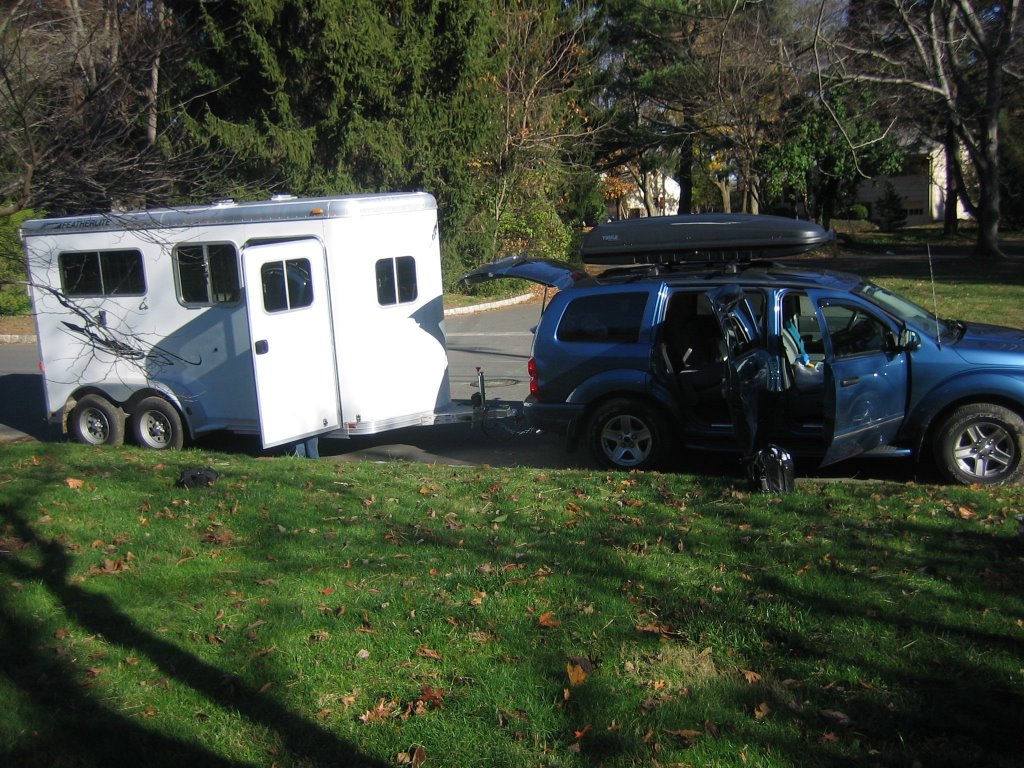

And, of course, thank you to God for permitting me to survive the towing of a trailer with two horses on the Washington Beltway during rush hour on the Wednesday before Thanksgiving.

(2) Comments

The rally in the stock market: It's Bush's fault 

The stock market hit a 4 1/2 year high on Friday (Pajamas Media round-up here). The fall rally reflects the muscular American economy, which managed to produce economic growth in the third quarter at almost triple the rate of the Euro zone. The comparative American strength was particularly impressive in light of the hurricanes: As I wrote a few weeks ago, not a single European city was destroyed this year (although I suppose Paris had a close call).

Today's news also forces me to remember -- against my will, to be sure -- the tradition at the New York Times of linking short term swings in the financial markets -- at least when they are negative -- to the policies of the Bush administration. On April 16, 2005, for example, the Times ran a front page story with the headline "Stocks plunge to lowest point since election," suggesting that it was the election that had something to do with the "plunge."

We eagerly await the front page story with this headline: "Stocks soar to highest point since before September 11, 2001". We're fairly sure, however, that we won't see it in the Times.

(13) Comments

Wednesday, November 23, 2005

More, Tireless Optimism 

An insightful piece from Max Boot in the LA Times today (thanks to Instapundit) worries that defeatism in the MSM and public opinion can become a self fulfilling prophecy -- as Boot suggests it did in Vietnam.

I don't see it that way. In Vietnam, you had an opposing force, well fed and supplied, with large numbers. You had a North Vietnam which eventually overwhelmed an abandoned South Vietnam. Furthermore, it wasn't MSM defeatism or anti-war opinion that got Nixon. It was corruption - a stupid, two bit political break-in - and a subsequent cover-up. It wasn't covert expansion of the war to Laos ad Cambodia, or Tet, or anything else.

I'll repeat what I've said many times. Iraq is already "won." The enemy leader and his heirs are in jail or dead. A new democratic government has been elected, a constitution voted upon and ratified and new elections are upcoming. Boots also cites data which reveals dramatic economic and military progress as well.

The American press doesn't create self fulfilling prophecies im Vietnam or Iraq. That is an immensely arrogant, even ridiculous, concept. Eason Jordon, Dan Rather, the CIA, the Russians and the French couldn't ultimately protect Saddam from his own fetid behavior meeting up with American strategic and moral interests. Iraq is well on its way to its post Saddam existence. This new Iraq may, and may not, align itself with US interests in the future. Its representative government alone will determine this. But it seems to me that there is no significant opposing force which will derail majoritarian rule in Iraq. Could it devolve into a civil war, or Iraqi dissolution? Every day that passes, this likelihood shrinks to vanishingly small, especially post constitution.

If the Murthas and the Democrats were serious about caring for our troops, rather than their obession with Bush, they would stop declaring defeat as a way to bring the troops home; they would instead declare victory as a way to bring the troops home.

(9) Comments

Michael Scott Doran at the NSC 

As we reported here back in May, Michael Scott Doran, formerly of Princeton University's Near Eastern Studies Department, has joined Stephen Hadley's team at the National Security Council. Doran is an expert on jihadi ideology, and has devoted himself to reading al Qaeda's philosophical and tactical writings. The Washington Post published an interesting profile of Doran last week which is well worth reading for anybody who wants to know how today's NSC forms its opinions about our enemy.

The WaPo article also reports that Doran is an excellent lecturer, which fact I can personally attest to. I attended a public lecture that Doran gave last spring on "Al Qaeda's grand strategy," and wrote up my notes here. My account of Doran's lecture remains the most widely read post I have ever written, and goes into much more detail than the Post's story.

Doran is probably the highest profile academic advocate for the view that al Qaeda's campaign is essentially a civil war within Islam, and that the West's involvement is something of a sideshow. Four years ago, when Doran wrote an article for Foreign Affairs that said as much, it was very controversial and quite inconsistent with the Bush administration's public pronouncements on the war on terror. Today, with al Qaeda attacking Muslim weddings in Jordan and Sunni leaders in Iraq, Doran's analysis seems spot on.

Doran has also written on the problem of Palestine, and whether a settlement with Israel would weaken al Qaeda. Since this is virtually received wisdom in Europe and American universities, his assertion that peace in Palestine would have very little impact on al Qaeda is more than a little controversial (my thoughts on that subject are here). If you have a moment over the long weekend, read the whole thing.

(3) Comments

Al Gore was for "extraordinary rendition" before he was against it 

While we're on the subject of the loyal opposition's wholesale memory failure, perhaps it is worth reviewing Al Gore's support for the practice of "extraordinary rendition" (aggressively anti-rendition Wikipedia entry here). I stumbled across this passage in Richard Clarke's Against All Enemies, published last year in a fairly blatant attempt to compare the Bush administration's anti-terrorism efforts unfavorably with those of Bill Clinton:
Snatches, or more properly "extraordinary renditions," were operations to apprehend terrorists abroad, usually without the knowledge of and almost always without public acknowledgement of the host government.... The first time I proposed a snatch, in 1993, the White House Counsel, Lloyd Cutler, demanded a meeting with the President to explain how it violated international law. Clinton had seemed to be siding with Cutler until Al Gore belatedly joined the meeting, having just flown overnight from South Africa. Clinton recapped the arguments on both sides for Gore: Lloyd says this. Dick says that. Gore laughed and said, "That's a no-brainer. Of course it's a violation of international law, that's why it's a covert action. The guy is a terrorist. Go grab his ass." (pp. 143-144)

This passage is especially interesting in light of Gore's more recent speechifying, in which he specifically denounced rendition. No more "go grab his ass."

Al Gore supported rendition before al Qaeda had declared war on the United States and hung its battle flag on the Khobar Towers, the USS Cole, the African embassies, the World Trade Center, the Pentagon, the Bali disco, the Madrid trains, and the United Nations. But after those defeats, Al Gore changed his mind. Has any reporter for any major news organization bothered to ask Gore to explain his reasoning?

(74) Comments

Tuesday, November 22, 2005

Demonstration disparity 

In the midst of an already excellent column, Mark Steyn makes a useful observation about the press coverage of demonstrations in the Middle East:
True, [Abu Masab al-Zarqawi] did manage to kill a couple of dozen Muslims. But what's the strategic value of that? Presumably, it's an old-fashioned mob heavy's way of keeping the locals in line. And that worked out well, didn't it? Hundreds of thousands of Zarqawi's fellow Jordanians fill the streets to demand his death.

Did they show that on the BBC? Or are demonstrations only news when they're anti-Bush and anti-Blair? And look at it this way: if the "occupation" is so unpopular in Iraq, where are the mass demonstrations against that?
I'm not talking 200,000, or even 100 or 50,000. But, if there were just 1,500 folks shouting "Great Satan, go home!" in Baghdad or Mosul, it would be large enough for the media to do that little trick where they film the demo close up so it looks like the place is packed. Yet no such demonstrations take place.

Nobody likes to be occupied. It is a shame that the optimists in the Bush administration assumed that Iraq would be an exception. Steyn, however, puts it in helpful perspective -- the dynamic in the Middle East does appear to be changing against al Qaeda and the other fascists. The press -- especially the foreign press -- is deeply reluctant to recognize this change because of the implication that it might -- Allah forfend -- be the result of American foreign policy under the hated Bush administration. But the world is changing whether the BBC admits it or not.

(3) Comments

Optimism and Thanksgiving 

One of the (many) things which motivates my animus towards much MSM reporting about our government, our military and our country generally is its profound pessimism. As the child of immigrants, who counts his blessings for having been born in the USA and no place else, I can say I feel extraordinarily fortunate. This is an amazing country - where people with no "birthright", no connections and no money, can enjoy great success and build a future for their families not available to so many elsewhere.

Thanksgiving is a uniquely American holiday which I think captures much of that sense of optimism. It is in some ways religious, yet non sectarian. Everyone who comes here and lives here can enjoy Thanksgiving -- and it isn't plagued with the commercialism of a Christmas holiday. Thanksgiving unites, brings families and the country together. I don't think any other nation shares this kind of event (though I may be corrected on this).

Reagan was right -- it is Morning in America.

Happy Thanksgiving...

(9) Comments

Would Bill Clinton have invaded Iraq? 

In the comments to this post by our sharp-penned co-blogger Cardinalpark, one of our leftish but nevertheless polite and reasonable commenters alleged:
Of course Clinton wouldn't have invaded Iraq. Most former presidents wouldn't have (including 41).

At one level, this is an easy claim to make, at least with respect to the last several presidents: None of them did invade Iraq, even when they had the chance (as was the case with Clinton and Bush pere). However, I am not at all sure that "most presidents" would not have invaded Iraq under circumstances similar to George W. Bush. Setting aside Bush 41 and Clinton, I submit that virtually all American presidents prior to Jimmy Carter would have invaded Iraq under similar circumstances. Do we really believe that Richard Nixon, Lyndon Johnson, Jack Kennedy or Harry Truman (each the author of geopolitical belligerance far greater and more erroneous than anything considered by George W. Bush) would not have invaded Iraq under the same circumstances? What about Woodrow Wilson, who never missed an opportunity to send a gunboat to support his foreign policy? Or Theodore Roosevelt? Or William McKinley, who was more than willing to wage a limited war of less strategic moment in the Philippines? Or James Polk? Or Thomas Jefferson, who launched America's first "small war"? President-by-president, I think we could construct a pretty persuasive argument that "most former presidents" would have invaded Iraq long before 2003. Certainly most of the great ones would have.

Indeed, there are many of us who believe that, in retrospect, the right time to have invaded Iraq was 1998, when Saddam booted out the UNSCOM inspectors the second time. George H. W. Bush might very well have done so had he been in office. How else to protect the legacy of the Gulf War? Clinton had the opportunity but did not, and history may well reveal this as one of his biggest errors. I think he knows this deep down, and that is why he has been curiously understanding of President Bush's decision (with occasional pandering lapses).

Why didn't Clinton invade Iraq in 1998, substituting stand-off bombing (the true "chickenhawk" tactic, by the way)? I think that two factors effectively limited his options. First, the Starr investigation and resulting impeachment made it very difficult for Clinton to take tough action abroad without appearing to "wag the dog." It is not honest to deny that the combination of an independent prosecution and Republican political attacks operated to limit Clinton's menu of options in foreign policy. This is not to say that Clinton would have invaded Iraq if he had not been under siege at home, but Republican attacks effectively took away the option of pre-emptive military engagements. The attacks on Clinton, however invited by his own moral weakness, damaged his ability to deal with both Iraq and al Qaeda aggressively.

Second, it is no secret that Clinton had a poor relationship with the military. He attacked military culture early in his term and built his fiscal policy around massive cuts in defense spending (as a proportion of national income). He filled his administration with people who were not comfortable around soldiers. The military responded in kind. It is not at all clear that he could have gotten the support within the military to launch an invasion of Iraq in 1998. The generals probably would have leaked to death any such effort, calling down the rage of the Republican Congress, which back then stood squarely against "nation-building."

One of the more interesting passages in Richard Clarke's book, Against all Enemies, reveals the intense frustration that characterized the Clinton administration's efforts to enlist the military in the war on al Qaeda:
Snatches, or more properly "extraordinary renditions," were operations to apprehend terrorists abroad, usually without the knowledge of an almost always without public acknowledgment of the host government. One terrorist snatch had been conducted in the Reagan administration. Fawaz Yunis, who had participated in a hijacking of a Jordanian aircraft in 1985 in which three Americans were killed, was lured to a boat off the Lebanese shore and then grabbed by FBI agents and Navy SEALS. By the mid-1990s these snatches were becoming routine [Counterterrorism Security Group] activity. Sometimes FBI arrest teams, sometimes CIA personnel, had been regularly dragging terrorists back to stand trial in the United States or flying them to incarceration in other countries. All but one of the World Trade Center attacks from 1993 had been found and brought to New York. Nonetheless, the proposed snatch in Khartoum [of bin Laden associated ABu Hafs al-Muratani] went nowhere. Several meetings were held in the White House West Wing with [National Security Advisor Sandy] Berger demanding the snatch. The Joint Staff had an answer that they used whenever asked to do something that they did not want to do:

- it would take a very large force;

- the operation was risky and might fail, with U.S. forces caught and killed, embarrassing the President;

- their "professional military opinion" was not to do it;

- but, of course, they would do it if they received orders to do so in writing from the President of the United States;

- and, by the way, military lawyers said it would be a violation of international law. (pp. 143-144)

Clarke believed that this was systematic (p. 145):
Whether it was catching war criminals in Yugoslavia or terrorists in Africa and the Middle East, it was the same story. The White House wanted action. The senior military did not and made it almost impossible for the President to overcome their objections.

This is, of course, as self-serving as the rest of Clarke's book. But that doesn't make it any less true. And there are more conservative voices that substantially agree.

Clinton, in effect, faced the same sort of obstructionism from the military as Bush has faced from the State Department. Perhaps, when the history of the era is written, bureaucratic in-fighting will be seen as the real reason why Bill Clinton did not put boots on the ground when it was obviously appropriate and propitious to do so, and why George Bush did notwithstanding the footnoted objections, leaked memos and hushed subversion of Foggy Bottom.

(12) Comments

"Grow up America" 

Even if the Democrats ride an anti-war wave back into power, our troops will remain in Iraq. This is not because the Democrats are incapable of doing anything as monumentally stupid as abandoning Iraq. The Democrat Party was, after all, largely responsible for our abandonment of Vietnam. No American government will abandon Iraq because doing so would be to take ownership of the next terrorist attack on our homeland.

Exactly.

(10) Comments

Monday, November 21, 2005

Kerried 

Heh. Read John O'Neill, the Swift Boat Veteran. The Bush Administration should really put him on the payroll.

(18) Comments

Clintons II 

No sooner had a I gone out on a limb to recognize their centrist political genius for supporting (or at least not attacking) the Bush Administration on Iraq and the GWOT, than out comes Bill with a very silly assault saying, essentially, "well I wouldn't of done that (speaking of Iraq)." Putting to the side that we don't know what Clinton means by "that" (since we know how he feels about the multifaceted word "is"), he is clearly pandering to the base and his MSM constituency.

This is a dangerous place for him to tread. Clearly, the Democratic Party has adopted a strategy geared for November 2006 which is denigrating the Iraq War decision in all its facets - prewar intelligence and decision-making, postwar execution, etc.

However, and thanks to Power Line, this approach has its flaws and its political dangers. Read this little article, which again stuffs Democrats own policies, actions and words in their mouths.

Here is the best way for Republicans to respond to the Democratic Party strategy of eroding confidence in the Iraq decision.

1) Repeat after me - we won. Saddam is in jail. Uday and Qusay are dead. The Iraqis have elected a representative government and embraced a constitutional government. Iraq has the best Arab government in the Middle East. And when their military is able, we will draw down troops. But in the meantime, we are daily killing al qaeda is Iraq with our finest...and better there than here.

2) We all read the same intelligence. Here are the quotes...etc etc etc. Let's not forget that the Congressionally legislated policy of the USA since 1998 was regime change in Iraq.

3) Here is where Democratic leadership policy gets you -- after the Cole bombing and the embassy bombings in Africa, we sent a couple of missiles into Al Shifa and Afghanistan. Half of the justification for this halfhearted, weak-kneed policy was the feared and suspected alignment of Iraq and Al Qaeda. Here's the quote...

4) Instead, we get 9/11. Hmmm. Guess that policy was a little lame. This is a place that the current administration has scrupulously avoided. But I have to believe that if Clinton falls off that respectful wagon, all bets are off.

5) The Republican Party, hey, we got after the enemy -- in Afghanistan. And in Iraq. Where we kill them every day. No 9/11 since then, eh? Oh, and by the way, we may finally have a shot at liberalizing the Middle East as a result. That's interesting...but remember, we kill the enemy. Boots on ground and such. And we're are going to continue to stomp around killing al qaeda wherever they operate. You can count on it. No more 9/11's. Testosterone. Not nuance. This is a winner with the American electorate.

That, of course, will send the MSM and Pacifist crowd into quite the tailspin. But if you cut through it, that's what the majority of the American people want. They want butts kicked overseas by our professional military until the threat is smashed.
They enjoy seeing dirtbags like Saddam and his son dead and imprisoned. They like seeing al qaeda names crossed off Most Wanted lists.

It is quintessentially American. And I would be surprised if the Clintons put themselves in the antiwar camp. I don't think it will win them the married woman vote, which they need to have a shot...

(5) Comments

Sunday, November 20, 2005

The President should "manipulate" intelligence 

We have lost our way in the partisan acrimony over whether the Bush administration "lied" about or "manipulated" intelligence to promote the war in Iraq. Opponents of the President's policies in Iraq (or opponents of the President, period) seem to be arguing for a world in which all Americans sit in judgment of every foreign policy decision as if they were the chief executive burdened with the responsibility of decision. This is an absurd conception of leadership that nobody serious actually believes. I'll say it: I want my president to manipulate intelligence in furtherance of his conception of the national interest. That's what we elect him to do.

We want the President to manipulate intelligence in small and large ways. The small ways are essentially bureaucratic -- it is in the nature of intelligence that it must be construed in the context of bureaucratic infighting. The large ways are geopolitical -- our foreign policy is an extended, endless game of poker. We do not want our chief executive to reveal all his cards, even if that means he must deceive us about his reasons for certain of his actions.

"Small" manipulation

Virtually all the information flowing into the office of a chief executive is attached to an agenda. In a corporation, executives with a particular expertise or area of responsibility will emphasize the information that matters to them. The sales department will "prove" that the critical input is more sales reps, and the research and development guys will argue that competitive advantage lies in developing new products. Not only will the chief executive understand that virtually all his advice depends from one or another agenda, but he will then cite the intelligence that he relies upon in making the case for the strategy that he ultimately advances. So, for instance, if a company cuts its R&D budget to hire more sales reps, the CEO will then cite the arguments of his sales department when defending his strategy to directors, analysts, stockholders and CNBC. Of course, he knows damn well that his R&D department argued differently and might ultimately prove to be correct, but he also knows that it is his job to argue for the policy that he embraces. To do that, he manipulates the "intelligence" he has received from his various departments to present the best possible case for the strategy he has decided upon. Stockholders do not feel "deceived" by this. Rather, they would think that any chief executive who revealed all the ugly internal argument over the best strategy had lost his mind.

So it is with Presidents. The White House receives thousands of intelligence inputs that support arguments for alternative policies. Some of those inputs are already digested in the form of a national intelligence estimate. That document is itself a bureaucratic compromise, a summary of thousands of other inputs that is bound to be qualified internally (via hedgy footnotes) and externally (via contradictory memos buried in the files of contributing agencies, or competing assessments entirely outside the government). We want the President to understand the intelligence and make a decision that incorporates it, but we don't want the intelligence to dictate the policy. We want the President to develop a policy that is based in part on intelligence and in part on sound judgment about the geopolitical benefits of the action proposed to be taken. The policy, though, will dictate that portion of the intelligence that the President emphasizes in his public argument for that policy. And that is how it should be. Do any of us want a President who twists his hanky in front of the world? Of course not. We want our President to decide upon the policy that he believes is in our best interest, and then we want him to go make it so.

President Bush believed that it was important for the United States to invade Iraq and replace its regime. There were a great many arguments in favor of this policy, most of which were made by the Administration in one form or another before the war. One of the arguments was a legalistic one -- that Saddam's government was, by virtue of its alleged present development and possession of WMD, in violation of United Nations Security Council resolutions. It was important to some people, including some Democrats and Tony Blair, that the UNSC endorse the war, or that it be unreasonably vetoed. Colin Powell went to the United Nations to make a legal case for a UNSC stamp of approval, not to make the best geopolitical case for the removal of Saddam Hussein. The geopolitical case did not depend on existing WMD, and still doesn't. But the intelligence that appeared to show Saddam's WMD programs were central to the administration's advocacy in front of the United Nations, so it is neither surprising nor shameful that it omitted all the various footnotes and hedges that have surfaced in the last thirty months or so. Do you want our President to share all our doubts and qualifications with the world? I certainly don't.

Large manipulation

Foreign policy is not an exercise in seeking the truth. It is a game of bluff and deception that occasionally turns bloody. Our government is engaged in an endless, high stakes game of poker in which cheating is essential and expected. We have spies to spot the other guy's cards, and he has spies to try to discover ours. He is going to defend himself by lying about his motivations and capabilities, and so must we. He is going to misdirect us by betting heavily on weak hands or fighting for positions that do not matter to him, and so must we. Since one cannot both lie to the enemy and tell the truth to the American people -- one can assume that the enemy watches CNN just like anybody else -- we need the executive branch to tell lies in the national interest even if it means lying to the American people. I am relieved when I learn after the fact that we did not understand the true reasons for a statement or action of our government. If we did know, that meant that our adversaries also knew, so we are better off if we, at least, were kept in the dark.

Nobody serious objects to this idea that we want our government to lie to our enemies. The objection, of course, is that an administration might lie not to deceive the enemy, but for a nefarious purpose. Obviously, if a government lies to justify an action that cannot be seen as in the national interest, the lie itself is suddenly indefensible. The political opposition to George Bush, therefore, has devoted a great deal of time to imputing a nefarious motive behind Operation Iraqi Freedom. This is why we hear the laughable claims that the war was for Halliburton, the product of some dark "neocon" conspiracy to aid Israel, or to grab Iraq's oil. The opposition hurls these slanders so that it can characterize the administration's behavior as self-serving, and therefore not in the national interest at all.

The problem with this line of attack, though, is that it exposes the weakness in the opposition's argument. We want the administration to lie if it is doing so in the national interest, and therefore will not object to its characterization of the available intelligence unless we think that the purpose of the war was nefarious. But if the purpose of the war was nefarious, does it really then matter that the administration lied about the intelligence? Is it not far worse to go to war for a nefarious purpose? The "respectible" opponents of the war -- the Cold Feet Democrats, for example -- will not claim that the purpose of the war was nefarious. They simply complain that the President "lied" about the underlying intelligence. But if the war was in the national interest, we needed him to lie. They know this, but for so long as the war repels rather than attracts votes we can expect them to claim that "truth" is the highest value, even if it means showing our cards to our enemies.

(28) Comments

Day late, dinar short: In re blowback 

Apparently proudly decapitating innocent people wasn't enough for Abu Masab al-Zarqawi's family to denounce him. For that, he had to attack Jordan. A day late and a dinar short, Zarqawi is persona non grata in his own home:
The family of al-Zarqawi, whose real name is Ahmed Fadheel Nazzal al-Khalayleh, reiterated their strong allegiance to Jordan's King Abdullah II in half-page advertisements in the kingdom's three main newspapers. Al-Zarqawi threatened to kill the king in an audiotape released Friday.

"A Jordanian doesn't stab himself with his own spear," said the statement by 57 members of the al-Khalayleh family, including al-Zarqawi's brother and cousin. "We sever links with him until doomsday."

The A.P.'s reporter, one Jamal Halaby (who bizarrely shares the same last name as the last Queen of Jordan, Princeton's own Lisa Halaby), suggests that "[t]he statement is a serious blow to al-Zarqawi, who no longer will enjoy the protection of his tribe and whose family members may seek to kill him." This is plausible, because Zarqawi was released from prison in Jordan in the first place through the good offices of his tribe:
The al-Khalayleh tribe is a branch of the Bani Hassan, one of the area's largest and most prominent Bedouin tribes, which help form the bedrock of support for the royal family's Hashemite dynasty.

Relatives hold senior posts in the army and other government departments.

Al-Zarqawi often boasted of his family's influence when he was jailed in his native Jordan, said Yousef al-Rababaah, an ex-convict who shared al-Zarqawi's cellblock for four years until both were freed under a royal amnesty in 1999.

"Prison wardens and other prisoners feared him because of his family connections and influence," he told The Associated Press recently.

Now, the tribe not only has renounced Zarqawi, it has assumed the burden of hunting him down:
"If my son was a terrorist, I wouldn't hesitate to kill him," family member Mousa al-Khalayleh said during Friday's rally, claiming he spoke on behalf of the tribe. "This is the slogan raised by the tribe as of this moment."

Such are the wages of shitting in one's own nest.

There are three fairly obvious points that flow from this, all of which are familiar to our regular readers, perhaps to the point of tedium. First, Zarqawi's tribe bears no small responsibility for failing to renounce him and his war until now. Where were these people for the last thirty months, other than being a "bedrock of support" for the Hashemite dynasty? Yet more evidence that however "friendly" the kings of the Middle East may be to the United States or "moderate" in their politics, they sleep with our mortal enemies.

Second, "blowback" is as much a problem for al Qaeda as it is for the United States. Indeed, all war generates blowback. Our objective must not be to avoid our own blowback, but to shape the blowback against al Qaeda into a strategic victory for the United States.

Third, the shaping of that blowback against al Qaeda -- and strategic victory -- requires that we create more enemies of al Qaeda within the Arab world. We create some of these enemies by moral suasion -- getting people to agree with our view of the world instead of their's. We create other enemies of al Qaeda by coercion -- have you noticed that every time the government of Pakistan seems to waiver in favor of the Islamists, the United States Air Force conducts war games with India? We create some of these enemies by evidencing our own commitment -- have you noticed that Saudi Arabia did not go to war against al Qaeda until the United States had put boots into Iraq and thereby reassured the House of Saud that it would not shrink from its engagement in the Arab world? We create enemies of al Qaeda by giving them something to fight for -- hence the realist case for the democratization strategy. Finally, we create enemies of al Qaeda by forcing them to fight the war on our terms, in a time and place of our choosing. This we have done in Iraq. When you ambush your enemy, when you throw them off balance, they do stupid things. We are forcing al Qaeda to flail around, attacking apostates and infidels willy-nilly, at enormous cost to their own credibility.

If we are to win this war, we have to get over the idea that the key to victory is creating "friends." The key to victory is in creating enemies of our enemy. Yes, in so doing we may plant the seeds of future conflict, just as we did when we rescued the Soviet Union from Germany and Afghanistan from the Soviet Union. But we did the right thing in supporting the Soviets to win the war against Hitler, and we did the right thing in supporting the mujahadeen to win the war against the Soviets. Now we are winning the war against al Qaeda and Islamic fundamentalism, which is more important than worrying about enemies not yet born.

Stay the course.

UPDATE: Cat 5 blowback? Let's hope so.

(6) Comments

The Cold Feet Democrats: Reveling in their gullibility 

The Mudville Gazette has produced an exceedingly useful timeline of the history of Saddam Hussein's regime in Iraq and its various confrontations with regional and world powers. And, in addition to the history, it is chock full of simply fascinating statements by Democrats who believed that Saddam posed a big security risk to the United States.

Oh, you say, these Democrats must have been deceived by the Bush administration's lies! No, actually. Many Democrats clearly understood what a threat Saddam was in 1998.

Saddam Hussein was hugely dangerous, he had a long record of both developing WMD and working with terrorist organizations, and everybody knows it. They knew it in 1998 and they know it today. Those who claim otherwise are either not being honest, or they have astonishingly short memories.

There are many principled criticisms of the invasion and occupation of Iraq. One might plausibly argue -- though I would not agree -- that we could have reinforced containment and thereby deferred the removal of Saddam until we had destroyed al Qaeda. I believe that there are several specific reasons why this would have been unwise or otherwise risky, but there are many smart people who believe it fervently. One can also argue that the war might have been handled very differently, or that we cocked up the occupation's early months and that has messed us up for years to follow. That may be true, too, but since all wars, including ultimately victorious ones, are filled with hugely consequential decisions for which commanders wish they could have a "mulligan," it is not surprising.

It is not, however, principled to argue that the Bush administration deceived anybody about the threat of Saddam Hussein to such a degree that they would vote for a war that they would otherwise oppose. The Cold Feet Democrats voted for the war because they thought it important to their own future political ambitions, not because they believed in it. Now that support for the war has moved from vote-getting to vote-repelling, these same Democrats have decided that they would rather be thought of as gullible -- fooled by the President that they allege is stupid -- than wrong or stubborn (these three being the only refuges available to them). I know this, you know this, and virtually every reporter writing or interviewing on the subject knows this.

(Among the options available to the Cold Feet Democrats -- being gullible, wrong, or stupid -- "gullible" is apparently the least toxic to the Democratic activists. Why should it surprise us that the same people who believe that Che Guevera makes for boffo logo attire should be willing to forgive gullibility?)

Read the Mudville Gazette's timeline, and then check back here later today for more.

(4) Comments

Saturday, November 19, 2005

Jonathan Alter reviews Mary Mapes 

One of the delights of home delivery of the New York Times is that you get a lot of the Sunday sections on Saturday, so you can fisk read them at your liesure. Tomorrow's Sunday Magazine today. That sort of thing.

Of old, the Times would not post the articles from these pre-delivered Sunday sections until Sunday, which was intensely annoying. Now it does, so we are free to be annoyed over the substance of their articles rather than the timing of their delivery into easily bloggable form. We always give credit where credit is due.

Anyway, my heart skipped a beat this morning when I realized that tomorrow's Book Review contains Jonathan Alter's review of Mary Mapes' book, Truth and Duty. Slipping it from the stylish blue baggie, I felt like the dumb girl in an ax-murderer movie, the audience thinking "don't turn the page!"

Imagine how disappointing it was for me to conclude that Alter's review is not a total abomination. It starts strong:
I realized Mary Mapes had not told the whole story of the CBS-National Guard fiasco when I looked in the index to her book for a reference to The Boston Globe. It wasn't there.

Why is this such a telltale omission? In an article published in February 2004, seven months before CBS News imploded, The Globe, under the headline "Doubts Raised on Bush Accuser," essentially destroyed the credibility of a man named Bill Burkett, a retired lieutenant colonel in the Texas National Guard. Burkett claimed to have stumbled upon some of George W. Bush's Guard records in a trash can in 1997 while on a visit to a military museum where documents were kept. In the Globe article, three witnesses disputed this outlandish yarn.

No matter. Mapes writes that she knew other reporters had found Burkett to be an anti-Bush zealot back in February, but she doesn't seem to have taken their work seriously. When Burkett gave her "new" documents in early September, she staked her career and those of several colleagues at CBS News, including Dan Rather, not to mention control of the White House and the precarious status of the American news media, on the word of a man who had long since been discredited. Oh, well.

Yeah.

Alter also concludes about as strongly as we could expect from, er, Alter:
Amid her tale of victimization, Mapes explains how investigative reporting is now an endangered species in the American news media, especially on TV. It's expensive and subject to endless carping. But blaming cyber-bullies and corporate greed-heads for that endangerment won't cut it. CBS News did this to itself, and to the rest of us. The only remedy for journalists is to admit mistakes, then put our helmets back on and return to the field.

The big, gooey middle part, though, is painful.

Alter, who says he read the Thornburgh Report, is almost unbelievably disingenuous in his characterization of its discussion of the Killian documents:
[I]n early 2005 an independent panel appointed by CBS Inc. issued a devastating report that raised questions about the documents without revealing them to be fakes. (emphasis added)

Actually, the independent panel absolutely "revealed" the documents to be fakes. It just did not say that they were. But nobody can honestly read the evidence marshalled in that report and fail to conclude that the odds that they were not of contemporary manufacture are vanishingly small.

Alter also ignores fairly glaring arguments against Mapes' version of events that were raised in the Thornburgh report and elsewhere.
The authentication experts she hired were forced to examine the documents over Labor Day weekend and remained uncomfortable with having to analyze copies instead of originals. Two of the experts raised red flags that she didn't consider carefully enough in the rush to deadline.

This is, of course, a gross understatement. The Thornburgh report and other accounts makes it clear that she ignored -- not "didn't consider carefully enough" -- the opinions of Emily Will and Linda James. Will, in fact, raised concerns ex ante almost identical to those that the blogosphere raised ex post. Mapes knew this when she wrote her book, and Alter knows this because he read the Thornburgh report. If he were being a tad more objective, he would not have shaved his characterization so strongly in Mapes' favor.

Alter recounts that Mapes attributes the corporate pressure from Viacom to greed and a desire to pander to the administration, which was (allegedly) in a position to influence the regulation of broadcasting and the licensing of Viacom stations.
In her attacks on Bush, on CBS's corporate parent, Viacom (for kissing up to Bush), and on her own colleagues, Mapes is merciless.

Alter knows that this argument is barely credible -- if Viacom were so willing to stomp on CBS News to suck up to the Bushies, why did CBS take so long to correct an obviously inaccurate story, and why has it not to this day admitted what every other honest person knows -- that somebody hoodwinked it into airing the obviously manufactured Killian memos? If one's corporate ambition were to suck up to the Bushies, such an admission in October 2004 would have been the way to go.

The mainstream media does its own credibility no favors in continuing to promote Mapes' side of the story. Even a reviewer as negative as Alter cannot, obviously, bring himself to attack the core of the scandal.

UPDATE: Power Line, of course, has more.

(7) Comments

Princeton in the morning 


Thirty minutes ago.

(2) Comments

Friday, November 18, 2005

Microsoft hits a 12 month high 

Microsoft closed over 28 today, setting a 12 month high. What do we make of
that? Comments solicited.


(4) Comments

More evidence that Iran is building a bomb 

This wins the award for the least credible denial since, well, Iran last claimed its nuclear program was for "peaceful" purposes:
The Iranians say they neither requested the data from AQ Khan nor used it.

What "data," you ask? The reference to A.Q. Khan should have been your first clue.
Iran has passed on to United Nations inspectors documents on how to build a crucial part of a nuclear bomb, the UN's atomic agency says.

Tehran says it got the information from the nuclear smuggling network run by disgraced Pakistani scientist AQ Khan, according to an agency report.

Iran expects us to believe that a man who sold nuclear secrets throughout the world gave them to Shiite Iran, Pakistan's immediate neighbor and strategic rival? And then, having enjoyed this entirely unsolicited windfall, they didn't "use" the information? OK. But did they read it, understand it, remember it, or copy it? What, pray tell, is our newest Nobel laureate going to do about this?

Iran is building a bomb, and the West is losing its opportunity to do something about it. Eventually, we will foreclose all policy options save deterrance. While the Iranians have proven themselves to be somewhat more rational in their brinksmanship -- and therefore theoretically deterrable -- than Saddam ever was, one has to wonder whether deterrance alone is sufficient protection against a regime that deploys suicide bombers to geopolitical advantage.

The interesting question, of course, is what motivated the Iranians to cough up the A.Q. Khan documents? The Pakistanis, who cannot want Iran to develop a nuclear weapon, probably ratted out Tehran, figuring that it is better to take the heat now for having allowed Khan to leak the information than suffer the consequences of a resurgent Shiite rival with a deployable atomic bomb.

(1) Comments

Giving regicide a bad name 

I think kings who wield actual rather than ceremonial power are absurd. When they maintain power by oppressing their people (as virtually all do), I say that the French had the right idea. As any good American knows, monarchy was a bad idea in the 18th century. It is a ridiculous, risible, laughable form of government in the 21st century. The monarchies of the Middle East are no exception. Whether "friends" of the United States or not, whether "good guys" or not, the kings have got to go.

So it is with enormous discomfort that I learned this morning that that parody of a rebel, the hated Abu Masab al-Zarqawi, apparently agrees with me. It's enough to give regicide a bad name.

(2) Comments

Blogging the Senate 

The view from S-219
The Senate Republican Conference, now chaired by Senator Santorum, invited a group of us to hear what several leading Republican Senators had to say on matters of moment great and small. The Conference staff has been working hard to build its relationship with bloggers, and devoted the event entirely to citizen journalism. No MSM invited, and the SRC itself made no attempt to ballyhoo the gathering to anybody but the Fifty-Five.

We were called to room S-219 in the Capitol at 1:30 yesterday afternoon. The view from the room is at right, and you can get a feeling for the setting itself from these pictures at Right Side Redux. See if you can pick me out.

In any case, the basic format gave us front-and-center access to the Republican leadership, including Senators Allen, Frist, Brownback, Santorum, Chambliss, Allard, Thomas and Thune. Suitably Flip was there and has links to their individual sites.

Some of the bloggers present tapped into the Capitol's fairly flimsy wireless network and blogged real-time, but I concentrated on taking notes and pictures. Rather than uploading the notes indiscriminately, I thought I would concentrate on two or three of the Senators who presented, including my observations.

Senator George Allen


George Allen is on everybody's short list of possible contenders for the Republican nomination in 2008, and was recently the subject of a cover story by Rich Lowry in the National Review. For further evidence of Allen's ambitions, look no further than the goofy pictures (scroll down through the Freeper thread) of Allen -- a Virginian -- trying to look real in cowboy attire. No Virginian would do that if he weren't running for president.

The official TigerHawk photo of Allen is at left.

In his opening remarks, Allen called for "less taxation, less regulation, less litigation." Like several of the Senators, Allen called for more "energy independence," which he thought we could accomplish through new and better technology. He and Senator Santorum were specifically focused on the question of energy security, and both were ambitious to do something about it beyond drilling in ANWAR (which they both want to do). Both reached for the magic of technological solutions, which for them offered the magic prospect of greater energy production and conservation without higher prices. I specifically asked Senator Allen whether he thought higher prices or moral suasion were the best methods to promote conservation, and he responded by denouncing regulation (such as corporate average fuel economy requirements). Allen instead talked about "incentives," the details of which were unclear but which I took to mean "subsides."

Obviously, if the Republicans are going to talk energy policy with bloggers, they are going to have to learn to explain how we can achieve energy independence without higher energy prices or more regulation. For my own part, I believe that higher energy prices would and will work like magic to reduce our dependence on imported fuel, but that is, apparently, a politically toxic admission.

Senator Allen also hammered on the importance of a restrained judiciary, and quite specifically campaigned against the Kelo decision: “The Supreme Court actually amended the Bill of Rights by judicial degree by allowing the commissars in New London, CT to take the people’s property.” TigerHawk loves the "commissars" reference, which is exactly what they are. If Allen's staff reads this, may I suggest that he use the line again, at least in gatherings of red-meat conservatives. "Commissars," indeed. Sent shivers down my spine.

Gerard Vanderleun asked Senator Allen to tell us "the three items on your must-do list" for America. Senator Allen raised "energy" to the top priority, followed by securing "our borders" and controlling federal spending. Much to my relief, Allen declared that we do not want to "lower our deficits by increasing taxes." I did not get a chance to ask him how he was going to achieve "energy independence" with subsidies and cut spending and avoid new taxes.

I liked George Allen as a personality -- frankly, who wouldn't? -- but it was extremely difficult even in this intimate setting to get a sense for how thoughtful he is. He had a chance, I think, to communicate the depth of his thinking for a very smart and critical group, and he largely resorted to canned talking points. If I were to offer his staff a bit of advice, it would be this: Give Senator Allen some extended time with a small group of non-partisan but generally sympathetic bloggers (TigerHawk comes to mind!) under ground rules that are sufficiently restrictive to allow him to take some risks. Let them see what is really going on inside his brain.

Senator Rick Santorum


Heading in to the session, I confess that I had thought of Rick Santorum as something of a lightweight. I am by no means a social conservative (generally speaking, I'm against "family values"), and Santorum is tough on those issues, especially for a Senator from east of the Mississippi and north of the Maxon-Dixon line. However, notwithstanding a minor gaff (of which more below), I came away extremely impressed with Rick Santorum and will pay much closer attention to him in the future. He spoke candidly, passionately and seriously. If I were to beat his performance to death with a cliche, I would say that he was a breath of fresh air.

Perhaps it is not surprising that Senator Santorum seemed to understand the difference between the bloggers with whom he was meeting and his typical audiences -- we later learned that he has been a driving force behind the Senate Republican Conference's web strategy, which is impressive.

Senator Santorum began with a "quick wrap" of the session, arguing that the press had inadquately covered many of the "successes" of this Congress. Suffice it to say that I do not think that the legislation he enumerated necessarily qualifies, but I have the luxury of being a purist and Senator Santorum makes sausage for a living. By Senator Santorum's lights, the successes included the comprehensive energy bill, liability reform for gun manufacturers, the new bankruptcy bill, a budget with "zero increase in domestic discretionary spending," and a "fiscally responsible highway bill." One might take issue with at least some of his adjectives.

The fun began with a question from Orin Kerr, who said (very MSMishly, I might add), that "2079 of our boys have been killed in Iraq. What is your reaction?" A fair question, to be sure, that all Senators should be able to answer forthrightly and without embarrassment. Senator Santorum rose to the occasion, saying (rough quote):
We can’t fail to recognize each one of their important sacrifices, but we must remember what they are accomplishing and what they are fighting for. We don’t tell this story, we don’t tell this side. The mainstream media does not report this stuff. The Iraqis are sacrificing their lives for their freedom in much greater numbers than we are. The focus of the media on the loss of American lives does not go unnoticed by the terrorists – they work very hard to make sure that that reporting continues.

My quickly-typed notes do not reveal the intensity in Santorum's voice or the rage in his eyes -- he is clearly on fire over the question of the reporting on the war, particularly the accusation coming from the Democrats that the Bush administration "lied" or otherwise mislead Americans in the run-up to the invasion.

Another blogger asked him whether the Republican response to this charge had been adequate. Santorum admitted that Republicans had been "tardy in responding to the charge that the President lied to the American public. There is no evidence. If anything, if you look at the presidential daily reports, the president understated what he was being told by the intelligence community."

“If we had twenty four hour news services back in 1776 we’d still be singing 'hail to the queen.'” I think he meant "God Save the Queen," but point taken.

Senator Santorum did make a couple of claims that he may want to tweak in future presentations. He alleged at one point in his otherwise passionate rant that "most" of the enemy in Iraq were "foreign fighters," which does not seem to be true. No matter, it need not be true.

Vanderleun asked Santorum to define victory in Iraq: "Would you say that victory in your eyes would involve the establishment and stability and democratic Iraq solely, or one that would also be a close ally with the United States that would allow basing in that part of the world?"

Santorum was quite blunt:
A would be sufficient, B would be better. It’s a democracy. We’ve got folks in Europe that don’t want our bases there. I’m not concerned about that as long as this government that may not want us there is in secure enough hands to make sure that it does not become a terrorist state or otherwise problematic. Whether we are there or not is of secondary importance.”

Vanderleun and I, by the way, agree on the more likely result: That we substantially withdraw over the next five years, but that formal and informal ties between the United States military and Iraq's new army remain sufficient to give us significant strategic flexibility in the region. The bases we are building will not necessarily be "American" bases, but quite curiously they will be adequate to sustain American military operations if the circumstances so require.

Senator Bill Frist


Senator Frist was very impressive. He spoke very briefly, leaving lots of times for questions, and stepped around the podium in front of us to speak to us very directly and respectfully. He is obviously a man of great interests, knowlege and depth. Whether he has the personality to make a good president remains to be seen, but by my measure he is much better prepared today for the presidency than any of the other Senators who appeared before us.

On the issues, Frist emphasized energy security, border security and economic security, in precisely the same order as George Allen (Frist had not been in the room when Allen spoke with us). Energy security, which means very different things to different people, is obviously a hot political issue when we are financing our enemies with our oil purchases and Americans are paying what they (absurdly) believe are high prices for gasoline.

That both candidates should raise border security, however, as their second most important issue confirms that the "Malkin" wing of the Republican Party is going to be very important in 2007-2008. Nativism has been a recurring Republican theme since the founding of the party in the years before the Civil War (down with "Rum, Romanism and Rebellion!"), and it may well be the key to winning the nomination. But will it cost the Republicans the general election? Will "border" security be to Republicans what national security is to the Democrats -- a defining issue in the primaries that comes back to bite them in November? I think it will be.


Without intending to short-change the other Senators who gave generously of their time, I did want to mention two others. Senator Thune was absolutely effusive about bloggers, to whom he may in fact owe his election. To Thune, "the blogosphere is where the freedom-fighters are." No doubt that is a sentiment with which even lefty bloggers would agree. While that is a bit blogger-triumphalist for my taste, I do consider myself the archtypical lonely pamphleteer, a metaphor I much prefer.

Senator Sam Brownback was also very impressive, and I will be paying much more attention to him in the future. Unlike the others, who touched the big general issues of energy security, border security, national security and economic security, Brownback was passionate on the crisis in the Congo. He is going therre the week after Thanksgiving, "hoping to raise with my colleagues" the "desperate plight of the people there." According to Brownback, the same number of peole die in the eastern Congo every four months as were lost in the great Asian tsunami last year. There is a "nine nation war going on with the Congo being the center, the least reported humanitarian disaster in the world.”

This campaign is part of a broader Republican effort, Brownback says, for which the Republicans in general and the administration in particular have not received fair credit. These humanitarian initiatives include President Bush's funding of programs to fight AIDS in Africa, and the campaign to reduce malaria infection by 50% over the next five years (which Brownback warns will require the indoor spraying of DDT, a policy I strongly support, by the way). Brownback seems to be one of the relatively few social conservatives who has backed his rhetoric with actual work, having visited many of the world's genuine disaster areas in the last several years.

Other bloggers, I'm sure, will have more. Thank you to the Senate Republican Conference for inviting me to participate.

UPDATE: Open Source Media's coverage is here, via Ed Driscoll.

(3) Comments

Worshippers and reporters, and credibility 

Terrorists in Iraq -- in this case, at least, the word "insurgent" is utterly inapplicable -- murdered 52 Shiites today while they were at prayer. Terrorists also went after journalists again, attacking the wall around the Hama hotel in Baghdad with two suicide bombers. Both these attacks strike me as strategically silly. The former, because the Sunnis in Iraq cannot win a civil war against the Shiites and the Kurds even if the defeatists in the United States win the political struggle and force a retreat. The latter, because the international journalists are fueling the domestic opposition to the war.

We will not defeat Islamic jihadism until we discredit it, or it discredits itself. This is not the same thing as popularity. Rather, it requires that Muslims regard jihadism as an ideological dead end. In forcing them to wage their war in the heart of the Arab world, they are -- by dint of their utter disregard for anything that ordinary people hold dear -- destroying their own credibility. This can happen even if anti-Americanism increases, just as we helped along the ultimate failure of Communism's credibility even as anti-Americanism rose throughout the Cold War.

(1) Comments

Thursday, November 17, 2005

Open Source Media and me 

I have been so busy I have not been able to write directly about Open Source Media and its launch event in New York on Wednesday. I will correct that over the weekend. In the meantime, for those of you who want to see what bloggers look like, or at least what some bloggers look like, Atlas has a big pile of pictures up, including a good one of your's truly and Austin Bay (who had very nice things to say about my father, but that's another story entirely).

(4) Comments

Remembering the murder of Sergio Vieira de Mello 

I had an extremely busy and interesting day in New York yesterday, which included both the Open Source Media launch event (of which more later) and meetings with high-powered New York lawyers. After all of that hard thinking, I took the 9 pm Accela express down to Washington, where I have another extremely busy day in front of me.

On the train I mostly read emails and prepared for today's work, but when all was done I was able to start William Shawcross' book Allies, the subtitle of which is "Why the West had to remove Saddam." Shawcross, you will recall, is a British journalist who has written quite critically of American foreign policy in the past. Thirty years ago, he wrote Sideshow: Kissinger, Nixon, and the Destruction of Cambodia, a very harsh indictment of that American administration. Suffice it to say that Shawcross has never been a knee-jerk hawk or devoted Yankeephile. He therefore writes about Anglo-American war in Iraq with some greater credibility, perhaps, than others on either side of the issue.

I was struck by the introduction, which focused the reader on the nature of the enemy in the murder of a single man, the UN Secretary-General Special Representative Sergio Vieira de Mello. To tide you over until I can get back to real blogging, I offer most of Shawcross' fascinating introduction below. Whatever one might think of the United Nations, it is really quite sad:
On August 19, 2003, a truck filled with explosive was driven into the Canal Hotel, the United Nations headquarters in Baghdad. The building contained the offices of 300 international and Iraqi civil servants and humanitarian workers. The bomb was targeted directly at the office of the UN Secretary-General Special Representative Sergio Vieira de Mello.

This was the international version of September 11. 9/11 was an attack against America; 8/19 was an attack, by the same sort of people, against the international system.

The bomber killed more than twenty people, including UN officials, and wounded scores of others. This number is not to be compared with those who died on September 11, but the impact is enormous. The terrorists who carried out this attack murdered more UN officials in any single assault since the organization was created following World War II. It represented a direct assault against the principles of international civil society that the world has tried to create since 1945. It was an attempt to murder not only fine men and women but also all the humane values that the UN, for all its shortcomings, represents and strives to fulfill.

Sergio Vieira de Mello was one of the most brilliant diplomats at the United Nations. He was considered to be a possible successor to Kofi Annan as Secretary-General, and it would have been a great appointment. On his death, Brazil, his home country, at once announced three days of official mourning.

His working life covered the gamut of the world’s attempts to deal with evil and its aftermath. After joining the Office of the United Nations High Commissioner for Refugees, he had worked in the 1970s in Bangladesh, in southern Sudan, in Mozambique, in Latin America, and in Lebanon. Later he moved to Indochina to help first with the Vietnamese boatpeople and then in Cambodia. Everywhere he worked with the same mix of dedication and flair.

I had known Sergio for many years, and I had watched him work in Cambodia, in the Balkans, in East Timor, and in Africa. He was a joy to be with – a magnetic personality. He spoke at least five languages fluently.

In Cambodia in the early 1990s, he was in charge of the repatriation of several hundred thousand refugees. He dealt with the odious Khmer Rouge commanders and with all the intransigent officials of the communist regime in Phnom Penh with equal charm, firmness, clarity, and skill. He made all the arrangements meticulously, and for an operation of that scale the repatriation was pretty flawless.

In Bosnia he slept and worked in one room in the headquarters of the UN Force Commander. I remember going with him to meet the egregious Bosnian Serb leader, Radovan Karadzic, in Pale. Karadzic was a psychiatrist of sorts, and Sergio gave him the latest edition of the New York Review of Books, in which a cover story was about war between psychiatrists. Having charmed Karadzic, Seregio then sat down to hours of tough negotiations with him.

He was intensely serious about his work, but he could also laugh and make fun of himself and the predicaments in which he often landed. He was debonair, immaculately dressed, remarkably handsome, carrying a smile that could launch a thousand cease-fires. Women adored him. Men admired him. One U.S. Senator once said, “Whenever I meet Sergio, two things happen. First, I feel poorly informed and secondly, I feel poorly dressed.” I have never heard anyone speak unkindly of him. People talked of “Sergio’s magic.”

We used to joke that the only possible title for his eventual memoir was “My Friends – The War Criminals.” Now he will never get to write it because the war criminals got him.

In 1999 Kofi Annan had asked him to go to East Timor after the Indonesians had finally been compelled to leave after their brutal twenty-five year occupation. Vieira de Mello helped lead the tiny society out of the wreckage left by Indonesia and into full independence, restoring its utilities and creating the foundations of civil society.

For this he and the UN were denounced by Osama bin Laden. Why? Because the UN had helped a basically Christian community secure its freedom from its Muslim occupiers.

Since then, Annan had appointed him UN High Commissioner for Human Rights, a difficult job that he was just settling into at the time of the invasion of Iraq in spring 2003.

After the fall of Saddam Hussein’s regime, the UN Security Council passed Resolution 1483 acknowledging the U.S.-led occupation of Iraq. Annan asked Vieira de Mello to go to Baghdad for just four months to set up an assistance mission. He was not very keen on the idea, but he understood the opportunities for Iraq as well as the dangers for himself and others.

His friend, the Peruvian novelist Mario Vargas Llosa, visited him in Baghdad and asked him,”Aren’t you tired of so many horrors? Why did you agree to come to this place?” “I found no good arguments for refusing,” Sergio replied, “with his eternal ear-to-ear smile.”

Sergio saw that the UN role was to lay the foundations of civil society in a country terrorized by decades of brutal dictatorship. He said, “The people of Iraq have suffered enough. It is time that we all… come together to ensure that this suffering comes to an end … We must not fail.” He quickly won the confidence of Paul Bremer, the U.S. administrator, and argued that the Iraqis must be empowered as quickly as possible. He spent his time meeting and talking to people and organizations from all parts of Iraqi society and traveling to the region, trying to persuade the neighboring governments to give the new Iraq a chance.

He learned enough Arabic to charm Iraqis in their own language and was in every way a very good friend to them. That was one reason why the terrorists killed him and many of the well-chosen team of UN officials assisting him. They included Sergio’s chief of staff, the Egyptian diplomat Nadia Younes, who was a delightful iconoclast with a deep-throated and constant laugh, as well as one of Kofi Annan’s most trusted lieutenants, and dedicated young people including Rick Hooper, and American, Fiona Watson (British), and Ranillo Buenaventura (Filipino), along with many others.

It was not clear whether the murderers were Baathist remnants of the Saddam regime or Islamic fundamentalists who had in recent weeks been rushing to Iraq to create a new war against the “crusaders.” There were suggestions that the two groups might have collaborated for this operation. Whoever they are, they were determined to stop the international community from building a decent Iraq. They wanted despotism – either Baathist or Islamic – to prevail. They had no thought for the welfare of the Iraqi people whom the UN was attempting to assist.

A few days after the attack, a communiqué published by Al Qaeda described the bombing thus: “One of the Mujahedeen broke in with a van full of explosives into the back part of the headquarters at the office of the personal representative of America’s criminal slave, Kofi Annan, the diseased Sergio de Mellow, Bush’s friend.” The statement asked: “Why cry over a heretic…? Sergio Vieira De Mello is the one who tried to embellish the image of America, the crusaders and the Jews in Lebanon and Kosovo, and now in Iraq. He is America’s first man where he was nominated by Bush to be in charge of the UN after Kofi Annan, the criminal and slave of America; and he is the crusader that extracted a part of the Islamic land [East Timor].”

This is the enemy of the West, and anybody in the Muslim world that qualifies as an "apostate." Keep that in mind.

(2) Comments

Wednesday, November 16, 2005

Open Source Media and press shield laws 

I am at the launch event of Open Source Media, the erstwhile Pajamas Media founded by Roger L. Simon, Charles Johnson and others (sitting with BoifromTroy and Solomonia!). The topics for the day will include, among other things, a discussion of the proposed federal press shield law, the Free Flow of Information Act sponsored by Richard Lugar, between Glenn Reynolds and Judith Miller, previously of the New York Times. The mainstream media has long pursued such a privilege but the federal government has never been able to get to it. The Plame investigation has put new life into the effort with its spectacle of subpoenaed reporters and the imprisonment of Ms. Miller.

I strongly support the passage of a federal shield law to protect people who rely on confidential sources in their writing and speaking, but take great exception to the version promulgated by Senator Lugar. The Lugar bill is essentially a license to practice journalism, nothing less than the establishment of a federal guild. It is an insidious bargain between elected officials, who greatly want the publicity afforded to them by the institutional press, and the media corporations that want to relieve pressure on their reporters and editors would prefer to avoid confronting the government that regulates them. Lugar himself essentially admitted this in a speech before the Inter American Press Association last month:
Bloggers would "probably not" be considered journalists under the proposed federal shield law, the bill's co-sponsor, U.S. Sen. Richard Lugar (R.-Ind.), told the Inter American Press Association (IAPA) Monday afternoon....

Lugar acknowledged that the legislation could amount to a "privilege" for reporters over other Americans.

"I think, very frankly, you can make a case that this is a special boon for reporters, and certainly for their role in freedom of the press," he said. "At the end of the day what we will come out with says there is something privileged about being a reporter, and being able to report on something without being thrown into jail."

Lugar wants to give specific people "super First Amendment" rights, and in turn he is sucking up to them (as any Senator worth his salt would do).

As I have written before, the FFIA, in its current mark-up (we understand a new version is coming) provides that
A Federal entity may not compel a covered person to testify or produce any document in any proceeding or in connection with any issue arising under Federal law unless a court determines by clear and convincing evidence, after providing notice and an opportunity to be heard to the covered person--

(1) that the party seeking to compel production of such testimony or document has unsuccessfully attempted to obtain such testimony or document from all persons from which such testimony or document could reasonably be obtained other than a covered person;

(2) that--

(A) in a criminal investigation or prosecution, based on information obtained from a person other than a covered person--

(i) there are reasonable grounds to believe that a crime has occurred; and

(ii) the testimony or document sought is essential to the investigation, prosecution, or defense; or

(B) in a matter other than a criminal investigation or prosecution, based on information obtained from a person other than a covered person, the testimony or document sought is essential to a dispositive issue of substantial importance to that matter; and

(3) in any matter in which the testimony or document sought could reveal the identity of a source of information or include any information that could reasonably be expected to lead to the discovery of the identity of such a source, that--

(A) disclosure of the identity of such a source is necessary to prevent imminent and actual harm to national security;


(B) compelled disclosure of the identity of such a source would prevent such harm; and

(C) the harm sought to be redressed by requiring disclosure clearly outweighs the public interest in protecting the free flow of information. (bold emphasis added)

Note that it is not at all clear that if this law were enacted it would have helped Judith Miller. She was not protecting the name of her source, or even the source's version of the conversation between the two of them. She was protecting only her version of the conversation between the two of them, and that would not have triggered the privilege.

Beyond the specifics of the Miller/Plame case, there are at least two huge problems with this proposed statute. First, it grants this privilege only to "covered persons," the definition of which I will address imminently. Second, it creates an absolute shield against prosecutorial inquiries that seek to disclose the identify of a source unless "disclosure of the identity of such a source is necessary to prevent imminent and actual harm to national security." In the absence of a threat to national security, no federal court would be able to compel any "covered person" to disclose any source under any circumstances. Since national security and individual security are manifestly different, the law presumably would shield a reporter who knew that a source was about to commit a murder or rob a bank. Does anybody think that such an expansive privilege is necessary to the functioning of our republic?

Far more troubling, though, is the definition of "covered persons," which describes a status rather than an activity:
The term `covered person' means--

(A) an entity that disseminates information by print, broadcast, cable, satellite, mechanical, photographic, electronic, or other means and that--

(i) publishes a newspaper, book, magazine, or other periodical in print or electronic form;

(ii) operates a radio or television broadcast station (or network of such stations), cable system, or satellite carrier, or a channel or programming service for any such station, network, system, or carrier; or

(iii) operates a news agency or wire service;

(B) a parent, subsidiary, or affiliate of such an entity to the extent that such parent, subsidiary, or affiliate is engaged in news gathering or the dissemination of news and information ; or

(C) an employee, contractor, or other person who gathers, edits, photographs, records, prepares, or disseminates news or information for such an entity.

In order to gain the benefit of the protection, an individual must be either an employee of or have a contract with "an entity" that publishes in certain pre-defined formats ("newspapers, books, magazines"), "operates" a radio or television station or network, or "operates" a wire service.

There is no protection under the statute for individuals writing and publishing without any pre-established relationship (employment or contract) with "an entity" that engages in the specified activities.

So, for example, if you are a free-lance journalist working on spec, the FFIA would not protect you. If you are a professor writing a book for which you do not yet have a publisher, it is hard to see how you would be protected by the FFIA. If you are a blogger who writes for no financial gain but simply because you take your role as a citizen seriously, you are out of luck. (Note that it may well be that bloggers who have enlisted with Open Source Media or other such organizations will gain the benefit of the statute by virtue of their contract with OSM.)

The FFIA is not, therefore, concerned with protecting the practice of journalism or, for that matter, the "free flow of information." It is concerned with protecting a class of people hired by media corporations as defined by the government. The FFIA grants a license to practice journalism, but it is only available to people who work for "entities" that do specific things. As it happens, these same entities are in a position to enhance the political fortunes of any politician that supports the granting of this license.

It would, of course, be fairly easy to revise the bill to protect the practice of journalism rather than the status of journalist. My proposed revisions appear below:
The term `covered person' means--

(A) an [individual or] entity that [is or has engaged in a covered activity during the course of which such individual or entity came into possesion of the information relevant to the proceeding for which testimony or the production of evidence is sought]disseminates information by print, broadcast, cable, satellite, mechanical, photographic, electronic, or other means and that--

(i) publishes a newspaper, book, magazine, or other periodical in print or electronic form;

(ii) operates a radio or television broadcast station (or network of such stations), cable system, or satellite carrier, or a channel or programming service for any such station, network, system, or carrier; or

(iii) operates a news agency or wire service
;

(B) a parent, subsidiary, or affiliate of such an entity to the extent that such parent, subsidiary, or affiliate is engaged in [a covered activity] news gathering or the dissemination of news and information; or

(C) an employee, contractor, or other person who [engages in a covered activity]gathers, edits, photographs, records, prepares, or disseminates news or information for such an entity.

The term 'covered activity' means the gathering, development, and publication (whether by print, electronic, broadcast or other means) of news or opinion intended for an unaffiliated audience.

By all means, let us enact a reasonable press shield law for people who speak and write about government or subjects otherwise in the public interest. But let's not define that privilege -- and it will be a privilege -- by creating a class of people who are entitled to it. One should gain that benefit by virtue of speaking or writing for public consumption, whether or not a major network, newsweekly or wire service pays you to do it.

(6) Comments

Tuesday, November 15, 2005

More reform in the Arab world 

This time it is from the top down. The Emirates Economist reports that reform is nigh in the United Arab Emirates.
A major declaration on political reforms in the UAE is expected to be announced by President His Highness Shaikh Khalifa Bin Zayed Al Nahyan "within months", it has been revealed....

A highly placed source confirmed to Gulf News that work was going on at the topmost levels on the planned reforms. "Women will be able to elect, and be elected to, government positions. There will be a complete change in the political scenario next year. Top officials are already working on this project," the source said.

As my grandmother used to say, "every little bit helps."

(1) Comments

The Clintons 

Say what you will about them, but they are really intelligent politicians. By showing up in Amman, they signalled (to me anyway), that they understand the War on Terror and its vital linkage to success in Iraq. By sending the former President Clinton on missions with the former President Bush on tsunami and hurricane relief, they have signalled their unity with the Administration on matters of urgency to the country. Note that GWB never assailed Clinton for not doing more against al Qaeda during his presidency, and Clinton never attacked GWB on the Iraq decision. Intelligent politics folks. All the other stuff is a distraction.

I suspect Hillary will not show up as a cold foot Democrat. And while I disagree with the Clintons on a host of issues, mostly domestic, and think they made some naive foreign policy decisions in the 1990s, I don't think they would make similar mistakes again. Her, and serious Democrats', greatest challenge in 2008 will be holding their fractured party together on the subject of the prosecution of the War against Islamofascism.

(12) Comments

Hitchens on the Cold Feet Democrats 

Hitchens:
Not only do the liberal Democrats apparently want their own congressional votes from 1998 and 2002 back. It sometimes seems that they are actually nostalgic for the same period, when Saddam Hussein was running Iraq, and there were no coalition soldiers to challenge his rule, and when therefore by definition there was peace, and thus things were more or less OK. Their current claim to have been fooled or deceived makes them out, on their own account, to be highly dumb and gullible. But as dumb and gullible as that?

RTWT. And then go read Ace.

(0) Comments

Unexpected visits 

Reuters, November 11:
U.S. Secretary of State Condoleezza Rice vowed America would stay the course in Iraq as she made an unannounced visit on Friday to try to reduce sectarian tensions just five weeks before elections....

Reuters, November 15:
French Prime Minister Dominique de Villepin made an unexpected visit to a Paris suburb on Tuesday, hours before parliament was to approve emergency powers to quell unrest in tough neighbourhoods....

Heh.

Via the always interesting Expat Yank. And while you're over there, don't miss his global survey of anger (are the really angry at Ireland?).

(0) Comments

Monday, November 14, 2005

Hanging the Cold Feet Democrats 

Actually, hanging is too humane. Tom Maguire eviscerated Jay Rockefeller yesterday. Rockefeller is surely one of the clumsiest of the Cold Feet Democrats. Read it all. And while we're on the subject, may I offer a friendly reminder that Ted Kennedy sold them all down the river last week?

Via Glenn.

(6) Comments

Rifle-shot statism 

If you ever wonder whether there's a limit to the statism of the editors of the New York Times, look no further than today's editorial on home heating oil prices. Iowa's hayseedish but smarter Senator, Chuck Grassley, has apparently suggested that oil companies donated 10% of their third quarter profits to helping poor people cope with high home heating fuel prices this winter. Grassley, whose constituents have to fend off a lot of cold weather in the typical winter (and who -- on average -- grossly overheat their houses, I might add), can be forgiven a little Big Oil bashing. But here's what the Editors had to say about it:
This is a new low. If it's in the public interest to help poor Americans keep the heat on in the winter - as Mr. Grassley's official attention to the matter attests - and if Mr. Grassley is correct that oil companies have a responsibility to help out, then Congress has both the obligation and the power to tax them for that purpose.

Just keep reading that sentence: "If it's in the public interest ... to help poor Americans ... then Congress has both the obligation and the power to tax [oil companies] for that purpose." Huh. Obviously, then, we should tax home builders to help homeless people and food companies to pay for food stamps. We need rifle-shot taxes on health care providers and technology companies to pay for all the uninsured people in our society, and we absolutely must tax authors and publishers of text books to help all the uneducated people (and punitive taxes on the wages of teachers -- don't forget that option!). Nursing homes need to be taxed so that we can take care of the old people who have no access to nursing homes, Intel and Microsoft absolutely should pay for computers for people who don't have them, and I honestly don't know why we don't tax Wal-Mart to pay for anything that any poor person might need from Wal-Mart's inventory.

Finally, we should tax the New York Times to pay for TimesSelect for all the poor people otherwise unable to pay for it. How else will they exercise their civic duty and vote properly the next time around?

(3) Comments

Strategic overview: Annotating and updating Den Beste 

More than two years ago, blogging great Steven Den Beste (now (perhaps) returned from retirement!) published a widely-linked "strategic overview" of the war on Islamic fascism, including (in Den Beste's conception) the invasion of Iraq. Den Beste's strategic overview was an extremely useful outline of the strategic issues identified by supporters of the Bush administration's policies, and it has in many respects stood the test of time. It runs more than twenty pages, but even at that length you are unlikely to read a more concise summary of America's strategic challenge circa 2003.

However, a lot has happened since the spring of 2003. Whatever might be said about the success of the war in Iraq compared to the standard of history, it has been at best a qualified success -- and many opponents of the war call it an unqualified failure, or worse -- compared to the standard set by its most optimistic advocates in early 2003. So where do we stand? Now that Den Beste has returned to blogging, perhaps he will be updating his own overview. However, since I thought my own thinking would benefit from the exercise, it is with great humility that I undertake to annotate and update Den Beste myself. The object of this post, then, is to organize my thinking about the war in light of what we knew then and what we now know. You guys are along for the ride. Do not expect spit and polish, but do not hesitate to dispatch your (constructive) arguments, additions and subtractions into the comments. In all likelihood, I will update this outline in the future, or use it as the basis for other work.

I have reproduced Den Beste's original post with the original links in italics below, with my additions, deletions and corrections in regular text or reflected as such in Den Beste's. Please excuse my formatting, which tends to be as aesthetically displeasing as everything else about this blog.

The purpose of this document is to provide a high level strategic view of the cause of the war, the reason that the United States became involved in it, the fundamental goals the US has to achieve to win it, and the strategies the US is following, as well as an evaluation of the situation as of July, 2003. Most of what is here has been explored in far greater detail in numerous posts made on USS Clueless (http://denbeste.nu). [It was adapted from this entry.]


[20030913: I have been making ongoing revisions to this document. I've been adding links to supporting information, and rewriting some sections which were misunderstood, whether accidentally or deliberately.]


  • Defining the war


  • Den Beste's original outline to some degree assumed the definition of "the war," which is itself a profoundly controversial question. The Bush administration and its allies settled on declaring war on "terrorism," which is actually a tactic rather than an enemy. This had a certain expediency, in that it avoided naming the enemy too specifically -- "al Qaeda" does not exactly issue identity cards -- or naming it too generally -- Muslims with certain political views and an inclination toward acting on them. The "war on terror" idiom makes it much more difficult, however, to explain links between various actions taken in furtherance of the war -- invading Iraq, for instance -- and the publicly stated war aims. Meanwhile, opponents of the Iraq war declare with great stridency that it has "nothing to do with the war on terror" (or at least they used to say this, before al Qaeda decided to make a stand in the Sunni Triangle). These declarations, though, are almost always made by people who seek to discredit either the Iraq war or the Bush administration. It is the rare supporter of the war that makes such a distinction. (Unlike many supporters of the invasion of Iraq, I believed that ex ante the invasion was justified and even necessary without taking into account al Qaeda, but history has revealed the weakness in that argument for the war.) In any case, more than four years after September 11, the Bush administration finally defined the enemy as something more than the practitioners of the methods of terrorism.

    Regardless of the claims of those who believe that Iraq has nothing to do with the broader war, it is clear that the actual participants think otherwise. My own view is that it is a front in the broader war voluntarily opened by the United States. Whether the decision to open this front turns out to have been wise or foolhardy remains to be seen, although I remain an optimist.

    So how to define "the war"? The definition of the war is inextricably bound up in its "root" and "proximate" causes (see below). As we shall see, the war is primarily a struggle within Islam between Islamic extremists and those they call apostates. The extremists want to dispose of apostate regimes and replace them with a pan-Islamic Caliphate that runs according to their interpretation of Islamic law. That Caliphate, in the doctrine of al Qaeda and in the imagination of its soldiers, will extend to the outermost boundaries of historical Muslim rule, including the Iberian peninsula, southern France, and the Balkans to the suburbs of Vienna. Israel, the United States, other Western powers, India, Russia and the Muslim "apostate regimes" -- which include any government that does not meet the exacting standards of the Taliban -- block the way and must be eliminated or contained (eliminated in the case of Israel and the apostate regimes, and contained in the case of the non-Muslim powers outside the Muslim core).

    The war, therefore, is against the ideological insurgency within Islam that pursues these objectives, and anybody who gives it aid, shelter or comfort.

  • What is the root cause of the war?


  • Den Beste developed the "root cause" of the war below, without the advantage of knowing much of what we know today about al Qaeda's development and ideology. Den Beste's analysis remains true as far as it goes, but at the end of this outline section I explore the connection between the social and economic factors identified by Den Beste and the ideological roots of al Qaeda. I also identify the "proximate causes" of the war, which are as or more important to understand if we are to evaluate American strategy and tactics.

    1. Collective failure of the nations and people in a large area which is predominately Arab and/or Islamic.

      1. Economically the only contribution they make is by selling natural resources which are available to them solely through luck.

      2. They make no significant contribution to international science or engineering.

      3. They make little or no cultural contribution to the world. Few seek out their poetry, their writing, their movies or music. The most famous Muslim writer of fiction in the world is under a fatwa death sentence now and lives in exile in Europe.

      4. Their only diplomatic relevance is due to their oil.

      5. They are not respected by the world, or by themselves.

      6. None of this has anything to do with historical Arab culture at its height, which was rich, powerful, and very impressive. It produced great literature and poetry, great science, and amazing architecture. It adopted and regularized place-value numbering, developed arithmetic and invented algebra. But that all largely ended several hundred years ago. All of the discussion above refers to the current culture of the region, and the people living there now.

    2. Since this is a "face" culture, shame about this this has led to rising but unfocused discontent, anger and resentment.

      1. A 2001 survey of Arab teenagers found that about half of them wanted to emigrate.


      2. People in a face culture are not comforted by the accomplishments of their ancestors if they themselves have none. Others in the world don't respect a people because of what was done by their ancestors. Thus the monumental accomplishments of Arab civilization at its height are not material to any analysis of the current situation.


    3. Some governments in the region have tried to focus it elsewhere so as to deflect it away from themselves. (The "Zionist Entity" is a favorite target.)

      1. There's good reason to believe that the Saudis have actually made deals with al Qaeda and other dissidents. It's been alleged that there was an explicit deal with al Qaeda that if it made no attacks in Saudi Arabia itself, in exchange the Saudi government would not interfere with its fund-raising in Saudi Arabia. [This is an important point. Saudi Arabia did not join the war on al Qaeda in a meaningful way until the invasion of Iraq. Since the spring of 2003, when Den Beste first published his overview, the Saudis and al Qaeda have been rather openly at war.]

      2. The Saudi government has been involved in a devil's deal with Wahabbist extremists for decades, letting them have full control over roving bands of thugs armed with canes who would beat women wearing "indecent" clothing or walking without male relatives, or anyone at all who acted in any way that the extremists thought violated their interpretation of proper behavior. The Wahhabists have also been given vast amounts of money (billions of dollars) to support their efforts to export their version of Islam around the world, both to Islamic and non-Islamic nations. In exchange for this, the Wahhabists have turned a blind eye to the decadence (and sins) of the members of the Saudi royal family and have not agitated for revolution against them.


      3. All the nations in the region demonize Israel. Their schoolbooks are loaded with propaganda against the Jews, many of which repeat historical lies and slanders.


      4. This amounts to a culture-wide addiction to "the cult of victimhood".

    4. Ambitious leaders of various kinds of tried to use it for their own purposes.


      1. Khomeinei and the Taliban used it to support revolutions respectively in Iran and Afghanistan.

      2. Saddam used it to gain support for creation of a united pan-Arab empire ruled from Baghdad.


      3. Den Beste explored the "root cause" of the war without explicitly drawing the connection between this sense of collective failure and the emergence of Islamic jihad. There are lots of cultures that have massively underperformed their potential -- sub-Saharan Africa and Latin America, to name two -- and they have not responded with jihad or its equivalent. So how did this "root cause" give rise to the proximate cause, which is a minority of Muslims at war with their majority and the West? There were three influences that came together uniquely in the Muslim world during the last 70 years.

      4. Al Qaeda's ideology, which is set forth in tens of thousands of pages of argument on the web, is the descendant, after many twists and turns, of arguments first made by Egypt's Muslim Brotherhood in the 1930s.
        The big problem, as they understood it, was that Egyptian society had been cut loose from its Islamic moorings. Their naïve view was to put jihad at the center of Muslim life and drive the British out. They thought that once the British were gone society would naturally revert to Islam. They were wrong. Why? According to al Qaeda, the villain was Gamel Abdel-Nasser, the secular Arab nationalist who dominated Egypt during the first half of the Cold War. “In the eyes of the jihadis, Nasser is the devil of all devils. He was a popular, nationalist leader who enjoyed legitimacy at home,” and he “continued the process of westernization that began under the colonialists.”

        The Egyptian Islamist, Sayed Qutb, founder of the Muslim Brotherhood, began to think about this problem – how is it that Egypt is ruled by an Egyptian, yet Islam in its original form has not returned?

        Qutb developed a set of doctrines that called for carrying out revolution at home, first. “Only by controlling the state and all of its power can [we] put true Islam back to the center of social and political life.”
        There is much more on al Qaeda's deep philosophical roots here.

      5. Saudi Wahhabism, which has emerged as a political force inside of Islam with the rising wealth of the House of Saud, devotes a great deal of energy to worrying about who is and is not an apostate.


      6. These two forces came together in Afghanistan during the 1980s, and a new synthesis emerged: an ideology that required that Islam control the state and all its power, and that it clearly define that state within the strict requirements of Wahhabism. Anything less would be apostasy.


    5. What is the "proximate cause" of the war? The rise of al Qaeda.


      1. During the 1980s, the United States rallied the Muslim world to support the Afghanis in their war against the Soviet Union. (Read, for example, Charlie Wilson's War, which describes the intersection of American and Saudi interests in this struggle). Saudi money, American arms, and Muslims willing to fight and die for Islam converged in Afghanistan.

      2. The Soviets left Afghanistan in defeat. The various victors drew different lessons. The Americans believed that their arms and international pressure took down the Soviet Union. The mujahideen believed that they had defeated the stronger of the two superpowers in armed struggle.

      3. All these factors -- the new synthesis in radical Muslim ideology, the myths and realities of the victory over the Soviets, and the fact of thousands of battle-hardened jihadis -- came together in Afghanistan in the early 1990s. Al Qaeda, which means "the base" in Arabic, emerged with the objective of laying the base for, and ultimately establishing, a pan-Islamic Caliphate governed in accordance with the principles of its host regime and overlapping ally, the Taliban. This is the origin of our enemy in this war.


    6. Why is the US fighting the war? Why were we attacked?

    7. Below, Den Beste identifies a true but incomplete list of reasons to explain "why [we were] attacked." Den Beste's reasons all explain why Islamist radicals might be motivated to attack us, but they do not clearly explain why al Qaeda considered it strategically propitious to do so. This is a subtly different but crucial question that I will attempt to answer below.

      1. American success casts Arab/Islamic failure in sharp contrast. Politically, economically, militarily, technologically and culturally we set the standard and our accomplishments make their failure look particularly bad.

      2. America is the largest and most important supporter of Israel. Arab leaders have used Israel as a scapegoat for their own failure, and part of that is to blame us since we refuse to abandon Israel. They have provided enough support to the Palestinians to keep the struggle going, so that their own people have someone outside to hate, which is why Israel is top of their shitlist. But that also causes them to hate us for our support of Israel.

      3. America is secular. Islamic religious zealots have been preaching that much of Arab/Islamic failure happens because Muslims have not been sufficiently devout. Allah has not been fighting on their side because they were sinners who have turned away from the teachings of the Prophet and a true virtuous life. The zealots claimed that only by embracing extreme forms of Islam could they again gain Allah's favor and begin to succeed. But the US government and the American people do not follow those teachings, and America is a success. At the same time, in the nations where the extremists took power things got even worse. American success is heresy. In religious terms the only explanation for that is that America is in league with Satan, and Khomeinei said as much.

      4. American culture and American ideas are very popular with many of the people who live in the Arab/Islamic belt in question, particularly among their young people. This is viewed with alarm by traditionalists of all kinds. Their own people were being seduced away from their traditional culture and extreme religious practices.

      5. America has earned a reputation in much of the world as being rich, well-armed, but also cowardly; full of bluster but having no guts. Such events as our defeat in Viet Nam, our experiences in Beirut and Somalia, our half-hearted and largely ineffectual responses to the attacks against us in the 1980's and 1990's, and many other episodes contributed to the impression that we would not fight back if attacked, and that there was little risk in in attacking us, whether rhetorically or even violently.

      6. America is the "top dog" in the world right now, and there was prestige associated with attempting to take down the "top dog".


      As I noted above, Den Beste's outline well explains why radical Islamists might be motivated to attack the United States, up to and including deriving rapturous release from dying in the effort. However, Den Beste's reasons -- that our success casts Arab/Islamic failure in sharp relief, that the United States is the most important supporter of Israel, that America is secular, that they are alarmed by the infectious appeal of our decadent ways, and that we were perceived as easy to scare off in the wake of Afghanistan, Beirut, and al Qaeda's extra-territorial attacks during the Clinton years -- do not explain why al Qaeda considered it advantageous to do so.

      The answer can perhaps be found in al Qaeda's own doctrine, which American scholars increasingly understand. According to Princeton's Michael Scott Doran (now on the National Security Council), al Qaeda's strategy is to "vex and exhaust" the apostate Muslim regimes and the United States, their principal sponsor:
      So where does the war stand now, according to al Qaeda? A leading al Qaeda operative has written a book, the title of which translates loosely to “The Management of Chaos.” According to al Qaeda, the current stage of revolution is the stage of “vexation and exhaustion” of the enemy. They have a notion of how to do this to the Americans and to their 'puppets'.

      You vex and exhaust the Americans, according to al Qaeda, by making them spend a lot of money. The United States is a materialist society, and if forced to spend too much money it will “cut and run.”

      The means to this end is to force the Americans to spread themselves thinly. Al Qaeda wants to strike everywhere, not just spectacular high value attacks. This will cause the Americans to defend a lot of places at high cost.

      This may explain the relatively low yield of the London attacks, the subsequent threats in New York and elsewhere, and so forth. Still, one is almost forced to wonder why there have not been more low grade attacks, the better to vex and exhaust the United States. More notes from Doran's lecture:
      In addition, al Qaeda wants to force Americans to carry the war into the heartland of the Middle East. There are two reasons why al Qaeda sought an American invasion in the Middle East. First, it will be very costly for the United States and will therefore drain our treasury. Second, bringing the war to the heartland will have a polarizing effect within Muslim society. Doran believes that they borrowed this “polarization” idea from Palestinian organizations of the 60s and 70s. Americans striking back “without precision” will polarize Muslim society between supporters and proponents of jihad.

      It is not necessary, according to al Qaeda, that they get the great masses on their side. The goal is to win over “an important segment of the youth.” Their propaganda is directed to young men. One of their propagandists says that “if we can win over only 5% of one billion Muslims, we will have an unbeatable army.”

      Al Qaeda also aims to "vex and exhaust" the local rulers. They start with the assumption that the social stratum in most of these countries is extremely thin. The number of well-trained troops in these countries who will remain loyal to the regime is small. The goal of the violence is to spread these loyal, competent troops thinly. Again, al Qaeda hopes therefore to strike dispersed soft targets with sufficient economic or political significance that they must be defended by the few competent soldiers loyal to the regime. They have targeted the foreign compounds in Saudi Arabia, for example. Once you have done this, then “space opens up in society where the jihadis can dominate.” The leadership in the country has to start making distinctions in their society about places that are and are not worth guarding. There are then, by the decision of the regime, places where the radicals can operate unmolested.

      So, al Qaeda's strategy was to "vex and exhaust" the United States and drive it from the region, and then do likewise with the apostate regimes, thus laying "the base" for the rise of the pan-Muslim Caliphate. Bin Laden in particularly was supremely confident that the United States would run easily, and that a couple of mass casualty attacks would drive the United States from the region, leaving them free to attack apostate regimes and then, finally, Israel.

    8. Possible responses, small and large


      1. Some advocated appeasement: reduce our military spending, massively increase foreign aid, stop supporting Israel and throw it to the wolves, and apologize, apologize, apologize. [Apart from a very few unreconstructed blame-America-firsters on the hard left, I do not recall that appeasement was very popular in the fall of 2001. Readers are invited to supply examples I may have missed.]


        1. Historically, appeasement doesn't work.

        2. Those proposing this generally hold strongly leftist, post-nationalist political positions and assumed that since the terrorists evidently hated the US as much as the leftists do, that they must hate the US for the same grounds. But there's no reason to assume that al Qaeda or the other terrorist organizations that imperil us have any sympathy with what Fonte calls transnational progressivism, or that they would cease making plans for attacks against us if the US ratified the Kyoto accord or the ICC treaty.

        3. This approach claimed that poverty and American foreign policy missteps in particular were the proximate cause of Arab/Islamic anger directed at the US. But there's no reason to believe that this is true.


          1. al Qaeda's original political statement regarding the US did not include any such claims. (Later statements sometimes did at least touch on such things because al Qaeda was trying to gain support from leftists in Europe.)

          2. Most of the terrorists who carried out the attack on 9/11 came from prosperous families. None of them came from impoverished backgrounds.

          3. There doesn't seem to be any difference in the degree of hostility expressed towards the West in Arab nations which are relatively prosperous (e.g. Saudi Arabia) and those which are less well off (e.g. Syria).

          4. Arab and Islamic hostility towards the US even in nations relatively unaffected by American foreign policy is far greater than in nations which have suffered far more at our hands, such as Viet Nam (which has been trying for years to reestablish normal diplomatic and commercial relations).


          The argument that poverty per se is ever a root cause of terrorism is discredited by the affluence of al Qaeda's leading lights. But the incompetence of Arab societies that leads to poverty is a root cause, even if insufficient by itself.

        4. If the true root cause was anger and resentment caused by Arab shame at lack of Arab accomplishment, massively increased aid would not help. You do not make a man proud by giving him charity. [Even if the root cause is less anger and resentment caused by Arab shame than ideological resistance to Western influence (al Qaeda's explanation), big piles of aid always come with strings, and that would be seen as furthering Western support for the apostate regimes, rather than diminishing it. So even if the "anger and resentment" of the average Arab might diminish with more aid -- and I'm with Den Beste in believing that it would not -- al Qaeda and its supporters would view such aid as more of the same "Crusader state" colonialism.]

        5. Irrespective of any other arguments against this approach, it wasn't politically possible in the US. The vast majority of Americans (especially America's Jacksonians) were in no mood to accept such a solution. The domestic reaction to those who advocated this solution was nearly uniformly hostile.


      2. The microscopic solution was to respond "proportionally" with a token counter-attack, and then deal with the situation as one of international law enforcement, by attempting to find and arrest those who were implicated in the plot so as to put them on trial for it after extradition.


        1. That's what we tried to do in the 1980's and 1990's, and it failed. Bin Laden was already under indictment for previous attacks against us, and all diplomatic efforts to gain control of his person for trial over a period of several years had failed.

        2. This policy in the 1980's and 1990's was part of what established our reputation in the Arab world as being cowardly.

        3. Doing this after an attack as devastating as the one on 9/11 would have further reinforced our reputation for cowardice. It would have raised the reputation of all terrorist groups by showing that terrorism was a valid (and successful!) way of striking back.

        4. Such a response would have encouraged further attacks against us which potentially might have been far more devastating, if the terrorists had
          managed to gain access to some sort of extreme weapon.
          [I do not agree with this last point. A weak response to 9/11 surely would have raised the prestige of the jihadis among non-jihadis, but it would not have "encouraged further attacks," except insofar as a weak response would have, by definition, not degraded al Qaeda's military capability as profoundly as a strong response Al Qaeda had already declared war, and was not going to relent under any circumstances.]


        The "law enforcement" reponse is necessary to deal with al Qaeda, and it has been deployed to great effect in the last four years. The question is whether it is sufficient. Doves argue that the belligerant American response increases anti-Americanism and decreases the "soft power" necessary to secure cooperation. Hawks argue that we most need the cooperation of the authorities in Muslim countries. These governments are often subject to enormous internal pressure from Islamists, and fear them more than the United States. Hawks, therefore, argue that we needed to go to war in order to secure the cooperation of Muslim governments.

      3. The small solution was to assume that al Qaeda was the entire problem, and to eradicate al Qaeda and all others who could be shown to be directly involved in the attack in September of 2001.


        1. If we had concentrated exclusively on al Qaeda it would have left intact other similar movements, equally dangerous but not directly implicated in the attack against us. Al Qaeda launched the attack against us but were not the only ones who had the ability or will to do so, and other groups had been and had every intention of continuing to launch such attacks against other targets (e.g. Bali, Israel, the Philippines, Kashmir). [We now know that there really is no such thing as attacking al Qaeda in the abstract. Al Qaeda is, by design, a network that is fundamentally decentralized. If we smash one part of the network, the network routes around the damage. Al Qaeda is able to accomplish this by disseminating a broad ideology and strategic objectives on the web for anybody to see. Subscribers to the ideology who have received training from more sophisticated "members" can then carry out attacks that were not explicitly authorized by the central hierarchy.]

        2. This would have been a case of treating the symptom, not the disease. It would have left the deep discontent and frustration of the "Arab Street" intact, as fertile ground for the next demagogue to come along wishing the plant the seeds of jihad against the West.

          [I think that this is true, but misses the point. The "seeds" of jihad were planted half a generation ago. Al Qaeda's virus is into the planet's system (the "disease"), but in a much more fundamental sense than Den Beste implies. The tiny fraction of the Muslim world necessary to support al Qaeda's operations are not motivated by amorphous discontent, but a transcending and well disseminated ideology. The enemy is no longer dependant on a "demagogue," so it is not worth worrying about the "next demagogue." The movement is sustained by an ideology, and it will continue to be so until that ideology is as thoroughly discredited as communism eventually was. For this reason, one of the best measures of strategic progress in this war has been the rising willingness of ordinary Arabs to denounce jihad, both in the abstract and by cooperating with the counterinsurgency.]


      4. The large solution is to reform the Arab/Muslim world. This is the path we have chosen.


        1. The true root cause of the war is their failure and their resentment and frustration and shame caused by that failure.

        2. They fail because they are crippled by political, cultural and religious chains which their extremists refuse to give up. The real causes of their failure is well described by Ralph Peters. Most of the Arab nations suffer from all seven of his critical handicaps, and the goal of reform is to correct all seven, as far as possible.

        3. If their governments can be reformed, and their people freed of the chains which bind them and cripple them, they will begin to achieve, and to become proud of their accomplishments. This will reduce and eventually eliminate their resentment.

        4. Their governments would then cease needing scapegoats. [This claim I'm not so sure about. All governments need scapegoats, even our own. The difference is that the scapegoats in transparent societies can defend themselves and argue the contrary position, and even those who will not defend the scapegoats will argue openly that the government is trying to distract the people via scapegoating. Democratic Arab countries will still demonize Israel and the United States -- if there are votes to be won doing that in Europe, you can bet it will happen in democratic Arab societies -- but there will be many people who will cry "bullshit" when it happens.]

        5. Their extremists would no longer have fertile ground for recruitment.

        6. This is a huge undertaking; it will require decades because it won't really be complete until there's a generational turnover. But ultimately it is the only way to really eliminate the danger to us without using the "foot-and-mouth" solution (which is to say, nuclear genocide). [This is too conclusory for my comfort. Even if Den Beste is correct that reform of the Arab/Muslim world is the only way to eliminate it is a threat, he does not consider two alternatives. The first is retreat -- we could abandon all support for apostate Arab and Muslim regimes, withdraw all troops and aid, and support the elimination of Israel. That would require that we consign more than a billion people to repression and darkness and countenance other horrors, but it would get al Qaeda off our case. At least if we take them at face value. The second is containment at greater remove, plus deterrance. We could simply ban the entry of Arab Muslims into the West, and threaten them with annhilation if there is ever a mass casualty attack in the West. Of course, neither of these solutions is particularly attractive, and neither is an acceptable answer given our other geopolitical requirements.]

        7. The primary purpose of reform is to liberate individual Arabs. This is a humanist reform, but it isn't a Christian reform. There will be no attempt to eradicate Islam as a religion. Rather, Islamism as a political movement, and as a body of law, and as a form of government must be eliminated, leaving Islam as a religion largely untouched except to the extent that it will be forced to be tolerant. The conceptual model for this is what we did in Japan after WWII, where only those cultural elements which were dangerous to us were eliminated, leaving behind a nation which was less aggressive, but still Japanese. No attempt was made to make Japan a clone of the US, and no such attempt will be made with the Arabs. [The differences between the Arab lands and Japan are profound. Japan was utterly vanquished and subjugated. We have not inflicted any Muslim country with a comparable defeat. As a result, the Arabs are not yet enthusiastically embracing our solution. Also, we had little continuing need for Japan's senior leadership, because it had been the enemy. We do have a continuing, if ephemeral, need for Arab governments, even their silly kings and fascist dictators, because our direct enemy is an insurgency within Islam that has dragged us into a fight that only can be won by Arab Muslims. We need Arab leaders to a far greater extent than we needed Japanese leaders. This gives Arab leaders, even those we might detest, leverage. Look no further than our extended negotiations (by force and otherwise) inside Iraq to see how we wrestle with this problem every day.]

        8. We need to give ordinary Muslims a reason to join the fight against the jihadis, and that requires an ideology that can compete with radical Islamism. Monarchy, fascism, and communism have all been discredited, and moderate Islam -- whatever that may mean -- does not seem robust enough to serve the purpose. Popular sovereignty may, though, stand a chance. Read my "realist" case for the democratization strategy here.

      5. Short term strategy in response to the 9/11 attacks


        1. al Qaeda had to be eliminated, or at least drastically crippled.

        2. In order to reduce the immediate hazard, we had to change the perception that we were cowards who could be attacked with impunity. In the short term, it was not possible for us to make the "Arab Street" love us, but we could convert its contempt into fear. Though not ideal, that had the dual merit of being feasible and effective. (Respect and friendship ideally would come later, as it did with Japan.) [However relevant the "Arab street," the perception of the front line "apostate regimes," particularly Saudi Arabia and Pakistan, was more critical. Neither the House of Saud no Pervez Musharref were going to lift a finger against their own Islamists unless they knew that the United States was committed. Only boots on the ground would suffice to prove American commitment after more than thirty years of geopolitical cowardice.]

        3. The international web of finance which supported the terrorist groups was vulnerable; their resources needed to be trimmed as much as possible to reduce their ability to operate against us. [Again, this required a commitment to the Saudis.]

        4. The purpose of all of this was to give us breathing room, to stabilize the situation for a few years so that we could carry out longer-term and more effective strategies. It was not, however, sufficient on its own.


      6. Stage 1: Afghanistan


        1. al Qaeda was based in Afghanistan, politically protected by the Taliban. It had operated there with impunity for years. The majority of its membership was organized into relatively normal military formations which had been fighting on behalf of the Taliban in the ongoing Afghan civil war. It also had training bases for terrorists, and most of the leadership of al Qaeda was located there, beyond the reach of international law enforcement. [See Stephen Coll's Ghost Wars, the most accessible analysis of the rise of al Qaeda in the years preceeding 9/11.]

        2. Even after the 9/11 attack, the Taliban refused to cooperate, and continued to protect al Qaeda. We now know that this is because al Qaeda controlled the Taliban. Omar was the nominal head of government but bin Laden pulled the strings.

        3. Thus the Afghan war, fought by us mainly with air strikes, special forces and bribery.

        4. The goal was to drastically reduce al Qaeda's ability to use Afghanistan as a base of operations and eliminate the government that had been protecting it.

        5. Elimination of the Taliban would be an object lesson for other governments who had been protecting terrorist organizations.

        6. "Nation building" in Afghanistan was not an essential part of the operation there, except to the extent needed to make sure that Afghanistan did not again become a large al Qaeda stronghold in the short run (3-5 years). Any "nation building" beyond that was inspired by humanitarian impulses, but did not further any strategic goals. [As it turns out, we are most of the way through Den Beste's 3-5 year horizon, and we still need to "nation-build" in Afghanistan to interdict the return of al Qaeda. Den Beste was correct about our purpose in nation-building -- interdiction -- but wrong on the necessary duration. I expect that we will need to interdict Afghanistan for 15 years, rather than 3-5.]


      7. Stage 2: Iraq


        1. Goal of Stage 2: we had to conquer one of the big antagonistic Arab nations and take control of it.


          1. To directly reduce support for terrorist groups by eliminating one government which had been providing such support. [Whatever the links between Saddam and the Islamists, they were tentative. Saddam did support terrorists, but primarily those aimed at Israel. However, once the United States was on the offensive against al Qaeda, it is foolish to suppose that such an implacable enemy as Saddam would not have supported them, and vice versa. If the far more rational government in Tehran is crossing the Shia-Sunni divide to treat with al Qaeda, it is very likely that Saddam would have had we not turned our attention to Iraq so quickly after the elimination of the Taliban.]

          2. To place us in a physical and logistical position to be able to apply
            substantial pressure on the rest of the major governments of the region.

            1. To force them to stop protecting and supporting terrorist groups

            2. To force them to begin implementing political and social reforms

            3. To prove to them that the United States was absolutely committed to fighting al Qaeda, we needed to put ourselves in a position from which we could not retreat in defeat.

          3. To convince the governments and other leaders of the region that it was no longer fashionable to blame us for their failure, so that they would stop using us as scapegoats.

          4. To make clear to everyone in the world that reform is coming, whether they like it or not, and that the old policy of stability-for-the-sake-of-stability is dead. To make clear to local leaders that they may only choose between reforming voluntarily or having reform forced on them.

          5. To make a significant long term change in the psychology of the "Arab Street"

            1. To prove to the "Arab Street" that we were willing to fight, and that our reputation for cowardice was undeserved.

            2. To prove that we are extraordinarily dangerous when we do fight, and that it is extremely unwise to provoke us.

            3. To defeat the spirit of the "Arab Street". To force them to face their own failure, so that they would become willing to consider the idea that reform could lead them to success. No one can solve a problem until they acknowledge that they have a problem, and until now the "Arab Street" has been hiding from theirs, in part aided by government propaganda eager to blame others elsewhere (especially the Jews).

          6. To "nation build". After making the "Arab Street" truly face its own failure, to show the "Arab Street" a better way by creating a secularized, liberated, cosmopolitan society in a core Arab nation. To create a place where Arabs were free, safe, unafraid, happy and successful. To show that this could be done without dictators or monarchs. (I've been referring to this as being the pilot project for "Arab Civilization 2.0".)

          7. Not confirmed: It may have been hoped that the conquered nation would serve as a honey-pot to attract militants from the region, causing them to fight against our troops instead of planning attacks against civilians. (This was described by David Warren as the "flypaper strategy".) It seems to have worked out that way, but it's not known if this was a deliberate part of the plan. [If it were deliberate, then the Bush administration botched it horribly. The poor preparation for a counterinsurgency after the end of major military operations seems to suggest that the "flypaper strategy" was no strategy at all, but an unforseen consequence. I depart from more dovish observers, though, in my view that it may be a fortuitous, even if bloody, unforseen consequence.] Many of the defenders who died in the war were not actually Iraqis. [Readers will recognize this as the "foreign fighter" controversy, and it still rages today because one's perception of the extent of foreign fighter intervention seems directly related to the political argument over American withdrawal. If the insurgency is essentially nationalistic, then the American presence probably exacerbates it. If, however, we have drawn al Qaeda into a strategic battle (even if by accident), then we would be tragically foolish to withdraw and hand al qaeda a victory even if our presence is otherwise feeding the nationalistic elements of the insurgency. My own view is that we are some distance from defeating the Sunni nationalists but that the Shia and the Kurds, acting through the government, will be able to contain it within the next few years. Al Qaeda, though, is on the run in Iraq. We have a chance to humiliate it if we chase it from the region. We must not let that chance slip by.]


        2. Neither Afghanistan nor Iran would serve the political goals. The conquered nation had to be one generally thought of as being Arab.

          1. The human and cultural material we needed for reform did not exist in Afghanistan.

          2. The "Arab Street" would not have been impressed by successful reform in Afghanistan or in Persian Iran.

        3. Why Iraq?


          1. Already a problem

            1. The existing sanctions process against Iraq (including patrols over the "no fly" zones) was a failure and was unsustainable. One way or another the status quo was going to end soon. Lifting the sanctions and ceasing to enforce the "no fly" zones without removing Saddam from power was too risky. [This is a critical point of divergence between thoughtful opponents of the war and its supporters. Both groups agree (especially now that we know Saddam's WMD programs had probably not revived, notwithstanding his best efforts) that containment was "working." Doves believe that this fact was reason enough to oppose the invasion. Hawks (including me) are convinced that containment was collapsing. The French had abandoned it in 1996, and together with the Russians, international NGOs, and Iraq's other allies and beneficiaries were campaigning for containment (including sanctions and the no-fly zones) to be removed entirely. The Saudis were under great pressure to remove American soldiers from Arabia. For us, the counterfactual question was and is the most troubling: what would the world look like with Saddam, Usay and Qusay uncontained?]

            2. Saddam represented a substantial long-term threat. He had demonstrated utter ruthlessness and viciousness in two external wars and uncountable internal repressions. He showed no sign of abandoning his ambition to develop nuclear weapons irrespective of how long it might take or how much it might cost or what political sacrifice might be required. [One day, we would have had to invade Iraq, even if we were not at war with al Qaeda. Because Saddam had demonstrated through prior irrational decisions that he was not deterrable, he had to be contained. Unfortunately, containment was collapsing (see above, and Kenneth Pollack, The Threatening Storm, which pretty much proves the case). Since we know that Saddam would try again to develop or buy nuclear weapons (having tried at least twice before 2003) and we now know that A.Q. Khan would have readily sold him the technology had the heat come off, we would have had to deal with Saddam when and if containment did collapse.]

            3. Saddam had been providing immense support for terrorist groups, both monetarily and in other ways. There were known terrorist training bases in Iraq and he had been providing money and arms. It appears that little of that support went to al Qaeda. Most of it went to various Palestinian groups such as Hizbollah. [I'm not sure. Hezbollah is an Iranian proxy with a Shia base. Saddam supported specific groups, not including Hezbollah.]

            4. Saddam had placed a bounty on Israelis by stating that he'd pay a lot of money to the families of any successful suicide bomber, no matter what group the bomber came from.

            5. Saddam had developed and used chemical weapons against Iranian troops and on Iraqi civilians. Left to himself there was a non-trivial chance of his giving such weapons to terrorists. After the war in 1991 and 12 years of Anglo-American enforcement of sanctions, Saddam had a grudge against the US, and the chance of him surreptitiously aiding terrorist attacks against us out of spite was too great to ignore. It's a matter of record that he attempted to have the senior George Bush assassinated. (George Bush Sr. had been President during the 1991 Gulf War.)


          2. Military feasibility

            1. The leaders of Kuwait feared Saddam and owed us a big favor from 1991 [and very much feared the collapse of containment], so Kuwait could be used as a base from which to launch an invasion of Iraq.

            2. NATO ally Turkey shared a northern border with Iraq and it was expected that a second invasion force could be massed there. (As it turned out, this didn't happen.) [One can only wonder whether the Sunni insurgency might not have been much weaker if it had not been possible for the Ba'athist soldiers to flee to north.]

            3. Iraqi terrain between Baghdad and the Kuwaiti border was well suited for mass armored assault.

            4. Because of ongoing low-level combat in enforcement of the southern "no fly" zone, it was possible to do most of the essential air preparation slowly over a period of months before combat began.

            5. Though the Iraqi military was large and had a reputation with the "Arab Street", in fact it was deeply crippled and likely to be much less formidable than many expected.


          3. Political feasibility

            1. A casus belli existed that could be leveraged to justify conquest in certain international fora.

              1. This related to Saddam's failure to abide by the truce terms signed in the aftermath of the war in 1991, particularly in cooperating with international inspections to eliminate Iraqi chemical, biological and nuclear weapons and development programs.

              2. Saddam's possession or intent to acquire such weapons represented an indirect and long term threat, but was not in actuality the primary justification for the war.

            2. There had been substantial support by American voters since 1991 for military operations to remove Saddam from power. There was far less support for invasion of Iran and no support at all for conquest of any other nation in the region.


          4. Strategic suitability

            1. Iraq is centrally located with borders on Syria, Iran, Saudi Arabia and Jordan. It has major ports through which supplies and troops can move. Thus if we occupied Iraq, it would be ideal as a potential base of military operations against any of those other nations later, should that become necessary. [We had such bases, but they were in Saudi Arabia and the Gulf States. We had to leave the former, and the bases in the latter are not well-suited to coercing Syria. In any case, the operative word is "potential." The prospect of military intervention might in fact reduce its likelihood.

            2. The governments in the region know it. Having American troops on their borders, or even the threat to move troops there, was guaranteed to get their attention. [Indeed it did. This is at least one reason why Syria and Iran have been at least passively supportive of the Sunni insurgency.]

            3. If the military victory over Iraqi forces was overwhelming, that would make the threat even more impressive. The military forces of the other nations in the region were even less formidable than that of Saddam's Iraq. [The question, it turns out, is whether we in fact won an "overwhelming" victory over Iraqi forces. We certainly did in the traditional sense that we overran its positions and captured its territory, but in two crucial respects it seems today that we were denied "overwhelming" victory. First, hawkish critics of the administration (including Ralph Peters and Michael Scheuer) argue that we did not kill enough of the enemy to instill the sense of defeat that is in turn necessary to reform the country (see, e.g., Japan for the opposite case). Second, it now appears that some elements of the Iraqi army melted away according to plan, and today form the nucleus of the Ba'athist rejectionist insurgency.]

            4. This would make diplomatic threats against them far more effective and inspire much more cooperation from them than had been forthcoming to that point.


          5. Potential for Reform

            1. Among the major nations of the region, Iraq before Saddam had been relatively mercantile, relatively secular, and had originally had a relatively well-educated and cosmopolitan population. [We now know that the insurgency recognized this fact as well, and has systematically murdered Iraq's professional class.]

            2. Iraq had a history of democratic government, albeit not very successfully.

            3. The Kurds had already established a government similar to what we needed to create.

            4. Iraq's oil wealth could be used to offset much of the cost of rebuilding after the war, as well as making the nation economically viable and prosperous and helping to finance diversification of its economy. [This turns out to be untrue at one level, because the insurgency has greatly increased the cost and difficulty of rebuilding. At another level, the oil wealth should help the government survive and rebuild over the long run.]


          6. Symbolism and propaganda value

            1. Saddam had become a hero to the "Arab Street". He was thought of as a strong Arab leader who was standing up to the West. Though Iraq's military had been decisively defeated in 1991, Saddam survived politically and this actually enhanced his reputation. He hadn't won against us, but at least he'd tried, which was better than anyone else seemed to be doing. The "Arab Street" was proud of him for making the attempt. (This involved a lot of revisionism, such as ignoring Saddam's earlier invasion of Kuwait, or the participation of large Arab military forces in the coalition army which fought against Iraq.)

            2. Iraq's military had the reputation of being the largest, best armed and most dangerous of any in the region. If it could be decisively crushed it would be psychologically devastating.

            3. Baghdad historically was one of the great capitals of classic Arab civilization. Having it fall to outsiders would be symbolically important. [There is no arguing this point in a vacuum. The question, again, is how the fall of Baghdad would be important. Would it be important because it would reinforce American credibility with the Arab street, or because it dovetailed so elegantly with the jihadi argument that the American presence in the region was but another chapter in the same "Crusader" campaign to subjugate Arabs? There is good evidence that both results have obtained.]


          7. Other factors

            1. We owed the southern Shiites a moral debt for not supporting their attempted revolution in 1991, and for our failure to make any attempt to prevent the retaliatory slaughter inflicted on them by Saddam afterwards. (I consider this the most important and most shameful lapse by the US since the end of the Cold War.)

            2. The Kurds had prospered under the umbrella of the northern "no fly" zone. If the sanctions against Iraq had ended and we had stopped enforcing the northern "no fly" zone, the Kurds would then have been crushed, in a repeat of the 1991 slaughter inflicted on the southern Shiites. [This is a crucial point that is insufficiently recognized on both sides. Containment in its post Gulf War form was collapsing, in no small part because Saddam was campaigning for an end to sanctions and the no-fly zones, from which the French had withdrawn in 1996. Without the active containment regime, itself essentially a war on Iraq, the Kurds would have been helpless.]

            3. Without invasion, reform in Iraq was impossible. The sanctions had failed, and after the debacle of the 1991 Shiite uprising, there was no further possibility of revolution. Removal of Saddam and beginnings of reform in Iraq could only be imposed from outside by military force. Thus invasion of Iraq would have been necessary eventually even if it wasn't the first target. [Agreed. One day, we would have had to invade Iraq, because the settlement after the Gulf War was inherently unstable. The interesting question is whether the war on al Qaeda added to or subtracted from the reasons to invade in 2003.]


          8. Potential problems

            1. Saddam might use nerve gas or biological agents against the invading force, or the buildup in Kuwait. The possibility existed that the cost of the war in casualties could be extremely high.


            2. Iraq isn't really a single nation; it is at least three, depending on how you count. (It had been three provinces under the Ottomans.) Creating a unified nation out of it involved problems due to ethnic divisions.


            3. It also included both Sunnis and Shiites, who generally felt about each other the way that the Catholics and Protestants feel in Northern Ireland. [This analogy appears to understate the hostility.]

            4. It could be expected that neighboring nations would try to support factions inside Iraq to work to prevent creation of a democracy there. Iran, in particular, was certain to try to inspire the majority Shiites to establish Iraq as another Khomeinite Islamic Republic. [This has clearly come true -- we know of active intervention from Iran, at least passive support from Syria, and probably support form elsewhere in the Arab Muslim world.]


          9. Preparing for war


            1. Development of a "coalition of the willing".


              1. NATO was a hopeless waste of time, especially since some NATO members sided with Saddam and tried to use the mechanisms of NATO to prevent our attack.

              2. The British and Australians openly sided with us. The British in particular could offer substantial military and diplomatic assistance. Australian assistance was smaller but no less welcome.

              3. Canadian opposition was a major unpleasant surprise.

              4. Other nations were willing to help, though in some cases they didn't want to admit it publicly until the last minute. [Obviously, a year after Den Beste wrote the small contributions from our "traditional allies" because a very hot topic in the presidential election campaign of John Kerry. Whether a better diplomat than George W. Bush could have attracted more support for Operation Iraqi Freedom is its own massive discussion, and beyond the scope of even this outline.]

            2. It was necessary for Congress to pass an authorization for war.


              1. The one passed in September of 2001 (under which we had fought in Afghanistan) could not plausibly be interpreted as authorizing war in Iraq unless the Bush administration claimed that Saddam's government was directly implicated in the 9/11 attack, and no such evidence existed. There's no reason to believe that Saddam was directly involved.

              2. An attempt to try to use the one passed in 1991, or to go into combat without one using the 60-day clause in the 'War Powers Act', would have caused a constitutional crisis.

              3. It would have been wrong to try to bypass Congress, violating both the spirit and letter of the Constitution.

              4. It was vital that the Congressional authorization for war in Iraq not include any provision that would give hostile foreign nations (e.g. France) the ability to veto the war. Thus it was vital that it not require UNSC authorization or NATO approval or participation. [Den Beste does not say why it was "vital" that Congressional authorization not depend on foreign approval, perhaps supposing that the reasons are obvious to his readers. They include, at a minimum, the following: First, the objective of the resolution was to permit the United States to go to war. If the resolution required foreign approval, it would strengthen foreign "approvers" at the expense of the United States. Second, such a provision would have increased Saddam's leverage immeasurably -- he would have had a tremendous incentive to "turn" one of his traditional allies on the UNSC (France or Russia). Finally, it would have been a permanent boost to the deeply unpopular and silly idea that the United States should surrender sovereignty to the United Nations.]


            3. We had to attempt to deal with the UN.


              1. Tony Blair required UN approval (or an "unreasonable veto") for domestic political reasons. In the British system, a decision to declare war is made by the cabinet and doesn't directly require approval from Parliament, but Parliament has the indirect ability to veto it through a vote of no confidence, causing the government to fall. If Blair's cabinet had decided to go to war without any attempt to gain UN approval it would have led to a party revolt and a vote of no confidence.

              2. It was clear that the UNSC would never actually grant permission for armed invasion. By going to the UN in September, it had become abundantly clear by October that the UN wasn't going to cooperate, so Congress defeated all attempts to include a requirement for UNSC approval in its authorization. (In the Democrat-controlled Senate, those attempts were defeated by a filibuster-proof majority.) [The Democrats seem to have actively forgotten this point as the war has become toxic to their base.]

              3. Wrangling with the UN ended up covering the primary period of troop deployment in Kuwait, restraining Saddam from a preemptive attack against us before we were ready. He believed right up to the last minute that his friends and supporters in Europe could prevent the attack, and knew that any military action by him would have scuttled that political effort by France, Germany and Russia. (Not yet known if this was a deliberate part of the Anglo-American strategy or fortunate side effect.)


            4. Dealing with the UN required arguing the case on the basis of Iraqi failure to comply with previous UNSC resolutions, and to concentrate on the issue of inspections and WMD disarmament. This was not the real issue for anyone involved.

            5. All negotiations at the UN happened on two levels. Speeches and announcements all talked about Iraq. The real issue was the fact that the French feared the US more than Iraq. It was a keystone of French foreign policy to use all possible means to restrain US military power and diplomatic influence.

            6. After Congress passed an authorization for war without requiring UNSC approval, and after the Republicans won the November election and gained a majority in the Senate while keeping control of the House, European opponents of war were chastened and permitted Res 1441 to pass. It started one "last chance" opportunity for Saddam to cooperate with inspections, and was ambiguous as to whether war would automatically be authorized if the inspections failed. The US claimed it did; the French that it did not.

            7. To no one's surprise, the new inspections were a joke. [It is worth remembering why the inspections were a joke. First, inspections were not meant to "find" WMD. They were designed to audit compliance with a set of rules and declarations. Audits assume that the organization (in this case, the government of Iraq) being audited is trying to comply. Just as financial audits are not, by design, intended to detect fraud, these UNSCOM inspections were not intended to find hidden weapons. Indeed, it took years of inspections after the Gulf War to detect Saddam's nuclear program, and even then the inspectors found it only because of two lucky defections. Second, the Iraqis obstructed the inspectors at every turn.]

            8. After Saddam yet again failed to really cooperate with inspections, the US and UK introduced one final resolution in the UNSC that effectively would have authorized war. Those opposing the US, in particular the French, continued to oppose this. The debate became surreal because the true French position was to oppose the US irrespective of the merits of the situation.

            9. Chirac ultimately overplayed his hand and gave the US and UK the diplomatic opportunity to walk away. Tony Blair had as a practical matter gotten his "unreasonable veto".


          10. Despite the setback of Turkish non-cooperation (due to another French political maneuver) [and, to be fair, the failure of American public diplomacy] logistical buildup was complete and CENTCOM told Bush that it had sufficient force in place and was ready to go. The attack was launched, and we won.


        4. Results. No battle or war is ever 100% effective in accomplishing the goals set for it, but this one was very good. To review:


          1. The military operation was rapid, efficient and overwhelming.

            1. Coalition losses were very light.

            2. Iraqi civilian losses were also very light, confounding predictions before the war. This claim has been vehemently contested. While it may well be the case that contemporaneous estimates of civilian casualties understated them, whether or not they were "light" depends on the point of comparison. Compared to wars in history, and especially given the firepower dumped on Iraq, they were extraordinarily light. In today's political climate, though, many people seem to think that any civilian casualties are unacceptable. Still others argue that the laws of war make the Coalition responsible for all civilian casualties, regardless of when inflicted or by whom.]

            3. As a result of a very successful psyops campaign before the war, large parts of the Iraqi military deserted. [Was this the result of psyops, or part of a plan to resist via insurgency? Probably more the latter than the former.] Many of those who remained refused outright to fight. Most of the paper strength of the Iraqi military never had to be engaged, and the remnants of the Iraqi air force didn't make a single sortie.

            4. Iraq's military was not seen by other Arabs as having put up a good fight. Most found the performance of the Iraqi military embarrassing and humiliating.

          2. We now control putatively occupy the territory of Iraq, and have been applying substantial pressure to Syria, Saudi Arabia and indirectly to Iran. Syria and Saudi Arabia appear to grudgingly accept the new situation. The situation in Iran is very fluid and difficult to predict. [Much could be written to qualify and elaborate on this point, but Den Beste was basically correct two years ago. The crucial point is that the war provoked al Qaeda into attacking Saudi Arabia, which brought the House of Saud into the fight on our side. This does not make the Saudis a genuine friend of long-term American interests, but it absolutely has made them the enemy of our enemy.]

          3. Headlines notwithstanding, in most of Iraq the rebuilding process is actually going moderately well. There have been mistakes and progress has not been as fast as many would like, but most of the resistance has been in a small region of Iraq which is dominated by those groups and tribes who were the top-dogs under Saddam. The armed resistance remains a concern and will continue to be a problem for months, but in the nation as a whole progress has been satisfactory. Most of the people of the nation are glad we're there, and their main fear is that we'll leave too soon, or that the Baathists will somehow regain power and reinstitute their reign of terror. [This is not one of Den Beste's most prescient predictions, however reasonable it might have appeared two years ago. Since that time, though, the insurgency has continued to rage. "Most of the people" are not "glad" that we are there, although they may appreciate individual gestures and hate America less than most Arabs. At best, they think of us as a necessary evil. There is nothing wrong with that, though. It is a peculiarly American belief (of which George Bush is as much a prisoner as, say, the editors of the New York Times) that people whom you have conquered should love you.]

          4. After the war, the true degree of brutality and barbarism of the Baathist regime began to be revealed. This helped shift the political discussion internationally, since it became increasingly difficult for anyone to argue retroactively in favor of any policy which would have left Saddam in power and thus let the horror continue.

          5. When Baghdad fell in just a couple of days, with very few American casualties, Arabs elsewhere were totally disillusioned and deflated.


          1. The news reports fed to them during the war had been lies, and had told them that the Americans were being badly hurt and that the Iraqi army was fighting well.

          2. As a result, the rapid fall of Baghdad was like a bucket of ice water in the face; totally unexpected and an even more massive shock.

          3. They are now asking themselves what other lies they've been fed by their governments.

          4. And some are asking themselves "why we Arabs always seem to fail? What is wrong with us?"

          5. Some Arabs are now openly debating the merits of reform.

        5. Anti-American rhetoric is rapidly going out of style in the region. It's no longer fashionable to advocate picking a fight with us. [This seems wildly wrong, in retrospect, at least insofar as the average Arab is concerned. However, it does not matter. Anti al Qaeda rhetoric has increased much more profoundly. Since it is far more important to discredit the jihadis than it is to be liked, this is itself huge progress.]

        6. Irrespective of whether Saddam actually had physical possession of any kind of WMD, it remains the case that he had not abandoned his ambitions to develop such things. Now that he has been deposed, that is no longer really possible, even if he is still alive. He may still have that ambition but he no longer has the means. It would be nice if he were captured or killed, but removing him from power was the primary goal. (Qusay and Uday were found and killed; Saddam may also die very soon. was subsequently captured in December 2003, and has gone on trial for crimes against the Iraqi people.)

        7. With Saddam's defeat, substantial support for Palestinian terrorist groups has been cut off, and it's already beginning to have effects on them.


    9. Stage 3 and beyond: the future


      1. Pacification and nation building in Iraq must continue. This is a gradual process which will go on for at least the next year and probably for several years at a reduced level. I expect us to have at least some military presence in Iraq for the next 30 years. (It is essential that we
        maintain such a presence
        .)
        [Those who advocate American "withdrawal" in the near future often call on the United States to declare that it does not intend to "permanently occupy" the bases that it is building in Iraq. This demand springs from several different motivations, depending on who is making it. Some believe that such a declaration will somehow prove to those who care that our motives are not imperialistic. Other believe (or seem to) that it is the prospect of these bases that fuels the nationalistic elements of the insurgency. Still others believe that a permanent American base in Mesopotamia would be inherently destabilizing in the Arab world and a constant irritant to the Arab "street." All of these arguments strike me as slightly true, but trivial compared to the advantages of major bases willingly leased by the sovereign of Iraq.]

      2. A new Iraqi army, modest in size but far higher quality compared to the old one, will be trained over the next year and will eventually take responsibility for most internal security. This is clearly happening, but at a much slower schedule than Den Beste predicted. For something of a contrary view, click here.]

      3. The process of creating Iraqi self-government got off to the wrong start with the wrong concept (top-down) but is now moving in the right direction (bottom up). Most of the cities and towns in Iraq now have ruling councils, and local elections will become the norm. A national council is in place but has little real power, but in perhaps a year there will be the beginnings of a process to write a new constitution and to hold real elections, after which most power will be turned over to the new government. Then, for a period of a few years, there will be "democracy on training wheels" where some of our troops remain but largely don't interfere unless there is a threat of the government being taken over by radicals. [Den Beste was substantially correct in this prediction of two years ago, and his vision of "democracy on training wheels" is manifestly true. Indeed, since tens if not hundreds of thousands of people have read Den Beste's original "strategic overview" over the years, his conception of this problem probably lowered the expectations of a great many influential people on the right, and may well explain why so many of us see the glass "half full," rather than cracked and leaking.]

      4. Iraqi liberal democracy will represent a threat to the autocratic regimes in the region merely by existing, and the US will have to militarily guarantee Iraqi security against threats in particular from Syria and Iran, and to a lesser extent from Saudi Arabia. We'll also have to guarantee Kurdish security against threats from Turkey. This is another reason why there will need to be a significant American military presence in Iraq for years. [Very true. Part of this is due to the Sunni-Shia war that is playing out in Iraq.]

      5. There's going to be low level armed resistance in Iraq for a very long time, and that means a ongoing trickle of casualties. This isn't a problem which can be solved in weeks. [Also accurate: Notwithstanding relentless MSM coverage, casualties are indeed "a trickle."]

      6. Diplomatic pressure will continue on other nations in the region to cut support for terrorist groups and to implement domestic reforms, and that will be far more effective. Also, as Iraq gets back on its feet, the new-found freedom there will serve as both a challenge and an inspiration for others in the region. The "Arab Street" will begin asking their governments why they can't have the same thing.

      7. There is no way to predict whether any more significant military operations will be needed in this multi-decade war to bring about fundamental reform in the Arab/Muslim region. We will plan no new major military campaigns there in the immediate future (the next three years), but invasions of Iran or Syria or even Saudi Arabia are conceivable sometime in the next 20 years if their leaders refuse to cooperate in reforming, or if hostile and activist regimes take power.

      8. Punitive or preventive bombing, especially of Iran's nuclear facilities, is entirely possible. There will probably be varying degrees of American involvement in low-level or non-traditional armed conflict in various places in the region. The Marines and Army Special Forces will continue to operate in Yemen and Somalia.

      9. The shadow war against terrorist group finances and against the cells of those groups will continue, occasionally popping into the public view when there's a high-profile success – or a high-profile failure.

      10. The chance of new and devastating attacks against the US and UK now appears to be substantially reduced. The risk of attacks against us is not zero; there will be more attempts and some may succeed. However, the terrorists now seem primarily to be operating inside the Arab world itself (except for ongoing Palestinian operations against Israel). That's doubly good, because it's motivating the governments there to help us more than they have been. [This prediction remains true, notwithstanding the 3/11 attacks in Madrid and the 7/7 attacks in London. Neither of these were "devestating" (although Madrid was a fair bit nastier than London). While they may have been the sort of "small" attacks that might have been calculated to "vex and exhaust" the West, it seems more likely that al Qaeda's ability to visit mass casualties on the West has been substantially degraded.]

    10. We can still lose this war.


      1. If nation building in Iraq fails, we won't succeed in demonstrating that reform can work for Arabs and make them happier and more successful. We will fail to show them that reform is a better choice for them than jihad.


      2. If we permit low level resistance in Iraq to drive us out, the Arab street will once again conclude that we are ultimately cowardly, and will again feel contempt for us. And no nation or group in the region will ever again take the risk of helping us in any future operation there.

      3. If other nations in the region don't implement reforms, their people will continue to be angry and will continue to support terrorism and extremism.

      4. If the other nations in the region don't cut off support for terrorist groups, those groups will continue to have the wherewithal to operate, and may eventually target us.

      5. If we do not bring about general reform before one or another nation in the region successfully develops nuclear weapons, the political situation will become vastly more complicated and we will be in extreme peril. It will become extremely difficult for us to continue to foster reform in the region, and there will be an unacceptably high likelihood that one of our cities will eventually be nuked.

      6. It is therefore critical that we continue to be engaged in the region and continue to work for reform there, doing whatever we must to prevent development of nukes by hostile nations in the region and continuing to work to weaken existing terrorist organizations. We are winning the war but we have not won it. It will take decades to win, just as the Cold War took decades to win. The greatest danger facing us now is that we'll lose heart and give up before we finish the job.

    Indeed.

    (66) Comments

    Sunday, November 13, 2005

    Tim Russert: Truth bandit 

    Sheesh.

    (3) Comments

    Crossing Jordan 


    Hillary Clinton materialized in Jordan today to tour the site of al Qaeda's last atrocity, yet another example of why she is the candidate to beat in 2008, not just for the Democratic nomination but in the general election as well. In one deft move she (i) again burnished her reputation as a hawk on al Qaeda, a requirement for her to win it all, (ii) took advantage of her husband's connections with the world's leaders to appear presidential without, er, looking as though she were taking advantage of her husband's connections, and (iii) managed to appear as though she were in charge, which was emasculating as hell in 1993 but which is utterly essential between now and [cough, cough - ed.] 2016.

    Suffice it to say that Howard Dean, John Kerry, John Edwards, and the rest of the cartoon candidates were nowhere to be seen. This trend will continue for three years -- you will never see a picture of Hillary or Bill with any of those men, except perhaps camouflaged in a huge gathering of other people. No worries, though -- those other guys are too afraid of their denialist base even to think of showing up at the site of a terrorist attack in the heart of the Middle East.

    (2) Comments

    Consent is a defense 

    Sissy Willis catches Lucianne.com swiping her stuff. While I have the sense that she's flattered, I have no doubt that she would have appreciated a Lucianne-lanche.

    (1) Comments

    Humpback whales 

    Steve D., proprietor of the interesting Seeker Blog, travels the Pacific from north to south all year long, living an endless summer. He has take some wonderful photographs of humpback whales. Don't miss them.

    (0) Comments

    Jarhead and the cynical military movie 

    Instapundit rounds up the blogosphere's reviews of Jarhead. This, I think, is obviously true:
    You know, I think Hollywood has been making cynical movies about the military -- movies that are supposed to be a corrective to the gung-ho John Wayne-era films about the military -- for longer than the gung-ho John Wayne era lasted. It's not fresh anymore, folks.

    (5) Comments

    Saturday, November 12, 2005

    Allah save the Queen! 

    Al Qaeda is losing touch. It's "number two" is drawing up a new enemies list, and who is right at the top but the flower of the House of Windsor, Queen Elizabeth II.
    Al-Qaeda has threatened the Queen by naming her as “one of the severest enemies of Islam” in a video message to justify the July bombings in London....

    In the video, Ayman al- Zawahiri, second-in-command to Osama Bin Laden, targets the Queen as ultimately responsible for Britain’s “crusader laws” and denounces her as an enemy of Muslims.

    Four years of isolation is obviously taking a toll on Mr. Zawahiri's previously deft political touch. Next thing you know, he'll blame the Germans for creating the conditions under which the United Nations partitioned Palestine.

    CWCID: Drudge.

    (1) Comments

    Princeton discovers an entirely new way to lose to Yale 

    After leading 14-0 at halftime, Princeton managed to give up three reprisal-free touchdowns in the second half to lose to Yale at home and thereby surrender its lead in the Ivy League. That Yale's ferocious second half derived in part from flukish plays did not mollify the hometown crowd, packed as it was with grey alumni who remember Princeton's glory of fifty years ago. More thoughtful observers than me put the blame squarely on Coach Roger Hughes, who came out of the locker room playing not-to-lose, calling one uninspired play after another. The grumbling in the crowd was palpable. There is no support for Hughes among the alumni, who ask very little of their football coach. All we want is to finish in the top half of the Ivy League, win a championship once a decade or so, and beat Yale. But actually, beating Yale pretty much makes up for failing to do either of those other things.

    Roger Hughes has a losing record as a coach over six seasons, and has not beaten Yale since 2001. His home losses in 2003 and 2005 were particularly humiliating and indefensible.

    I've heard "Bulldog! Bulldog! Bow wow wow! Eli Yale" quite enough in recent years.

    Fire Roger Hughes now. Click here to send an email to Gary Walters, Princeton's Director of Athletics, and here to send an email to Princeton's president, Shirley Tilghman.

    UPDATE: Check out SportsProf's somewhat less hate-filled and much more learned review of Saturday's disaster.

    (2) Comments

    Considering dissent and limited war II 

    President Bush's speech this afternoon -- a response to the unfortunately persistent idea that the Bush administration lied or mislead the Senators who voted to support regime change in Iraq -- has re-ignited the argument about patriotism and the questioning thereof in the context of debating an ongoing war. See, for example, this long post on Instapundit.

    In the dog days of August last summer, during the peak of Sheehan-mania, we had a pretty good discussion of this very question on this blog, and it bears reopening in our post-Sheehan, post-Katrina political world. With that in mind, I thought I would republish the post from last summer, modified slightly to reflect small revisions in my thinking.

    I originally wrote this essay as a follow-up to a short post about the efforts of the Filipino insurgency of 1898-1901 to influence the American election of 1900. The insurgents stepped up attacks in advance of the election, hoping to boost the candidacy of William Jennings Bryan, who ran for part of the campaign on an "anti-imperialist" platform. The post quoted American soldiers from that long-forgotten war who viewed the anti-war activists at home as having undermined their efforts in the Philippines. That historical footnote, which actually said nothing about the Iraq war, generated a lot of comments by the standards of this blog.

    When a democratic nation is at war, there are inevitably those who will object to the way in which the war is being fought, or that it is being fought at all. If the war is manifestly for the country’s survival or otherwise of great moment, the objectors will be so marginalized that they and their arguments will have no effect on the politics of the country, the morale of its military, or the tactics of the enemy.

    Dissent can, however, have an enormous impact on the means by which a democracy wages a limited war, the persistence with which it wages the war, or whether it wages the war at all. This post considers the objectives of domestic dissent to limited wars, the impact of anti-war dissent on the means of fighting the war and the morale of the soldiers at arms, the different types of anti-war dissent and, finally, whether some objectives and types of dissent are more moral than others.

    I write about this subject not because I claim any particular expertise – I do not – but because it is burdened with more than the usual amount of sloppy thinking and emotionalism on both sides and I can’t resist a challenge.

    Regarding the current limited war in Iraq, opponents object to virtually everything about the war – that we invaded in the first place, the stated and unstated reasons for the invasion, how it is being fought, and the lack of a “plan” for coalition withdrawal -- but having learned at least one lesson from Vietnam they claim nevertheless to “support our troops.” This claim is sometimes true, and sometimes malarkey. Meanwhile, supporters of the war sometimes charge -- as the president did today -- that dissent hurts the morale of our soldiers and gives aid and comfort to the enemy.

    Even if this is true, or only sometimes true, the charge in and of itself does not dispose of the morality of dissent because it leaves no room for principled public discussion of the propriety of the war or the effectiveness of its prosecution. Our democracy requires room for anti-war dissent, even if the price is aid and comfort to the enemy.

    Assuming, arguendo, that anti-war dissent does give aid and comfort to the enemy (I discuss why this must be so later in the post), are there types of dissent that more efficiently balance the benefit (robust public debate about a topic as momentous as the war) with the costs (the sending of signals that embolden the enemy and demoralize our own soldiers) than other types? If so, are these more efficient methods or arguments of dissent more moral or legitimate than methods or arguments that do little to advance the debate but do relatively more damage to the American war effort? These are the questions that interest me.

    The objectives of dissent. Dissenters to limited wars have numerous objectives, honest and otherwise. I am not regularly invited to their strategy sessions, but it seems to me that the objectives of today’s American anti-war protestors include or included at least the following with respect to the war in Iraq:
     To prevent the war from starting and, having failed in that, to end the war as quickly as possible even if by unilateral withdrawal. Their motives for wanting early American withdrawal vary, and include honest geopolitical perspectives (some think that the occupation of Iraq is strengthening, rather than weakening, al Qaeda) to less honest intentions (including many of the motives implicit in the additional objectives set forth below). For purposes of this discussion, though, motives are not nearly as relevant as objectives and methods. (There are those who opposed the war in the first place on the grounds that it was strategic folly, but who support its continuation because they believe America’s vital national interests are now at stake, even if they weren’t when the war began. The members of this exclusive club are not dissenters, however much they may object to the Bush administration, because they clearly support the continuation of the American war effort.)

     To deter this or any future administration from launching a war under similar circumstances in the future.

     To give effect to personal morality (i.e., to promote American withdrawal from a war that they believe is inherently immoral).

     To weaken the President and his supporters politically to achieve unrelated objectives.

     To advance the political interests of certain Democrats at the expense of other Democrats.

     To advance the bureaucratic interests of one federal agency over another.

     To prevent any more casualties among American soldiers.

     To increase their own influence among Americans and foreigners who also oppose the war in Iraq.

     To oppose the President’s policies simply because they hate him and what he stands for.

     To vent their own frustration or rage, without any other clear objective in mind.

     To weaken the United States, which even some American far leftists believe is an inherently immoral nation.

    Obviously, not every dissenter embraces all of these objectives, and virtually all dissenters would deny some of these objectives (what normal person would admit that their objective is to vent their rage?). Most would take great umbrage, ingenuously or otherwise, at any suggestion that their objective is to weaken the United States (since at least the last election Democrats have taken to accusing their pro-war opponents of “questioning their patriotism” even on those occasions when the opponent has done no such thing – apparently they think there is political mileage in that accusation). Be that as it may, I believe that the foregoing is a reasonably complete list of the objectives for anti-war dissent (additions are solicited in the comments).

    The impact of anti-war dissent. A civil insurgency such as the one raging in the Sunni Triangle of Iraq cannot defeat the United States, in the sense of vanquishing its armed forces. It is perfectly within the capacity of our country to spend $80 billion a year on this war and suffer perhaps 1000 fatalities a year ad infinitum. The insurgency can therefore have only two victory conditions. First, to shape the political circumstances of post-war Iraq. Second, to induce the United States and the rest of the coalition to withdraw from Iraq (some insurgents would probably be happy to see this result under any circumstances, but al Qaeda wants humiliation to accompany the withdrawal). It is therefore manifestly the case that to the extent that anti-war dissent achieves those of its objectives that require an American withdrawal, the domestic opponents of the war have helped the enemy achieve at least the second of these victory conditions. And, since American withdrawal would probably (although not necessarily) increase the political leverage of the insurgency, it might also help the enemy achieve its first victory condition. How can it be otherwise?

    Dissenters often (but not always) claim that they “support the troops.” Fairly or not, one often gets the impression that many of them do not really like soldiers and claim that they support them only as a political tactic, to avoid the backlash that followed the anti-war protests during Vietnam. Be that as it may, since our soldiers are fighting for the expressed purpose of preventing the enemy from achieving its victory conditions, it seems to me obvious that one cannot both advocate withdrawal and “support the troops,” at least in this superficial sense. “Supporting the troops” means nothing if it does not mean supporting their principal and motivating endeavor, which is to kill the enemy or otherwise deprive it of its capacity to fight. Advocates of early withdrawal do not “support the troops,” at least as long as most of the troops in question believe in their mission, which seems to be the case even today. Moreover, certain forms of dissent quite explicitly undermine the troops. For example, activists who seek to obstruct military recruitment raise the chances that any given soldier will have a longer tour in the Iraq theater. Preventing the replacement of a soldier is precisely the opposite of "supporting the troops".

    In any case, for a few people on the right the simple fact that anti-war dissent can help the enemy and undermine our soldiers is enough to destroy its legitimacy (it is actually very difficult to find examples of this point of view among influential serious people, but the left keeps claiming that the right says this, so let's give the left the benefit of the doubt). They are wrong. The American system of government depends on open and public debate about policy. If some of that debate has the unintended consequence of giving hope to the enemy or demoralizing our soldiers, that is an acceptable price to pay. Our soldiers understand that the free society they defend exercises its freedom by arguing over the propriety and conduct of limited wars. They also understand that reasonable Americans can disagree about limited wars without being “unpatriotic,” even if their arguments inflict collateral damage on the war effort.

    However, certain anti-war dissenters have objectives that have very little to do with furthering public debate about policy. In some of those cases, the objectives are purely political and inherently self-centered. If these dissenters in the pursuit of these personal objectives inflict collateral damage on the war effort and undermine our soldiers, is it not fair to suggest that these dissenters are not acting patriotically? If a dissenter’s primary objective is to advance the political interests of one Democrat compared to another -- to assist the candidacy of Howard Dean at the expense of Hillary Clinton, for example -- is that dissent “worth” the collateral damage to the same degree as forthright public debate? Suppose that an anti-war dissenter does not really care about the war, but is using her dissent as a pretext to oppose the President because she is worried that he’ll appoint pro-life Supreme Court justices? Is that dissenter not aiding the enemy and undermining our soldiers to achieve an unrelated political objective? The First Amendment guarantees that dissenter her right to speak, but it does not protect her from the opprobrium that will fairly attach.

    Think about these questions as we examine the various types of dissent, and whether some types are more moral than others. In the nomenclature of this post, dissent that efficiently balances our systemic interest in robust public debate with the collateral damage it inflicts is "legitimate," and dissent that causes gratuitous collateral damage to the war effort to achieve a different political objective or a personal one is not legitimate.

    The types/methods of anti-war dissent.

    In the last three or four years, we have seen anti-war dissent in many forms. Sitting in the living room of an Adirondack camp in front of a fire and a “cubble o’ paints” in the hole, I came up with the following methods of dissent off the top of my head:
     Votes against the war in the Congress;
     Carefully reasoned written argument that acknowledges counterarguments, such as in academic journals;
     Less well-reasoned opinion essays, such as editorials in the New York Times, that rarely acknowledge counterarguments;
     Votes against pro-war candidates in elections;
     Public demonstrations against the war, at various levels of vitriol;
     Propaganda calculated to discredit the United States government, such as the Lancet’s thoroughly discredited article estimating civilian casualties in Iraq;
     Press coverage and propaganda that deliberately emphasizes bad news and ignores good news;
     Permanent, government sanctioned demonstrations, such as “Arlington West”;
     The production and distribution of anti-war films and documentaries, including Fahrenheit 911;
     Organized public anti-war advocacy, such as by recognized “talking heads” or movie stars;
     Calculated interference with the recruitment of new soldiers for our all-volunteer force (such as at many universities and certain high schools);
     Encouraging foreign regimes that oppose the war to escalate their pressure on the United States, or encouraging members of the coalition to withdraw;
     Events staged for the press primarily for the purpose of damaging the President politically, rather than making a reasoned argument for withdrawal (such as Cindy Sheehan’s absurd press event in Crawford); and
     Social pressure (imagine supporting the continuation of this war in Princeton!), anti-war blogs and bumper stickers and other one-to-one sloganeering and pamphleteering.

    Readers are invited to pump in other examples.

    Certain of these methods of dissent are built into the constitutional system -- votes in Congress, for example. Other forms of dissent -- declaring support for foreign governments that oppose the war -- are disloyal and not legitimate (again, even if lawful under the First Amendment). The production of an anti-war propaganda film (a more honest version of Farenheit 911, for example) is legitimate if shown within the United States, because it furthers our national interest in robust debate. It is not legitimate to show it outside the United States, because its only purpose (other than to earn profits for its producer) is to undermine support for American policy among our allies. The legitimacy of most of the rest of these methods of dissent depends on the objective to which they are deployed.

    The morality of anti-war dissent. This post has argued that in the case of limited wars, anti-war dissent -- or at least effective anti-war dissent -- almost inevitably hurts the war effort and undermines our soldiers. The very system that the soldiers defend, however, depends upon robust public debate to establish policy, including foreign policy. Dissenters whose primary objective is to change American policy concerning the war are, by and large, dissenting legitimately. They are appropriately balancing the costs of the dissent -- the promotion of the enemy's victory conditions -- with its function in our system.

    However, there is a lot of anti-war dissent that is primarily motivated by other objectives, or which use methods that are designed not to persuade Americans that policy should be changed, but to interfere with the fighting of the war. Dissenters who are actually furthering some unrelated political objective or simply working out their personal rage may be acting lawfully -- the First Amendment is very powerful mojo -- but they are not acting legitimately. It is not legitimate to damage our war effort and undermine our soldiers because you hate George Bush, want to protect Roe v. Wade, are ideologically opposed to all war, believe that the United States needs to be cut down to size, want to bolster the fortunes of a particular Democratic candidate or Democrats in general, believe that the State Department has been disrespected, believe that the Pentagon is inept and corrupt, or want to discredit Dick Cheney and Donald Rumsfeld. If you do that, you are being frivolous with the lives of our soldiers and helping the enemy without the benefit of having advanced the important public discussion over whether we should change American foreign policy. In short, your objectives and therefore your dissent are illegitimate, and it is fair for your opponents to attack you as unpatriotic. You are.

    Similarly, if you use tactics that interfere with American policy -- if you attempt to obstruct military recruitment, campaign against American policy outside of the United States or to primarily foreign audiences, demonstrate against weapons manufacturers simply because they are weapons manufacturers, and so forth -- you are deliberately undermining the American capacity to win the war. This is not legitimate anti-war dissent (again, even if it is lawful), and it is by no measure patriotic.

    Finally, and obviously, hypocritically arguing in front of the world that the President of the United States lied to or misled the United States Senate is to give aid and comfort to the enemy and undermine our soldiers for no constructive purpose other than political advantage. Fatuous claims that we must argue this issue now -- during the war and in the midst of great uncertainty in Iraq -- so it "never happens again" are nothing but a fig leaf to cover up the awful truth -- that anybody who makes this argument is sacrificing America's best interests for their own.

    (110) Comments

    Friday, November 11, 2005

    Live-blogging Mapes on "Hardball" 

    Updates numbered, running behind to catch everything material on TiVo, my comments in italics. The pseudo-transcript that follows is not perfect, but will hold up, I believe, against the actual once it is released.

    [Final UPDATE, 6:30 pm.]


    1. Matthews begins by re-running part of the Bill Burkett interview on "Hardball" from February 12, 2004. Then we cut to Mapes today.

    CM: All things considered what do you think of Bill Burkett's reliability?

    Mapes: Boy, mixed feelings, I think like a lot of people have about most sources. I don't think Burkett is a forger or a liar. I think he is a self-interested person, I think he has strong feelings about Bush.

    The one thing I would point out in the year since the debacle as you guys framed it there (which is probably a pretty good word), I have done some more reporting and I did find somebody who backed up -- not a friend of Burkett's but a Guard employee who backed up his story about the scrubbing of documents and how they were all put inside a huge trash can in 1997. Who? It would be nice to get a name and position.

    2. CM: Well he told us, we're not going to waste time showing all the tape, but three things he said. One, he [Burkett] overhead a telephone conversation with General James at the National Guard, and he said he overhead Joe Alba's voice, and Dan Bartlett's voice, and he heard them talking about sending Karen Hughes, the president's other aide, out to collect the information on the current governor. Do you buy that?

    MM: You know what, Chris, I have not really looked at that. I looked in a completely different direction. What I can tell you is I do buy in 1997 there was some kind of scrubbing. I don't know if it was aimed specifically at Bush, but there was some sort of big deal going through files there at the Austin headquarters of the Guard.

    3. CM: Did you buy the fact that [Burkett] said that he happened to be walking by and overheard a senior officer talking another officer about how they were going to scrub the records of President Bush, the second incident, and then the third incident wherer he was standing and he was looking into a trash can and he is standing in the same office of General James, [Mapes interrupting "no".] and on the top of the trash can right on top, were George Bush's records, he then began to read, read six or seven pages, and then began to read. Do you believe?

    MM: No, but here's what I do believe, I'll believe what I was able to confirm. There was this scrubbing in '97, the person I spoke with who was a guard employee [Who?] told me that Burkett came in and looked in the trash can, and these were a number of trash cans, and that several people came in and came through and took documents. And what I have also learned about the Guard in the years since and actually in the years before our story aired, was that the TANG and the Army but the TANG in particular I think was a tremendously politicized organization full of patronage, it had been a real, during the Vietnam War, an incredibly favored spot, it had been a place for children of privilege, and it had been a place where political favors had been paid back. [Mapes just asserts this, without offering any evidence. But it is hardly news in and of itself, and not evidence of anything asserted in the Killian memos.]

    CM: Did the document he gave you stand up under your inspection. Do you believe that the document he gave you was authentic?

    MM: He actually gave me ultimately six documents, and what I did was, first of all, we had the document analysis done and I know that is highly controversial and its always so technical that it makes your eyes glaze over to talk about it and that is what conservatives, bloggers in particular, siezed on. But the things that really gave me confidence were the vetting that we did where we went through looking for small errors in service numbers, address, rankings, we looked up the 1972 Air Force manual paragraph and page, we did all the kinds of tiny things that give away forgeries like the Niger forgeries that people talk about -- the uranium documents. The other I did was mesh these new documents with the old official records so I could see and I really actually was skeptical, I believed I was going to see dates bump up against each other. Things that were impossible. And the other thing I did was corroborate it with Lt. Col. Killian's commander, Bobby Hodges.

    4. CM: How come no where in this book do you show a copy of the documents? Books always show materials relevant to the main story. The main story here is that document. I can't find it in the book.

    MM: As I said, its six documents, if you go to the back of the book what I did do was show an example -- what we did at CBS was put up a faxed copy of the document. And then I put up a copy that no one's ever seen before which is unfaxed, and you can see there's a real difference in the way they look. The bloggers all seized on the faxed copy and began taking that apart and, to me, that was one of the relevant points. These things have been out on the Internet forever. ... We have a web side -- truthandduty.com -- where you can go and see them.

    CM: So you stand behind them?

    MM: I do.

    5. CM: I want you to put some comments in context. "We had to build our own confidence in the authenticity of the papers." Were you instinctively a little worried that they might not be real?

    MM: Absolutely, I was. I lived in Texas for fifteen years, I watched Karl Rove cut his teeth on the gubernatorial races and some other races along with some other extremely colorful Texas political consultants, and as you know politics can get wild and wooly down there...

    CM: You know we had Bill Burkett on this show, and what made me somewhat skeptical, I suppose, is that he said he had no problem with President Bush, he has nothing against him. That isn't the case, is it?

    MM: No, not at all. He's like most whistle-blowers, he's got his own agenda. Mother Theresa never hands you documents. It's always gotta be somebody who's got a motivation of some kind and Burkett had a lot of them. But what I believe though was that he didn't have a motivation to forge or to lie about getting or what he knew about these documents. [He did lie! He changed his story during the course of CBS' own investigation before the show aired! See the Panel report at pp. 25, 200.] He told me he really knew virtually nothing. I did believe that Burkett was a likely conduit for documents that somebody else was trying to bring forward. I just can't emphasize enough to you Chris, and I know you understand how politicized things can become, how this organization, the TANG, was an absolute hotbed -- I don't want to say corruption -- but I will say it was a hotbed of cronyism, political coups within the organization, discrimination suits, it seemed quite likely to me that people would hand out something like this to Burkett...

    CM: I didn't find him very reliable when I had him on...

    Let me ask you, you had a good case about favoritism in the TANG. Wouldn't you have been better off not putting this document, these documents into the report?

    MM: Would my career have gone easier? Absolutely. On the other hand, what do you do when you get documents that you believe are significant, you check them out every way you possibly can [The Panel report found that she deliberately ignored the experts who warned her that they were of recent manufacture. See, for example, Emily Will, who typed the documents into Microsoft Word and was troubled by their resemblence.], what I was taught to do in terms of investigative journalism was to build a table that you sit a story on, and I did that with three or four legs of documentation and convincing sorts of evidence, and I thought they were ready to be presented to the American people. I think what my myopic -- was I was referred to -- if I had any myopia it is because I did not realize what a toxic political atmosphere we were in and I didn't realize that there would be this incredible swarming blog attack on CBS News and I didn't know they would cave in to it.

    That's it. Matthews utterly failed to confront her with any of the evidence against Mapes. It was a genuinely disingenuous performance by Matthews, perhaps the most softball interview he has ever conducted. Shameful.

    UPDATE: See my fisking of Mary Mapes' article in Vanity Fair here.

    (2) Comments

    Batman, by a hair's breadth 

    You scored as Batman, the Dark Knight. As the Dark Knight of Gotham, Batman is a vigilante who deals out his own brand of justice to the criminals and corrupt of the city. He follows his own code and is often misunderstood. He has few friends or allies, but finds comfort in his cause.

    Batman, the Dark Knight

    63%

    James Bond, Agent 007

    63%

    William Wallace

    58%

    Lara Croft

    58%

    Indiana Jones

    54%

    The Terminator

    54%

    The Amazing Spider-Man

    50%

    Captain Jack Sparrow

    46%

    Neo, the "One"

    42%

    Maximus

    42%

    El Zorro

    21%

    Which Action Hero Would You Be? v. 2.0
    created with QuizFarm.com


    CWCID: Murdoc.

    (5) Comments

    Notes from Prospect Avenue 

    If you are an alumnus of Princeton University, there is nothing the least bit surprising about this story. But that doesn't make it any less hilarious.

    (3) Comments

    Isolating al Qaeda 

    As we have written many times before, Iraq has become a central battlefield in the war on Islamist jihad. Critics of American policy believe that this fact proves the folly of Operation Iraqi Freedom, while supporters of that war, including me, believe that we must exploit this battle with al Qaeda to our strategic benefit. In that regard, the Iraq war is putting enormous pressure on al Qaeda's reputation in the Arab world, in no small part because we are driving al Qaeda to reveal the full ugliness of its tactics. While the enemy strives to "vex and exhaust" the apostate regimes in the Middle East, it in fact provokes a political and military counterattack. Support them or deplore them, the House of Saud has been attacking al Qaeda relentlessly since, oh, the spring of 2003. Perhaps more tellingly, this week's attack in Jordan has triggered a remarkable popular reaction in a country that should be fertile ground for al Qaeda (by dint of its large Palestinian population, proximity to Israel, support for the United States and minority monarchy). They've crapped in their own nest, perhaps because they are out of moves in Iraq. There are ever more reports that even the Iraqi Ba'athist rejectionists are turning on them:
    Al-Qaida in Iraq, the terrorist group headed by Abu Musab al-Zarqawi, has broken with local Sunni Muslim Arab insurgent groups in central Iraq, in some cases resulting in gunbattles on the street....

    The groups have fallen into disputes about money and tactics, including over whether to participate in Iraq's political system. Residents think the strong support al-Qaida in Iraq has had in Anbar province is starting to fracture, if not completely break. The group is dominated by non-Iraqis.

    This does not mean that support in Iraq for the United States is growing, but if the Sunnis of Iraq and Jordan turn against al Qaeda we will score an important strategic victory in the wider war even if we do not resolve all conflict among the ethnic groups of either country.

    (1) Comments

    The 11th hour of the 11th day of the 11th month, the guns went silent 

    Whether you call it Veteran's Day, Remembrance Day or Armistice Day, Winds of Change has it all this morning. See particularly Marc Danziger's post of Veteran's Day, 2003. And don't forget to re-read "In Flanders Fields."

    (0) Comments

    Warning shots 

    Major K. is on leave to witness the birth of his son. Among his observations upon his return to the United States:
    I got to drive a civilian vehicle, and didn't have to scan the side of the road for IED's. Although I did get stuck in LA traffic and couldn't fire any warning shots - bummer.

    Word.

    (0) Comments

    An incendiary story 

    I have not weighed in on the stories about the use of incendiary munitions in Fallujah last year, the outrage du jour among opponents of the Iraq war (responses here and here, by the way), mostly because I've been busy and don't know much about it. However, I did run across this interesting discussion of incendiary munitions by Fabio, the author of the bilingual blog The Italian Version. It offers some useful perspective from a generally non-antiAmerican European.

    UPDATE: Do not miss Jeff Goldstein's deconstruction of the Fallujah story.

    UPDATE: Fabio has more.

    (2) Comments

    Annals of reliquary: The Buddha "bird" 


    A 2,500-year-old fragment of bone believed to be one of Buddha's fingers went on public display in Seoul Friday after arriving from China, officials said...

    The 3 1/2-week exhibition will be the first showing of the relic in South Korea. It has previously been displayed in Thailand in 1994, Taiwan in 2002, and Hong Kong in 2004....

    "This is an important event in the 1,600-year history of friendly relations between the two countries," the head of the Chinese delegation, monk Sheng Hui, was quoted as saying.

    UPDATE: In other body-parts-from-history news, Napoleon's tooth is apparently off the market.

    (0) Comments

    A giant discovery 

    I suppose this is why people go into archeology:
    Archaeologists digging at the purported biblical home of Goliath have unearthed a shard of pottery bearing an inscription of the Philistine's name, a find they claim lends historical credence to the Bible's tale of David's battle with the giant...

    The shard dates back to around 950 B.C., within 70 years of when biblical chronology asserts David squared off against Goliath, making it the oldest Philistine inscription ever found, the archaeologists said.

    Proof, at least that Philistine's named people "Goliath."

    CWCID: The Anchoress.

    (1) Comments

    Thursday, November 10, 2005

    The Goblet of Fire 

    Trailer here (broadband).

    (1) Comments

    "Environmental contamination" in Iraq 

    Apparently there are a lot of "contamination" problems in Iraq:
    The U.N. Environment Program, or UNEP, has assessed five contaminated sites during the past 18 months to train Iraqi specialists to detect the risks, analyze harmful chemicals and eventually clean up such sites.

    "We are still at the beginning," said Narmin Othman, Iraq's environment minister. "We have thousands of polluted areas, and we need millions and millions (of dollars) to clean them up....

    The sites include chemical and petrochemical factories, mines, military scrap-yards and sites polluted by depleted uranium. Almost all the sites have been repeatedly looted after they were destroyed or bombed during conflicts, including the 2003 U.S.-led invasion of Iraq, the 1991 Gulf War and the Iran-Iraq war of the 1980s.

    I wish I could think of some follow-up questions that are left unanswered by this article. Call me a bonehead, but I can't think of a single one.

    (1) Comments

    It's always fun to tweak the Eurocrats 

    Heh:
    European suspicions about George W were briefly confirmed then pleasantly confounded when the president of the European Commission, Jose Manuel Barroso, visited Washington.

    When president met president the discussion somehow turned to suits, and how nice George's W's attire was. Po-faced, he said, "God told me to wear it". Adding after a couple of beats: "That's a joke."

    Well, now we know that Dubya reads the papers.

    This is actually a good idea. Indeed, I think that all Americans should adopt this as a standard response when a European asks them why they did this or that. And then when the European gets a weird look on his face suggesting that he believes it, just say "that's a joke." After a couple of weeks of this Europeans will never again claim that American religiousity is the fountainhead of our shortcomings.

    (0) Comments

    France and World War III 

    Well. It is impressive the conspicuous silence of the reporting on the riots ongoing in France; the politically correct avoidance of the rather obvious observation that most, if not all, of the rioters (or is that rebels?) are of Muslim and North African or Arab extraction. There may be an insurrection going on there.

    Chirac and De Villepin miscalculated. They believed that if they stridently opposed America at the UN, that if they enacted generous social welfare program, that if they spoke up against Israel and on behalf of Palestinians (it is afterall, where Arafat died), they would -- shall we say it -- appease their immigrant population.

    Hmmm. They were dreadfully wrong. These folks have clearly not been appeased. In fact, when the French insisted on the headscarf ban (consistent with their national secularism), they set the stage for a social collision which may escape their ability to manage in post WWII European tradition. the have enacted a State of Emergency which rolls the clock back to 1955. But it may soon be the case that they need to go back in time. Way back. According to Mark Steyn, all the way back to 732 AD, when Charles Martel beat back the invading Muslims 200 miles from Paris.

    This is the most significant development at the moment in the War on Terror. England was well engaged prior to July 7th. Spain was as well. Now they've rolled over. But France was sitting it out. Now it's broken loose there. Can Germany be far behind?

    Will the media ever come to understand that there is a war on -- and it is a war against them and their values?

    (3) Comments

    Instant umbrellas and the miracle of free trade 

    There I was, walking out of the "W" Hotel on Lexington Avenue last night in the teeth of rush hour, staring at the rain, contemplating how I was going to get across town to Penn Station without getting soaked to the skin. Demand for taxis outstripped supply by a huge ratio, and I have not sufficiently untangled the mysteries of cross-town subway routes to consider that option seriously (in the matter of New York subway riding, I ride strictly north-south).

    Fortunately, there was an Asian guy right in front of me selling umbrellas for $3 each. That's a great thing about New York. It starts to rain, and all of a sudden a zillion guys appear seemingly from the ether to sell umbrellas for less than a latte. And they are all made in China.

    How is it that we can manufacture an umbrella on the other side of the world, sell it to a distributor, ship it across the Pacific, distribute it throughout the United States, sell it for $3 on the streets of Manhattan precisely when there will be demand for it, and still leave profit for all involved?

    It's a wonderful world.

    (13) Comments

    Thank a Marine 

    It's his birthday.

    Semper Fi.

    (0) Comments

    The attacks in Jordan 

    I'm tired and have been very busy at work, so Stratfor will have to do the thinking for both of us. It argues$ that yesterday's attacks in Jordan are as much evidence of al Qaeda's weakness as strength:
    Even though al Qaeda's leader in Iraq is a Jordanian by birth and the country has extensive Wahhabi and jihadist networks, this is the first major terrorist bombing in Jordan. Since the Hashemite kingdom's security and intelligence agencies have been successful at preventing such attacks in the past, it seems the jihadists have found a way to circumvent the law enforcement cordon in the country. That this attack takes place less than four months after the July 22 Sharm el-Sheikh bombings in Egypt suggests that al Qaeda jihadists are expanding their activities within the region....

    Jordanian authorities arrested and charged six people Nov. 9 with being part of a group called the “Khattab Brigades,” involved in planning attacks against alcohol-related establishments and U.S. citizens. As a result, it is likely that Amman thought it had pre-empted today's attack. The jihadists may have used the arrests to their advantage -- preparing multiple and insulated cells to stage the attack while allowing Jordanian security to believe that they had yet again succeeded in thwarting the militants.

    Striking in a new place allows al Qaeda to project the image that it is expanding, while in reality it is only compensating for the inability to strike more frequently and in the West.

    There certainly is no grounds for triumphalism, but one need not ignore the attacks in Madrid and London to observe fairly that al Qaeda has either decided to retreat from truly "mass casualty" disaster attacks (such as September 11, or as imagined by security experts and novelists) or been frustrated in carrying them out. The former -- that al Qaeda has chosen to back off flamboyant attacks -- would be more believable if it were carrying out scattered attacks in the West designed to probe our security and "vex and exhaust" our population. But it has not done that, either, so Stratfor may be right that we have substantially degraded and interdicted al Qaeda's ability to attack us here.

    The same Stratfor analysis, by the way, contains this cautionary tale about releasing prisoners from Guantanamo Bay:
    To Jordan's south, in Saudi Arabia, al Qaeda's indigenous node largely has been decimated. However, in keeping with the Muslim practice of granting amnesties for Ramadan, the Saudi government has set up a reward system for the 121 remaining Saudi terrorism suspects currently being held in Guantanamo Bay, Cuba. The Saudi interior ministry says all of the 36 most-wanted extremists will be released “only after their families promise to keep them on the right path.” Riyadh's rationale is that the wanted militants will change their ways and reintegrate into society.

    Pardoning Saudi Arabia's wanted jihadists may lead to a revival of al Qaeda's Saudi base. This lesson was learned from Abdul Aziz al-Muqrin, who was rewarded for his allegiance to the Quran and the House of Saud by being released from prison in 2001. Al-Muqrin then "reintegrated" into Saudi society by becoming an al Qaeda chief in the Saudi kingdom and waging a massive beheading campaign, before he was killed in a raid by Saudi security forces in Riyadh on June 18, 2004. Following in al-Muqrin's footsteps, pardoned militants can return to the scene and reignite al Qaeda nodes in the region, especially if al Qaeda creates the impression that it is alive and kicking by expanding its operations into the Hashemite kingdom.

    If I were the Saudis, I might insist that transmitting ankle bracelets might be a handy way to insure that they stay "on the right path." In the famous words of the greatest president of the last quarter of the 20th century, "Trust, but verify."

    (1) Comments

    Wednesday, November 09, 2005

    Illusions, Partisanship and War 

    Instapundit links us to Norman Podhoretz's factual summary of the intelligence regarding Iraq and weapons, and the consensus which existed leading up to war. It is clear from the primary sources that there was bipartisan agreement on Saddam and the weapons threat, and intelligence service consensus across nations allied with the US about Saddam and the weapons threat. Those who oppose the war will undoubtedly complain that Podhoretz is the father of the neocons. So what? This precludes him from reciting the facts correctly? They are indisputable.

    Joseph Wilson will undoubtedly be called to testify in Lewis Libby's trial by the defense. While he has shown a tremendous propensity to lie to reporters, he is ulikely to lie in court - he didn't in his senate testimony, which ultimately debunks his own NYT op-ed piece (if only the MSM would notice). It should be great fun, and quite illuminating. The sooner the better.

    (5) Comments

    Safe, legal and rare 

    Megan McArdle gets about as close to my position on abortion as anybody I have read. I could not have written it better, except to add the other side. Just as one gets the sense that among strong pro-choicers "there's an underlying belief ... that it's somehow better if those babies aren't born," one might also say that the "pro-life" crowd seems keen on exterminating sex out of wedlock, no matter how unlikely to result in a pregnancy. But that's another fight.

    Read the whole thing.

    (0) Comments

    Fisking Mary Mapes: Resisting the revision of RatherGate 

    Like an instant replay review that will never end, apologists for CBS News, Dan Rather, Mary Mapes and the mainstream media in general insist on reconstructing the history of "RatherGate," the scandal that exploded more than a year ago when 60 Minutes II used obviously forged documents to attack George W. Bush and, perhaps, alter the course of the 2004 presidential election. Back in March, the New York Review of Books published an article by James Goodale, the former General Counsel of The New York Times, who tried to defend Mary Mapes and the rest of CBS News against the Thornburgh Panel's report. Goodale's article was so dishonest that virtually no paragraph survived close examination. Now, Mary Mapes, the fired producer who to this day insists that the forged documents at the heart of the scandal are in fact genuine, has written a book in her own defense (and for an advance reported in the "high six figures"), an excerpt of which Vanity Fair has graciously published in its December 2005 issue.

    If the Vanity Fair excerpt is representative of the book, Mapes has no meaningful response to the questions raised by the bloggers who originally questioned the authenticity of the famous "Killian" memos or the Panel convened by CBS News to investigate the scandal in the aftermath. Since the Vanity Fair article is not available yet on line, this post will not attempt a full-blown soup-to-nuts paragraph-by-paragraph fisking -- I don't feel like re-typing vast excerpts of the excerpt -- but certain of Mapes assertions need to be refuted immediately, without waiting for the link.

    Mapes begins by describing the documents at the heart of the controversy, and her own basis for concluding that they were authentic:
    Our story also presented never-before-seen documents purportedly written in 1972 and 1973 by Bush's then commander, Lieutenant Colonel Jerry B. Killian, who died in 1984. These documents appeared to show that Killian had not approved of Bush's departure from the Guard in 1972 to work on a U.S. Senate campaign for Republican Winton Blount in Alabama. They seemed to indicate that Killian had ordered Bush to take a physical that was never completed and that Killian had been pressured from higher up to write better reports on Bush than were merited by the future president's performance. The Killian memos, as they came to be called, challenged the version of George W. Bush's Guard career that the White House had presented.

    I had spent weeks trying to get these pieces of paper and every waking hour since I had received them vetting each document for factual errors or red flags. I compared the new memos with Bush's official records, which I had been collecting since 1999, when it first became apparent that he would be running for president. They meshed in ways large and small.

    Mapes builds her argument around a journalistic technique called "meshing." As I wrote last March in my discussion of James Goodale's defense of Mapes, "meshing" was never a rational basis for determining whether the Killian memos were authentic because the basic facts and arguments around Bush's Guard service were widely known.
    Meshing analysis, as described by Goodale, the Panel, and Mapes, tries to determine whether documents "fit" an established narrative. The narrative is the lock, and the document is the key. If a document is not inconsistent with the narrative, then the key opens the lock and the authenticity of the key is established. The problem is obvious: if the basic facts of a narrative are widely known and publicly available as was the case with Bush's Guard service (anybody who argues that the memos are "accurate" even if fake essentially concedes this point), then it is relatively easy to manufacture a document that fits that narrative. Anybody can make a key if he has access to the lock, so "meshing" proves nothing in such a case.

    Mapes also defends the use of the documents because experts saw nothing to indicate that the memos "had been doctored or had not been produced in the early 1970s." Specifically, Mapes cites Marcel Matley in the first instance, and claims that James Pierce "agreed."

    Mapes characterization of the opinions rendered by Mapes and Pierce are so profoundly at odds with the Thornburgh Panel report it is shocking that Vanity Fair did not at least annotate Mapes claims. Matley, for his part, concluded nothing more than that a single signature on a photocopy of one of the Killian memos in question (three of the four had no signature) matched other signatures of Killian in the official record. That's it.

    For his part, Pierce told Associate Producer Yvonne Miller (Panel Report p. 109) that the samples of Killian's signature on the photocopies he examined "appeared consistent" with those on official Bush records. Miller also told the Panel that Pierce had examined the typeface in the heavily photocopied Killian memos and that he had said that it "appeared consistent" with the typeface in authenticated official documents known to have been produced in 1972.

    The idea that "authentication" of a photocopied signature was of any value at all is laughable. As I wrote last spring,
    [t]hese were multi-generation photocopies, so there is no way to know whether the signatures, even if copies of Killian's actual handwriting, were afixed to the one memo with a signature by Killian. Indeed, the fact that only one of the documents had a signature suggests to this skeptic that the creator of the documents had access to only one copy of Killian's actual handwriting. If the creator of the documents wasn't Killian, he obviously could not insert Killian's signature on more than one document because identical signatures would have revealed the fraud.

    This point is so absurdly obvious that Mapes failure at least to acknowledge and dispose of it is virtual proof that she knows she has no case.

    But it gets worse for Mapes, because she ignored two other experts -- Emily Will and Linda James -- in 2004 (before she broadcast the fateful 60 Minutes II segment) and this year in the writing of her book. Me again:
    [Emily] Will not only did not determine that the signatures matched, but she raised concerns about the font (including the famous "th") and the structure of the address on the memo. She also told Miller that the documents "could not have been prepared in 1972 and believed that they must have been prepared using a word processor." Indeed, Will had typed the two documents into Microsoft Word and "noticed they were very similar to the documents she had been provided," and she warned Mapes that if 60 Minutes Wednesday used the memos "every document expert in the country will be after you with hundreds of questions." (Panel Report at 107) Will in fact presaged the blogswarm that would erupt just a couple of days later. But the Panel Report is quite clear that Mapes blew off Will's warning, presumably because she was the bearer of bad tidings. Had Mapes assessed Will's concerns honestly and passed them on to her superiors, the report would not have aired.

    Mapes also blew off Linda James, who detected "unexplainable differences" in the signature and also raised the superscript "th" issue.

    It is one thing to have ignored Will and James ex ante, but it is profoundly dishonest to write a self-serving defense ex post and fail to acknowledge that they, it seems, were right.

    Finally there remains Pierce's hearsay claim that the typeset in the Killian memos "appeared consistent" with typesets common thirty years ago. There has been endless analysis of this point, but the most compelling refutation came very early in the controversy. Charles Johnson of Little Green Footballs opened up Microsoft Word -- just as, unbeknownst to him, Emily Will had done -- and typed out the Killian memos using the Word default settings. They matched perfectly, lines breaking on Charles' computer exactly as Lt. Col. Killian's typewriter was alleged to have done more than thirty years earlier, before Bill Gates got out of high school. If there was an honest person in the world who still doubted that the Killian memos had been manufactured recently rather than discovered in some lost private archive, this flashing graphic adds up to game, set and match.

    Of course, even if we give a Mapes a pass for blowing off Emily Will before the show aired -- most people tend to believe the experts that agree with them -- intellectual honesty requires that she address Charles Johnson's MS Word mimetic in her post hoc defense. That neither Mapes nor Vanity Fair even attempt to refute his experiment is proof of their intellectual dishonesty.

    There are other long passages in Mapes' excerpt that walk through her "meshing" analysis and the absence of "telltale flaws," none of which respond to the most basic questions raised about the documents before the segment aired (by Emily Will in particular) and afterwards (by Power Line, Little Green Footballs, the Thornburgh Panel and countless others). When and if Vanity Fair puts up a link, the fiskings of those passages will no doubt be extensive and devestating.

    Still, there are other bits of Mapes' self-defense that perhaps reveal more than she intended. Notwithstanding the post-hoc claim that it did not matter that the Killian memos were "fake" because the underlying story was essentially "accurate," Mapes slips up and tells us how important the memos were. Referring to one of the memos she received from Bill Burkett:
    The memo said that Bush was being suspended not just for "failure to meet annual physical examination (flight) as ordered," but also for "failure to perform to USAF/TexAng standards." That was new. And it was big.

    Indeed. The Killian memos were the sine qua non of the story.

    Mapes recounts the early hours after the segment aired, and paints the blogswarm that followed as a disingenuous and coordinated political attack.
    Just before midnight eastern time, a few hours after the broadcast, an anonymous writer calling himself Buckhead posted a long analysis of our memos based on what he claimed were facts about typography... Buckhead's conclusions and accusations were immediately echoed on a bouquet of other far-right Web sites -- particularly Power Line and Little Green Footballs -- places that most of the mainstream media had never heard of but would learn about in the hours, days and weeks ahead.

    Mapes is undoubtedly correct that most of the mainstream media had never heard of Power Line or Little Green Footballs. Since both blogs even in September 2004 had larger actual readerships than most MSM reporters, Mapes is, in effect, conceding how profoundly out of touch the mainstream media was as recently as 14 months ago.

    Mapes has few kind words for the Panel, which she views as an "inquisition" driven by "money":
    I am convinced that CBS and Viacom did not want an angry administration making vindictive decisions that would cost them a single dollar... so the executives decided stage this upside-down, inside-out re-enactment of the famous face-off between Murrow and McCarthy. At this new CBS, the journalists were the bad guys. The corporate fat cats would cloak themselves as seekers of truth.

    This is, of course, asinine. If, as Mapes disingenuously alleges, CBS and Viacom convened the Panel to suck up to the Bush Administration, then one is forced to ask why CBS did not just obviously and honestly retract the story before the election. Instead, they stuck to their guns in the face of overwhelming evidence that they had been hoodwinked at great cost to Bush's re-election campaign. No. CBS convened the Thornburgh Panel in a desperate attempt to restore some measure of credibility to the "Tiffany network's" humiliated news division.

    Finally, Mapes (like James Goodale last spring) tries to wrap herself in the mantle of Bob Woodward and Carl Bernstein:
    I had to laugh to myself at some of the panel's rigid, legalistic ideas of how reporting should work. With these guys running the newsroom, the details of Watergate would have stayed with Deep Throat in the parking garage. Based on their questioning, I'm convinced that Dick Thornburgh would have found Mark Felt an inadequate source, clearly a person with an agenda or political and personal motivations, something he and the panel thought was inappropriate.

    Mapes, in the end, proves that she knows nothing of the history of her own profession. Mark Felt never gave Woodward and Bernstein a shred of evidence, fabricated or otherwise. He directed them in their search for genuine evidence, and in so doing gave Ben Bradlee the confidence he needed to pursue a very difficult story. Had Felt given Woodward and Bernstein forged documents that purported to tie Nixon to the break-in or any of the other depredations of that era and had the Washington Post printed those documents, the discovery of the fraud would have brought down that great paper and saved Nixon from impeachment. That Mapes thinks that her own actions were even remotely comparable to the revelation of Watergate proves that she has absolutely no idea what she did wrong. That Vanity Fair would print such trash proves that Graydon Carter remains deeply invested in discrediting George W. Bush, regardless of the cost to his own credibility.

    (33) Comments

    Tuesday, November 08, 2005

    The New York Times continues to lose money 

    As much as it pains me, circumstances force me to point out that the currency trading desk of The New York Times continues to lose money at a prodigious pace. You will recall that on April 2, 2005, a scant seven months ago, the Times declared that "the dollar's current uptick is just a breather in its overall downward trajectory," and that "[t]he dollar is heading down, no matter what." This inevitable decline in the currency was of course the obvious consequence of Bush Administration policies.

    On April Fool's Day, you had to spend $1.30 to buy a Euro. Today you can buy that same Euro for $1.17. That's an improvement of over 9% in the value of the dollar, which is a pretty significant move, in the direction opposite to that predicted by the New York Times because Bush's economic policies were what they were. So that must mean that Bush's economic policies are smart, right?

    (5) Comments

    Painting Condoleezza Rice 

    Belgium's Foreign Minister, Karel De Gucht, who seems to be either transportingly sexist and arrogant or imperfect with the English language, once remarked that our Secretary of State "is a strong woman, but not entirely unattractive." The American press seems to have missed this particular indignity, so it is with a great mixture of pride and xenophobia that I report it here.

    In perhaps related news, Belgian painter Luc Tuymans has painted Condoleezza Rice, she looking both strong and "not entirely unattractive," although a lot more stern and dominating than I think of her. However, if stern and dominating is how the rest of the world imagines her, that's good enough for me. Never look a gift strategic asset in the mouth. Or something like that.

    The New Yorker's Peter Schjeldahl reviews artist Tuymans' current exhibition at David Zwirner in New York, calling him "the most influential painter of his generation." Indeed, my reflexive desire to mock Schjeldahl's short note in the November 14 issue is as powerful evidence of my own philistinism as anybody is likely to unearth. But hey, why mock it? Why not just repeat it verbatim?
    What is Condoleezza Rice to Luc Tuymans, the Belgian who, at forty-seven, is the most influential painter of his generation? A small, fuzzy picture of the Secretary of State, glowering, jumps out from the mostly large, fuzzy pictures of decidedly bland subjects now at Zwirner, including a bed canopy, tree trunks, a table setting, and a pair of ballroom dancers performing in the Texas State Capitol rotunda (everything must happen somewhere). It's like Tuymans, famous for generating poetic intensity while painting about very little, to execute the occasional shocker (a Holocaust gas chamber, once), as if to test the resilience of both his style and his audience. As an artist, Tuymans follows -- and improves on -- Gerhard Richter in setting epistemological soft traps for viewers, exciting and then confounding interpretive cravings. Growing intellectual frustration overlaps dawning aesthetic plesure in subtle beauties of extraordinary touch and color. (The pale hues in this show -- lavender, plum, peach, citron -- are practically aromatic.) In the end, your questions aren't answered; you just can't remember them.

    Correct me if I'm wrong, but I think Schjeldahl just said that Tuymans' painting of Rice was "to test the resilience of his ... audience." Not a terrifically challenging task in Soho, I should think.

    (1) Comments

    Is Joe Wilson a tool of French intelligence? 

    It isn't the most whacked theory I've ever read. And if you dislike the government of Chirac and Villepin, it's the must-read post of the day.

    (1) Comments

    Mamma's got a squeezebox... 

    I've always thought of breasts in poetic rather than musical terms, but hey, I can change.

    (0) Comments

    Monday, November 07, 2005

    France reaches into the counterinsurgency toolbox 

    France has declared a nationwide curfew to quell what is now, "in material terms," the worst unrest in that country since World War II (it is not clear whether the Associated Press considers the German invasion to be the "unrest" that was then worse). Interestingly, the curfew is authorized under a national law that was passed in connection with France's last great counterinsurgency, the Algerian war of independence.
    Villepin said curfews will be imposed under a 1955 law that allows the declaring of a state of emergency in parts or all of France. The law was passed to curb unrest in Algeria during the war that led to its independence.

    The French considered Algeria to be a department of metropolitan France, so it is not surprising that a law passed to deal with unrest in Algeria applies by its terms to France proper. It is both poetic and ironic that Villepin -- a biographer and devotee of Napoleon -- is deploying the law to suppress an uprising of North Africans. The French, who ordinarily appreciate historical symmetry, perhaps can be forgiven if they do not notice this time.

    The question arises, to whom does the curfew apply? Everybody, or only youths? Or perhaps only "youths"? The English language press accounts are not helpful, but the French are. Here is the original French story on the curfews from Le Monde, translated here.
    The prime minister [Villepin - ed.] announced that Jacques Chirac has called a special meeting of his ministers Tuesday morning treating the application of a curfew “wherever necessary,” activating provisions of the 1955 law. “Prefects will be able, under the authority of the interior minister [Nicolas Sarkozy, Villepin's political rival - ed.], to apply the curfew if they find it useful to allow calm to return and to assure the protection of residents. The prefects will determine which areas are most sensitive where they judge such a measure to be necessary.”

    It seems that the local police will have the authority to determine curfews, which means that there is the possibility, and the risk, of inflammatory [bad choice of words - ed.] selective application. Note that Villepin announced the curfew, but declared that it was "under the authority of the interior minister." (Speculation Alert) Without knowing a damned thing about the French law, it seems as if Villepin is setting up the interior minister, Villepin's political rival, to be the fall guy for any adverse reaction to the curfew. Readers who know something of French governance and politics are invited to comment.

    The last question, of course, is whether the curfews will work. Wretchard, who graphs the rate of growth in "Car-B-Qs," believes that the government missed a huge opportunity to act decisively about a week ago. Now that we've passed the Car-B-Q inflection point, an early bedtime might not be enough to shut it down.

    (4) Comments

    Bernard Lewis snarks on Brent Scowcroft 

    Bernard Lewis, the great scholar of the Middle East, wrote a letter to the editor of The New Yorker (November 14, 2005 issue, no link) responding to an accusation from Brent Scowcroft, who was himself the subject of an article by Jeffrey Goldberg a couple of weeks ago. The backdrop is that Scowcroft is one of many alumni from the administration of George H. W. Bush who have been sharply critical of Bush 43's foreign policy. Lewis, however, is one of the intellectual godfathers of the current administration's grand strategy in the war on Islamic extremism. Lewis' letter is both ruthless and classy, a combination that I find extremely entertaining:
    In Jeffrey Goldberg's article ("Breaking Ranks," October 31st), Brent Scowcroft quotes me as saying, "I believe that one of the things you've got to do to Arabs is hit them between the eyes with a big stick. They respect power." General Scowcroft is of course entitled to disagree with me -- I would be surprised, even alarmed, if he did not. But he should disagree with what I really think and say. Yes, I do think that Arabs respect power, as do most people, and that they despise meek acquiescence in tyranny and aggression. But the pseudo-quotation he uses is a grotesque caricature, equally alien to me in language and in content. In its place, let me offer a quotation from the great Arabic thinker and writer Ibn Hazm, who died in 1064: "He who treats friend and foe alike will only arouse distaste for his friendship and contempt for his enmity."

    Bernard Lewis
    Professor Emeritus of New Eastern Studies
    Princeton University
    Princeton, New Jersey

    Needless to say, bold emphasis added.

    (0) Comments

    Do you blog from the Arab world? 

    Put yourself -- and your blog -- on the map. Sabbah's invitation is open both to Arabs and foreigners who blog from Arab lands. I certainly hope that these excellent bloggers take up his offer. This strikes me as an excellent way to cross-fertilize the great debate over how to build a better future for the Arab world.

    (0) Comments

    Seeds of Trouble 

    TH has posted on the French riots and I would not seek to add or disagree. They cover the issues. Other than I would observe that over time, Sarkozy's cultural heritage as a Jew may come into play in a controversial way and it is interesting that, just as writers have avoided highlighting the cultural provenance of the rioters, so have they generally avoided pointing out that Sarkozy is Jewish. I suppose that will be left to his political rivals to do.

    I would also observe that nobody is yet writing much about that inevitable reaction that will arise -- count on it -- from the traditional Christian Right in France and Europe generally. It is a mere handful of years since a rather grotesque religious war broke out in Europe's backyard whereby Croation Catholics, Orthodox Serbs and Bosnian Muslims tried to exterminate one another - with the Serbs enjoying a rather pronounced advantage and therefore more effectiveness until the US (not Europe) put a stop to it. We today have a German Pope. He is a doctrinal conservative.

    In my view, the London bombings, the Madrid bombings, the murder of Theo Van Gogh and now the French riots are all hastening the day that the European right will react. And bacause that reaction is likely to happen only after a lengthy period of appeasement, it may in fact result in an overreaction. This will not be pretty.

    (2) Comments

    You get what you pay for 

    'Yale Makes Graduate Music School Free'

    (2) Comments

    France's social settlement and its riotous "youth" 

    No sooner had I written this post, in which I observed that the unemployment in the Muslim ghettos of France was in no small part a function of French employment regulation, than I read this op-ed article by Theodore Dalrymple. Dalrymple explains the political settlement that defines the sticky French labor market that maintains prosperity for most at the cost of unemployment and isolation for a few (a much larger "few" than prevails in "Anglo-Saxon" economies):
    A Martian observing France dispassionately, without ideological preconceptions, would come to the conclusion that the French had accepted with equanimity a kind of social settlement in which all those with jobs would enjoy various legally sanctioned perks and protections, while those without jobs would remain unemployed forever, though they would be tossed enough state charity to keep body and cellphone together. And since there are many more employed people than unemployed people in France, this is a settlement that suits most people, who will vote for it forever. It is therefore politically unassailable, either by the left or the right, which explains the paralysis of the French state in the present impasse.

    The only fly in the ointment (apart from the fact that the rest of the economies of the world won't leave the French economy in peace) is that the portion of the population whom the interior minister, Nicolas Sarkozy, so tactlessly, but in the secret opinion of most Frenchmen so accurately, referred to as the "racaille" -- scum -- is not very happy with the settlement as it stands. It wants to be left alone to commit crimes uninterrupted by the police, as is its inalienable right.

    Unfortunately, to economic division is added ethnic and cultural division: For the fact is that most of Mr. Sarkozy's racaille are of North African or African descent, predominantly Muslim. And the French state has adopted, whether by policy or inadvertence, the South African solution to the problem of social disaffection (in the days of Apartheid): It has concentrated the great majority of the disaffected paupers geographically in townships whose architecture would have pleased that great Francophone (actually Swiss) modernist architect, Le Corbusier, who -- be it remembered -- wanted to raze the whole of Paris and rebuild it along the lines of Clichy-sous-Bois (known now as Clichy-sur-Jungle)....

    The French left, ever vigilant on behalf of the downtrodden privileged, won't consider a reform of the labor market that might just help to integrate the racaille into French society. The French right, by contrast, wants to deal with the problem first by ignoring it -- for, as the South African whites used to say about the rioting Africans, they are only fouling their own nest -- and then, if the worst comes to the worst and the violence spills over to where the decent people live, by repressing it with force.

    The question, then, is whether these riots will disturb the political equilibrium that brought France to this state of affairs. It will be surprising if they do not.

    (2) Comments

    The French riots: A series of inflammatory statements 

    After digesting the reports from France during the last 11 days, I thought it would be useful to write down my thoughts in the form of a laundry list of statements that I believe are true. Some of them, perhaps all of them, are undoubtedly inflammatory, but everything about these riots is inflammatory.

    1. The Muslims of France are there by choice. Not only are many of them immigrants from elsewhere, but once in the European Union they are free to live and work anywhere.

    2. Whatever the discrimination against Muslims in France, it has apparently not motivated them to move elsewhere. Presumably, that is because they are either incompetent to decide to move and act upon it, or they have decided that notwithstanding all its shortcomings France is the best place to live.

    3. Many of these Muslims are unemployed. This is not surprising, because many people in France are unemployed, whether Muslim or otherwise. This is because France imposes many burdens on employers that discourage them from hiring people. Don't argue with me on this point -- unlike most topics that I write about, I actually know something about employing people in France.

    4. This fact of unemployment does not mean that these Muslims are without economic opportunity, as has been often alleged in the press. There are at least three options available to unemployed people. First, they can take jobs that nobody else wants, endure some indignities, save their money, and bootstrap their way up. Lots of people the world over do this. Second, they can start a business. Third, they can migrate, which is what all mobile species do when the conditions in any particular location turn against survival.

    5. Nobody in France seems to have connected that nation's burdensome employment regulation with the high rate of unemployment among Muslims. Or, if somebody has, the English language press has not reported it.

    6. The mainstream media's desire to avoid discussing the religion of the rioters is remarkable. Eleven days into the rioting, one needs to get to the 13th paragraph in the Associated Press's lead article this morning to see the word "Muslim," and then in connection with a report that France's "biggest Muslim fundamentalist organization" has issued a fatwa against those "who seek divine grace from taking part in any action that blindly strikes private or public property or can harm others." LGF readers are undoubtedly parsing the fatwa to find the loopholes.

    7. I'm not sure that it is entirely a bad thing that the media is playing down the fact that the rioters are Muslims. Yes, it does reveal a set of assumptions in the MSM that is very unfortunate in many other contexts. In this explosive situation, though, we don't want to turn the responsible Muslims of France -- and there are surely a great many -- into targets when the counterattack begins. That would radicalize a lot of basically moderate Muslims, which we do not need.

    8. The shooting war began last night. A couple of cops were hit by birdshot, the first known casualties from firearms in 11 days of severe rioting. At the risk of irritating Dave Kopel and Glenn Reynolds, it is a fair bet that there would have been a lot more shooting a lot earlier and with far more potent weapons if French ghettos enjoyed American rates of gun ownership. For countless reasons, this is not an argument for more intense gun regulation in the United States, but I'm guessing that France's police are pretty happy that most of these thugs aren't armed.

    9. There is obvious schadenfreude coursing through the right-wing blogosphere, which has never been a hotbed of Francophilia. Don't even bother denying it. This reaction is misplaced, however, because these riots have the real potential to metastasize into a defeat in the war on terror. This is bad for everybody. Even if it does mean that Americans will be able to go a decade or so without having to endure sanctimonious lectures about our racist society. Which will be huge.

    10. Against all odds, I have yet to see a press account or even a blog allegation that these riots are George Bush's fault. Even more amazingly, nobody has yet thought to blame Israel. France's long record opposing both has innoculated the usual villains, which probably explains why the press has been groping for somebody else to blame. Apparently that person is Nicolas Sarkozy, who may possibly regret referring to these "youths" as riff-raff. Or rabble. Or "scum." Or whatever racaille means in the English. Even if a lot French voters agree with him.

    11. You have to figure that automobile insurance rates in France are going up quickly.

    UPDATE: I forgot one, which is perhaps the most important.

    12. France invented revolution and counterrevolution. It knows how to cope with riots, barricades, and social unrest. As Theodore Dalrymple wrote in this morning's must-read op-ed:
    If push were ever to come to shove, the trains to the townships could be turned off, assuming they were not wrecked first by the inhabitants themselves, and the roads to the center of Paris (and other towns and cities) could be blocked with a few armored cars or a couple of tanks. A state of emergency could be declared, after which the CRS [the Compagnies Republicaines de Securité - ed.] could go about its business in all calmness and serenity. The left would squeal and protest a bit, but secretly be relieved that, thanks to the CRS, the labor laws protecting their voters did not have to be changed after all, with the consequent introduction of "savage liberalism" into France.

    France will survive.

    UPDATE: Roger L. Simon, one of the few Francophile bloguers (however well hidden -- I can tell you like France, Roger!) on the right, has been writing on the riots at length. Go to his blog and start scrolling.

    (9) Comments

    Sunday, November 06, 2005

    Do you vote in Princeton? 

    If so, Fausta has something for you to read before Tuesday. Like many of us, she wonders what's up with the Belgian blocks.

    (1) Comments

    Ted Kennedy sandbags the Cold Feet Democrats 

    Tim Russert set the hook right into one of Ted Kennedy's enormous jowls this morning, but utterly failed to reel him in, even as Kennedy cut off the legs of the Cold Feet Democrats who voted for the war and now wish they hadn't.

    I had been getting increasingly annoyed as Russert gave Kennedy the opportunity for long uninterrupted bloviating monologues on a wide range of topics. The first 15 minutes of "Meet the Press" was an extended campaign commercial, until Russert put up a "statement that was talked about during the war":
    We know [Iraq is] developing unmanned vehicles, capable of delivering chemical and biological warfare agents ... all U.S. intelligence experts agree that they are seeking nuclear weapons. There is little question that Saddam Hussein wants to develop them. ...In the wake of September 11th, who among us can say with any certainty, to anybody, that those weapons might not be used against our troops or against allies in the region? Who can say that this master of miscalculation will not develop a weapon of mass destruction even greater -- a nuclear weapon. ...

    Here's how the off-the-TiVo transcript reads:

    Russert: Are those the statements you're concerned about?

    Kennedy: Well, I am concerned about it, and that's why I believe that the actions that were taken by Harry Ried in the Senate last week, when effectively he said that we are going to get to the bottom of this investigation -- this has been kicked along by the Intelligence Commitee, by Pat Roberts, for over two years, and Harry Ried did more in two hours than that Intelligence Committee has done in two years. And the American people are going to get this information and it is important that they get this information about how intelligence was misused because of the current situation. It's important to know where we've been but its important to know where we are today because we are facing serious challenges over in Iran, we're facing serious challenges in North Korea, and we cannot have a government that is going to manipulate intelligence information. We've got to get to the bottom of it. And that is what the Democrats stood for on the floor of the United States Senate last week. That was a bold stroke, one that has the overwhelming support of the American people. It is about time that they got the facts on it, they haven't got them to date, they deserve them and they'll get them.

    Russert: But Senator, what the Democrats stood for on the floor of the Senate in 2002, let me show you who said what I just read: John Kerry, your candidate for president. He was talking about a nuclear threat from Saddam Hussein. Hillary Clinton voted for the war. John Edwards, Joe Lieberman, John Kerry. Democrats said the same things about Saddam Hussein. You yourself said quote "Saddam is dangerous, he's got dangerous weapons." It wasn't just the Bush White House.


    Kennedy (with a stricken look): The fact is -- and I voted against the war -- because every military leader, highly decorated military leader, said it was foolish to have a military intervention. General Hoar, with the Marines, General Hoar who has more silver stars than you could possibly count, said that if we go into Baghdad, it will look like the last five minutes of Private Ryan. So, we know we had enough information to vote against it, I believe.

    The Democrats who voted for the war are focusing on the idea that the Bush administration "manipulated" the intelligence findings running up to the war, because that is the only way they can both denounce the war as Republican folly and absolve themselves of responsibility. Hanging off Russert's hook, Ted Kennedy made it clear that "we had enough information" to vote against the war ex-ante, effectively denouncing the very idea that pro-war Democrats can rely on the excuse that they "were misled." Russert, to his great discredit as an interviewer, utterly failed to reel in Kennedy on his admission and its obvious implications for the Cold Feet Democrats: that those who voted for the war in 2002 cannot honestly claim that they were "misled" into voting for it.

    The ugly truth is that some of the Cold Feet Democrats voted for the Iraq war because it was the right thing to do (Lieberman and probably Hillary Clinton), and some did so because they thought it essential to their political future (quite obviously John Kerry). Now that the war has become unpopular in general and verily toxic among Democratic activists, the former group takes refuge in the means by which the Bush administration -- they carefully avoid criticizing the military -- has conducted the war. There is unfortunately enough validity in this argument that Cold Feeters who make the competence argument -- such as HRC -- are not entirely dishonest. The latter group -- Cold Feeters such as John Kerry who supported the war out of rank political expediency -- is pushing the idea that they were deceived, which argument is, as Ted Kennedy made clear, totally disingenuous.

    And, by the way, as highly decorated as General Hoar may be, he was obviously quite wrong in his prediction that the occupation of Baghdad would look anything like any part of "Saving Private Ryan." The total Coalition casualties in all of Iraq in two and a half years of war barely exceed the Allied casualties on June 6, 1944, the single opening day of the Normandy invasion.

    (13) Comments

    Saturday, November 05, 2005

    The appeasement reflex 

    For all I know, it is necessary for the French to appease the Muslim rioters, rather than crack down. Perhaps the French nation is out of moves, and will have to give them what they want -- whatever that is -- now and in the future. For if rioting is met not with arrests but new social programs, we can be certain that there will be more rioting.

    Still, this was a startling admission of the weakness of France's government:
    "All we need is one death and things will get out of control," said Jean-Christophe Lagarde, mayor of Drancy.

    Mayor Lagarde, there has been one death. "Youths" burned a crippled woman alive. What he meant, of course, is that France cannot tolerate the death of a "youth." It must be nice to be untouchable according to proclamation. What, pray tell, is going to put an end to this?

    UPDATE: Oops. My ass has been fact-checked. A reader pointed out correctly that the woman who was burned alive actually survived the attack. It was only attempted murder.

    (6) Comments

    Friday, November 04, 2005

    "French youths" burn woman alive 

    The rioting "French youths" burned a woman alive today:
    Bands of youths roaming Parisian suburbs burned more than 500 vehicles and hurled stones at police Friday, as the worst rioting in a decade entered its second week and spread elsewhere in France. The U.S. warned Americans against taking trains to the airport via strife-torn areas.

    A savage assault on a bus passenger highlighted the dangers of travel in the impoverished outlying neighborhoods, where authorities were struggling to regain control.

    Attackers doused the woman, in her 50s and on crutches, with an inflammable liquid and set her afire as she tried to get off a bus in the suburb of Sevran Wednesday, judicial officials said. The bus had been forced to stop because of burning objects in its path. She was rescued by the driver and hospitalized with severe burns.

    The BBC thinks they are doing this because they are unemployed. Hmm. I never knew that setting crippled women ablaze would impress prospective employers.

    Let's hope that al Qaeda -- which to my knowledge has never doused a crippled woman with accelerant and burned her alive -- doesn't adopt the vicious tactics of the "French youths".

    (5) Comments

    George Bush destroys Argentine small businesses 


    According to the Associated Press, the big news out of the Summit of the Americas in Argentina are the demonstrations against George Bush, which were neither unusual nor unexpected. Acting for all the world like French suburbanites,
    [t]housands of demonstrators [including about 100 Canadians - ed.] flooded the streets of this seaside resort Friday chanting "Get out Bush" as the U.S. president sought to promote free trade at a divided Summit of the Americas. Protests turned violent with about 1,000 people shattering shopfronts with clubs and pelting riot police with stones....

    Protesters set fire to American flags and a bank. Several young people threw sharpened sticks toward police, who carried plastic shields and wore orange vests. Some shops, including a minimarket and a pastry store, had their windows shattered during the rioting. Protesters dragged furniture from some stores and used it as fuel to set fires to keep police back.

    It really is remarkable how the mere presence of George Bush in a country causes people to destroy small businesses that presumably were not huge contributors to his re-election campaign. He just shows up and people go completely insane and attack their own countrymen. Too bad he can't wangle a visit to Syria or Iran.


    Hugo Chavez -- "[s]peaking before a six-story banner of revolutionary Che Guevara" -- vowed to "bury" the Free Trade Area of the Americas. Vicente Fox would have none of it, hoping to push the agreement forward without the holdouts, which include Brazil, Argentina, Uraguay, Paraguay and Venezuela.
    With talks stalled on forming a massive 34-nation free trade zone from Alaska to Argentina, Mexico's president on Friday floated a new proposal: Exclude dissenting countries like Venezuela and make a smaller alliance that would still rival the European Union.

    Trade experts say a watered-down version of the Free Trade Area of the Americas could be a solution to fruitless negotiations that have failed for years to overcome key sticking points and create the 34-nation bloc.

    Mexican President Vicente Fox, speaking to reporters on the sidelines of the fourth Summit of the Americas in this south Atlantic beach resort, said 29 countries in the Western Hemisphere have decided to consider moving forward with negotiations to craft the smaller zone.

    Argentina and Brazil are two of the three largest Latin American economies, but their exclusion would probably be temporary anyway. Eventually, the stupidity of tariff walls, or whatever Hugo Chavez' "socialist" alternative might be, would overwhelm the opposition, no matter how many small businesses it burns.

    (4) Comments

    Disillusionment in France 

    Coverage from the New York Post on the new French intifada:

    A reporter who spent last weekend in Clichy and its neighboring towns of Bondy, Aulnay-sous-Bois and Bobigny heard a single overarching message: The French authorities should keep out.

    "All we demand is to be left alone," said Mouloud Dahmani, one of the local "emirs" engaged in negotiations to persuade the French to withdraw the police and allow a committee of sheiks, mostly from the Muslim Brotherhood, to negotiate an end to the hostilities. President Jacques Chirac and Premier de Villepin are especially sore because they had believed that their opposition to the toppling of Saddam Hussein in 2003 would give France a heroic image in the Muslim community. That illusion has now been shattered — and the Chirac administration, already passing through a deepening political crisis, appears to be clueless about how to cope with what the Parisian daily France Soir has called a "ticking time bomb."

    It is now clear that a good portion of France's Muslims not only refuse to assimilate into "the superior French culture," but firmly believe that Islam offers the highest forms of life to which all mankind should aspire.


    (3) Comments

    Rumsfeld tweaks the Germans and European passivity 

    I am intensely ambivalent on the subject of Donald Rumsfeld, but it is very hard not to love his persistent tweaking of, er, Old Europe. Der Spiegel interviewed Rumsfeld a couple of days ago, and while his responses were mostly the usual evasive cant there is this priceless passage on the question of Iran:
    SPIEGEL: How concerned are you about Iran?

    Rumsfeld: All of us have to be concerned when a country that important, large and wealthy is disconnected from the normal interactions with the rest of the world. They obviously have certain ambitions, powers and military capabilities ...

    SPIEGEL: ...and nuclear ambitions...

    Rumsfeld: That's apparently what France, Germany, the UK and the International Atomic Energy Agency have concluded. Everyone wants to have the Iranians as part of the world community, but they aren't yet. Therefore there's less predictability and more danger.

    SPIEGEL: The US is trying to make the case in the United Nations Security Council.

    Rumsfeld: I would not say that. I thought France, Germany and the UK were working on that problem.

    SPIEGEL: What kind of sanctions are we talking about?

    Rumsfeld: I'm not talking about sanctions. I thought you, and the U.K. and France were.

    SPIEGEL: You aren't?

    Rumsfeld: I'm not talking about sanctions. You've got the lead. Well, lead!

    SPIEGEL: You mean the Europeans.

    Rumsfeld: Sure. My Goodness, Iran is your neighbour. We don't have to do everything!

    SPIEGEL: We are in the middle of regime change in Germany...

    Rumsfeld: ... that's hardly the phrase I would have selected.

    Heh.

    SPIEGEL's assumption that the European powers are just American proxies in the confrontation with Iran says vastly more about the state of European public opinion than American foreign policy. It frankly does not occur to most Europeans that they might take action in the world beyond their own borders, no matter how great or proximate the threat. This passivity -- which is quite different from pacivism -- is the ultimate evidence of Europe's great collapse. Wretchard:
    The rise of America to global dominance is, from another point of view, simply the result of surviving the European crash. David Fromkin argues in Europe's Last Summer that the Cold War was the tail end of the most consequential event of the 20th century: the Great War, caused by the fact that European Powers had run out of countries to conquer and hence, fell upon themselves. America has remained functional and grown to power as a nation, but it does not, nor does it seek to dominate the world to the extent of Europe in its heyday, when Britain alone governed a quarter of the world.

    What the Great War did not wreck and the Second War did not finish off, postwar socialism did. Europe is facing death spiral demographics and flat economic growth. If current trends continue, India will surpass the German economy within a few years. But nowhere have the effects of Europe's only indigenous religion, Marxism, been more pronounced than in the country that embraced it most closely: Russia. Mark Steyn in The Australian revives a term once reserved for the Ottomans when he calls Russia The Sick Man of Europe.

    Russia is literally dying. From a population peak in 1992 of 148 million, it will be down to below 130 million by 2015 and thereafter dropping to perhaps 50 or 60 million by the end of the century. ... most Russian women are voting with their foetus: 70 per cent of pregnancies are aborted. ... Add to that the unprecedented strains on a ramshackle public health system. Russia is the sick man of Europe, and would still look pretty sick if you moved him to Africa. It has the fastest-growing rate of HIV infection in the world. By 2010, AIDS will be killing between 250,000 and 750,000 Russians every year. It will become a nation of babushkas, unable to muster enough young soldiers to secure its borders, enough young businessmen to secure its economy or enough young families to secure its future. True, there are parts of Russia that are exceptions to these malign trends. Can you guess which regions they are? They start with a "Mu" and end with a "slim".

    The world may be reverting to the pre-European era, and Gingrich's Long War may really be the Long War for the survival of the West. Not its return to dominance, but simply its right to continued existence; to the chance of rediscovering its identity.

    The question, of course, is whether the end of European passivity would help, or hurt. Ralph Peters is worried. Writing well before the present intifada in suburban Paris:
    Europe's current round of playing pacifist dress up was enabled by America's protection during the Cold War. We allowed our European wards to get away with a minimum number of chores. The United States did (and still does) the dirty work, seconded by our direct ancestor, Britain. Even the North Atlantic Treaty Organization merely obscured how little was asked of Europe. For almost a century the work of freedom and global security has been handled by the great Anglolateral alliance born of a struggle against the tyranny of continental European philosophies hatched on the Rhine and Danube. Our struggle continues today, against fanaticism and terror.

    It is unlikely that Europe's present pacifism will last... Europe will rediscover its genius, reforming itself if necessary. There will be plenty of bitterness and recriminations along the way, but Europe will accept the need to change because change will be forced upon it. The trouble with European genius, of course, is that it has a dark side. If its racist populations feel sufficiently threatened by the Muslim millions within their divided societies and by terror exported from the Islamic heartlands, Europe may respond with a cruelty unimaginable to us today. After all, Europe is the continent that mastered ethnic cleansing and genocide after a thousand years of pactice. We Americans may find ourselves in the unexpected position of confronting the Europe of tomorrow as we try to restrain its barbarities toward Muslims.

    Perhaps even 73-year old Donald Rumsfeld will live to regret the return of European leadership.

    (16) Comments

    Thursday, November 03, 2005

    Gendarme Krupke? 

    Paris has endured many revolutions, and it will survive the Ramadan rising of its suburban Muslim ghettos. I have not followed the story closely, because I have nothing to add to the otherwise fascinating coverage elsewhere in the blogosphere. However, I could not fail to comment on this rather conclusory reporting from the Associated Press:
    The violence has exposed deep discontent in neighborhoods where African and Muslim immigrants and their French-born children are trapped by poverty, unemployment, racial discrimination, crime, poor education and housing.

    Of course, if these people are actually "trapped" in their condition one would demand that justice be done and acknowledge that their behavior is not only acceptable but down right self-reliant. But are they actually "trapped" by French law and society? Is it perhaps that their "bringing up-ke" gets them out of hand? Or is it that they have not solved their own problems, either by starting businesses, educating themselves, or leaving France for a more hospitable country with more opportunity? I know very little about the North Africans of France, but it seems to me that this is the point of departure for any discussion of their true condition. And therein lies the question: should we sympathize with the rioters, or Gendarme Krupke?

    UPDATE (Friday morning): OK, it turns out I'm completely ignorant on the matter of the Paris ghettos. Read Hugh Hewitt's interview of Mark Steyn. (Via Instapundit) Also, Stratfor makes two points in its letter($) this morning -- first, that the French government is basically pursuing a strategy of watchful waiting, and containment of the riots in Paris by not cracking down too hard, and second, that domestic politics drive the response:
    So far, there has been little visible reaction by French government officials. At the highest level, there have been meetings (some of them over breakfast) and statements calling for calm. Prime Minister Dominique de Villepin postponed a visit to Canada in order to deal with the issue, but government officials are proceeding slowly and carefully, fearing action that could further enflame the rioters or cause them to spread. The deployment of the riot police, however, is a sign of growing concern among the leadership.

    De Villepin has been in talks with officials from Parisian suburbs affected by the rioting, as well as with Interior Minister Nicholas Sarkozy -- who, incidentally, has ignited controversy of his own by referring to the rioters as "scum" and alluding to the need to clean out the poor suburbs from which the rioters hail. All told, there are several flashpoints in the situation: The racial and ethnic component and the political rivalries between Sarkozy, who likely will be de Villepin's rival for the presidency in 2007, and current President Jacques Chirac. Sarkozy could be trying to exploit the situation to his own ends -- making inflammatory statements about the rioters that might tap into sentiments held by the French majority. Unlike most other French politicians, he has made tough-talking, law-and-order rhetoric a major feature of his political agenda.

    In contrast to Sarkozy, de Villepin has avoided tough rhetoric. He pledged to restore order and denied that rioters have been able to assert control over entire neighborhoods. Meanwhile, because domestic issues generally fall under the jurisdiction of the prime minister and interior minister, President Chirac has had the luxury of watching fairly passively from the sidelines, all the while urging calm. Overall, the French government's plan seems to be to hold fast and contain the unrest -- preventing it from spreading beyond Greater Paris -- while waiting for the rioters to run out of steam. At the same time, it appears that French security forces are watching for any leaders to emerge among the rioters -- and particularly for any known jihadists -- in order to disable them at the right time.


    UPDATE FURTHER: Dr. Demarche, that rare conservative American foreign service officer, thinks that the Gendarme Krupke metaphor has some legs:
    Of course there is: Muslims are discriminated against. The Beeb has a nice piece out titled French Muslims face job discrimination. Here is my favorite part:

    Sadek recently quit his job delivering groceries near Saint-Denis, just north of Paris. He was tired of climbing stairs with heavy bags.

    Sadek, 31, has a secondary school education and aspires to something better. But he knows his options are limited: "With a name like mine, I can't have a sales job."

    Okay- he had a job. It was hard. He didn't like it. He quit. Now he is unemployed. No, now he is unemployed- and we should feel sorry for him. I am going to type this next part slowly so that everyone can follow along:

    He had a job. He quit. Now he is unemployed.

    That is not discrimination. It is stupidity, it is laziness, it is weak and shallow. He is playing the race card, period. Lots of people have tough jobs. Work, save, learn and get a better job. That is the fundamental key around the world to success.

    Sounds like something I would write, but you should not sign up for it uncritically without reading the aforementioned Mark Steyn interview, in which he describes these "suburbs" quite graphically.

    Demarche has a few choice words for the assymetrical intolerance that Muslims apparently demand:
    More from the Beeb: Headscarf defeat riles French Muslims...

    French Muslims marched against a move that many condemned as intolerant.

    You might recall that thousands of of French Muslims condemned September 11th, packingthe Champs Elysee. Or that they thronged to the Eifel Tower when the Bali bombings occured. Or maybe you remember the moving footage of the tiny paper lanterns the Muslims of France floated down the River Seine after the Madrid bombings. Oh, you don't recall that? Sorry, I forgot- those things never happened. See, they only want to be tolerated, not to tolerate others.

    Read the whole thing.

    (H/T Larwyn)

    (0) Comments

    Artistically inclined? 

    Even if a few days late, you can definitely waste some time at this site.

    CWCID: Amsterdamned Opinionated.

    (0) Comments

    Brilliantly Insightful Cartoon 

    On October 8, 2001, in the aftermath of the attack on the World Trade Center and the Pentagon, the New Yorker ran this remarkable cartoon by Jack Ziegler.

    I often think of this cartoon when I reflect on the complexities of dealing with Al Qaeda and revamping our foreign policy, our intelligence capabilities and our military to address new and different threats and challenges to our society. Most directly viz. the war on radical Islamists, the fall of the Soviet Union, and its communist satellites like Yugoslavia, unleashed a previously brutally oppressed Muslim population which we don't deal with in quite the same way Stalin and Tito did.

    Perhaps this explains the reluctance in DC to complain much about Putin's less democratic tendencies. Some people long for the bad old days...imagine how insightful Ziegler's cartoon was, particularly when you consider that it came so soon after the shock of 9/11. I don't think this Islamist genie could be put back in the bottle, and I am certain we shouldn't long for a return of tyranny to Russia. But give Ziegler some credit. In some respects, it was easier to deal with the Soviets...and to benefit from their willingness to oppress these radicals. That's his point, I think.

    (5) Comments

    The Berger/Libby disparity 

    Via Glenn, a good question:
    If stealing and destroying secret documents, stuffing them into your pants and then lying about it isn't a crime worthy of jail time, why is having a different recollection of events than Tim Russert?
    This is a good question, even if I think that the writer rather willfully downplays the moral case against Libby later in the editorial.

    The question, I think, is backwards: isn't the real mystery why Sandy Berger got off with a small fine and no jail time? Since a full-blown investigation and conviction of Sandy Berger would have been strong mojo in an election year, one has to assume that Berger had powerful leverage of some sort in the plea negotiations. (Speculation alert) Berger probably persuaded the Justice Department that it wanted a trial even less than he did, probably because he would have introduced evidence or adduced testimony that would damage either or both of the United States or the Bush administration.

    (17) Comments

    Those clumsy enviros1 


    How did I miss this story?

    Greenpeace, while assessing coral reefs for gradual damage caused by global warming, quickly damaged a reef by running into it with the Rainbow Warrior II (the first Rainbow Warrior having been sunk almost exactly twenty years ago by, er, frogmen).
    Environmental group Greenpeace has been fined almost $7,000 (£4,000) for damaging a coral reef at a World Heritage site in the Philippines.

    Their flagship Rainbow Warrior II ran aground at Tubbataha Reef Marine Park, in the Sulu Sea, 650km (400 miles) south-east of Manila.

    Park officials said almost 100 sq m (1,076 sq ft) of reef had been damaged.

    Greenpeace blamed the government of the Philippines for making a lousy map, which, at least, shows that they have mastered the art of bad PR management.
    ___________________________
    1. Notwithstanding the snarky delight with which I revel in this incident, I actually respect the activist arm of Greenpeace, which has done some great things. There is never a good reason to kill a whale on purpose, and if it weren't for Greenpeace even more of them would be dying than are today at the hands of Norwegian and Japanese whalers. Stop killing the farookin' whales! And, no, I don't care about your stupid "way of life" or that a few vicious cetacean killers lose their jobs. Lots of people lose their jobs. Move some place where they need you badly, such as New Orleans.

    (1) Comments

    Wednesday, November 02, 2005

    Presidential and geopolitical weakness and the arc of history 

    (Via email, while flying from Chicago to San Diego)
     
    Stratfor's email of last night considers the geopolitical impact on the United States of President Bush's current political weakness.  As any newshound knows, after a summer and fall of soaring gasoline prices, sustained casualties in Iraq, the destruction of New Orleans, the Plame investigation, and the Miers nomination, Bush's approval ratings have fallen to roughly 40 percent.  This is the lowest level of his presidency, and it makes it difficult for Bush to get anything done.  It also creates an opportunity for America's enemies -- who see a window to exploit transient American indecisiveness -- and a conundrum for America's allies and rivals, who can be expected to behave quite differently when an American president is weak at home.  Friends, foes and rivals know that a weak presidency is an indecisive presidency.  If one doubts this, look no further than the Clinton administration's tepid responses to al Qaeda's attacks during the last years of his presidency, notwithstanding the claimed warnings of Richard Clarke.
     
    Bush's weakness may be permanent, or it may be ephemeral.  Presidents have recovered from worse.  Of these various troubles, the Miers nomination posed the greatest threat to Bush's core political strength because it threatened to fracture the social conservatives.  They are Bush's last reliable supporters, since "business" conservatives are rattled by his large budget deficits and "national security" conservatives are increasingly unhappy with the open-ended commitment in Iraq (at least in light of Bush's unwillingness to spread the burden of the war by significantly increasing the size of the military).  The Alito nomination, therefore, is calculated to energize the core social conservative base and restore operational flexibility to the Bush presidency.  If Bush achieves Alito's confirmation, the story will change to reflect the enormous impact that Bush has had on the Supreme Court.  The Democrats are going to fight Alito tooth and nail because their own activist base will not allow them to do otherwise, but therein lies a trap:  when Alito is confirmed, and he probably will be, the perceived magnitude of the Bush victory will only increase with the intensity of the opposition to it.  The bigger the victory, the more profound the restoration of his popularity and the power of his presidency.
     
    If this scenario does not unfold into a Bush victory -- if, for example, the Democrats defeat Alito or some new crisis changes the terms of the debate again -- we will suffer even more foreign policy reversals.  Recent momentum in the "six party" talks with North Korea may flag, and Iranian sabre-rattling and defiance might metastesize into even more aggressiveness in Iraq and further deployments of Hezbollah against the American agenda in the Middle East.  Russia will resolve its various competing agendas -- its desire to expand its influence south of the Caspian in both Iran and Iraq, its interest in containing American influence in central Asia, and its own fundamental alliance with the United States against the jihadis --  less favorably toward American interests if it believes that defiance of the United States will bear no costs.  Even the government of Ariel Sharon will be less likely to heed American warnings if it knows that the Bush administration has no political margin.
     
    (Prediction alert)  Opponents of the Bush administration -- including especially people who secretly or openly long for American decline -- will characterize looming strategic defeats as evidence of structural American geopolitical weakness.  We will learn a lot about the true feelings of many of the prospective candidates for the presidency in 2008 if we listen closely to the tone of these characterizations.  Those who sound triumphant in citing American foreign policy defeats cannot be trusted in the office.  Those who sound frustrated and sad can at least be taken seriously.  If history is useful for predicting history in the making, however, all diagnoses of structural American weakness will be wrong, or at least very premature.  We have seen this story before.  Stratfor:
     
    The rest of the world is sensing this weakness. They have long experience with the American political cycle and its periodic weakening of the president. They understand that, despite the objective power of the United States, internal constraints frequently tie the president's hands -- limiting his ability to act or to change the pattern of his actions. These cycles can last from months to several years, but they are not permanent. They do, however, open important windows of opportunity.

    The obvious example is the Nixon-Ford presidency and Vietnam, but the weakness extended into the Carter presidency as well. As events in Iran and Afghanistan transpired, options that might have been available under other circumstances were not available to Carter. Indeed, except for the perception that political circumstances precluded the United States from taking certain actions, it is not clear that either the Iranian revolutionaries or the Soviet Union would have behaved in exactly the manner they did. They were able to exploit the temporary situation to their benefit.

    The United States is enormously powerful, and viewed within the context of a century, these periodic paralyses are not decisive. It has been established that Woodrow Wilson was unable to control U.S. foreign policy after World War I. Roosevelt could not act as early as he would have liked on World War II, and others were unable to keep control in Vietnam and Iran. But these substantial moments of paralysis and failure did not define the main trajectory of U.S. power -- which consistently increased throughout the century. To those who doubt this premise, consider the fate of Japan and Germany in World War II or the Soviet Union in the Cold War. There were those -- Henry Kissinger included -- who were prepared to argue that the United States was a declining power after Vietnam. The decline is hardly visible 30 years later.
     
    This, I think, is the critical observation.  Along most dimensions -- economic, political, cultural and military -- American power and influence is growing, not shrinking, relative to the total.  A few years of mere weakness in any American presidency is unlikely to affect that long term trend.  Weakness today may make life painful for a while and require future wars to recover ground lost in the near term, but transient presidential weakness cannot in and