Tuesday, May 31, 2005
It is true what they say about New Jersey drivers
Only Rhode Island and Massachusetts have dumber drivers:
GMAC Insurance administered a questionnaire to more than 5,000 drivers around the country, and learned that New Jersey's drivers were dumber than those of 47 other states. Dumber than, for example, drivers in Mississippi. Or West Virginia. Or any number of other places upon which New Jerseyans would heap scorn. The various pathologies described in the study seem particularly common in the Garden State:
What do they think windshield wipers are for?
State rankings here. Iowa, the first state to issue me a driver's license, has the third most knowledgeable drivers in the country. For what that's worth.
Bizarrely, Massachusetts and New Jersey are also ranked second and third, respectively, in per capita income. So they have that going for them.
(5) Comments
The state of Rhode Island leads the nation in driver cluelessness, according to the survey. The average test score there was 77, just eight points above a failing grade.
Those in neighboring Massachusetts were second worst and New Jersey, third worst.
GMAC Insurance administered a questionnaire to more than 5,000 drivers around the country, and learned that New Jersey's drivers were dumber than those of 47 other states. Dumber than, for example, drivers in Mississippi. Or West Virginia. Or any number of other places upon which New Jerseyans would heap scorn. The various pathologies described in the study seem particularly common in the Garden State:
According to the study, many drivers find basic practices, such as merging and interpreting road signs, difficult.
For instance, one out of five drivers doesn't know that a pedestrian in a crosswalk has the right of way, and one out of three drivers speeds up to make a yellow light, even when pedestrians are present, the study said.
What do they think windshield wipers are for?
State rankings here. Iowa, the first state to issue me a driver's license, has the third most knowledgeable drivers in the country. For what that's worth.
Bizarrely, Massachusetts and New Jersey are also ranked second and third, respectively, in per capita income. So they have that going for them.
(5) Comments
Memo to Arthur Andersen - Oops, Sorry, We Didn't Mean It
Too bad there's nobody there to get the memo. I rarely get worked up about the accounting profession, but I must admit I find this simply staggering. Arthur Andersen was one of the Big Six accounting firms, an employer of thousands of people providing services to hundreds of companies around the world. Its conviction, overturned today, spelled its demise. It is not hard to conclude today that Andersen was liquidated as a result of a combination of large, stupid investments made by the management and board of Enron, the greedy and probably fraudulent activity of a few senior managers at Enron, with the complicity of a few auditors at Andersen. For the entire firm to have been destroyed by a weak and reckless case, now proven to be so by the Supreme Court's decision, seems tragic, foolish, disorienting in its wicked and cavalier destruction of the lives of so many.
To find individuals culpable for bad behavior and punish them is sensible and proper. It is what allows our economic system, built on its foundation of trust, to thrive. To shut entire companies down by government fiat does the opposite -- it saps our system of its risk taking appetite and fosters paranoia. It reeks of Putin's Russia, not the American way.
I hope somebody notices.
(8) Comments
To find individuals culpable for bad behavior and punish them is sensible and proper. It is what allows our economic system, built on its foundation of trust, to thrive. To shut entire companies down by government fiat does the opposite -- it saps our system of its risk taking appetite and fosters paranoia. It reeks of Putin's Russia, not the American way.
I hope somebody notices.
(8) Comments
Credibility and Power
Tigerhawk posts expansively on the reformulation of American Foreign Policy in the Bush II Administration and its related influence on the expansion of democracy in the middle east and elsewhere. The question being debated in many quarters is the impact of our military triumph in Iraq on the peaceful expansion of democracy. The problem with empirically proven results dumped in the lap of nonbelievers is that it makes the nonbeliever either acknowledge being wrong -- never easy -- or casts them into a state of perpetual denial. Many continued to believe the earth was flat long after it had been proven round, but after decades, maybe a century, most people came around to it. Heretics they called them. Some were burned for embracing the obvious before the reactionaries figured it out. Fortunately, we live in a more benign world today.
I'll be less nuanced and perhaps a little more strident than Tigerhawk. History books will ultimately write that the expansion of peaceful democratic movements on the heels of the war in Iraq came about as a direct consequence of the most credible projection of American power since WWII. Kennan's strategy of containment of the USSR, while understandable in light of the duration and brutality of WWII, did ultimately condemn hundreds of millions of people to the fate of autocrats around the world, whether it was Stalin, Ho Chi Minh, Castro, or Mao. Furthermore, we explicitly supported non-communist tyrants like Pinochet or the Shah as containment bulwarks. And we failed to provide support to democracy movements in Hungary (1956), Czechoslavakia (1968) and China (1991). Many thousands died because American policy did not rescue them from the iron hand of tyrants. Even in 1991, when we committed billions and American lives to the First Persian Gulf War, we left the tyrant in place to again kills thousands of his people -- this after he had already gassed the Kurds and sufficiently threatened Israel with nuclear devastation that the Israelis felt compelled to flatten Osirak, Saddam's nuclear project. So advocates of liberty inside of tyrannically run countries did not have an active friend or protector in America - until 2003 in Iraq. Until then, we hadn't dumped containment in favor of something less cynical, although the Soviet Union was long gone. We even referred actively to our strategy for dealing with Saddam as containment, even though the notion of treating Saddam like the USSR is really quite silly.
In 2003 in Iraq, we upended a fellow who had miscalculated his fate, but not as stupidly as some might think, because we had no record of sacrificing blood and treasure to extend liberty. Osama thinks he won the Cold War, not us, because the Wahhabis spilled more blood against the Soviets in Afghanistan than we ever did. We spilled none. And when we pulled our guys out of Somalia, and didn't properly respond to our embassy bombings and walked away from Iran, we left ourselves with no credibility. Power becomes meaningless if not used effectively, and with political will and purpose.
There is a reason these democracy movements are happening now and not being crushed by the local tyrant. None of Assad, or Qaddafi or some other petty thug want to be pulled from a spiderhole, photographed in their briefs or getting their teeth cleaned. Nobody envies Uday and Qusay (anymore). Osama and Zarqawi may be legendary heroes to some freaks, but to most thoughtful people they are cockroaches and aspiring tyrants crawling around from cave to cave, running for their lives, having midnight surgery in a dirty room to remove shrapnel from some sensitive body part. We are CREDIBLE. Really CREDIBLE. Nobody of any import really longs to tangle with America at the moment. Even Chirac and Schroeder may be having some regrets. It doesn't seem that Blair and Howard are.
Today, advocates of freedom in these cesspools of tyranny feel protected in a way they never have before. And they are testing the tyrants resolve to roll out the troops. They would never have done that before the Iraq War. Just look at the empirical evidence...they never did.
(1) Comments
I'll be less nuanced and perhaps a little more strident than Tigerhawk. History books will ultimately write that the expansion of peaceful democratic movements on the heels of the war in Iraq came about as a direct consequence of the most credible projection of American power since WWII. Kennan's strategy of containment of the USSR, while understandable in light of the duration and brutality of WWII, did ultimately condemn hundreds of millions of people to the fate of autocrats around the world, whether it was Stalin, Ho Chi Minh, Castro, or Mao. Furthermore, we explicitly supported non-communist tyrants like Pinochet or the Shah as containment bulwarks. And we failed to provide support to democracy movements in Hungary (1956), Czechoslavakia (1968) and China (1991). Many thousands died because American policy did not rescue them from the iron hand of tyrants. Even in 1991, when we committed billions and American lives to the First Persian Gulf War, we left the tyrant in place to again kills thousands of his people -- this after he had already gassed the Kurds and sufficiently threatened Israel with nuclear devastation that the Israelis felt compelled to flatten Osirak, Saddam's nuclear project. So advocates of liberty inside of tyrannically run countries did not have an active friend or protector in America - until 2003 in Iraq. Until then, we hadn't dumped containment in favor of something less cynical, although the Soviet Union was long gone. We even referred actively to our strategy for dealing with Saddam as containment, even though the notion of treating Saddam like the USSR is really quite silly.
In 2003 in Iraq, we upended a fellow who had miscalculated his fate, but not as stupidly as some might think, because we had no record of sacrificing blood and treasure to extend liberty. Osama thinks he won the Cold War, not us, because the Wahhabis spilled more blood against the Soviets in Afghanistan than we ever did. We spilled none. And when we pulled our guys out of Somalia, and didn't properly respond to our embassy bombings and walked away from Iran, we left ourselves with no credibility. Power becomes meaningless if not used effectively, and with political will and purpose.
There is a reason these democracy movements are happening now and not being crushed by the local tyrant. None of Assad, or Qaddafi or some other petty thug want to be pulled from a spiderhole, photographed in their briefs or getting their teeth cleaned. Nobody envies Uday and Qusay (anymore). Osama and Zarqawi may be legendary heroes to some freaks, but to most thoughtful people they are cockroaches and aspiring tyrants crawling around from cave to cave, running for their lives, having midnight surgery in a dirty room to remove shrapnel from some sensitive body part. We are CREDIBLE. Really CREDIBLE. Nobody of any import really longs to tangle with America at the moment. Even Chirac and Schroeder may be having some regrets. It doesn't seem that Blair and Howard are.
Today, advocates of freedom in these cesspools of tyranny feel protected in a way they never have before. And they are testing the tyrants resolve to roll out the troops. They would never have done that before the Iraq War. Just look at the empirical evidence...they never did.
(1) Comments
"Deep Throat" reveals himself
A former FBI official says he was the source called "Deep Throat" who leaked secrets about President Nixon's Watergate coverup to The Washington Post, Vanity Fair reported Tuesday. W. Mark Felt, 91, who was second-in-command at the FBI in the early 1970s, kept the secret even from his family until 2002, when he confided to a friend that he had been Washington Post reporter Bob Woodward's source, the magazine said.
Felt has long been a candidate.
Wow.
(2) Comments
The TPM Cafe is up
Joshua Micah Marshall's much ballyhooed group blog project is up and running. This is probably the greatest concentration of moderate lefty brainpower in the blogosphere. Let's see if it lives up to its hype.
(0) Comments
(0) Comments
French voters buy dollars
Thanks to the big "non" on Sunday, the dollar is up to 0.81 Euros this morning, which is its highest level since last summer. The World's Greatest Currency is up 10.5% against the Euro since the beginning of this year, and 5% since the New York Times shorted the dollar ("The dollar is heading down, no matter what").
(2) Comments
(2) Comments
The New York Times on the Alternative Minimum Tax
It is broken record time. Yes, I'm back to writing about the Alternative Minimum Tax. If you don't care about the Alternative Minimum Tax, skip to the next post, which is much more interesting.
The New York Times is going after the AMT again, having modified its proposal of March 13. Then it described taxpayers earning between $100,000 and $200,000 as "middle class," a classification that may match the self-perception of those people but which is wholly at odds with the redistributional politics usually practiced at the Times. It has since scaled back its proposal for AMT reform to exempt taxpayers making less than $100,000, without (of course) admitting that it has changed its point of view, or explaining why.
But that's not why I'm irritated.
The Times thinks that the real atrocity is that there is "a special low rate on investment income" in the personal income tax, meaning by this that long-term capital gains and dividends are taxed at 15% regardless of bracket, whereas wages and other ordinary income are taxed at 35% in the top bracket.
Never mind that the "super-low rate" that the Times describes is not a "loophole" at all -- it is out there in plain sight. If the lower rate for capital gains and dividends is a "loophole," so is the tax credit for having children or the deduction for state taxes. No, that is not what annoys me.
I am annoyed because capital gains and dividends are not, in fact, taxed at lower rates than wages. Rather, they are taxed at higher rates, because the underlying corporation has already paid corporate income tax at roughly 34% on its profits. When all is said and done, a $1 of corporate profit that is paid out in dividends to its stockholders is taxed at more than 43%, a rate substantially higher than wages. The Times, of course, knows this, but would prefer to describe this lower rate as "super-low" and a "loophole."
There are certainly principled arguments for reform of the AMT, and it may even make sense to exempt people who make less than $100,000 per year, as the Times proposes. But the editors would be a lot more persuasive if they weren't so unabashedly disingenuous when they write about tax policy.
We now return to regularly scheduled blogging.
(1) Comments
The New York Times is going after the AMT again, having modified its proposal of March 13. Then it described taxpayers earning between $100,000 and $200,000 as "middle class," a classification that may match the self-perception of those people but which is wholly at odds with the redistributional politics usually practiced at the Times. It has since scaled back its proposal for AMT reform to exempt taxpayers making less than $100,000, without (of course) admitting that it has changed its point of view, or explaining why.
But that's not why I'm irritated.
The Times thinks that the real atrocity is that there is "a special low rate on investment income" in the personal income tax, meaning by this that long-term capital gains and dividends are taxed at 15% regardless of bracket, whereas wages and other ordinary income are taxed at 35% in the top bracket.
Then, to fight excessive tax sheltering, Congress should close a gaping loophole in the law that allows wealthy investors to avoid paying the alternative tax on much of their investment income. Here's how the loophole works: The tax rate on investment income is typically much lower than the rate on wages and salary. For example, the tax on a $1,000 capital gain from the sale of stock generally comes to $150, while the tax on $1,000 of salary can be as high as $350. The special low rate on investment income allows investors to avoid paying tens of billions of dollars in taxes each year. And yet the alternative tax does not treat that super-low rate as a tax shelter. (emphasis added)
Never mind that the "super-low rate" that the Times describes is not a "loophole" at all -- it is out there in plain sight. If the lower rate for capital gains and dividends is a "loophole," so is the tax credit for having children or the deduction for state taxes. No, that is not what annoys me.
I am annoyed because capital gains and dividends are not, in fact, taxed at lower rates than wages. Rather, they are taxed at higher rates, because the underlying corporation has already paid corporate income tax at roughly 34% on its profits. When all is said and done, a $1 of corporate profit that is paid out in dividends to its stockholders is taxed at more than 43%, a rate substantially higher than wages. The Times, of course, knows this, but would prefer to describe this lower rate as "super-low" and a "loophole."
There are certainly principled arguments for reform of the AMT, and it may even make sense to exempt people who make less than $100,000 per year, as the Times proposes. But the editors would be a lot more persuasive if they weren't so unabashedly disingenuous when they write about tax policy.
We now return to regularly scheduled blogging.
(1) Comments
Monday, May 30, 2005
American power and the democracy movement
There is no denying that the democratic reforms in Iraq, Afghanistan, Lebanon, the Palestinian Authority, Ukraine, Georgia and even Egypt are remarkable and wonderful. The question is, why have they occurred? Like so much else in American and now global politics, supporters of the Bush administration have tended to attribute much if not all of this progress to the example of the Iraq war and subsequent elections, while critics have claimed that these reforms would have occurred regardless. For example, Adam Shatz wrote in the Los Angeles Times a couple of months ago that the American invasion of Iraq was counterproductive:
It has seemed to me that both explanations were needlessly reductionist. How can it be that the Iraq war and its example could be responsible for so much (in the pro-Bush version) or be so meaningless (in the anti-Bush conception)? The answer, I think, is that the example of Iraq is not the cause of these positive changes that have occurred, but it is the product of the same American foreign policy that has also had an enormous influence in these other places.
Imagine how pleased I was, therefore, to read Lawrence F. Kaplan's essential article in the current issue of The New Republic (June 6 & 13, 2005), unfortunately available online only by subscription. Kaplan writes it thusly:
Kaplan, I believe, captures the point perfectly. Whatever the original rationale for the war, the Bush administration's commitment to free and fair elections in Iraq and the determined response of the Iraqi people has turned the United States into the leading champion for democracy in many places beyond Iraq. This is probably as much a function of bureaucratic dynamic as preconceived grand strategy. Having argued that democratic elections were the antidote to jihad in Iraq, one could almost see the Bush administration becoming captured by its own argument and applying it suddenly and dramatically all over the world. If, after all, democracy is the solution to Islamic fascism in Iraq, why shouldn't it be everywhere else?*
In any case, Kaplan goes on to detail how and why American policy is fostering democratic movements elsewhere.
Kaplan also discusses the case of Egypt, reminding us of Secretary Rice's decisive expression of "displeasure."
Kaplan concludes that "[t]here is a lesson here, and a reminder, for a nation chastised by the war in Iraq: When it comes to democratization, either the decisive push will come from Washington or it may not come at all."
In any case, if this formulation is correct -- that the United States is systematically destabilizing authoritarian regimes in order to "drain the swamp" that breeds jihadism and otherwise advance American security -- how should we consider the Iraq war in this framework? Proponents of the war might argue that it is but one example of American support for status quo-busting democracy, and in addition to Afghanistan the only example of armed intervention. Principled opponents of the war would argue that the United States should have supported democratic movements on its own initiative, rather than having to have been boxed into that position as a consequence of its counterinsurgency strategy in Iraq, and that American support for democracy would be far more popular in most of the world if the United States had not invaded in the first place. The response, of course, is that American coercion would not have been nearly as credible were it not for our demonstrated willingness to go to war. While this last argument is one that I strongly agree with, there is no doubting that historians will argue its validity for at least two generations.
Finally, there will be -- and already is -- a lively debate in the Arab world about the consequences of American policy, and a derivative argument in the West about the "lively debate" in the Arab world. Kaplan cites numerous examples of Arab and Muslim politicians and activists who credit George Bush with the progress that has already been made, but for every supporter there are many more who are baffled by this application of American power. See, for example, this cartoon, published yesterday:

According to the unofficial TigerHawk advisor on such matters, the signs call for the withdrawal of Israel from the occupied territories. The Israeli soldier is saying that all of this democracy belongs to the American, the message being that if you let the Arab peoples say what they really think, then they will stand in opposition to Israel and the American connection to it.
At first blush, this looks like an extremely anti-American cartoon. After all, it assumes the unbreakable linkage between the hated Israelis and the United States. But does it not also implicitly credit the United States for promoting reforms that will advance Arab democracy? Why else would the Israeli soldier be blaming the American soldier for all this democracy? In the cartoonist's vision, America might well be responsible for the democratic reforms in the Arab world, but is too stupid to realize that it has unleashed forces that will rise up against its ally, Israel.
Perhaps. But stupid is as stupid does. The United States -- and its allies with the vision to support popular movements in the Arab world -- are betting that Arabs with a stake in their future and power to throw out their own governments will realize that they have more to live for than can be accomplished by detonating a bomb belt on a crowded bus.
___________________________
*I'm well aware that President Bush and others raised the "democracy rationale" before the invasion of Iraq in March 2003. It is also the case, though, that the democracy rationale has assumed a much greater significance since then. This is not, as cynics suggest, because the WMD rationale failed. Rather, it is because both the United States and Ayatollah al-Sistani realized that forceful advocacy for democracy was the necessary response to Sunni intransigence. Forced, then, to make the case for democracy in Iraq, the Bush administration became much more comfortable -- and persuasive -- arguing that it was a plausible solution in other contexts.
(1) Comments
If anything, the war was a gift to the jihadists. And to the extent that the Middle East has moved toward democracy, it's as much in spite of American pressure as because of it.
It has seemed to me that both explanations were needlessly reductionist. How can it be that the Iraq war and its example could be responsible for so much (in the pro-Bush version) or be so meaningless (in the anti-Bush conception)? The answer, I think, is that the example of Iraq is not the cause of these positive changes that have occurred, but it is the product of the same American foreign policy that has also had an enormous influence in these other places.
Imagine how pleased I was, therefore, to read Lawrence F. Kaplan's essential article in the current issue of The New Republic (June 6 & 13, 2005), unfortunately available online only by subscription. Kaplan writes it thusly:
Both arguments reflect what Georgetown University's Robert Lieber calls a reductio ad Iraqum, in which every accomplishment or setback of U.S. foreign policy traces back to Iraq. Neither version of events fares well under scrutiny. When democracy blossums in several different places at once in a region whose political culture hasn't budged in 60 years, it's illogical to credit internal forces alone. At the same time, crediting the inspirational effect of Iraq's elections with events in places as far-flung as Ukraine and Egypt goes too far -- and, in slighting the U.S. role as an agent of democracy in every one of them, not far enough.
Each camp approaches the events of this spring from a different direction, but both end up in the same place: repeating the claim that "people power," triggered either by unique circumstances or the example of Iraq, accounts for the democratic wave sweeping over the Middle East and Central Asia, and that it alone can accomplish the ends of U.S. foreign policy in the region. What neither mentions is that, absent direct U.S. intervention, not one of these movements would have succeeded. This holds true in Egypt, Ukraine, Georgia, the Palestinian Authority, Lebanon, Kyrgyzstan, and wherever else democracy has gained a foothold since the invasion of Iraq. Has that invasion changed the world directly? Maybe. Maybe not. What we do know is that it changed the orientation of U.S. foreign policy. And that is changing the world.
Kaplan, I believe, captures the point perfectly. Whatever the original rationale for the war, the Bush administration's commitment to free and fair elections in Iraq and the determined response of the Iraqi people has turned the United States into the leading champion for democracy in many places beyond Iraq. This is probably as much a function of bureaucratic dynamic as preconceived grand strategy. Having argued that democratic elections were the antidote to jihad in Iraq, one could almost see the Bush administration becoming captured by its own argument and applying it suddenly and dramatically all over the world. If, after all, democracy is the solution to Islamic fascism in Iraq, why shouldn't it be everywhere else?*
In any case, Kaplan goes on to detail how and why American policy is fostering democratic movements elsewhere.
In Lebanon, popular outrage at the assassination of former Prime Minister Rafiq Hariri on February 14 put thousands of demonstrators in the streets, launching the Cedar Revolution. But it was the United States -- joined this time by France -- that translated outrage into concrete results... What resulted was, in the words of U.N. envoy Terje Roed-Larson, a "unique, remarkable, and broad consensus" at the Security Council that the Syrians must withdraw before Lebanon's upcoming elections -- a U.S.-led consensus that Syrian officials themselves credit for their retreat...
The U.S. involvement in last December's Orange Revolution in Ukraine followed exactly the model of its involvement in 2003's Rose Revolution in Georgia, where Washington subsidized a democratic movement from within and pressured an undemocratic regime from without. Over the past two years, the United States has poured roughly $65 million in democracy aid into Ukraine -- funding, among other things, the exit poll showing that pro-Kremlin candidate Prime Minister Victor Yanukovich had lost the presidential election he claimed to have won last year, as well as training sessions for the judges who dismissed the outcome...
The least publicized example of U.S. involvement is Kyrgyzstan's Tulip Revolution. There, in a country most Americans have never heard of -- but home to a vital U.S. airbase -- Washington flexed its muscle from the back of a truck. As part of his campaign against political dissent on the even of parliamentary elections in February, President Askar Akayev cut off power to a U.S.-funded printing press -- on which opposition newspapers calling for his ouster depended. Overnight, the U.S. Embassy trucked over generators to restart the presses, which, via articles detailing electoral fraud and growing popular unrest, would soon engineer Akayev's downfall. The highest per capita recipient of U.S. aid in Central Asia, Kyrgyzstan was already home to an assortment of U.S.-funded TV and radio programs and, most important, a U.S. Embassy unusually committed to promoting democracy -- so much so that Akayev's government forged documents purporting to show it plotting his demise. As opposition leader Edil Baisilov told the Associated Press after Akayev fled the country in March, "It would have been absolutely impossible for this to have happened without [U.S.] help."
Kaplan also discusses the case of Egypt, reminding us of Secretary Rice's decisive expression of "displeasure."
Kaplan concludes that "[t]here is a lesson here, and a reminder, for a nation chastised by the war in Iraq: When it comes to democratization, either the decisive push will come from Washington or it may not come at all."
In any case, if this formulation is correct -- that the United States is systematically destabilizing authoritarian regimes in order to "drain the swamp" that breeds jihadism and otherwise advance American security -- how should we consider the Iraq war in this framework? Proponents of the war might argue that it is but one example of American support for status quo-busting democracy, and in addition to Afghanistan the only example of armed intervention. Principled opponents of the war would argue that the United States should have supported democratic movements on its own initiative, rather than having to have been boxed into that position as a consequence of its counterinsurgency strategy in Iraq, and that American support for democracy would be far more popular in most of the world if the United States had not invaded in the first place. The response, of course, is that American coercion would not have been nearly as credible were it not for our demonstrated willingness to go to war. While this last argument is one that I strongly agree with, there is no doubting that historians will argue its validity for at least two generations.
Finally, there will be -- and already is -- a lively debate in the Arab world about the consequences of American policy, and a derivative argument in the West about the "lively debate" in the Arab world. Kaplan cites numerous examples of Arab and Muslim politicians and activists who credit George Bush with the progress that has already been made, but for every supporter there are many more who are baffled by this application of American power. See, for example, this cartoon, published yesterday:
According to the unofficial TigerHawk advisor on such matters, the signs call for the withdrawal of Israel from the occupied territories. The Israeli soldier is saying that all of this democracy belongs to the American, the message being that if you let the Arab peoples say what they really think, then they will stand in opposition to Israel and the American connection to it.
At first blush, this looks like an extremely anti-American cartoon. After all, it assumes the unbreakable linkage between the hated Israelis and the United States. But does it not also implicitly credit the United States for promoting reforms that will advance Arab democracy? Why else would the Israeli soldier be blaming the American soldier for all this democracy? In the cartoonist's vision, America might well be responsible for the democratic reforms in the Arab world, but is too stupid to realize that it has unleashed forces that will rise up against its ally, Israel.
Perhaps. But stupid is as stupid does. The United States -- and its allies with the vision to support popular movements in the Arab world -- are betting that Arabs with a stake in their future and power to throw out their own governments will realize that they have more to live for than can be accomplished by detonating a bomb belt on a crowded bus.
___________________________
*I'm well aware that President Bush and others raised the "democracy rationale" before the invasion of Iraq in March 2003. It is also the case, though, that the democracy rationale has assumed a much greater significance since then. This is not, as cynics suggest, because the WMD rationale failed. Rather, it is because both the United States and Ayatollah al-Sistani realized that forceful advocacy for democracy was the necessary response to Sunni intransigence. Forced, then, to make the case for democracy in Iraq, the Bush administration became much more comfortable -- and persuasive -- arguing that it was a plausible solution in other contexts.
(1) Comments
The triumph of France
New Sisyphus explains the "non" vote perfectly:
Read the whole thing.
(0) Comments
A great nation has been asked to vote itself out of existence, to subsume its identity in a larger mix.
We know not what the ultimate destiny of the French shall be, but it shall not be this, of that we are certain. France is eternal, great and glorious; it shall not whimper and walk off the world stage mixed with Belgians.
It is true that other peoples of Europe have already ratified the Constitution, but the Spanish are not a people in the way the French are. What does a Catalonian have to lose in moving his remote capital from a government he dislikes and distrusts from Madrid to Brussels? The Italians are similarly divided, as any member of the Northern League would explain to you. As for the Germans, their entire post-war ideology has been based on denying that they are a great people with a unified destiny; for them that reality will always bear the taint of evil.
In the next few days, the Dutch will also rally to their senses and—we feel confident in predicting this—will also soundly reject the proposed Constitution. Had they an opportunity to vote the British would similarly reject the proposal. (Is there no man more blessed with luck in the entire field of European politics than the Right Honorable Anthony Blair, MP?)
Read the whole thing.
(0) Comments
The "climax" of the Miss Universe contest
Not my word for it:
On the first leg of Reuters huge slideshow I thought that Miss Canada, one Natalie Glebova, was a contender...

...until I saw her in her "national costume."

WTF? She would have looked better in a hot "Mountie" uniform, to wit:

UPDATE: Miss Canada actually won(!), notwithstanding the blue plumage. Come to TigerHawk for all your major beauty pageant predictions.
(4) Comments
Eighty-one beauties from Albania to Zambia applied a final layer of make-up and worked up their best smiles on Monday for the climax of a Miss Universe tournament that once again failed to avoid controversy.
On the first leg of Reuters huge slideshow I thought that Miss Canada, one Natalie Glebova, was a contender...
...until I saw her in her "national costume."
WTF? She would have looked better in a hot "Mountie" uniform, to wit:
UPDATE: Miss Canada actually won(!), notwithstanding the blue plumage. Come to TigerHawk for all your major beauty pageant predictions.
(4) Comments
The vast universe
This is the coolest "powers of ten" slideshow that I've seen. Definitely worth a look.
CWCID: Toothdigger's Comeback.
(1) Comments
CWCID: Toothdigger's Comeback.
(1) Comments
The abuse of prisoners in American custody
For those of you who stop here before going to Instapundit, I commend to you this well-documented and sober discussion of the abuse of prisoners in the custody of the American military. Those of us who are strong supporters of the American military and its deployment in the war on Islamic fascism need to speak out. The left may have insufficient credibility with our military to provoke reform, but perhaps those of us with a long track record of supporting our soldiers can have an impact.
I will have more on this subject later.
(1) Comments
I will have more on this subject later.
(1) Comments
Sunday, May 29, 2005
Al Qaeda in Thailand
Evidence that the Muslim troubles in the south of Thailand may expand into a jihadist struggle were illustrated by the May 19 raid on an Islamic school at Ban Taloh Kapo village in the Ya Rang district of Pattani province. According to a report in the Bangkok Post Thai soldiers were led to the school after two persons, arrested on charges of setting fire to Buddhist schools, confessed that they had received military training there.
What made the raid notable was the uncovering, amid the discovery of firearms and ammunition, of evidence of Arabic language documents and al-Qaeda training CDs. Col. Chatuporn Kalampasut, commander of the 22nd Task Force said he believed the school was "linked to a separatist network which has created unrest in the South" and that "the school's owner … is a leader of the network."
Link.
(0) Comments
The truth laid bare
PostSecret is an ongoing community art project where people mail-in their secrets anonymously on one side of a homemade postcard.
Some of the postcards are simply astonishing, and virtually all of them ring true. See, for example:

Go here and start scrolling.
(0) Comments
One for the alums: Princeton Reunions blogging
[Warning: This post will be extremely tedious -- and perhaps offensive -- if you didn't go to Princeton. Sorry. My blog.]

It is Reunions weekend at Princeton, and graduating seniors are the only undergraduates left on campus. There are, however, countless thousands of alumni and their families swarming the campus in orange and black. Why families? Princeton Reunions are very much a family affair, for what kid doesn't enjoy dressing up in a costume, seeing his parents in costumes, and marching in a parade? Or, as we say, a P-Rade.
In order to have a P-Rade, you have to muster a P-Rade. The oldest classes, plus the 25th reunion class, gather by their posts in front of Nassau Hall.

The younger classes muster behind Nassau Hall on Cannon Green, and then along the road that cuts through the campus past Jadwin Gym, Cuyler, Patton and so forth. The classes in the rear begin the P-Rade, starting with the Princeton University marching band, the 25th reunion class and the "Old Guard" -- the last surviving alumni from the oldest extant classes. These classes march past the gathered alumni from oldest to youngest, with each successive class folding into the P-Rade at the end.
 The graduating seniors line the last leg of the parade route, cheer every class that has preceeded them, and then form up behind the youngest alumni. For me and perhaps most alumni, the "graduation" of the seniors into the ranks of the alumni at the end of the P-Rade was and remains more emotional than the actual commencement on Tuesday afternoon, when the old grads are long gone and all that remain are the clueless parents.
 It is hokey as the day is long, but as a goofball ceremony to build loyalty among the alumni, there is nothing quite like it. Where else can you see a dog dressed up like a tiger?

Our house was crowded with returning alumni this year. It was an "off year" for me by any measure -- even our gung-ho class doesn't turn out in force for the 22nd reunion -- but my mother and stepfather ('56) turned out and marched with great style. Yes, that t-shirt does in fact date from the late 1950s. Princeton alumni collectively own the world's largest inventory of vintage orange clothing.
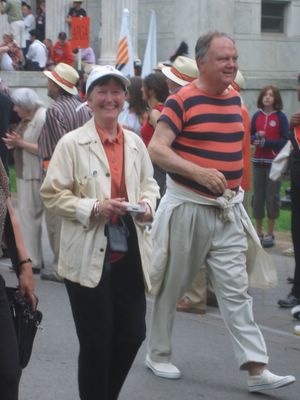
The TigerHawk sister, entomologist extraordinaire and unofficial scientific advisor to this blog, returned for her 15th reunion. The class of 1990 adopted a firefighter motif, complete with very high quality black canvas coats with orange reflectors. They were extremely sweaty while the sun was out, but when the rain came pouring down later in the day the Class of 1990 was ready.

The graduating seniors were, of course, very pumped. I should also say that their "beer jackets" are very tasteful, which is itself quite unusual. Each graduating class designs its own beer jacket for graduation and subsequent reunions costumes, so look for the Class of 2005 to set a standard of stylishness for years to come.

Finally, the tiny delegation from the great Class of 1983 formed up in front of our class banner, our ranks swelled by children and other hangers-on. Your blogger is in the front, kneeling.

(10) Comments
Syrian blogger calls us to action
Roger L. Simon reports that Syrian blogger-dissidents need your help. Syrian blogger Ammar Abdulhamid is calling for the blogosphere to flood the Syrian embassy, its UN delegation, and any other Syrian target with emails calling for the release of the Atassy 8, "prisoners of conscience" in Syria.
Here are some early targets:
Syrian Embassy in Washington, DC
syrembas@syrembassy.net
Fax: (202) 232-4357
Ministry of Tourism:
Fax: +963 11 2242636
Email: min-tourism@mail.sy
Syrian Arab News Agency
sana@net.sy
Be loud, be clear, and be persuasive. The world's dictators need to know that transparency is the friend of freedom and rule of law.
UPDATE: The original title to this post was inaccurate, so it has been revised. That will change the permalink, so if you have linked to it you will need to fix the link.
(2) Comments
[T]he Atassy 8 may not be known to you, you may not know what they have done over the years, you may not know what their exact political philosophy is (I don’t think they know that themselves really), but suffice it to know that they were committed to democracy, committed to reform and committed to dialogue. That should be enough for them to deserve our support.
So, flood the embassies with your emails, this is the least that we can do. Student groups that can hold vigils for their sake are more than encouraged to do so. Those who can write articles, op-eds or blog entries about them, go ahead and do so. Freedom for the Atassy 8 and all prisoners of conscience in Syria should be our rallying cry from now on. No reform package will be accepted from this regime if it does not include strict guarantees for our basic freedoms. We will not live at the whim of anyone. (emphasis in original)
Here are some early targets:
Syrian Embassy in Washington, DC
syrembas@syrembassy.net
Fax: (202) 232-4357
Ministry of Tourism:
Fax: +963 11 2242636
Email: min-tourism@mail.sy
Syrian Arab News Agency
sana@net.sy
Be loud, be clear, and be persuasive. The world's dictators need to know that transparency is the friend of freedom and rule of law.
UPDATE: The original title to this post was inaccurate, so it has been revised. That will change the permalink, so if you have linked to it you will need to fix the link.
(2) Comments
Saturday, May 28, 2005
Paul Krugman speaks to Princeton alumni
Paul Krugman spoke yesterday afternoon to a self-selected audience at the Princeton University Store, which hosted the event to draw in alumni during Reunions weekend. The ostensible purpose of the appearance was to sell The Great Unraveling, but Krugman spoke for almost ninety minutes on a wide range of subjects to a packed room.

The audience was heavily skewed toward older alumni -- say, 40th reunion on up -- and very young alumni. The former applauded Krugman for his strident opposition to the Bush Administration's proposals to reform Social Security, and the latter asked freighted questions about Bush's "lies" in connection with the Iraq war. No apparent conservative asked a question.
I typed six single-spaced pages of notes -- an abbreviated transcript -- during both his short introductory remarks and through the questions and answers, and if I posted it all it would be too much Krugman by almost any standard. There were, however, some highlights.
Krugman's "reluctance" to write on politics
In his introductory remarks, Krugman characterized himself as an economist with a facility to explain his profession in plain English. When the Times approached him in 1999 to write a regular column, he imagined that he would write about such things as the currency crisis in Argentina and fiscal policy. Instead, he says, he found himself increasingly concerned about the direction of the country during the 2000 election campaign.
That Paul Krugman thinks we are trying "to completely change how the Senate does business" and that the audience nods approvingly does indeed suggest that somebody is being profoundly dishonest.
Daniel Okrent's "very peculiar blast"
Newshounds know that the outbound public editor of The New York Times, Daniel Okrent, took a shot at Paul Krugman in his farewell article last Sunday. Okrent went out of his way to snark:
One of Krugman's "acolytes" asked him in sympathetic terms if he had anything to say about Okrent's charge. Many of the people in the audience did not understand the reference to Okrent, so Krugman explained that "the public editor" of the Times -- Krugman never once used Okrent's name himself -- "took a very peculiar blast" at him about the misuse of numbers without supplying any evidence. Krugman said that he had exchanged emails with "the public editor" in the last few days in response to the article, and that Okrent had not supplied any instance of Krugman misrepresenting numbers. He attributed Okrent's criticism to pressure from conservatives, and said that Okrent had questioned him about his columns via email since Okrent had come to the paper a year and a half ago, but that he (Krugman) "always had an answer." Okrent, who was "under constant pressure" from conservatives, finally gave up asking Krugman about the columns and "built up a list of grievances in his mind" which he uncorked in his final column.
Basically, Krugman believed that Okrent had a psychological need borne of pressure from conservatives to find misrepresentations in Krugman's work. According to Krugman, there are no such misrepresentations.
On the distribution of income
One old alumnus fairly bitterly asked whether we were heading toward a world in which a small group of people would make "a minimum of $3 million a year" and most everybody else would earn "a maximum of $3 per hour". Even Krugman had to admit that "it doesn't work that way," but went on to claim that all the improvements in income distribution that had occurred between the Crash of '29 and the late 1970s had been erased, that "we are back to 1920s income distribution -- the Great Gatsby has returned," and that social mobility is declining and "is actually a lot lower in the United States than in Western Europe." Any of the Krugman fans out there want to point us toward the data that prove that last point?
On politics and universities
Another person asked whether universities were "cultivating" this trend toward extreme income distribution. This question had some promise if answered honestly -- one might ask whether the bloated inefficiencies of most universities didn't push tuition beyond the reach of the middle class, for example -- but Krugman dodged it. He emphasized that it was "important to maintain independence of thought," and digressed that David Horowitz was leading an "organized campaign" against that. "Whenever I give a large class, I assume that somebody in there is feeding any example of bias back to him."
A subsequent questioner suggested that Krugman was "censoring" what he said in class, and he denied it. But he did say that he was very careful to label political opinions as such and that when he gave an assignment on a political subject such as fiscal policy, he asked the student to argue both sides on the exam. Krugman quite clearly offered these two precautions into evidence as steps he had taken to innoculate himself against the accusation that he was politically biased in his classes. When the audience tisk-tisked and looked grim, as if these concessions were themselves evidence of rising fascism, it was genuinely hard not to burst out laughing.
The crushing of dissent
One of the younger generation asked why the "Downing Street" memorandum had not received more coverage in the United States, and whether Krugman thought "that the Bush Administration has initimidated the media to the point where they can’t even report on the truth any more?"
"Hell yes," said Krugman. Huh? "Everybody understands that if you are critical of the administration, they will come down on you. They will put pressure, they will scream at the editors, and they will try to destroy your credibility."
Well, Paul, destruction of credibility is the sine qua non of refutation, and any editor who can't deal with somebody from the White House staff screaming at them isn't very committed to free speech.
Shorting the dollar
Krugman was at his most interesting when he talked about economics. He was asked "what are the changes for a big currency crash" and what would its effects be on politics and the economy? Krugman replied that this question is best answered by asking and answering four other questions:
As regular readers know, I have argued repeatedly that the dollar will generally rally against most foreign currencies because the alternatives are so poor. However, I agree with Krugman that there is something going on with American investment flows that is historically anamolous and potentially troubling:
Krugman also answered several questions about universal health care, said that Brad DeLong was his "favorite econo-blogger" and sympathized with a half dozen "questioners" who stood up and made speeches about the United States becoming an authoritarian country. One woman who looked about 60 claimed she "grew up in Stalin's Russia" and that a lot of the things she saw in the United States today reminded her of Russia under Uncle Joe. Another perfectly respectable-looking member of the audience offered a long rant about the rise of fascism and compared the intimidation of the press in the United States today to the suppression of the press in Germany during the 1930s. Krugman politely deflected these questions with a smile, probably aware that some blogger would be all over him if he agreed. He did not, however, take issue with these people, but only suggested that it would be a poor tactic if he wrote so bluntly in his column:
Finally, Krugman confided some optimism.
(12) Comments

The audience was heavily skewed toward older alumni -- say, 40th reunion on up -- and very young alumni. The former applauded Krugman for his strident opposition to the Bush Administration's proposals to reform Social Security, and the latter asked freighted questions about Bush's "lies" in connection with the Iraq war. No apparent conservative asked a question.
I typed six single-spaced pages of notes -- an abbreviated transcript -- during both his short introductory remarks and through the questions and answers, and if I posted it all it would be too much Krugman by almost any standard. There were, however, some highlights.
Krugman's "reluctance" to write on politics
In his introductory remarks, Krugman characterized himself as an economist with a facility to explain his profession in plain English. When the Times approached him in 1999 to write a regular column, he imagined that he would write about such things as the currency crisis in Argentina and fiscal policy. Instead, he says, he found himself increasingly concerned about the direction of the country during the 2000 election campaign.
It became clear to me that something funny was going on. People were being profoundly dishonest. The issue that radicalized me in 2000 was the issue of Social Security, so in some sense we have come full circle. Then from then on things became increasingly political.
And I hate it, by the way. I wish we didn’t live in that kind of world. I’m a moderate Democrat.
The big thing in The Great Unraveling is that I went out on a limb and said that these are not just bad guys from my point of view, but that we are facing a radical challenge. I have slimmed it down: Basically we have a coalition between a radical religious right and a radical economic right that has come to power in Washington, and does not take for granted things as they were. That we are trying to completely change how the Senate does business as just one small example.
That Paul Krugman thinks we are trying "to completely change how the Senate does business" and that the audience nods approvingly does indeed suggest that somebody is being profoundly dishonest.
Daniel Okrent's "very peculiar blast"
Newshounds know that the outbound public editor of The New York Times, Daniel Okrent, took a shot at Paul Krugman in his farewell article last Sunday. Okrent went out of his way to snark:
Op-Ed columnist Paul Krugman has the disturbing habit of shaping, slicing and selectively citing numbers in a fashion that pleases his acolytes but leaves him open to substantive assaults. Maureen Dowd was still writing that Alberto R. Gonzales "called the Geneva Conventions 'quaint' " nearly two months after a correction in the news pages noted that Gonzales had specifically applied the term to Geneva provisions about commissary privileges, athletic uniforms and scientific instruments. Before his retirement in January, William Safire vexed me with his chronic assertion of clear links between Al Qaeda and Saddam Hussein, based on evidence only he seemed to possess.
No one deserves the personal vituperation that regularly comes Dowd's way, and some of Krugman's enemies are every bit as ideological (and consequently unfair) as he is. But that doesn't mean that their boss, publisher Arthur O. Sulzberger Jr., shouldn't hold his columnists to higher standards.
I didn't give Krugman, Dowd or Safire the chance to respond before writing the last two paragraphs. I decided to impersonate an opinion columnist.
One of Krugman's "acolytes" asked him in sympathetic terms if he had anything to say about Okrent's charge. Many of the people in the audience did not understand the reference to Okrent, so Krugman explained that "the public editor" of the Times -- Krugman never once used Okrent's name himself -- "took a very peculiar blast" at him about the misuse of numbers without supplying any evidence. Krugman said that he had exchanged emails with "the public editor" in the last few days in response to the article, and that Okrent had not supplied any instance of Krugman misrepresenting numbers. He attributed Okrent's criticism to pressure from conservatives, and said that Okrent had questioned him about his columns via email since Okrent had come to the paper a year and a half ago, but that he (Krugman) "always had an answer." Okrent, who was "under constant pressure" from conservatives, finally gave up asking Krugman about the columns and "built up a list of grievances in his mind" which he uncorked in his final column.
Basically, Krugman believed that Okrent had a psychological need borne of pressure from conservatives to find misrepresentations in Krugman's work. According to Krugman, there are no such misrepresentations.
On the distribution of income
One old alumnus fairly bitterly asked whether we were heading toward a world in which a small group of people would make "a minimum of $3 million a year" and most everybody else would earn "a maximum of $3 per hour". Even Krugman had to admit that "it doesn't work that way," but went on to claim that all the improvements in income distribution that had occurred between the Crash of '29 and the late 1970s had been erased, that "we are back to 1920s income distribution -- the Great Gatsby has returned," and that social mobility is declining and "is actually a lot lower in the United States than in Western Europe." Any of the Krugman fans out there want to point us toward the data that prove that last point?
On politics and universities
Another person asked whether universities were "cultivating" this trend toward extreme income distribution. This question had some promise if answered honestly -- one might ask whether the bloated inefficiencies of most universities didn't push tuition beyond the reach of the middle class, for example -- but Krugman dodged it. He emphasized that it was "important to maintain independence of thought," and digressed that David Horowitz was leading an "organized campaign" against that. "Whenever I give a large class, I assume that somebody in there is feeding any example of bias back to him."
A subsequent questioner suggested that Krugman was "censoring" what he said in class, and he denied it. But he did say that he was very careful to label political opinions as such and that when he gave an assignment on a political subject such as fiscal policy, he asked the student to argue both sides on the exam. Krugman quite clearly offered these two precautions into evidence as steps he had taken to innoculate himself against the accusation that he was politically biased in his classes. When the audience tisk-tisked and looked grim, as if these concessions were themselves evidence of rising fascism, it was genuinely hard not to burst out laughing.
The crushing of dissent
One of the younger generation asked why the "Downing Street" memorandum had not received more coverage in the United States, and whether Krugman thought "that the Bush Administration has initimidated the media to the point where they can’t even report on the truth any more?"
"Hell yes," said Krugman. Huh? "Everybody understands that if you are critical of the administration, they will come down on you. They will put pressure, they will scream at the editors, and they will try to destroy your credibility."
Well, Paul, destruction of credibility is the sine qua non of refutation, and any editor who can't deal with somebody from the White House staff screaming at them isn't very committed to free speech.
Shorting the dollar
Krugman was at his most interesting when he talked about economics. He was asked "what are the changes for a big currency crash" and what would its effects be on politics and the economy? Krugman replied that this question is best answered by asking and answering four other questions:
Is the current balance of payments sustainable? If not, will it end with a wimper or a bang? Whether with a wimper or a bang, how bad is the end going to be? What are we going to do? My answers are, in order: "No," "bang," “I don't know, but have a bad feeling about it,” “and run away.” The current balance of payments is not sustainable. Almost always these things come to an abrupt end. We are going to have a “Wile E. Coyote” moment. The case for a big fall in the dollar is overwhelming, with the one caveat that if you think about the alternatives you say, oh, wait a minute, what is so attractive about the Euro or the yen. But we are living way beyond our means, and the Europeans are not. So I think it happens quite suddenly when it happens. How bad? There is one big difference between the United States and Argentina, for example. Our foreign debt is in our own currency. We do not have the Argentina problem, but there may be other stuff. Housing already looks like a bubble. If interests rates go up – which they would if the dollar plunged – housing would be in trouble. Ultimately, I don’t know, for sure, how bad it would be. For what it's worth, Robert Rubin and Paul Volcker, who are the two clamest men I know, are both very concerned about this.
As regular readers know, I have argued repeatedly that the dollar will generally rally against most foreign currencies because the alternatives are so poor. However, I agree with Krugman that there is something going on with American investment flows that is historically anamolous and potentially troubling:
[Our balance of payments] is a very weird situation. The way it is suppose to work is that rich advanced countries lend some of their extra savings to poor countries where the opportunities are. Capital is supposed to flow from the rich countries to the poor countries. What we have instead is that the U.S. is sucking in huge amounts of capital from the rest of the world for the purpose of high consumption, instead of investment, and a lot of that capital is coming from China and oil producing countries. It should be unstable. As a share of GDP, the current account deficit is bigger than most precedents. So far, however, the Chinese are still buying lots and lots of dollars. I believe it is going to blow, but if you had believed me all along and speculated on that you would have lost money.
Krugman also answered several questions about universal health care, said that Brad DeLong was his "favorite econo-blogger" and sympathized with a half dozen "questioners" who stood up and made speeches about the United States becoming an authoritarian country. One woman who looked about 60 claimed she "grew up in Stalin's Russia" and that a lot of the things she saw in the United States today reminded her of Russia under Uncle Joe. Another perfectly respectable-looking member of the audience offered a long rant about the rise of fascism and compared the intimidation of the press in the United States today to the suppression of the press in Germany during the 1930s. Krugman politely deflected these questions with a smile, probably aware that some blogger would be all over him if he agreed. He did not, however, take issue with these people, but only suggested that it would be a poor tactic if he wrote so bluntly in his column:
You have to modulate yourself so you don’t lose people. I cannot write two columns a week saying “gee, this looks like the road to fascism.” It won’t do any good. We all have to pick and choose.
Finally, Krugman confided some optimism.
Weirdly, I’m feeling somewhat encouraged. I was deeply encouraged that Joe Lieberman voted against John Bolton yesterday... If you compare the way things are today to the way you felt after the election, you want to give Harry Reid and Nancy Pelosi a Nobel prize for politicking.
(12) Comments
Friday, May 27, 2005
The forever war
Japanese diplomats investigated claims Friday that two former Japanese soldiers have been hiding in the mountains of the southern Philippines since World War II.
The health ministry, in charge of repatriating Japanese overseas, said it was sending an official to the southern Philippine city of General Santos on Saturday to join Japanese embassy officials attempting to reach the pair....
In September, a Japanese national in the lumber business ran into the men in the mountains, the Japanese newspaper Sankei Shimbun reported. It was learned later that they wanted to go back to Japan but were afraid of facing a court-martial for withdrawing from action, the newspaper said.
Another source told the paper there may be more than 40 other Japanese soldiers living in the mountains, and they all want to return to Japan, the Sankei said.
The family of one of the soldiers released this picture of their lost soldier.

In this undated photo released by a family member and obtained by Kyodo News, Japanese Imperial Army soldier Tsuzuki Nakauchi is seen aboard a military horse. Pfc. Nakauchi is believed to be one of two former Japanese servicemen who have been hiding in the mountains of the southern Philippines island of Mindanao since World War II. Diplomats from Japan on Friday May 27, 2005, investigated the astonishing claims of two men who say they are former Japanese soldiers who have been hiding in the mountains of southern Philippines since World War II. Japanese Embassy representatives went to the region to interview the men in a meeting that was being arranged by a third person who contacted the mission, embassy official Masaru Watanabe said. Japanese Embassy spokesman Shuhei Ogawa cautioned that it was too early to draw any conclusions, saying there was no evidence yet that the men were WWII fighters. (AP Photo/Kyodo News)
Imagine how alienated these men would feel in modern Japan, and how shocked modern Japan might feel by the return of these men. If the Japanese react the way I imagine Americans would, these soldiers would be on television before they had ever watched television, an astonishing idea. Would the return of perhaps 40 soldiers from Imperial Japan -- soldiers that have not lived through the occupation of Japan and its forced democratization under the United States -- change the political consciousness of that country just as it is flexing its muscles for the first time in sixty years? If these Japanese ba'al t'shuva remind Japan of its martial history, will adventurism abroad become more popular in a wave of nostalgia, or less popular in a fit of revulsion?
(0) Comments
The rewards of anti-Americanism
Colombian artist Fernando Botero's "Sitting Woman," a bronze sculpture made in 1976, was sold at auction for 688,000 dollars -- a record for a Botero sculpture.
Sold at Christie's late Wednesday, the sculpture went for the fourth highest price for a Latin American work for the auction house.
Would Botero's art be worth so much if he hadn't devoted the last year to bashing the United States?
(3) Comments
Condaleeza hammers, Syria confesses
Condoleezza Rice has been hammering away at Syria in recent weeks, at one point saying that "Syria that needs to understand that it should not think itself immune from the way that the region is going." This is widely understood as an accusation that Syria has been supporting the reactionaries in Iraq, at least to the extent of ignoring their use of its border as an entrance and an exit.
Syria has responded with extended whining, finally declaring that it would no longer share intelligence or otherwise cooperate with the United States. Presumably to bolster the point that the United States would regret losing that cooperation, Syria announced yesterday that in recent weeks it had arrested 1,200 would-be insurgents who were attempting to cross from its territory into Iraq.
The Associated Press, it seems, has written this story upside down. If Syria has, in fact, been able to arrest more than a thousand insurgents in just the last few weeks, why hasn't it been doing that for the last two years? Syria, in its braggodocio, has implicitly confessed that it has been able to stop insurgents from crossing the border all along, and effectively admitted the charges against it.
UPDATE: Ooops. I spelled the Secretary of State's first name wrong. That's something that definitely would not happen in the mainstream media, so they have that going for them!
(11) Comments
Syria has responded with extended whining, finally declaring that it would no longer share intelligence or otherwise cooperate with the United States. Presumably to bolster the point that the United States would regret losing that cooperation, Syria announced yesterday that in recent weeks it had arrested 1,200 would-be insurgents who were attempting to cross from its territory into Iraq.
"We gave a lot of information to the United States on these issues, which prevented many attacks, but regrettably, the United States did not recognize such kind of help," [Syria's ambassador to the United Nations, Fayssal Mekdad,] said in an interview.
The Associated Press, it seems, has written this story upside down. If Syria has, in fact, been able to arrest more than a thousand insurgents in just the last few weeks, why hasn't it been doing that for the last two years? Syria, in its braggodocio, has implicitly confessed that it has been able to stop insurgents from crossing the border all along, and effectively admitted the charges against it.
UPDATE: Ooops. I spelled the Secretary of State's first name wrong. That's something that definitely would not happen in the mainstream media, so they have that going for them!
(11) Comments
Open SESAME
If Arthur Chrenkoff is looking for another "good news" beat, perhaps he should turn next to Israel and its neighbors. There is more than hatred in the region, and therefore a chance at peace in the long run. For example, Haitham Sabbah, a Palestinian living in Jordan, wonders whether SESAME can become an "oasis of peace" in the Middle East.
SESAME's web site is here. The project obviously bears watching, yet Technorati reveals essentially no coverage from the blogosphere.
Sabbah, by the way, is an excellent blogger. I do not agree with his politics (he is more than a little anti-American), but he writes well on a very wide range of topics. I have blogrolled him under "Regional Blogs" down the sidebar.
(0) Comments
Here’s some good news from the Jordan: Israel, Iran, Syria, Bahrain, United Arab Emirates, Egypt, Palestine Morocco, Saudi Arabia, Lebanon, Algeria, Jordan and many other countries from around the globe ... need no “Open SESAME magic” to be able to cooperate on an advanced scientific project.
In Al-Balqa’ Applied University, just north of Amman - and at a comfortable distance from the spotlight thrown by political conflicts - representatives of these countries are involved in developing SESAME, an acronym for Synchrotron-light for Experimental Science and Applications in the Middle East.
It’s a rare and possibly unique example of scientific cooperation between Israel and so many Arab countries. Libya is expected to join soon as an observer....
The political importance of the project cannot be underestimated. Scientists in the region work together in a spirit of cooperation for the sake of developing the Middle East.
SESAME, the Middle East’s first major international research center, is a synchrotron accelerator. It uses magnets to create a circular path for electrons traveling at nearly the speed of light, producing a beam of bright ultraviolet and X-ray light, about the diameter of a human hair, that is directed down beam lines to end stations.
SESAME's web site is here. The project obviously bears watching, yet Technorati reveals essentially no coverage from the blogosphere.
Sabbah, by the way, is an excellent blogger. I do not agree with his politics (he is more than a little anti-American), but he writes well on a very wide range of topics. I have blogrolled him under "Regional Blogs" down the sidebar.
(0) Comments
Thursday, May 26, 2005
The stem cell nonsense
Paul Mirengoff of Power Line gives voice to the ambivalence that many conservatives feel about embryonic stem cell research.
I agree. If I had a chance to direct investment in embryonic stem cell research, I would do so. But Mirengoff is falling into a trap that the Democrats have set. This debate is not -- as the Democrats and the MSM contend -- a struggle between religious moralists who want to ban embryonic stem cell research and seekers of truth who want to save humanity from devestating pathologies. Stem cell research will not be stopped. It is happening all over the place, with federal funds on the grandfathered lines, with state funds in New Jersey and California, without restriction in the private sector, and in many other scientifically advanced countries of the world. No disease will go uncured -- at least not in the long run -- because the government of the United States does not fund stem cell research.
No. This argument is about convenience for a few American university professors. They want to be able to experiment with embryonic stem cells without soiling themselves in the for-profit sector or moving to a foreign country. Never mind that they could save the world from a lab in a British university or an American biotech company -- they only want to do their work if they can do it in the comfort of federally subsidized laboratories in American universities, not caring that the subsidy itself is deeply offensive to millions of people.
That the mainstream media has taken up the cause of these professors as if it were anything other than self-serving says a great deal about the contempt that the elite press has for religious people.
UPDATE: Daniel Gottesman argues against the position I've taken in this post in an interesting comment.
(8) Comments
President Bush has said that he will veto legislation Congress is likely to pass calling for federal funding of embryonic stem cell research on stem cell lines other than those previously approved by the administration. It would be the first time Bush has used his veto power.
This issue divides conservatives and it's easy for me to see why, since I'm of two minds about it myself. On balance, while I admire Bush for taking a principled stand on the issue, I tend to think he's taken the wrong stand.
I agree. If I had a chance to direct investment in embryonic stem cell research, I would do so. But Mirengoff is falling into a trap that the Democrats have set. This debate is not -- as the Democrats and the MSM contend -- a struggle between religious moralists who want to ban embryonic stem cell research and seekers of truth who want to save humanity from devestating pathologies. Stem cell research will not be stopped. It is happening all over the place, with federal funds on the grandfathered lines, with state funds in New Jersey and California, without restriction in the private sector, and in many other scientifically advanced countries of the world. No disease will go uncured -- at least not in the long run -- because the government of the United States does not fund stem cell research.
No. This argument is about convenience for a few American university professors. They want to be able to experiment with embryonic stem cells without soiling themselves in the for-profit sector or moving to a foreign country. Never mind that they could save the world from a lab in a British university or an American biotech company -- they only want to do their work if they can do it in the comfort of federally subsidized laboratories in American universities, not caring that the subsidy itself is deeply offensive to millions of people.
That the mainstream media has taken up the cause of these professors as if it were anything other than self-serving says a great deal about the contempt that the elite press has for religious people.
UPDATE: Daniel Gottesman argues against the position I've taken in this post in an interesting comment.
(8) Comments
Tolerance Does Not Require Cultural Relativism and Political Correctness
Neo-Neocon expresses beautifully a sentiment I'd venture many feel about politically correct commentary and Islam. Those who forcefully argue that we must be especially culturally sensitive about Islam are either fools, cowards or the bad guys. How many culturally insensitive comments are made daily in the liberal press about Evangelicals, Jews and Catholics, to name a few? Yet those comments don't give rise to violence or murder, do they? Yet make an intellectually sound comment or critique of Islam, and the next thing you know, you have a death sentence hanging over your head - please note Theo Van Gogh's rather culturally insensitive murder after he made a movie about it. Or the dozens of similar death sentences issued for writers and critics of Islam.
Where is the MSM outrage there?
(1) Comments
Where is the MSM outrage there?
(1) Comments
The Children's Brain Tumor Foundation
Yesterday and today are given over to a management off-site meeting, which has been declared "e-free," probably to prevent me from blogging through the boring parts. Normally, the first night of these two day meetings involves a dinner, but last night we all dressed up and boarded a bus for Manhattan to attend a fund-raiser for the Children's Brain Tumor Foundation. This organization does amazing work, both to support research into the identification and cure of pediatric brain cancer, and to help families who have been stricken with this tragedy. Please consider clicking through and making a donation. It is a wonderful cause.
Our CEO supports the Children's Brain Tumor Foundation, so he naturally asked the professional firms who service our company to pitch in, and many of them did. For those of you who are familiar with the first firm, here is photographic evidence of their participation:

If you are in both serious legal trouble and have some money or a good insurance company, there is no better friend. And, by the way, if you are a bloodsucking leech of a plaintiff, there is no worse enemy.
(1) Comments
Our CEO supports the Children's Brain Tumor Foundation, so he naturally asked the professional firms who service our company to pitch in, and many of them did. For those of you who are familiar with the first firm, here is photographic evidence of their participation:
If you are in both serious legal trouble and have some money or a good insurance company, there is no better friend. And, by the way, if you are a bloodsucking leech of a plaintiff, there is no worse enemy.
(1) Comments
This explains a lot
Scientists have discovered Comedy Central in the brain - specific tissue regulating the ability to understand sarcasm.
People with damage to the right frontal lobe, right behind the eyes, are unable to appreciate this kind of humor.
In sarcasm, "the literal meaning is different from the true meaning, and some people just don't understand that difference," said Simone Shamay-Tsoory, a psychologist at the Rambam Medical Center and University of Haifa in Israel. Her study appears in the May issue of the journal Neuropsychology.
I have always thought that people who do not understand sarcasm are brain damaged. How right I was.
(0) Comments
We're chillin'

Wednesday, May 25, 2005
A small victory
If, as is being reported, Abu-Musab al-Zarqawi has fled Iraq to a "neighboring country" so that he can recover from gunshot wounds to his lung, we should chalk it up as a victory for the good guys. The question is, has Zarqawi built a command-and-control structure that can survive his departure?
I'm sure you all agree that it will be very interesting to discover which "neighboring country" he has fled to.
(2) Comments
I'm sure you all agree that it will be very interesting to discover which "neighboring country" he has fled to.
(2) Comments
A blog entry solves a murder
West Africa: "the next Afghanistan"
Having been driven into the caves in Afghanistan and western Pakistan and having learned the the Sunni Triangle of Iraq is less a "haven" than a killing field, al Qaeda is looking for a new base of operations from which it can operate free of Western entanglements. There is growing evidence that Al Qaeda is embedding itself into the slums and villages of West Africa.
A couple of weeks ago I wrote this long post about al Qaeda's "investments" Mauritania. Now we have this report, which claims that Liberia's revolting former president Charles Taylor was on al Qaeda's payroll.
Taylor counts among his various sordid colleagues a Middle Eastern businessman named Mohamed Mustafa Fadhil. Fadhil has long been on the FBI's "most wanted" list of terrorists, and has been indicted in the Southern District of New York for his alleged involvement in the bombings of the American embassy bombings in Tanzania and Kenya in August, 1998.
This is going to be a long war.
(2) Comments
A couple of weeks ago I wrote this long post about al Qaeda's "investments" Mauritania. Now we have this report, which claims that Liberia's revolting former president Charles Taylor was on al Qaeda's payroll.
Liberia's exiled former president, Charles Taylor, received money recently from an al-Qaida operative and is trying to destabilize west Africa, prosecutors for Sierra Leone's U.N.-backed war crimes tribunal said Tuesday.
Chief prosecutor David Crane said Taylor harbored members of al-Qaida including those who allegedly took part in the bombings of the U.S. embassies in Kenya and Tanzania in 1997, and was allegedly in contact with a member of the terrorist network as recently as last month.
"Al-Qaida has been in west Africa. It continues to be in west Africa, and Charles Taylor has been harboring members of al-Qaida," Crane said, adding that he believes west Africa is going to become the next Afghanistan.
Taylor counts among his various sordid colleagues a Middle Eastern businessman named Mohamed Mustafa Fadhil. Fadhil has long been on the FBI's "most wanted" list of terrorists, and has been indicted in the Southern District of New York for his alleged involvement in the bombings of the American embassy bombings in Tanzania and Kenya in August, 1998.
This is going to be a long war.
(2) Comments
Rings

Specially designed Cassini orbits place Earth and Cassini on opposite sides of Saturn’s rings, a geometry known as occultation. Cassini conducted the first radio occultation observation of Saturn’s rings on May 3, 2005.
Three simultaneous radio signals of 0.94, 3.6, and 13 centimeter wavelength (Ka-, X-, and S-bands) were sent from Cassini through the rings to Earth. The observed change of each signal as Cassini moved behind the rings provided a profile of the distribution of ring material as a function of distance from Saturn, or an optical depth profile.
This simulated image was constructed from the measured optical depth profiles. It depicts the observed ring structure at about 10 kilometers (6 miles) in resolution. Color is used to represent information about ring particle sizes in different regions based on the measured effects of the three radio signals.
Purple color indicates regions where there is a lack of particles of size less than 5 centimeters (about 2 inches). Green and blue shades indicate regions where there are particles smaller than 5 centimeters (2 inches) and 1 centimeter (less than one third of one inch). The saturated broad white band near the middle of ring B is the densest region of ring B, over which two of the three radio signals were blocked at 10-kilometer (6-mile) resolution, preventing accurate color representation over this band. From other evidence in the radio observations, all ring regions appear to be populated by a broad range particle size distribution that extends to boulder sizes (several to many meters across).
Link.
Consider this the monthly TigerHawk gratis promotion of the space program.
(0) Comments
Tuesday, May 24, 2005
Body art
John McCain '08?
In order to reach the rather tepid agreement Tigerhawk earlier described to defuse the filibuster controversy, it seems the Republican crowd needed somebody to sell them out. And that person, if Senator Frist's recent threat to renew the "constitutional/nuclear option" is correct, was John McCain -- undoubtedly preparing to seize the "middle ground" for his presidential run. Giuliani is lucky to sit this one out.
(4) Comments
(4) Comments
Zarqawi is wounded
According to al Qaeda in Iraq, which apparently can get Reuters to report its press releases:
Old news to readers of TigerHawk, I might add.
(1) Comments
"O nation of Islam ... Pray for the healing of our Sheikh Abu Musab al-Zarqawi from an injury he suffered in the path of God," said a statement from the Al Qaeda Organization for Holy War in Iraq. Its authenticity could not be verified.
"The injury of our leader is an honor and an incentive to tighten the noose on the enemies of God and a reason to step up our attacks on them," the statement said.
Old news to readers of TigerHawk, I might add.
(1) Comments
An American classic...
Reinterpreted by a Palestinian. This guy should hook up with Fernando Botero.
If the world held Americans to the same low standards that it applies to Muslims, it would expect deadly riots and fist-pumping demonstrations in the streets of Cedar Rapids.
(0) Comments
If the world held Americans to the same low standards that it applies to Muslims, it would expect deadly riots and fist-pumping demonstrations in the streets of Cedar Rapids.
(0) Comments
A proposal for Japan
China is "upset" over a Japanese war shrine. While I am also at least a little troubled by Japan's cultural unwillingness to accept culpability for its atrocities in Asia during the thirties and forties, the "Toilet-Koran" kerfuffle has burned out my sympathy for international rage over perceived slights or even alleged desecretations.
So I have a proposal for the Japanese: We'll build memorials to their war dead, and they'll flush the Korans down the toilet and interrogate the prisoners at Gitmo. That'll confuse everybody, and probably get better results.
(0) Comments
So I have a proposal for the Japanese: We'll build memorials to their war dead, and they'll flush the Korans down the toilet and interrogate the prisoners at Gitmo. That'll confuse everybody, and probably get better results.
(0) Comments
The Senate filibuster "deal"

Link to the pdf file here.
A quick read of the lefty blogs suggests that they are less annoyed by the compromise than the righty blogs (or at least the righty blogs that care a lot about this issue). Or, to put it differently, the lefty blogs are happy that the conservatives are so annoyed.
As regular readers of this blog know, judicial filibusters have not been one of my big issues. However, I think that the Republicans handled this issue all wrong from the get-go. Whether or not abolishing judicial filibusters would have increased the leverage of sitting Republicans over these few nominees, we know that abolition would have weakened the Senate as an institution vs. the executive branch. This is because the possibility of a filibuster forces the executive branch to negotiate. Eliminate that possibility, and you weaken the Senate. Eventually, enough Republicans figured out that weakening the Senate's institutional muscle was not in their interest, even if it got a few more conservative judges through. They will face the wrath of Dobson, but so what? Where are the Christians going to turn?
Of course, this exercise also proves that the bleating on the left about "theocracy" and all the rest of their scaremongering is just so much hot air. When push came to shove, the fundamentally conservative -- as in non-changing -- Senate came to its senses. This showdown amounted to brinksmanship, not too different from traditional bladder-burster filibusters of old.
CWCID (for the links): AMERICABlog.
UPDATE: Michelle Malkin has a complete round-up of conservative rage and betrayal angst, including her own. Not having consumed this particular Kool-Aid, I seem to be immune to whatever it is that has gotten the right in such a twist over all this.
(8) Comments
The Seventh Circuit is down with that...
One of the great things about life tenure is you get to write stuff like this (pdf, footnote 1) and it carries, er, the force of law:
Word.
CWCID: Adam.
(1) Comments
1 The trial transcript quotes Ms. Hayden as saying Murphy called
her a snitch bitch “hoe.” A “hoe,” of course, is a tool used for
weeding and gardening. We think the court reporter, unfamiliar
with rap music (perhaps thankfully so), misunderstood Hayden’s
response. We have taken the liberty of changing “hoe” to “ho,” a
staple of rap music vernacular as, for example, when Ludacris
raps “You doin’ ho activities with ho tendencies.”
Word.
CWCID: Adam.
(1) Comments
Monday, May 23, 2005
Goodnight Moon
Margaret Wise Brown, the author of Goodnight Moon and more than 100 other children's books, would have been 95 today. If she hadn't died in 1952.
How many millions of parents have memorized Goodnight Moon, and reluctantly caved when their toddler demanded "Moon!" for the umpty-umpth time?
Of course, many people do not appreciate the best line of the book, which must be yelled and accompanied by a fist-pumping salute: "Good night mush!"
(1) Comments
How many millions of parents have memorized Goodnight Moon, and reluctantly caved when their toddler demanded "Moon!" for the umpty-umpth time?
Of course, many people do not appreciate the best line of the book, which must be yelled and accompanied by a fist-pumping salute: "Good night mush!"
(1) Comments
Best wishes...
SportsProf had his first blogiversary yesterday, and he celebrated with a highlights post. Well worth checking out, and encourage him to cough up that novel he has inside.
(0) Comments
(0) Comments
Painting Venice

The artist, one "Diamonster," invested 500 hours creating this "painting" with MS Paint, plus a little touchup with Photoshop. Count me as impressed.
CWCID: My favorite Tunisian blogger, Subzero Blue, who observes that the artist must have "nerves of steel" to do something like this in MS Paint. Indeed.
(1) Comments
"This we'll defend"
Major K. explains why he fights:
Better there than here. Be thankful that we have soldiers like the Major to bear our standard Over There.
(0) Comments
We are fighting this war on their turf, not ours. We do this for two reasons: First, so that our neighborhoods, buildings and innocent civilians don't get blown up or shot by the arhabi as they did on 9/11. This allows a lot of Americans to live in blissful ignorance of what war and real poverty are like. The idea of the local police station in Anytown, USA being attacked with mortars and machine guns several times a week is inconceivable to Americans. I like it that way. Second, we fight on their turf so that they alienate themselves from their local sympathizers. When a bomb goes off or a rocket impacts, it destroys the very roads, buildings and other infrastructure of the people that the arhabi claim to be fighting for. This is why the Iraqis hate the arhabi, but a lot of them are still scared of them.
Better there than here. Be thankful that we have soldiers like the Major to bear our standard Over There.
(0) Comments
RABBITinator

If you nudge this robot, it steps forward and catches its balance—much like a human.
The machine called RABBIT, which resembles a high-tech Tin Man from "The Wizard of Oz," minus the arms, was developed by University of Michigan and French scientists over six years. It's the first known robot to walk and balance like a human, and late last year, researchers succeeded in making RABBIT run for six steps. It has been able to walk gracefully for the past 18 months.
Link. Live motion video here.
Compare and contrast:


Does anybody else think that RABBIT's resemblence to the Terminator skeleton is disturbing?
(1) Comments
Half forensic lab, half tavern
The New York Times reports this morning on a new study by the Pew Institute, which seeks to tease out the impact of bloggers on the mainstream media's agenda. The study looked at various of the "blogstorms" for which we (as a class) have taken so much credit, and apparently concludes that they are more potent when there is a totem or document that bloggers can latch on to. The article (on page C5 of the business section) focuses on RatherGate, and concludes that it would not have gained the traction that it did if the memos had not been available in digital form for dissection.
Interestingly, the author of the column, Tom Zeller Jr., refers to the Killian memos as "forged Vietnam-era documents," which boosts his credibility on the subject of blogging far above, say, this fool (via Mark Tapscott and Instapundit). Or this guy.
Zeller quotes the study's author, George Washington University Professor Michael Cornfield [he isn't from Iowa, is he? - ed.], who has this to say about the impact of blogging:
I think this is as decent a metaphor as I have seen. Bloggers as a group combine two attributes -- the ability to assemble expertise on almost any topic at extreme speed, and the propensity to write at very high velocity. This combination of expertise and velocity comes at the cost, perhaps, of sobriety (there's the tavern metaphor) and deliberation. However, the competing tendency of bloggers to edit each other, also at high velocity, limits the potential damage of errors of fact.
UPDATE: I'll have more to say on the underlying report at the other end of the work day.
(8) Comments
For all that, though, the most crucial factor contributing to blog influence in that issue may have been the smoking gun: digital copies of the 1970's-era documents and their impossibly modern fonts.
These became powerful totems because they could be relentlessly examined, tinkered with, traded and discussed online by blogs of all political stripes, each with its own agenda and each contributing to a buzz that ultimately could not be ignored.
Interestingly, the author of the column, Tom Zeller Jr., refers to the Killian memos as "forged Vietnam-era documents," which boosts his credibility on the subject of blogging far above, say, this fool (via Mark Tapscott and Instapundit). Or this guy.
Zeller quotes the study's author, George Washington University Professor Michael Cornfield [he isn't from Iowa, is he? - ed.], who has this to say about the impact of blogging:
"The blogosphere is half forensic lab and half tavern," said Michael Cornfield, an adjunct professor at the Graduate School of Political Management at George Washington University and the chief author of the study.
"The magic of the Internet is you can be looking at evidence, at direct documentation, while you're talking," Mr. Cornfield said, referring to the fake memos that turned blogs into influential buzzmakers. "It would be as if the Nixon tapes were available in MP3 format during Watergate."
I think this is as decent a metaphor as I have seen. Bloggers as a group combine two attributes -- the ability to assemble expertise on almost any topic at extreme speed, and the propensity to write at very high velocity. This combination of expertise and velocity comes at the cost, perhaps, of sobriety (there's the tavern metaphor) and deliberation. However, the competing tendency of bloggers to edit each other, also at high velocity, limits the potential damage of errors of fact.
UPDATE: I'll have more to say on the underlying report at the other end of the work day.
(8) Comments
Sunday, May 22, 2005
SkivviesGate and the rule of law
The Glittering Eye has its skivvies in a twist over, er, SkivviesGate. His argument is, essentially, that da law is da law:
Well, sure. Far be it from me to come out and approve of a palpable violation of the law. But was the leaking of these photos some sort of heinous crime, or was it the moral equivalent of stealing from the Mafia?
In any enterprise as large and chaotic as war, violations of law are bound to occur. In this war, more than any before it, the violations of one side -- the United States and its allies -- are exposed to the scrutiny of billions of people. In virtually every case, American violations of law were brought to light after they had been investigated by the United States itself. Even in SkivviesGate, the United States responded quickly at the highest levels. How a government responds to a violation of international law is important. Notwithstanding the partisan bleatings of the left, I cannot think of another example in history of a government responding as openly as the United States has to charges of war crimes (other than perhaps Israel on various occasions). How many internal investigations did the Russians launch during their long occupation of Afghanistan? Did Saddam prosecute any of his own soldiers for the crimes they committed in his wars against Iran and Kuwait? I think we know the answers to both questions.
The other fairly obvious point is that the Geneva Conventions protect the dignity of soldiers in part because rank-and-file grunts are considered to have been doing their duty, substantially under compulsion. They are, to a great degree, innocent, insofar as they had no meaningful choice but to fight for their country. Saddam, however, is a dirtbag of a different order. While it is true that he is a prisoner of war because of his membership in the Iraqi military, his culpability is of a palpably more heinous nature than that of the typical soldier for whom the Geneva Conventions were devised.
SkivviesGate has not degraded the rule of law. It has reinforced the rule of law. The United States has responded with an almost laughable gravity to a technical violation of the Geneva Conventions. Indeed, most of the public expressions of rage at the United States over this episode are disingenuous (not that of The Glittering Eye), and motivated by purposes other than concern for the rule of law.
(0) Comments
Saddam Hussein is a prisoner of war. We are obligated by the treaty to protect him from public curiosity. That taking pictures of him in his underwear and then allowing those pictures to be published in a newspaper is a failure to protect him from public curiosity would appear to be self-evident. That it is a failure to secure “respect for his person and his honor” would also appear to be self-evident. If you don't believe so, just read any of the many outraged comments from Iraqis.
That Saddam Hussein is vile and loathsome is irrelevant. The United States is a party to a treaty and the terms of that treaty should be scrupulously observed.
I agree with those who point out that in the total scheme of things a picture in his skivvies is small potatoes compared with the thousands or hundreds of thousands of atrocities that Saddam committed, ordered to be committed or condoned. But that, too, is irrelevant. The issue isn't Saddam, it's the United States.
Well, sure. Far be it from me to come out and approve of a palpable violation of the law. But was the leaking of these photos some sort of heinous crime, or was it the moral equivalent of stealing from the Mafia?
In any enterprise as large and chaotic as war, violations of law are bound to occur. In this war, more than any before it, the violations of one side -- the United States and its allies -- are exposed to the scrutiny of billions of people. In virtually every case, American violations of law were brought to light after they had been investigated by the United States itself. Even in SkivviesGate, the United States responded quickly at the highest levels. How a government responds to a violation of international law is important. Notwithstanding the partisan bleatings of the left, I cannot think of another example in history of a government responding as openly as the United States has to charges of war crimes (other than perhaps Israel on various occasions). How many internal investigations did the Russians launch during their long occupation of Afghanistan? Did Saddam prosecute any of his own soldiers for the crimes they committed in his wars against Iran and Kuwait? I think we know the answers to both questions.
The other fairly obvious point is that the Geneva Conventions protect the dignity of soldiers in part because rank-and-file grunts are considered to have been doing their duty, substantially under compulsion. They are, to a great degree, innocent, insofar as they had no meaningful choice but to fight for their country. Saddam, however, is a dirtbag of a different order. While it is true that he is a prisoner of war because of his membership in the Iraqi military, his culpability is of a palpably more heinous nature than that of the typical soldier for whom the Geneva Conventions were devised.
SkivviesGate has not degraded the rule of law. It has reinforced the rule of law. The United States has responded with an almost laughable gravity to a technical violation of the Geneva Conventions. Indeed, most of the public expressions of rage at the United States over this episode are disingenuous (not that of The Glittering Eye), and motivated by purposes other than concern for the rule of law.
(0) Comments
Desperate Snobbery
Occasionally, one or another of The New Yorker's writers tries so hard to turn his or her nose up you wonder whether they break their neck in the event. In this week's "On Television" column, Nancy Franklin certainly comes close in dishing an entirely gratuitous slam at Desperate Housewives:
"Unyielding dullness"? This from the television critic? Desperate Housewives is one of the most original shows on television. It is hilarious. Unless and until she retracts her unaccountable trashing of the Housewives, Nancy Franklin is not fit to review television for people who enjoy television. It is a top show for a reason.
The magazine's movie reviewer, however, has acquired a big fat target this week. Anthony Lane's review of Sith is hilarious, at least if you've already seen the thing.
And don't miss:
"A gay, gold-plated Jeeves"? Bwahahaha!
CWCID: Mrs. TigerHawk.
(0) Comments
[ABC]’s series “Desperate Housewives,” whose juicy title belies its unyielding dullness, became an instant Sunday-night hit upon its début, in October...
"Unyielding dullness"? This from the television critic? Desperate Housewives is one of the most original shows on television. It is hilarious. Unless and until she retracts her unaccountable trashing of the Housewives, Nancy Franklin is not fit to review television for people who enjoy television. It is a top show for a reason.
The magazine's movie reviewer, however, has acquired a big fat target this week. Anthony Lane's review of Sith is hilarious, at least if you've already seen the thing.
What can you say about a civilization where people zip from one solar system to the next as if they were changing their socks but where a woman fails to register for an ultrasound, and thus to realize that she is carrying twins until she is about to give birth?
And don't miss:
The general opinion of “Revenge of the Sith” seems to be that it marks a distinct improvement on the last two episodes, “The Phantom Menace” and “Attack of the Clones.” True, but only in the same way that dying from natural causes is preferable to crucifixion. So much here is guaranteed to cause either offense or pain, starting with the nineteen-twenties leather football helmet that Natalie Portman suddenly dons for no reason, and rising to the continual horror of Ewan McGregor’s accent. “Another happy landing”—or, to be precise, “anothah heppy lending”—he remarks, as Anakin parks the front half of a burning starcruiser on a convenient airstrip. The young Obi-Wan Kenobi is not, I hasten to add, the most nauseating figure onscreen; nor is R2-D2 or even C-3PO, although I still fail to understand why I should have been expected to waste twenty-five years of my life following the progress of a beeping trash can and a gay, gold-plated Jeeves.
"A gay, gold-plated Jeeves"? Bwahahaha!
CWCID: Mrs. TigerHawk.
(0) Comments
Identifying the enemy
Bloggledygook explains, in the clearest possible terms, why we must take Islam seriously and ask when it will reform:
Read the whole thing, and consider the possibility that we treat Muslims as if they are not responsible for their actions because we -- meaning the Western media and policy elites -- do not believe that they are capable of responsibility. This is contemptuous and racist, and does not make this war any easier to win.
The Bush Administration, for its part, has shown massively more respect for Muslims than the Western media, the Western left, or the rulers of most Muslim countries. It shows this respect by demanding that Muslims entrust their populations with the franchise, and by insisting that Muslims conduct themselves according to the standards of the world. This is shocking for Muslims, who are used to Westerners who treat them with kid gloves for fear that they will riot, blow themselves up, and shout "death to America," and they are enraged that an American president would demand this of them. This Muslim rage, though, is that of a teenager who is finally being called to account for his behavior. In a few years, or a generation, Muslims may look back and marvel that George W. Bush was the first Western leader who did not condescend to them, but respected their faith and expected that they behave themselves in accordance with its highest ideals, not the degraded perversion of it that moves them to lethal riots or to strap on bomb belts and slaughter innocents by the thousands.
CWCID: Instapundit.
(1) Comments
But all this [squabbling between the Bush administration and the press] is only a means to confuse the real and pressing issue facing the media, government and military. This issue is not who is most honest and who has what agenda, but what is to be done about Islam. No one from any institution of American life has as yet enunciated the dangers of failing to demand that Muslims the world over take control of their religion and either reform or eliminate those that would destroy a centuries-old spiritual path that boasts peaceful adherents in every country on earth, a tradition of scientific and cultural innovation and at least, a history of tolerance and peaceful respect of other religious practices.
When the president tosses yet another off-handed "Islam is Peace" remark he does no service to the thousands who have been slaughtered and oppressed so "peacefully." When the media refuses to use certain words (e.g. "terrorist") for fear of insulting Muslims and seeming to be on the side of the US government, thus inciting yet another Islamist riot, it hardly demonstrates an understanding of the stakes in this fight. Neither the government nor the media wish to call out the foe, no matter that that very same foe yells in our face each and every day what its intentions are.
Read the whole thing, and consider the possibility that we treat Muslims as if they are not responsible for their actions because we -- meaning the Western media and policy elites -- do not believe that they are capable of responsibility. This is contemptuous and racist, and does not make this war any easier to win.
The Bush Administration, for its part, has shown massively more respect for Muslims than the Western media, the Western left, or the rulers of most Muslim countries. It shows this respect by demanding that Muslims entrust their populations with the franchise, and by insisting that Muslims conduct themselves according to the standards of the world. This is shocking for Muslims, who are used to Westerners who treat them with kid gloves for fear that they will riot, blow themselves up, and shout "death to America," and they are enraged that an American president would demand this of them. This Muslim rage, though, is that of a teenager who is finally being called to account for his behavior. In a few years, or a generation, Muslims may look back and marvel that George W. Bush was the first Western leader who did not condescend to them, but respected their faith and expected that they behave themselves in accordance with its highest ideals, not the degraded perversion of it that moves them to lethal riots or to strap on bomb belts and slaughter innocents by the thousands.
CWCID: Instapundit.
(1) Comments
Suicide bombers begin hunger strike
No. Really.
Of course, they are going on the hunger strike to gain press coverage that will make it harder for Abbas to crack down on terrorism. Reuters has chosen to cooperate with these would-be suicide bombers and give them that press coverage. Am I the only person who sees anything wrong with that? I would think that the prospects for peace in Palestine would be improved if Reuters did not give these people precisely the publicity that they need to put pressure on the fragile Palestinian Authority. Better that they die of starvation silently in a PA jail than loudly in an explosion on a bus or in a cafe. Let them die without their propaganda victory.
(3) Comments
Nine militants held by Palestinian security forces over a suicide bombing in Israel have begun a hunger strike to demand their release, security officials said on Sunday.
Of course, they are going on the hunger strike to gain press coverage that will make it harder for Abbas to crack down on terrorism. Reuters has chosen to cooperate with these would-be suicide bombers and give them that press coverage. Am I the only person who sees anything wrong with that? I would think that the prospects for peace in Palestine would be improved if Reuters did not give these people precisely the publicity that they need to put pressure on the fragile Palestinian Authority. Better that they die of starvation silently in a PA jail than loudly in an explosion on a bus or in a cafe. Let them die without their propaganda victory.
(3) Comments
Stem cells, cloning, and American policy
I will admit that I'm not very spiritual when it comes to the politics of the life sciences. I think that the theory of evolution is science and "intelligent design" is not, I have no objection to research involving human stem cells, and I do not subscribe to the principles behind the opposition to regulated therapeutic human cloning (recognizing that there may be any number of practical objections).
However, I also respect the fact that people on the other side of each of these issues make complex arguments that deserve respect. The editors of The New York Times have nothing but contempt for these people, and they proved it this morning. In an editorial about recent advances in cloning by South Korean scientists (which research was roundly condemned by President Bush yesterday), the Times seems to think that this argument is about American industrial policy:
In case you missed the argument that this is really a fight about trade policy, the Times repeats it for you:
If you believe that opposition to therapeutic cloning and stem cell research is a moral imperative, the editors of the Times have just expressed their contempt for you. The argument embedded in this editorial is that there is no moral debate to be had if America might lose its commercial advantage in the life sciences industry. Right and wrong are not even on the table. To the Times, the fight over stem cell research simply a question of smart industrial policy versus nonsensical voodoo.
Perhaps the Times is not standing up for American industry, but is concerned about the careers of American university professors (the only meaningful group of scientists who are dependant on federal funds). If its argument is about desire of scientists for subsidies, may I respectfully suggest that their alternative is to move somewhere else. Tens of thousands of scientists come from other countries to the United States every year because this is a more hospitable environment to live and work. If a few Americans have to move elsewhere to conduct research that the American electorate deems immoral, it will be no great loss.
The advances in South Korea prove a point that I have long believed: opposition to stem cell research and therapeutic cloning in the United States will not have a meaningful long-term impact on the development of derivative treatments, because scientists elsewhere in the world will develop them. Yes, America will have given up some business in the upholding of a moral principle. Even if you disagree with the arguments that sustain that principle, how does this policy reflect poorly on the United States? How many other countries in the world make such decisions?
The secular left may, in an uncharacteristic moment of reflection, wonder why it can't win elections in this country. One reason is that it persists in expressing contempt for people of faith, as the Times has done in this editorial.
(2) Comments
However, I also respect the fact that people on the other side of each of these issues make complex arguments that deserve respect. The editors of The New York Times have nothing but contempt for these people, and they proved it this morning. In an editorial about recent advances in cloning by South Korean scientists (which research was roundly condemned by President Bush yesterday), the Times seems to think that this argument is about American industrial policy:
South Korean scientists stunned their rivals around the world last week by announcing that they had produced the first human embryos that were genetic matches for diseased or injured patients, and had done so by a highly efficient method that could bring further rapid advances in cloning. It was sobering evidence that leadership in "therapeutic cloning" has shifted abroad while American scientists, hamstrung by political and religious opposition, make do with private or state funds in the absence of federal support.
In case you missed the argument that this is really a fight about trade policy, the Times repeats it for you:
In the upcoming struggles over stem cell legislation, supporters of sound science must ensure that no ban is imposed on therapeutic cloning that would further shackle American researchers while scientists in Asia and Britain forge ahead.
If you believe that opposition to therapeutic cloning and stem cell research is a moral imperative, the editors of the Times have just expressed their contempt for you. The argument embedded in this editorial is that there is no moral debate to be had if America might lose its commercial advantage in the life sciences industry. Right and wrong are not even on the table. To the Times, the fight over stem cell research simply a question of smart industrial policy versus nonsensical voodoo.
Perhaps the Times is not standing up for American industry, but is concerned about the careers of American university professors (the only meaningful group of scientists who are dependant on federal funds). If its argument is about desire of scientists for subsidies, may I respectfully suggest that their alternative is to move somewhere else. Tens of thousands of scientists come from other countries to the United States every year because this is a more hospitable environment to live and work. If a few Americans have to move elsewhere to conduct research that the American electorate deems immoral, it will be no great loss.
The advances in South Korea prove a point that I have long believed: opposition to stem cell research and therapeutic cloning in the United States will not have a meaningful long-term impact on the development of derivative treatments, because scientists elsewhere in the world will develop them. Yes, America will have given up some business in the upholding of a moral principle. Even if you disagree with the arguments that sustain that principle, how does this policy reflect poorly on the United States? How many other countries in the world make such decisions?
The secular left may, in an uncharacteristic moment of reflection, wonder why it can't win elections in this country. One reason is that it persists in expressing contempt for people of faith, as the Times has done in this editorial.
(2) Comments
The divorce rate myth
What percentage of American marriages will end in divorce? Did you ever hear somebody claim that 50% of marriages will break up? Red State Rant explains why the real proportion is much lower. RSR quotes The New York Times from a month ago:
Other data suggests that it is lower still.
(1) Comments
The method preferred by social scientists in determining the divorce rate is to calculate how many people who have ever married subsequently divorced. Counted that way, the rate has never exceeded about 41 percent, researchers say. Although sharply rising rates in the 1970's led some to project that the number would keep increasing, the rate has instead begun to inch downward.
Other data suggests that it is lower still.
(1) Comments
Filibuster pucky
In case you thought otherwise, among the various methods for debating the confirmation of judicial nominees or procedural devices for permitting or blocking a vote on same, there is no principled basis for defending one position against another. This is a bare-knuckle political fight motivated by the fire-breathers on both sides of the argument. The threat inflation and ridiculous preening of Frist, Conryn, Santorum, Reid, Harkin, Kerry, Kennedy and virtually everybody else who has pronounced on the subject are nothing but spin, as empty of content as a shouting match on "Hardball."
The United States Senate is not a "democratic" institution, at least not in any real meaning of the word. It is quite deliberately anti-democratic. That is why tiny little inconsequential states like North Dakota get the same number of Senators as California. Therefore, there is no real basis -- other than past practice -- for the idea that legislation or judicial confirmations or anything else should pass with 51 votes. If the Senate wanted to get together and pass a rule that required 67 votes to pass anything, I am not aware of any provision in the Constitution that would prevent it from doing so. The same is true for all the other countless procedural devices and precedents that govern the Senate.
At the same time, of course, the Republican argument that every nominee is "entitled to a vote" is absurd. The nominees are not entitled to a damn thing. The interests of the nominee are inconsequential.
The fact is, the Republicans won the last election big time, and their constituents want them to use their considerable power to deliver a conservative judiciary. There is really nothing the Democrats can do about it within the Senate, so they are trying to raise the political cost to Republicans by making up all sorts of nonsense about the filibuster being essential to the protection of "minority rights" and and hoping that the press and the Great Unwashed will get the impression that the Republicans are acting like unprincipled bullies. The Republicans are, of course, bullies, as are all ascendant political parties. They are no more or less unprincipled than the Democrats, though, as this story makes clear.
The Republicans, for their part, want to act like bullies -- which is only natural -- but they don't want the voters to get that impression -- which also is only natural -- so they have made up all sorts of silly arguments about the nominee being "entitled" to a vote. Yeah. They're standing up for the little guy, that's the ticket.
This fight is about the allocation of power inside and outside the Senate. There is no truth or justice in this quarrel, only victory or defeat. I do not say this cynically -- as my regular readers know, I am not a cynic -- but because I have not heard an argument advanced by either side that is grounded in principle rather than public relations.
(2) Comments
The United States Senate is not a "democratic" institution, at least not in any real meaning of the word. It is quite deliberately anti-democratic. That is why tiny little inconsequential states like North Dakota get the same number of Senators as California. Therefore, there is no real basis -- other than past practice -- for the idea that legislation or judicial confirmations or anything else should pass with 51 votes. If the Senate wanted to get together and pass a rule that required 67 votes to pass anything, I am not aware of any provision in the Constitution that would prevent it from doing so. The same is true for all the other countless procedural devices and precedents that govern the Senate.
At the same time, of course, the Republican argument that every nominee is "entitled to a vote" is absurd. The nominees are not entitled to a damn thing. The interests of the nominee are inconsequential.
The fact is, the Republicans won the last election big time, and their constituents want them to use their considerable power to deliver a conservative judiciary. There is really nothing the Democrats can do about it within the Senate, so they are trying to raise the political cost to Republicans by making up all sorts of nonsense about the filibuster being essential to the protection of "minority rights" and and hoping that the press and the Great Unwashed will get the impression that the Republicans are acting like unprincipled bullies. The Republicans are, of course, bullies, as are all ascendant political parties. They are no more or less unprincipled than the Democrats, though, as this story makes clear.
The Republicans, for their part, want to act like bullies -- which is only natural -- but they don't want the voters to get that impression -- which also is only natural -- so they have made up all sorts of silly arguments about the nominee being "entitled" to a vote. Yeah. They're standing up for the little guy, that's the ticket.
This fight is about the allocation of power inside and outside the Senate. There is no truth or justice in this quarrel, only victory or defeat. I do not say this cynically -- as my regular readers know, I am not a cynic -- but because I have not heard an argument advanced by either side that is grounded in principle rather than public relations.
(2) Comments
Saturday, May 21, 2005
Saturday afternoon blogjam
There's nothing like a lazy Saturday afternoon for a blogjam. Here's what I found on my stroll through the blogroll:
Ann Althouse has piles, and a house that sounds a lot like ours.
Gregory Djerejian (The Belgravia Dispatch) explains the spat between Andrew Sullivan and Glenn Reynolds. Better than either of them have, I might add.
A Different River explores the true record of Janice Rogers Brown, the Circuit Court of Appeals nominee over which the Democrats in the Senate have gone to the mat. A principled examination of her record reveals that she is far more liberal than her critics, including The New York Times (which said she was "an extreme right-winng idealogue"), claim. It is almost as though the Democrats are blocking the vote on her nomination because they are afraid that in a couple of short years a Republican President will appoint the first black woman to the United States Supreme Court. But that can't possibly be the reason. Can it?
Firewolf's twin sister committed suicide on Friday, May 13th. The service was this afternoon. Click through and wish him well.
Tom Kirkendall has an outstanding post that indicts the mainstream media for turning a blind eye to prosecutorial misconduct in business cases. Using the Houston Chronicle as his foil, Kirkendall shows how prosecutors regularly deploy tactics against executives that would and do draw howls of protest if used against politicians. If you believe that the criminalization of American business has gone too far and the media bears no small responsibility, you must read Kirkendall's post. (And, by the way, if you don't believe that, you are either a commie, a partisan hack, or a professor.)
Little Green Footballs (and others) catch the Palestinian Authority republishing the notorious anti-Semitic forgery, The Protocols of the Elders of Zion. Sadly, this story is not in the least bit surprising.
Scrappleface: 'Baghdad Mosque Closings Spark Weapons Shortage'.
Bwahahaha!
Finally, Dr. Sanity takes a hard look at assymetry in the writing of headlines at The New York Times.
(0) Comments
Ann Althouse has piles, and a house that sounds a lot like ours.
Gregory Djerejian (The Belgravia Dispatch) explains the spat between Andrew Sullivan and Glenn Reynolds. Better than either of them have, I might add.
A Different River explores the true record of Janice Rogers Brown, the Circuit Court of Appeals nominee over which the Democrats in the Senate have gone to the mat. A principled examination of her record reveals that she is far more liberal than her critics, including The New York Times (which said she was "an extreme right-winng idealogue"), claim. It is almost as though the Democrats are blocking the vote on her nomination because they are afraid that in a couple of short years a Republican President will appoint the first black woman to the United States Supreme Court. But that can't possibly be the reason. Can it?
Firewolf's twin sister committed suicide on Friday, May 13th. The service was this afternoon. Click through and wish him well.
Tom Kirkendall has an outstanding post that indicts the mainstream media for turning a blind eye to prosecutorial misconduct in business cases. Using the Houston Chronicle as his foil, Kirkendall shows how prosecutors regularly deploy tactics against executives that would and do draw howls of protest if used against politicians. If you believe that the criminalization of American business has gone too far and the media bears no small responsibility, you must read Kirkendall's post. (And, by the way, if you don't believe that, you are either a commie, a partisan hack, or a professor.)
Little Green Footballs (and others) catch the Palestinian Authority republishing the notorious anti-Semitic forgery, The Protocols of the Elders of Zion. Sadly, this story is not in the least bit surprising.
Scrappleface: 'Baghdad Mosque Closings Spark Weapons Shortage'.
"My children and I stood on line at a back-alley dealer for seven hours just to buy mortar rounds," said one unnamed local resident. "My uncle just called and he's got one rocket-propelled grenade left, and has completely exhausted his family's supply of roadside bombs."
Indeed, industry sources report that the price of all kinds of small armaments jumped 73 percent within minutes of the announcement that the mosques would close.
Bwahahaha!
Finally, Dr. Sanity takes a hard look at assymetry in the writing of headlines at The New York Times.
(0) Comments